Listen to this Post
Introduction:
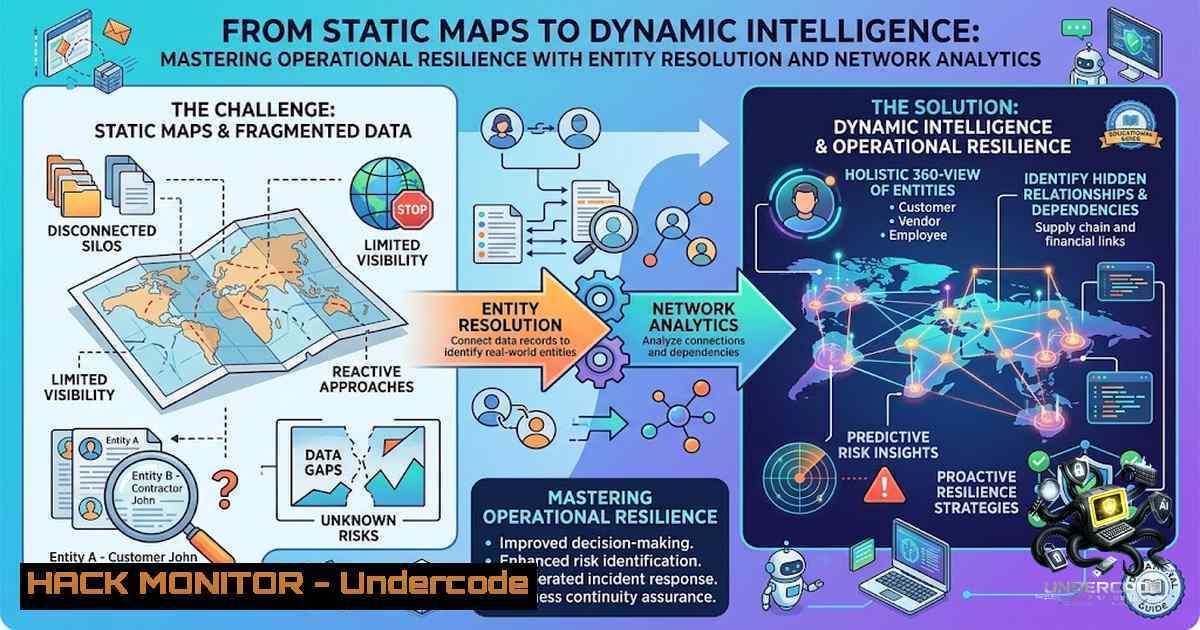
In an era where UK public sector organisations face escalating cyber threats, supply chain disruptions, and the rapid adoption of AI, traditional static process maps and siloed data are no longer sufficient to ensure operational resilience. The convergence of KPMG’s risk management expertise with Quantexa’s Decision Intelligence platform—built on advanced entity resolution and network analytics—marks a paradigm shift toward dynamic, evidence-based views of interconnected services, suppliers, assets, and data. This article provides a technical deep dive into how security professionals, IT architects, and risk managers can operationalise these capabilities to uncover hidden dependencies, quantify concentration risk, and harden infrastructure before disruption impacts service delivery.
Learning Objectives:
- Understand the architecture and core components of entity resolution and network analytics for operational resilience.
- Implement practical Linux and Windows commands to audit data silos, map dependencies, and simulate resilience scenarios.
- Apply configuration guidelines for API security, cloud hardening, and vulnerability mitigation within decision intelligence frameworks.
You Should Know:
1. Entity Resolution: Building the Trusted Data Foundation
Entity resolution is the process of identifying and linking disparate records that refer to the same real-world entity—whether a person, organisation, address, device, or bank account. Quantexa’s platform ingests data from any source, in any format, at any scale, and uses AI-powered matching to consolidate siloed information into a clean, connected, and continuously refreshed view. This capability is critical for cybersecurity because threat actors often operate across fragmented datasets; without resolution, analysts cannot see the full attack surface.
Step‑by‑step guide: auditing and preparing your data for entity resolution
- Inventory your data sources. Identify all internal systems (SIEM, CMDB, Active Directory, cloud logs) and external feeds (threat intelligence, vendor risk reports). Use the following Linux command to list open database ports and services that may hold entity data:
nmap -sS -p 1433,3306,5432,27017 <target_ip_range> | grep open
On Windows, use PowerShell to enumerate ODBC data sources:
Get-OdbcDsn | Format-Table Name, DriverName, Platform
-
Assess data quality. Entity resolution degrades with duplicate, incomplete, or conflicting records. Run a simple deduplication audit on a CSV export using `awk` (Linux):
awk -F, '!seen[$1]++' customers.csv > deduped_customers.csv
For Windows, use PowerShell to find duplicate hashes in a directory (indicating potential file-based entity duplication):
Get-FileHash -Path C:\data\ -Algorithm SHA256 | Group-Object Hash | Where-Object { $_.Count -gt 1 } -
Define your entity model. Determine which attributes define a unique entity (e.g., email + phone + address for a customer, or IP + MAC + hostname for a device). Document these in a schema that can be ingested by the platform’s no-code/low-code data ingestion layer.
-
Configure entity resolution rules. In Quantexa, this involves setting matching thresholds, blocking keys, and survival rules (which record wins when conflicts arise). Test with a sample dataset:
Simulate matching with a fuzzy search (Linux example using fzf) cat sample_entities.json | jq '.[] | select(.name | test("John.Doe"; "i"))' -
Run a pilot resolution job. Monitor performance metrics—Quantexa claims over 90% accuracy and 60× faster resolution than traditional approaches. Validate against a ground-truth set to tune false positives.
-
Network Analytics: Revealing Hidden Dependencies and Attack Paths
Once entities are resolved, network analytics materialises the relationships between them, applying community detection, pathway analysis, and network feature generation. This transforms a flat list of assets into a contextual knowledge graph—essential for identifying single points of failure, supply chain concentration risks, and potential blast radius during a breach.
Step‑by‑step guide: mapping dependencies and simulating disruption
- Extract dependency data. Use system commands to map service dependencies. On Linux, list all systemd services and their dependencies:
systemctl list-dependencies --all | grep -E ".service" | sort -u
On Windows, use PowerShell to query service dependencies:
Get-Service | ForEach-Object { $<em>.Name + " depends on: " + ($</em>.DependentServices -join ", ") }
- Import into a graph database. Tools like Neo4j or the Quantexa Knowledge Graph can ingest these relationships. Example Cypher query to create nodes and edges:
CREATE (s:Service {name: 'web-server'}) CREATE (d:Database {name: 'user-db'}) CREATE (s)-[:DEPENDS_ON]->(d) -
Run path analysis. Identify critical paths from public-facing services to backend data stores. Use networkx (Python) for quick analysis:
import networkx as nx G = nx.DiGraph() G.add_edges_from([('web', 'app'), ('app', 'db'), ('app', 'cache')]) print(list(nx.all_simple_paths(G, 'web', 'db'))) -
Simulate node failure. Remove a critical node and observe downstream impact—this mirrors the “impact tolerance” testing required by UK operational resilience frameworks. On Linux, simulate a network partition with
tc:tc qdisc add dev eth0 root netem loss 100%
(Revert with `tc qdisc del dev eth0 root`)
- Visualise concentration risk. Aggregate suppliers by tier and geography. A simple SQL query on your CMDB:
SELECT supplier, COUNT(asset_id) FROM assets GROUP BY supplier ORDER BY COUNT DESC;
This reveals which single vendor, if compromised, could cripple multiple services—exactly the kind of insight KPMG and Quantexa help clients uncover.
3. API Security and Integration Hardening
Quantexa’s platform exposes scalable APIs for data ingestion and downstream integration. These APIs are prime attack vectors if not properly secured. The Q Assist Integration Layer provides tools, connectors, and APIs that must be configured with zero-trust principles.
Step‑by‑step guide: securing your decision intelligence APIs
- Enforce mutual TLS (mTLS). Ensure all API calls require client certificates. On Linux, generate a client certificate:
openssl req -1ew -1ewkey rsa:4096 -days 365 -1odes -x509 -keyout client.key -out client.crt
Configure your API gateway to reject non-mTLS connections.
- Implement rate limiting and anomaly detection. Use `fail2ban` or cloud-1ative WAF rules to block excessive API calls that may indicate scraping or brute-force attempts. Example `fail2ban` jail:
[quantexa-api]
enabled = true
port = https
filter = quantexa-api
logpath = /var/log/nginx/access.log
maxretry = 50
bantime = 3600
-
Validate all inputs. Entity resolution APIs are vulnerable to injection attacks if input data is not sanitised. Use JSON Schema validation on all incoming payloads:
{ "$schema": "http://json-schema.org/draft-07/schema", "type": "object", "properties": { "entity_id": {"type": "string", "pattern": "^[A-Za-z0-9-]+$"} }, "required": ["entity_id"] } -
Audit API logs regularly. On Windows, use PowerShell to parse IIS logs for suspicious patterns:
Select-String -Path C:\inetpub\logs\LogFiles.log -Pattern "POST./api/resolve" | Group-Object ClientIP | Sort-Object Count -Descending
-
Rotate secrets and keys automatically. Integrate with HashiCorp Vault or Azure Key Vault to avoid hardcoded credentials in your CI/CD pipelines.
4. Cloud Hardening for Hybrid Deployments
Quantexa can be deployed on-premises, in the cloud, or in hybrid environments. Each model introduces unique hardening requirements. The UK public sector increasingly mandates cloud-first but with strict data residency and sovereignty controls.
Step‑by‑step guide: hardening your cloud deployment
- Restrict network access. Use security groups (AWS) or NSGs (Azure) to allow only necessary ports. Example AWS CLI command to list open security group rules:
aws ec2 describe-security-groups --query 'SecurityGroups[].IpPermissions[]' --output table
-
Enable encryption at rest and in transit. Ensure all S3 buckets or Azure Blob Storage used for entity data have default encryption enabled. Audit with:
aws s3api get-bucket-encryption --bucket your-bucket
-
Implement privileged access management (PAM). Restrict who can modify entity resolution rules or graph schemas. Use Azure PIM or AWS IAM with least-privilege policies. Example IAM policy snippet:
{ "Effect": "Deny", "Action": "quantexa:UpdateEntityRules", "Resource": "", "Condition": {"StringNotEquals": {"aws:PrincipalArn": "arn:aws:iam::account:role/admin-role"}} } -
Monitor for configuration drift. Use tools like `aws-config` or Azure Policy to detect non-compliant resources. On Linux, you can also use `auditd` to monitor changes to critical configuration files:
auditctl -w /etc/quantexa/config.yaml -p wa -k quantexa-config
-
Conduct regular cloud penetration tests. Simulate an attacker gaining access to your cloud console and attempt to exfiltrate resolved entity data—this validates your detection and response capabilities.
-
Vulnerability Exploitation and Mitigation in Decision Intelligence Systems
While decision intelligence enhances resilience, it also introduces new vulnerabilities: adversarial attacks on entity resolution models, poisoning of graph databases, and manipulation of AI-driven decisions. The Agent Gateway, which powers autonomous decisioning, must be protected against prompt injection and data poisoning.
Step‑by‑step guide: securing AI and graph components
- Validate training data integrity. Before ingesting new data sources, run a tamper-detection check using checksums:
sha256sum new_data_source.csv > new_data_source.checksum
Compare against a known-good baseline.
- Implement output filtering. For Q Assist and LLM-based components, sanitise all generated outputs to prevent sensitive entity data from being exposed. Use regular expressions to redact PII:
import re redacted = re.sub(r'\b\d{3}-\d{2}-\d{4}\b', '[REDACTED SSN]', llm_output) -
Monitor graph anomalies. Sudden changes in community structure or centrality scores may indicate poisoning. Use Python to compute graph metrics and alert on deviations:
import networkx as nx G = nx.read_graphml('knowledge_graph.graphml') baseline_centrality = nx.degree_centrality(G) Compare with new snapshot; alert if >20% change. -
Harden the Kafka streaming layer. Quantexa processes streaming updates using Kafka. Secure Kafka with SASL/SCRAM authentication and ACLs. Example configuration:
security.protocol=SASL_SSL
sasl.mechanism=SCRAM-SHA-256
sasl.jaas.config=org.apache.kafka.common.security.scram.ScramLoginModule required username="admin" password="secure";
-
Run red-team exercises. Simulate an adversary attempting to insert fake entities to create false relationships. Use a script to generate synthetic malicious records and test whether your entity resolution flags them as anomalies.
What Undercode Say:
- Key Takeaway 1: Operational resilience in the UK public sector is transitioning from compliance-driven checklists to data-driven, dynamic intelligence—entity resolution and network analytics are the technical pillars enabling this shift.
- Key Takeaway 2: The KPMG-Quantexa partnership exemplifies how combining advisory expertise with AI-powered platforms can uncover hidden dependencies and concentration risks that traditional risk registers miss.
Analysis: The technical integration of entity resolution with graph analytics provides a force multiplier for cybersecurity teams. Instead of reacting to alerts in isolation, analysts can now visualise the entire kill chain—from initial compromise to downstream impact—across organisational boundaries. However, this power comes with responsibility: the same graph that reveals vulnerabilities can also expose sensitive relationships if not properly secured. Organisations must treat their decision intelligence platform as a crown jewel, applying zero-trust architecture, continuous monitoring, and rigorous red-teaming. The £175m HMRC contract with Quantexa is a bellwether—expect similar investments across defence, health, and transport as the UK government operationalises its resilience framework. The winners will be those who embed security into the data foundation, not bolt it on after the graph is built.
Prediction:
- +1 Decision intelligence platforms will become mandatory for UK public sector organisations bidding for large-scale digital transformation contracts by 2028, driven by resilience framework requirements.
- +1 Entity resolution will merge with threat intelligence feeds to enable real-time attribution of cyber attacks to specific supplier or supply chain nodes, reducing mean time to identify (MTTI) by over 70%.
- -1 The complexity of graph-based systems will outpace the current cybersecurity workforce, creating a skills gap that could leave some deployments misconfigured and vulnerable to graph poisoning attacks.
- +1 Open-source tooling for entity resolution and graph analytics (e.g., Apache TinkerPop, Neo4j) will see rapid adoption, but will lack the out-of-the-box security controls of commercial platforms like Quantexa.
- -1 Adversarial ML targeting entity resolution models—such as crafting synthetic identities that evade matching—will emerge as a critical threat vector, requiring continuous model retraining and adversarial validation.
▶️ Related Video (78% Match):
🎯Let’s Practice For Free:
🎓 Live Courses & Certifications:
Join Undercode Academy for Verified Certifications
🚀 Request a Custom Project:
Secure, high-velocity infrastructure and disruptive technological engineering. Contact our engineering team for high-tier development and proprietary systems:
[email protected]
💎 Smart Architecture | 🛡️ Secure by Design | ⭐ Trusted by Thousands
IT/Security Reporter URL:
Reported By: James Dearman – Hackers Feeds
Extra Hub: Undercode MoN
Basic Verification: Pass ✅


