
Listen to this Post
Introduction
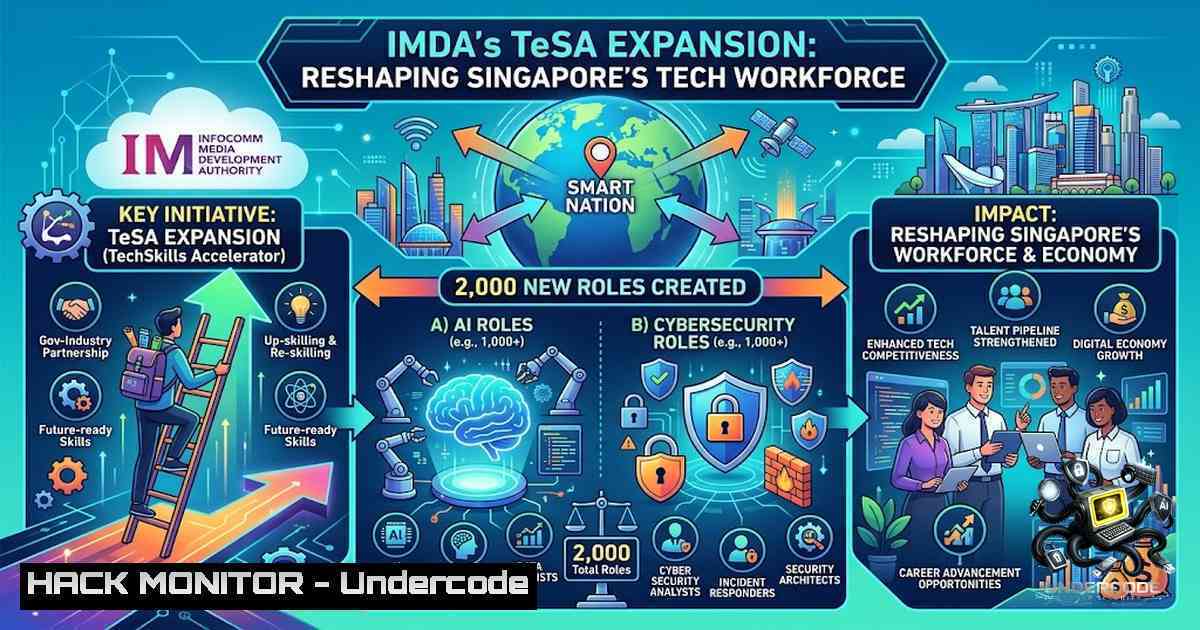
The Infocomm Media Development Authority (IMDA) is scaling up its TechSkills Accelerator (TeSA) initiative to offer nearly 2,000 job and training opportunities for fresh graduates and mid-career professionals across artificial intelligence, cybersecurity, data analytics, and software development. As Minister Josephine Teo affirmed at the Tech3 Forum 2026, “We cannot prevent AI from impacting businesses and jobs. But we can help everyone who’s willing to adapt and find new relevance”. This national-scale upskilling push—partnering with Accenture, NCS, Microsoft, JP Morgan, and ST Engineering—represents a strategic response to the dual-edged nature of AI: while automation commoditizes basic coding skills, it simultaneously elevates the premium on human judgment, contextual understanding, and cybersecurity acumen.
Learning Objectives & Secrets
- Objective 1: Master AI-Augmented Security Operations — Learn to integrate AI-driven threat detection tools (e.g., SIEM with ML-based anomaly detection) into enterprise security workflows. Secret tip: Focus on interpreting AI-generated alerts rather than blindly trusting them—false positives remain a critical challenge, and human validation is where true expertise shines.
-
Objective 2: Secure AI Pipelines & LLM Deployments — Understand the OWASP Top 10 for LLM Applications, including prompt injection, training data poisoning, and insecure output handling. Secret tip: Implement red-teaming exercises specifically targeting your organization’s AI models; many teams overlook adversarial testing until after deployment.
-
Objective 3: Transition from Traditional IT to Cyber-AI Roles — Leverage TeSA’s Company-Led Training (CLT) programme to gain hands-on experience with AI application development and enterprise system integration. Secret tip: Build a portfolio of AI-security projects (e.g., a Python-based log analyzer using OpenAI APIs) to demonstrate practical competence—employers increasingly value demonstrable skills over certifications alone.
You Should Know
- Essential Linux Commands for AI & Security Workflows
Modern AI and cybersecurity roles demand proficiency in Linux environments, where most security tools and AI frameworks operate. Below are verified commands for common tasks:
System Monitoring & Log Analysis:
 Monitor real-time system logs for suspicious activity
sudo journalctl -f -u sshd

Analyze failed login attempts
sudo grep "Failed password" /var/log/auth.log | awk '{print $11}' | sort | uniq -c | sort -1r

Monitor network connections
sudo ss -tulpn | grep LISTEN

Check for unusual processes
ps aux --sort=-%mem | head -20
AI/ML Environment Setup:
 Install Python virtual environment for AI projects
python3 -m venv ai-security-env
source ai-security-env/bin/activate

Install common AI/security libraries
pip install torch transformers pandas numpy scikit-learn
pip install openai langchain chromadb
Container Security Scanning:
 Scan Docker images for vulnerabilities
docker scan --severity high my-image:latest

Check running containers for exposed ports
docker ps --format "table {{.Names}}\t{{.Ports}}"
Step-by-Step Guide: Set up a basic AI-powered log analyzer. First, install the Python environment as shown above. Second, create a script that reads /var/log/auth.log, uses a local LLM (via Ollama or similar) to classify suspicious patterns, and outputs a JSON report. Third, schedule this script as a cron job to run hourly. This mimics real-world security operations where AI augments human analysts.
Windows Equivalents:
 PowerShell: Check failed logon events
Get-WinEvent -LogName Security | Where-Object { $_.Id -eq 4625 } | Select-Object TimeCreated, Message

Check listening ports
netstat -an | findstr LISTENING

Monitor running processes
Get-Process | Sort-Object -Property CPU -Descending | Select-Object -First 20
2. Configuring SIEM Tools for AI-Enhanced Threat Detection
Security Information and Event Management (SIEM) platforms are the backbone of modern security operations. With AI integration, SIEMs can now detect anomalies that rule-based systems miss.
Elastic Stack (ELK) Configuration for AI-Powered Analytics:
 elasticsearch.yml - Enable machine learning features
xpack.ml.enabled: true

kibana.yml - Enable AI Assistant (requires proper licensing)
xpack.assistant.enabled: true
Step-by-Step Guide: Deploy a basic SIEM with ML capabilities. Install Elasticsearch, Kibana, and Fleet Server on a Ubuntu 22.04 server. Use Elastic’s pre-built ML jobs for anomaly detection on network traffic and authentication logs. Configure alerting rules that trigger when the ML model detects deviations beyond three standard deviations from baseline behavior. This setup mirrors what many organizations deploy as their first line of defense.
Splunk Query for AI-Security Correlation:
index=main sourcetype=linux_secure
| stats count by src_ip, dest_ip, action
| where count > 100
| eval threat_score = if(action="failed", count2, count)
| sort - threat_score
3. Cloud Hardening for AI Workloads
As AI models move to the cloud, securing these environments becomes paramount. IMDA’s TeSA programme emphasizes cloud and cybersecurity skills.
AWS Security Best Practices for AI Deployments:
 AWS CLI: Enable detailed CloudTrail logging for AI service usage
aws cloudtrail create-trail --1ame ai-audit-trail --s3-bucket-1ame my-ai-audit-logs

AWS CLI: Restrict SageMaker notebook access to specific IP ranges
aws sagemaker update-1otebook-instance \
--1otebook-instance-1ame my-ai-1otebook \
--security-group-ids sg-12345678
Azure AI Security Configuration:
 Azure CLI: Enable private endpoints for AI services
az network private-endpoint create \
--1ame ai-private-endpoint \
--resource-group my-ai-rg \
--vnet-1ame my-vnet \
--subnet default \
--private-connection-resource-id /subscriptions/{sub-id}/resourceGroups/my-ai-rg/providers/Microsoft.CognitiveServices/accounts/my-ai-account

Azure CLI: Configure diagnostic settings for AI services
az monitor diagnostic-settings create \
--1ame ai-diagnostics \
--resource /subscriptions/{sub-id}/resourceGroups/my-ai-rg/providers/Microsoft.CognitiveServices/accounts/my-ai-account \
--logs '[{"category": "Audit","enabled": true}]'
Step-by-Step Guide: Implement a zero-trust architecture for AI workloads. Start by creating a dedicated VPC with no public subnets. Deploy AI models behind an API gateway with WAF protection. Enable VPC flow logs and route them to a central S3 bucket for analysis. Configure IAM roles with least-privilege permissions—never use root credentials for AI service access. Finally, set up automated vulnerability scanning for all container images before deployment.
4. API Security for AI-Powered Applications
With AI applications exposing APIs for inference, securing these endpoints is critical. The OWASP API Security Top 10 provides a solid framework.
API Gateway Security Configuration (Kong):
 Kong Plugin: Rate Limiting to prevent abuse
plugins:
- name: rate-limiting
config:
minute: 100
hour: 1000
policy: local

Kong Plugin: JWT Authentication
- name: jwt
config:
secret_is_base64: false
run_on_preflight: true
Step-by-Step Guide: Secure an AI inference API. Deploy Kong or AWS API Gateway in front of your model endpoint. Implement JWT-based authentication with short-lived tokens (15-minute expiry). Add rate limiting to prevent denial-of-service attacks. Enable request validation to reject malformed payloads that could trigger prompt injection. Log all API requests to a centralized SIEM for anomaly detection. Finally, conduct regular penetration testing of the API surface—many AI breaches occur through improperly secured endpoints.
5. Vulnerability Exploitation & Mitigation in AI Systems
Understanding how attackers target AI systems is essential for defense. The MITRE ATLAS framework maps adversarial threats to machine learning systems.
Common AI Attack Vectors & Mitigations:
| Attack Vector | Description | Mitigation |
||-||
| Prompt Injection | Malicious inputs manipulate LLM outputs | Input sanitization, context window restrictions |
| Training Data Poisoning | Attacker corrupts training data | Data provenance tracking, outlier detection |
| Model Extraction | Steal model weights via API queries | Rate limiting, query fingerprinting |
| Adversarial Examples | Slightly modified inputs cause misclassification | Adversarial training, input preprocessing |
Practical Mitigation Commands:
 Python: Input sanitization for LLM prompts
import re

def sanitize_prompt(user_input: str) -> str:
 Remove potential injection patterns
sanitized = re.sub(r'ignore previous instructions', '', user_input, flags=re.IGNORECASE)
sanitized = re.sub(r'system:', '', sanitized, flags=re.IGNORECASE)
return sanitized[:500]  Enforce length limits
Step-by-Step Guide: Set up a red-teaming exercise for your AI system. First, define a threat model based on MITRE ATLAS. Second, create test cases for common attack vectors—prompt injection, data poisoning attempts, and adversarial inputs. Third, run these tests against your staging environment and document all successful breaches. Fourth, implement mitigations and retest. This iterative process should be part of your regular security cadence, not a one-time exercise.
6. Ransomware Defense in the AI Era
Ransomware remains a top threat, with AI now being used by both defenders and attackers. Gregory Evans, a world-renowned penetration tester and crisis manager, emphasizes that AI in cybersecurity is “a double-edged sword”.
Ransomware Detection Commands:
 Linux: Monitor for mass file encryption patterns
sudo inotifywait -m -r --format '%w%f' /home/ 2>/dev/null | while read FILE; do
if file "$FILE" | grep -q "encrypted"; then
echo "ALERT: Possible ransomware activity on $FILE"
fi
done

Windows PowerShell: Monitor for suspicious file extensions
Get-ChildItem -Path C:\Users\ -Recurse -Include .encrypted, .locked, .crypt |
ForEach-Object { Write-Host "ALERT: Suspicious file found: $($_.FullName)" }
Step-by-Step Guide: Implement a ransomware response playbook. First, ensure immutable backups are in place—use AWS S3 Object Lock or Azure Blob Storage immutable policies. Second, deploy endpoint detection and response (EDR) tools with behavioral analytics. Third, segment your network to limit lateral movement—use VLANs and firewall rules to isolate critical systems. Fourth, conduct tabletop exercises simulating a ransomware attack, involving both technical and executive teams. Fifth, establish a clear communication plan for notifying stakeholders without causing panic.
7. Certificate & Training Pathways Aligned with TeSA
IMDA’s TeSA programme offers structured pathways for entering tech roles. Since its inception in 2016, TeSA has trained over 17,000 locals in AI, analytics, software, 5G, cloud, and cybersecurity. The expanded initiative targets 18,000 talent in tech roles over the next three years through over 180 AI-related courses.
Recommended Certification Roadmap:
| Role | Entry-Level | Mid-Level | Advanced |
||-|–|-|
| Security Analyst | CompTIA Security+ | CISSP | OSCP |
| AI Engineer | AWS Certified ML | Azure AI Engineer | Google ML Engineer |
| Cloud Security | AWS Security Specialty | CCSP | SANS SEC541 |
| Penetration Tester | eJPT | PNPT | OSCP/OSCE |
Step-by-Step Guide: Navigate the TeSA programme. Visit IMDA’s official website for the full list of job roles. Identify your target role and review the required competencies. Enroll in a Company-Led Training programme that provides hands-on experience with real enterprise systems. Complement formal training with personal projects—build a home lab, contribute to open-source security tools, or participate in bug bounty programs. Finally, leverage TeSA’s industry partnerships (Accenture, NCS, Microsoft) for internship and placement opportunities.
What Undercode Say
- Key Takeaway 1: Singapore’s aggressive upskilling initiative signals a fundamental shift—AI is not replacing jobs but transforming them. Professionals who combine technical AI proficiency with domain expertise and human judgment will command premium value in the job market.
-
Key Takeaway 2: Cybersecurity remains a critical pillar of this transformation. As AI systems proliferate, so do attack surfaces—prompt injection, model extraction, and data poisoning represent new threat vectors that traditional security measures alone cannot address. The 2,000 roles include security analysts specifically trained to defend AI-enabled infrastructure.
Analysis: The IMDA TeSA expansion represents one of the most comprehensive national responses to AI-driven workforce disruption globally. By partnering with 20+ companies including Accenture, NCS, Microsoft, JP Morgan, and ST Engineering, Singapore is not merely funding training but creating direct employment pipelines. The emphasis on human judgment alongside AI skills is particularly astute—as AI commoditizes technical execution, the ability to understand context, navigate relationships, and make high-stakes decisions becomes the true differentiator.
The parallel AIxLegal programme targeting 11,000 legal professionals demonstrates a whole-of-1ation approach, extending beyond pure tech roles. For cybersecurity professionals specifically, this means opportunities to specialize in AI security—a field that Gartner predicts will be one of the fastest-growing security domains through 2030. The key challenge remains execution: will training quality match quantity, and will mid-career professionals successfully transition? Early TeSA results (17,000 trained since 2016) suggest the model works, but scaling to 18,000 in three years will test institutional capacity.
Prediction
- +1 The TeSA expansion will catalyze a regional talent migration, with professionals from neighboring countries seeking Singapore’s structured upskilling pathways and attractive tech salaries, further consolidating Singapore’s position as Southeast Asia’s tech hub.
-
+1 AI-security specialization will emerge as a distinct career track within 24 months, with dedicated certifications and job titles (e.g., “AI Security Engineer,” “LLM Red Teamer”) becoming standard across enterprises deploying generative AI.
-
-1 The rapid upskilling push may create a “skill inflation” effect where basic AI literacy becomes expected, not differentiating, forcing professionals to pursue ever-higher levels of specialization to remain competitive.
-
-1 Organizations that fail to integrate security considerations into their AI adoption strategies will face increased breach risks, potentially undermining public trust in AI-powered services and slowing adoption rates.
-
+1 The emphasis on human judgment and context understanding will revive interest in liberal arts and critical thinking education, as purely technical skills become increasingly automated—a positive counterbalance to the STEM-only narrative.
-
-1 Mid-career professionals over 45 may struggle with the transition despite available training, potentially widening the age-based digital divide unless targeted support mechanisms are implemented.
-
+1 The Company-Led Training model will be adopted by other nations as a best practice for workforce transformation, creating a global benchmark for public-private partnership in tech upskilling.
▶️ Related Video (84% Match):
https://www.youtube.com/watch?v=1mo3yRvvH_g
🎯Let’s Practice For Free:
🎓 Live Courses & Certifications:
Join Undercode Academy for Verified Certifications
🚀 Request a Custom Project:
Secure, high-velocity infrastructure and disruptive technological engineering. Contact our engineering team for high-tier development and proprietary systems:
[email protected]
💎 Smart Architecture | 🛡️ Secure by Design | ⭐ Trusted by Thousands
IT/Security Reporter URL:
Reported By: https://lnkd.in/p/e8Tb3yH6 – Hackers Feeds
Extra Hub: Undercode MoN
Basic Verification: Pass ✅


