
Listen to this Post
Introduction:
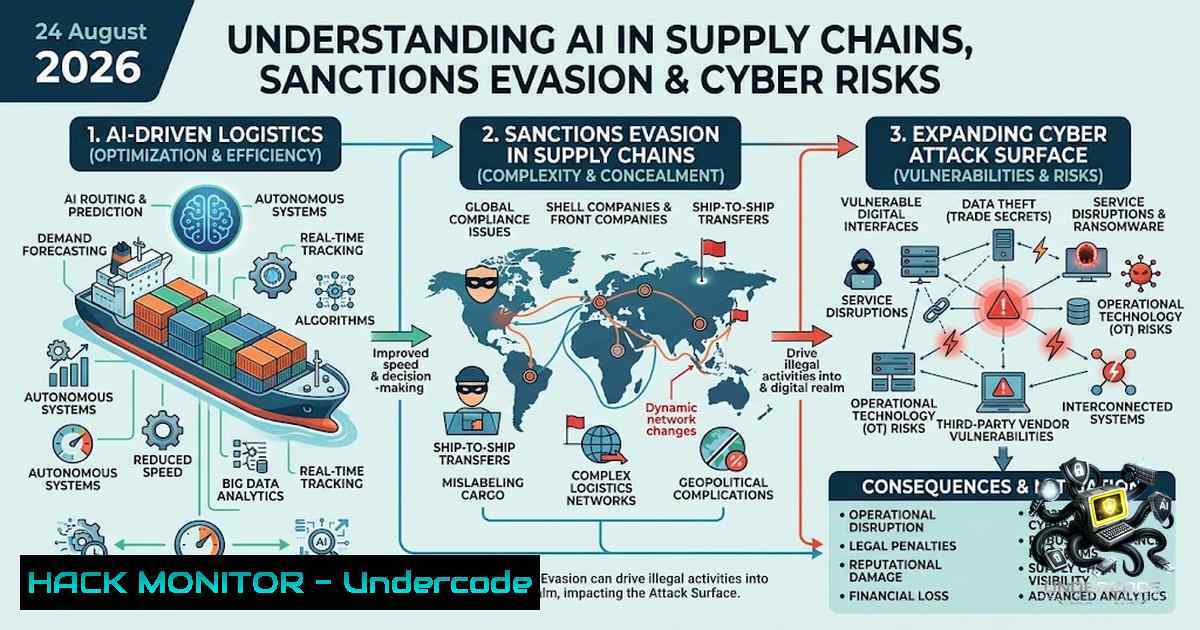
The confluence of artificial intelligence, predictive analytics, and real-time data integration is fundamentally restructuring global logistics, energy markets, and maritime trade. On 24 August 2026, three key developments underscore this structural shift: MG Ship’s introduction of AI-driven predictive supply chain frameworks at LogiSYM Malaysia 2026, global oil benchmark fluctuations amid U.S. sanctions on Iranian trade partners, and South Korea’s PanStar Acro launching a commercial trial of the Northern Sea Route. However, as logistics systems become AI-powered and increasingly interconnected, they simultaneously expose unprecedented cybersecurity vulnerabilities—from model poisoning and data integrity attacks to API misconfigurations and supply chain compromises that can disrupt fleet operations, manipulate routing decisions, and enable large-scale sanctions evasion. This article examines the technical underpinnings of these developments and provides actionable security guidance for securing AI-driven logistics infrastructure.
Learning Objectives & Secrets:
- Objective 1: Understand the AI Attack Surface in Logistics and Maritime Systems – Learn how AI-powered logistics platforms, digital twins, and predictive analytics create new entry points for attackers, including adversarial inputs, data poisoning, and prompt injection attacks that can manipulate demand forecasts, reroute shipments, or disable fleet management systems.
-
Objective 2 Secret Tip: Hunt for Exposed Credentials and Misconfigured APIs – Enterprise TMS platforms now process real-time GPS feeds, carrier financials, and AI dispatch decisions across 15 to 40 active integrations. A single misconfigured API endpoint can expose shipment data across thousands of enterprise orders. Security teams should routinely scan public repositories for exposed tokens—researchers found 17,637 exposed corporate security tokens and API keys, with 33% of exposed AWS credentials still active.
-
Objective 3 Secret Tip: Monitor Third-Party AI Model Supply Chains – The JFrog 2026 Software Supply Chain Security report identified 495 malicious models on Hugging Face carrying live payloads, including system command execution scripts and credential harvesting tools. Organizations must vet every AI model and package integrated into logistics systems, as attackers increasingly weaponize trusted model registries.
You Should Know:
- The AI Exposure Gap: Why Logistics Security Is Falling Behind
The rapid adoption of AI in logistics has created what Tenable researchers call an “AI Exposure Gap”—the difference between security governance and the speed at which organizations deploy AI-driven services. According to Tenable’s Cloud and AI Security Risk Report 2026, 70% of organizations have integrated at least one third-party AI or Model Context Protocol package, frequently without centralized security monitoring. Furthermore, 86% host third-party code packages containing critical vulnerabilities, making the software supply chain a primary source of cloud exposure.
For logistics operators, this translates into tangible risk. Fleet management platforms, routing software, and automated dispatch applications are all built on software pipelines that now incorporate AI-generated code. Attackers are no longer just breaching traditional defenses—they are actively weaponizing the trusted models, registries, and agentic tools driving AI-powered development. The era of “scan and hope” is over.
Step-by-Step Guide: Securing the AI Software Supply Chain in Logistics
- Inventory all AI/ML components – Document every AI model, library, and third-party package integrated into logistics systems, including those from Hugging Face, Docker Hub, and other registries.
- Enforce centralized security monitoring – Implement continuous scanning for vulnerabilities across all AI components, rather than relying on periodic assessments.
- Vet third-party models before deployment – Scan for malicious payloads, backdoors, and system command execution scripts.
- Apply secure coding practices to AI-generated code – Developers must review AI-generated code for decades-old flaws like database injection.
- Establish certified AI model governance – While 97% of organizations claim certified governance, the prevalence of malicious models calls this into question—verify, don’t assume.
-
Digital Twins and AI-Driven Threat Detection in Logistics
Digital twin (DT) systems—virtual replicas of physical supply chains—are emerging as powerful tools for market volatility warning and risk detection. By coupling DTs with AI/ML, edge computing, and 5G/6G connectivity, logistics operators gain real-time insight and predictive intelligence. However, these advantages introduce profound cybersecurity, privacy, and trust challenges. Existing standards such as ISO/IEC 27000, 3GPP TS 33.501, and ITU-T Y.3172 only partially address generic security and AI frameworks, lacking specificity toward dynamic, AI-driven DT ecosystems.
A next-generation AI-driven digital twin framework must emphasize security, interoperability, and standard alignment, mapping cross-layer threats to curated countermeasures. For logistics volatility detection, this framework supports resilient, trustworthy operations—but only if organizations actively address standardization gaps and implement DT-aware AI governance.
Step-by-Step Guide: Implementing Secure Digital Twins for Logistics
- Map data flows and integration points – Identify every source of data feeding into the digital twin, including supplier feeds, sensor streams, and external signals.
- Implement data integrity verification – Corrupted inputs can produce confident, coordinated, and wrong actions at machine speed. Use cryptographic hashing and anomaly detection to validate data authenticity.
- Deploy AI-powered anomaly detection – Machine learning models can detect deceptive routing patterns and AIS spoofing that human analysts would miss.
- Establish cross-functional incident response – A threat detected in one system must propagate to every function whose decisions depend on the affected data: supply, movement, planning, and sustainment.
- Align with emerging standards – Monitor IEEE and ITU-T developments for DT-aware AI governance and real-time assurance frameworks.
-
Maritime Cyber Threats: Sanctions Evasion and the Shadow Fleet
The maritime sector faces escalating cyber threats as AI transforms both enforcement and evasion tactics. Windward, Spire, and government intelligence agencies now deploy AI/ML to detect dark fleet tactics: AIS spoofing, ghost transits, and false identities. When a Russian tanker switched off its AIS transponder and resurfaced with a false position claim, a machine learning model flagged the pattern in real time. This represents the first large-scale operational deployment of AI to defeat organized sanctions evasion.
Conversely, criminal networks are using AI-driven data analysis to rapidly discover weak links in supply chains. Cyber vulnerabilities in maritime operations come from increased automation, with navigation and power-management systems becoming connected to online threats through satellite communications, cloud connections, and unsecured firmware updates. The U.S. Coast Guard has discovered “dark fleet” tankers using digital tools for illicit trade, creating cyber risks where compromised systems could be used to cause explosions or oil spills. Cyber threats against maritime and port infrastructure surged in 2025, with incidents such as GPS spoofing becoming increasingly common.
Step-by-Step Guide: Hardening Maritime OT/IT Systems
- Segment OT and IT networks – Isolate navigation, engine control, and power-management systems from corporate IT and internet-facing connections.
- Monitor AIS data for anomalies – Deploy ML-based behavioral analysis to detect AIS spoofing, dark transits, and ghost routing.
- Secure firmware update processes – Service engineers using memory sticks for updates create attack vectors; implement signed, encrypted update mechanisms.
- Implement GPS/GNSS redundancy – Use multiple positioning sources (satellite AIS, terrestrial systems) to detect spoofing attempts.
- Conduct regular OT security assessments – Exposed services, open ports, and poorly secured equipment are major risk factors in operational technology environments.
4. API Security and Integration Layer Protection
Enterprise Transportation Management System (TMS) platforms now process real-time GPS feeds, carrier financials, driver PII, and AI dispatch decisions across 15 to 40 active integrations, making the integration layer the primary attack surface. A single misconfigured API endpoint can expose shipment data across thousands of enterprise orders, carrier rate agreements worth millions, and real-time location feeds for an entire fleet. The IBM Cost of a Data Breach Report 2025 puts the average global breach cost at $4.44 million, with supply chain incidents involving third-party integrations consistently exceeding that baseline.
AI agents pulling tools, models, and data from sprawling chains of upstream providers introduce additional risks. In 2026, attackers learned to poison these chains—and the fallout is shaping how enterprises buy and operate agentic systems. The agent itself is now the smallest part of the attack surface.
Step-by-Step Guide: Securing TMS APIs and Integrations
- Inventory all API endpoints and integrations – Document every carrier connection, telematics feed, and ELD integration.
- Implement strict access controls – Apply least-privilege principles to API credentials and monitor for anomalous traffic patterns.
- Rotate credentials regularly – Exposed cloud tokens and API keys are a primary entry vector.
- Enforce API rate limiting and input validation – Prevent abuse and injection attacks at the integration layer.
- Audit third-party integrations continuously – Be ready to disconnect external services that exhibit suspicious behavior.
-
The Arctic Trade Corridor: New Routes, New Risks
South Korea’s PanStar Acro commercial trial via the Northern Sea Route aims to shave 7,000 km and up to 10 days off traditional Asia-Europe transit times. However, as climate change accelerates the viability of the Arctic Sea Route, its commercial utilization brings a new class of maritime cybersecurity threats. The adoption of connected systems has revolutionized operations yet exposed critical infrastructure to unprecedented digital vulnerabilities, with Arctic routes facing heightened cyber risks compared to traditional sea routes.
Ships traversing Arctic waters may require assistance due to cyberattacks compromising IT networks or navigation equipment. Attacks can occur through random incidents or intentional actions by cyber criminals who target vulnerable ships from public databases. Rising maritime activity in the Arctic raises risks of accidents, environmental disasters, and sabotage—including to undersea infrastructure.
Step-by-Step Guide: Arctic Route Cybersecurity Preparedness
- Develop Arctic-specific contingency plans – Tailor incident response to the unique challenges of Arctic navigation, including limited communication and rescue capabilities.
- Harden navigation systems against GPS spoofing – Ships with spoofed GPS signals have been found in disputed territorial waters.
- Implement satellite communication redundancy – Ensure backup communication channels independent of terrestrial networks.
- Conduct cyber risk assessments for Arctic operations – Address the interdependence between cyber resilience and physical safety in extreme environments.
- Monitor for hybrid threats – Low-signature, deniable disruption of maritime infrastructure is a growing concern in Arctic waters.
What Undercode Say:
- Key Takeaway 1: AI adoption in logistics is outpacing security governance, creating an “AI Exposure Gap” that attackers are actively exploiting. Organizations must move beyond “scan and hope” to implement continuous monitoring, credential rotation, and certified AI model governance. With more than 48,000 new software vulnerabilities disclosed in 2025—a 20% increase—and 495 malicious models identified on Hugging Face, the risk is compounding across the software supply chain. The data that makes logistics intelligent—supplier feeds, sensor streams, demand signals—has become a primary target whose corruption can degrade operational readiness as surely as a physical disruption.
-
Key Takeaway 2: The integration layer and API ecosystem represent the most critical—and most neglected—attack surface in modern logistics. Enterprise TMS platforms with 15–40 active integrations expose shipment data, carrier contracts, and fleet location feeds through a single misconfigured endpoint. Combined with exposed cloud credentials (17,637 found, 33% still active) and the rise of agentic AI systems with sprawling upstream dependencies, logistics organizations face an attack surface that has expanded far beyond traditional network perimeters. Security must shift from detection-only to coordinated response across supply, movement, planning, and sustainment functions.
Prediction:
-
+1 The adoption of AI-driven maritime intelligence for sanctions enforcement will accelerate, with private-sector AI firms (Windward, Spire) becoming integral to government enforcement workflows. This public-private partnership model will expand to other domains, including customs enforcement and trade compliance.
-
+1 Digital twin frameworks with integrated security controls will become a competitive differentiator for logistics providers. Organizations that implement DT-aware AI governance and cross-domain interoperability will achieve greater resilience and customer trust.
-
-1 The Arctic Sea Route’s commercial expansion will outpace cybersecurity preparedness, leading to a major maritime cyber incident within 24–36 months. The combination of extreme environment, limited response capabilities, and heightened geopolitical tensions creates a high-risk scenario for navigation system compromise or sabotage.
-
-1 Cyberattacks targeting energy infrastructure and oil trading will intensify, with AI-powered attacks on civilian fleets, logistics supply chains, and oil infrastructure increasing by over 100% between 2025 and 2026. The growing computerization of merchant vessels exposes them to technical vulnerabilities that state and non-state actors will increasingly exploit.
▶️ Related Video (74% Match):
https://www.youtube.com/watch?v=-N2NWgPtVRE
🎯Let’s Practice For Free:
🎓 Live Courses & Certifications:
Join Undercode Academy for Verified Certifications
🚀 Request a Custom Project:
Secure, high-velocity infrastructure and disruptive technological engineering. Contact our engineering team for high-tier development and proprietary systems:
[email protected]
💎 Smart Architecture | 🛡️ Secure by Design | ⭐ Trusted by Thousands
IT/Security Reporter URL:
Reported By: https://lnkd.in/p/e6VaVYyW – Hackers Feeds
Extra Hub: Undercode MoN
Basic Verification: Pass ✅


