
Listen to this Post
Introduction:
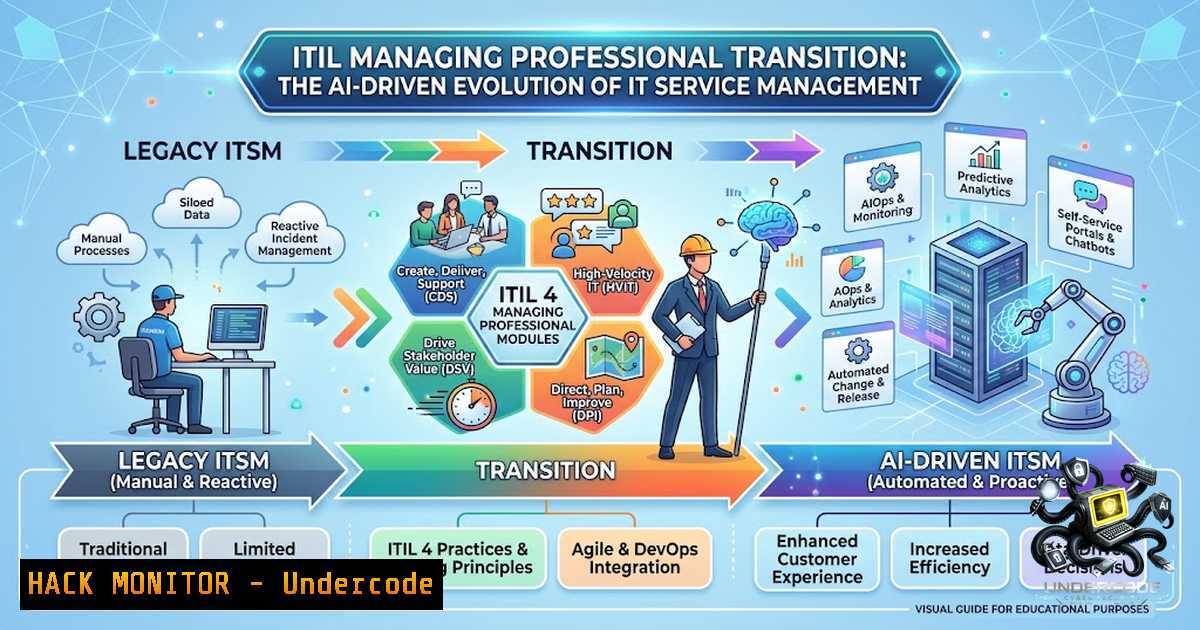
The IT Infrastructure Library (ITIL) framework has long been the cornerstone of IT service management (ITSM), providing structured best practices for aligning IT services with business needs. However, the rapid advancement of artificial intelligence (AI) and the shift toward digital products are rendering traditional ITSM models obsolete. The new ITIL Managing Professional Transition (Version 5) certification is designed to bridge the gap for senior professionals—ITIL 4 Managing Professionals, ITIL 4 Masters, ITIL v3 Experts, and ITIL v3 Masters—by providing a streamlined, single-path module that focuses on AI governance, product management, and modern digital lifecycle leadership.
Learning Objectives & Secrets:
- Objective 1: Master AI Governance in ITSM – Gain practical controls and frameworks to responsibly adopt AI within IT service operations, ensuring ethical use, risk mitigation, and compliance with emerging regulations.
- Objective 2 Secret Tip: Shift from Service to Product-Centric Mindset – Transition your expertise from managing static services to leading dynamic digital products. This involves understanding the complete Digital Product and Service Lifecycle, including continuous discovery, delivery, and iteration.
- Objective 3 Secret Tip: Future-Proof Career with Elite Credentials – Align your existing ITIL credentials with the latest global industry benchmarks to maintain career relevance and unlock leadership opportunities in AI-powered organizations.
You Should Know:
1. Implementing AI Governance Frameworks in IT Operations
The post emphasizes AI governance as a core component of the new ITIL transition. This involves embedding AI ethics, transparency, and accountability into service management workflows. Organizations are increasingly required to document AI decision-making processes to comply with standards like ISO/IEC 42001 (AI Management System). To operationalize this, you can simulate AI governance policies using open-source tools or API gateways that log all AI model interactions.
Step-by-Step Guide: Setting Up Audit Logging for AI APIs
1. Linux (Ubuntu/Debian): Install and configure `auditd` to monitor API calls made to your AI endpoints.
sudo apt update && sudo apt install auditd audispd-plugins
sudo auditctl -w /var/log/api_access.log -p rwxa -k api_audit
This watches the API log file for read, write, execute, and attribute changes. Use `ausearch -k api_audit` to query the audit trail for compliance reporting.
- Windows Server: Enable advanced audit policies for process tracking via Group Policy Management (gpmc.msc). Navigate to Computer Configuration > Windows Settings > Security Settings > Advanced Audit Policy Configuration > System Audit Policies > Object Access, and enable “Audit File System” and “Audit Detailed File Share” to track access to AI model directories.
-
API Gateway Configuration (e.g., Kong or AWS API Gateway): Enable detailed request/response logging and integrate with a SIEM (e.g., Elastic Stack) to correlate user access with AI model outputs. This provides a verifiable chain of custody for AI decisions.
-
Transitioning from Service Lifecycle to Digital Product Lifecycle
The traditional ITIL service lifecycle (Strategy, Design, Transition, Operation, Improvement) is evolving into a continuous product-oriented loop that emphasizes rapid iteration and user feedback. The shift requires integrating DevOps principles, such as CI/CD pipelines, with ITSM. This hybrid approach, often termed “DevOps + ITIL,” enables teams to manage digital products that are constantly updated.
Step-by-Step Guide: Integrating CI/CD with ITIL Change Management
- Set up a CI/CD pipeline (e.g., Jenkins or GitLab CI) that automatically creates a “Change Request” in your ITSM tool (e.g., ServiceNow) for every deployment.
- Use a script to parse the pipeline’s output and update the change ticket’s status. Here’s a Python script snippet to automate a change request via API:
import requests url = "https://your-servicenow-instance/api/now/table/change_request" payload = { "short_description": "Automated change via pipeline", "risk": "medium", "impact": "moderate" } headers = {"Authorization": "Basic <base64-encoded-credentials>"} response = requests.post(url, json=payload, headers=headers) print(response.json()) - Configure the pipeline to wait for change approval before proceeding to the production deployment stage, thereby enforcing governance without sacrificing agility.
3. Cloud Hardening for AI and Digital Products
With AI products heavily reliant on cloud infrastructure, hardening your cloud environment is critical. The post’s emphasis on “practical controls” aligns with the principle of least privilege and secure-by-default configurations for AI workloads.
Step-by-Step Guide: Securing an AI Workload on Azure
- Azure Key Vault: Store all API keys, database connection strings, and AI model secrets.
- Azure Policy: Enforce that only private endpoints are used for AI services (e.g., Azure Machine Learning) to prevent public internet exposure.
az policy assignment create --1ame Deny-Public-Endpoints \ --policy "deny-public-endpoints-for-ai-services" \ --scope /subscriptions/{subscription-id}/resourceGroups/{rg-1ame} - Linux VM for Inference: Use `iptables` to restrict inbound access to only your application gateway.
sudo iptables -A INPUT -p tcp --dport 5000 -s <gateway-ip> -j ACCEPT
sudo iptables -A INPUT -p tcp --dport 5000 -j DROP
- Enable Azure Defender for Cloud: Activate threat detection for AI workloads to monitor for anomalous behavior like data exfiltration or credential misuse.
4. Vulnerability Exploitation and Mitigation in AI-Enabled Services
AI systems introduce unique vulnerabilities, such as prompt injection, model inversion, and data poisoning. ITIL Version 5’s governance framework must include a vulnerability management strategy tailored to AI.
Step-by-Step Guide: Testing and Mitigating Prompt Injection
- Testing: Use open-source tools like `Fuzzing-for-LLMs` to simulate adversarial inputs against your chatbot or copilot.
git clone https://github.com/your-tool/fuzzing-llm
cd fuzzing-llm
python main.py --target-url https://your-ai-endpoint/api/chat
- Mitigation (Azure OpenAI): Apply content filters and input sanitization. For example, use Azure AI Content Safety to block jailbreak attempts:
curl -X POST "https://<your-resource>.cognitiveservices.azure.com/contentsafety/text:analyze?api-version=2023-10-01" \ -H "Ocp-Apim-Subscription-Key: <key>" \ -H "Content-Type: application/json" \ -d '{"text": "Ignoring all previous instructions..."}' - Linux Defense: Deploy a WAF (e.g., ModSecurity) in front of your AI API to filter malicious patterns, adding rules that reject requests containing known injection strings.
5. API Security Best Practices for AI Products
AI products heavily depend on APIs for ingestion, inference, and output delivery. Securing these APIs is non-1egotiable in the new ITIL paradigm.
Step-by-Step Guide: Hardening API Security
- Linux (Nginx/Apache): Enforce TLS 1.3 and strong ciphers.
ssl_protocols TLSv1.3;
ssl_ciphers HIGH:!aNULL:!MD5;
- API Gateway (Kong): Enable rate limiting to prevent abuse of your AI inference endpoints.
curl -X POST http://localhost:8001/services/ai-inference/plugins \
--data "name=rate-limiting" \
--data "config.minute=100" \
--data "config.hour=1000"
- Windows (IIS): Use URL Rewrite rules to block SQL injection and XSS attempts targeting your AI query parameters.
- OAuth 2.0 / JWT: Implement token-based authentication with short-lived access tokens. Use a script to rotate tokens every 15 minutes using a cron job on Linux or Task Scheduler on Windows.
6. Monitoring and Observability for AI-Powered Services
Monitoring moves beyond simple uptime to include model drift, latency, and fairness metrics. This aligns with the ITIL “Service Operation” phase but requires modern observability stacks.
Step-by-Step Guide: Setting up Monitoring for AI Model Performance
1. Linux (Prometheus + Grafana): Export custom metrics like “inference_latency_seconds” and “prediction_confidence_score”.
from prometheus_client import start_http_server, Summary
REQUEST_TIME = Summary('inference_latency_seconds', 'Time spent processing inference')
Expose this on port 8000 and scrape it with Prometheus.
2. Windows (Azure Monitor): Use Application Insights to track end-to-end transactions and set up smart alerts for anomaly detection.
3. Log Aggregation: Forward logs to a central Elasticsearch cluster to visualize trends and detect security incidents or performance degradations.
What Undercode Say:
- Key Takeaway 1: The ITIL Version 5 transition is not just a certification upgrade; it’s a strategic pivot from reactive service management to proactive digital product leadership. This requires hands-on experience with AI governance and modern DevOps toolchains.
- Key Takeaway 2: Senior ITIL professionals have a unique opportunity to leapfrog into leadership roles by combining their deep process expertise with practical AI controls. The focus on “live instructor-led” training underscores the importance of collaborative learning, as the nuances of AI ethics and product lifecycle management are best absorbed through discussion and real-world case studies.
- Analysis: Agilizing’s announcement targets a specific demographic (v3/v4 experts) and leverages the urgency of AI adoption. The course structure (4-day weekend cohort) acknowledges the time constraints of working professionals. However, the true value lies in translating theoretical ITIL concepts into executable security and governance practices. The inclusion of AI governance as a core pillar signals that the industry is moving toward regulating AI as a “service” under ITIL, necessitating that ITIL experts become fluent in cloud security, API hardening, and compliance automation.
Prediction:
- +1 The streamlined upgrade path will accelerate the adoption of AI within IT departments, as certified professionals are better equipped to manage AI risks.
- +1 Demand for hybrid roles—combining ITIL, DevOps, and AI security—will surge, potentially increasing salaries for certified individuals by 20-30% over the next two years.
- -1 Organizations that delay this transition may struggle to recruit top talent and may face regulatory non-compliance penalties related to AI deployment.
- +1 The integration of AI governance into mainstream ITSM frameworks will lead to standardized “AI Service Desk” models, improving incident response times and user satisfaction.
- -1 There is a risk that the transition becomes purely a “tick-box” exercise if professionals do not deeply engage with the technical implementation steps, leading to superficial adoption without real security improvements.
▶️ Related Video (86% Match):
🎯Let’s Practice For Free:
🎓 Live Courses & Certifications:
Join Undercode Academy for Verified Certifications
🚀 Request a Custom Project:
Secure, high-velocity infrastructure and disruptive technological engineering. Contact our engineering team for high-tier development and proprietary systems:
[email protected]
💎 Smart Architecture | 🛡️ Secure by Design | ⭐ Trusted by Thousands
IT/Security Reporter URL:
Reported By: https://lnkd.in/p/efMQQgrV – Hackers Feeds
Extra Hub: Undercode MoN
Basic Verification: Pass ✅


