
Listen to this Post
Introduction
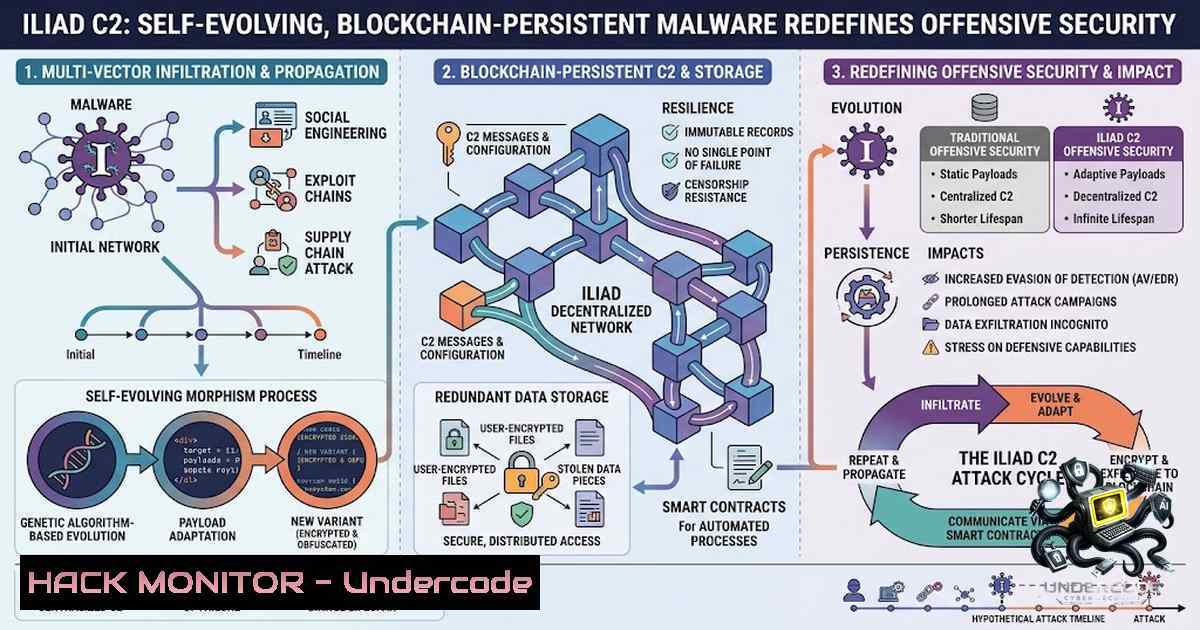
The cybersecurity landscape is witnessing a paradigm shift with the emergence of advanced persistent threats that transcend traditional malware paradigms. The Iliad Command and Control (C2) system represents a quantum leap in offensive security capabilities, employing self-evolving code, blockchain-based persistence, and artificial intelligence to create digital organisms that survive, adapt, and thrive in hostile environments. Unlike conventional malware that relies on signatures and static payloads, Iliad C2 eliminates the concept of a payload entirely—the system itself becomes the payload, with no traces, no logs, and no fingerprints left behind.
Learning Objectives & Secrets
- Objective 1: Understanding Self-Evolving Malware Architecture – Master the concepts behind AI-driven malware that scrapes the web, learns from victim systems, and upgrades its code in seconds to evade modern AV scanners and LLM-based detection systems.
-
Objective 2 (Secret Tip): Blockchain-Based Persistence Exploitation – Learn how threat actors leverage decentralized ledgers to maintain C2 infrastructure resilience, ensuring that even if the server is destroyed, command data remains recoverable and operational.
-
Objective 3 (Secret Tip): Zero-Footprint P2P Communication – Discover how payloads communicate peer-to-peer without central servers, sharing pieces of data across infected systems to reconstruct actionable intelligence while evading network monitoring tools.
You Should Know
- Detecting SSH Key Compromise and AWS Infrastructure Hijacking
The initial attack vector described involves an SSH key compromise leading to AWS EC2 exploitation. Detection and mitigation require immediate action:
Linux Commands to Audit SSH Keys:
 List all SSH keys on the system
find ~/.ssh -type f -1ame ".pub" -exec ls -la {} \;

Check authorized_keys for unauthorized entries
cat ~/.ssh/authorized_keys | while read key; do
echo "Key: $key"
 Verify each key against known users
done

Monitor SSH authentication logs for anomalies
sudo tail -f /var/log/auth.log | grep -E "(Failed|Accepted) password"
sudo journalctl -u ssh -f

Audit SSH configuration for security misconfigurations
sudo grep -E "^PermitRootLogin|^PasswordAuthentication|^PubkeyAuthentication" /etc/ssh/sshd_config
Windows PowerShell Commands:
 Get all SSH keys in user directories
Get-ChildItem -Path C:\Users\.ssh\authorized_keys -Recurse -ErrorAction SilentlyContinue

Check for suspicious scheduled tasks that might maintain persistence
Get-ScheduledTask | Where-Object {$<em>.State -eq "Running" -or $</em>.State -eq "Ready"}

Audit Windows Event Logs for SSH-related events
Get-WinEvent -LogName Security -MaxEvents 100 | Where-Object {$_.Id -in @(4624,4625,4672)}
Step-by-Step Mitigation:
- Immediately revoke compromised SSH keys from AWS EC2 instances
2. Rotate all IAM credentials and enable MFA
3. Implement AWS GuardDuty for continuous threat detection
- Deploy AWS Config rules to monitor unauthorized SSH key additions
- Enable VPC Flow Logs to capture network traffic anomalies
2. Analyzing PDF-Based Malware Vectors
The attack chain highlights PDF files as initial infection vectors. Understanding PDF exploit analysis is crucial for defense:
PDF Analysis with Peepdf (Linux):
 Install peepdf for PDF analysis
sudo pip install peepdf

Analyze suspicious PDF for embedded JavaScript or exploits
peepdf -c "extract js" suspicious_file.pdf
peepdf -c "stats" suspicious_file.pdf

Extract objects and streams for manual inspection
peepdf -c "object 1" suspicious_file.pdf
Python Script for Basic PDF Suspicion Analysis:
import PyPDF2
import re

def analyze_pdf(file_path):
with open(file_path, 'rb') as file:
reader = PyPDF2.PdfReader(file)
suspicious = False
for page in reader.pages:
text = page.extract_text()
 Check for common exploit indicators
if re.search(r'/JavaScript|/JS|/OpenAction|/Launch', text):
suspicious = True
print(f"[!] Suspicious JavaScript or Action found on page {page}")
return suspicious
Windows Tools for PDF Analysis:
 Use didier stevens' pdfid.py (requires Python)
python pdfid.py -1 suspicious_file.pdf

Check for embedded files
pdf-parser.py -e suspicious_file.pdf
3. Memory Forensics and Kernel-Level Detection
Since Iliad C2 operates at the kernel level with no traditional payload, memory forensics becomes essential:
Volatility 3 Framework (Linux):
 Install Volatility 3
git clone https://github.com/volatilityfoundation/volatility3.git
cd volatility3
python3 vol.py -f memory.dump windows.malfind.Malfind
python3 vol.py -f memory.dump windows.pslist.PsList
python3 vol.py -f memory.dump windows.cmdline.CmdLine

Check for hidden processes and kernel modules
python3 vol.py -f memory.dump windows.modscan.ModScan
python3 vol.py -f memory.dump windows.driverirp.DriverIrp
Process Injection Detection Commands:
 Monitor running processes for suspicious memory regions
sudo cat /proc/$(pgrep -f suspicious_process)/maps

Use checksec to verify binary security mitigations
checksec --file /path/to/binary
Windows Memory Analysis with Sysinternals:
 Use ProcDump to capture process memory
procdump -ma <PID> suspicious_process.dmp

Analyze with Strings to find embedded C2 indicators
strings suspicious_process.dmp | findstr /i "c2 command beacon"

Use Windows Defender Offline Scan
Start-MpWDOScan
4. Blockchain Transaction Analysis for C2 Detection
The blockchain persistence mechanism requires monitoring for suspicious transactions:
Blockchain Monitoring Commands:
 Using Bitcoin RPC to check for suspicious transactions
bitcoin-cli listtransactions "" 100 | grep -A 5 -B 5 "suspicious_address"

Monitor Ethereum for potential C2 communications
curl -X POST -H "Content-Type: application/json" --data '{"jsonrpc":"2.0","method":"eth_getLogs","params":[{"address":"0x..."}],"id":1}' https://mainnet.infura.io/v3/YOUR_PROJECT_ID
Python Script for Transaction Analysis:
from web3 import Web3
import json

def analyze_transactions(address, max_blocks=100):
w3 = Web3(Web3.HTTPProvider('https://mainnet.infura.io/v3/YOUR_PROJECT_ID'))
latest_block = w3.eth.block_number
for i in range(max_blocks):
block = w3.eth.get_block(latest_block - i, full_transactions=True)
for tx in block.transactions:
if tx['from'].lower() == address.lower():
print(f"[!] Suspicious transaction found in block {block.number}")
print(f"To: {tx['to']}, Value: {tx['value']}")
5. LLM-Based AV Evasion Countermeasures
Since Iliad C2 uses LLM to evolve against detection, organizations need proactive strategies:
Implementing Behavioral Analysis:
 Monitor system call anomalies with strace
sudo strace -p <PID> -o system_call_log.txt

Track network connections in real-time
sudo netstat -tunap | grep ESTABLISHED

Use Auditd to monitor file integrity
sudo auditctl -w /etc/ -p wa -k etc_change
sudo auditctl -w /bin/ -p wa -k bin_change
Advanced YARA Rules for Behavioral Detection:
rule Behavioral_Anomaly {
meta:
description = "Detects anomalous system behavior"
severity = "high"
strings:
$network = /(POST|GET).https?:\/\/[0-9]{1,3}.[0-9]{1,3}.[0-9]{1,3}.[0-9]{1,3}/
$suspicious_process = /powershell.-e|wget.-O/
condition:
any of them and (filesize < 5MB)
}
What Undercode Say:
Key Takeaway 1: The Iliad C2 framework demonstrates that traditional signature-based detection and even modern AI scanners are obsolete against self-evolving, LLM-embedded malware. Organizations must shift to behavioral analysis and proactive threat hunting rather than reactive detection.
Key Takeaway 2: Blockchain persistence means that even complete infrastructure takedowns cannot destroy the C2 capability. This requires new incident response strategies that consider data resilience across decentralized networks, demanding improved blockchain monitoring and forensic techniques.
Key Takeaway 3: The P2P, zero-footprint architecture eliminates centralized points of failure, making eradication nearly impossible. Defenders must focus on containment and isolation strategies, assuming breach persistence and building robust segmentation controls.
Key Takeaway 4: The evolution time of days for traditional AV signatures versus seconds for Iliad’s self-upgrade mechanism creates an unfillable gap in current security operations. This demands real-time threat intelligence sharing and AI-driven defensive AI (defensive AI) to match offensive pace.
Key Takeaway 5: Organizations must rebuild security architecture with zero-trust principles, emphasizing workload identity, network micro-segmentation, and continuous verification of all system states, as the “hostile environment” survival described indicates traditional perimeter defense is entirely ineffective.
Key Takeaway 6: The “system becomes the payload” concept indicates memory-only, fileless malware that exists solely in runtime. This requires memory forensics, endpoint detection and response (EDR) with behavioral baselining, and advanced memory scanning tools capable of detecting non-persistent threats that vanish upon reboot.
Prediction:
- +1 Security vendors will accelerate development of AI-powered defensive solutions that can counter self-evolving malware, potentially creating an arms race between offensive and defensive AI systems.
- +1 The emergence of such advanced C2 frameworks will push regulatory bodies to mandate stricter cybersecurity standards, particularly for financial institutions and critical infrastructure, driving innovation in compliance-driven security.
- -1 Small to medium enterprises lacking advanced security resources will be disproportionately vulnerable, as they cannot afford the sophisticated defense mechanisms required to detect and mitigate such threats.
- -1 Law enforcement and intelligence agencies will struggle to attribute attacks originating from blockchain-based, self-evolving malware, increasing the challenge of holding threat actors accountable.
- -1 The self-learning capability combined with web scraping means that the malware can adopt new evasion techniques faster than defensive teams can implement countermeasures, creating a perpetual advantage for attackers.
- -1 Zero-footprint, no-log operations make post-breach forensic investigation nearly impossible, severely hampering incident response teams’ ability to determine the full scope and impact of compromised systems.
- +1 Increased investment in memory forensics, behavioral analytics, and deception technologies will emerge as critical defensive pillars, leading to a new generation of security tools focused on anomaly detection rather than signature matching.
- -1 The P2P communication between payloads creates a resilient botnet-like infrastructure that is nearly impossible to dismantle through traditional takedown operations, as no central command exists.
- +1 Open-source security communities will develop new detection frameworks and share threat intelligence more aggressively, leveraging collective knowledge to combat such sophisticated threats.
- -1 The tactical advantage afforded by Iliad C2-like systems could destabilize the global cyber equilibrium, potentially triggering state-sponsored cyber warfare escalations that traditional deterrence measures cannot address.
▶️ Related Video (86% Match):
🎯Let’s Practice For Free:
🎓 Live Courses & Certifications:
Join Undercode Academy for Verified Certifications
🚀 Request a Custom Project:
Secure, high-velocity infrastructure and disruptive technological engineering. Contact our engineering team for high-tier development and proprietary systems:
[email protected]
💎 Smart Architecture | 🛡️ Secure by Design | ⭐ Trusted by Thousands
IT/Security Reporter URL:
Reported By: https://lnkd.in/p/es84a8rt – Hackers Feeds
Extra Hub: Undercode MoN
Basic Verification: Pass ✅


