
Listen to this Post
Introduction:
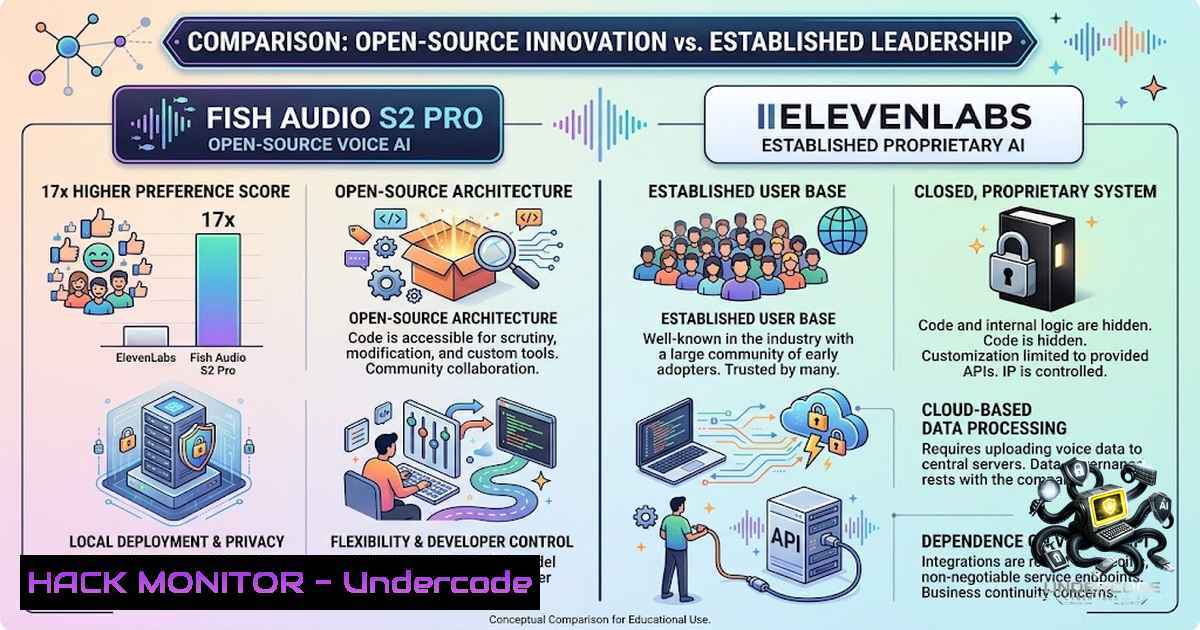
The text-to-speech (TTS) landscape is undergoing a seismic shift as Fish Audio’s S2 Pro emerges as a formidable challenger to ElevenLabs’ long-held benchmark status. In a 10-day blind A/B test conducted on real production traffic, S2 Pro achieved a Bradley-Terry score of 3.07 compared to ElevenLabs V3’s 1.80—nearly 1.7x higher—with a 65.7% overall win rate. Beyond the rankings, this signals a broader trend: production-quality voice AI is no longer the exclusive domain of a single provider, and developers now have more choice, lower barriers, and greater deployment flexibility than ever before.
Learning Objectives & Secrets:
- Objective 1: Master Fine-Grained Emotional Control – Learn to use natural-language `
` tags (e.g., <code>[whispers sweetly]</code>, <code>[laughing nervously]</code>, <code>[professional broadcast tone]</code>) to control prosody and emotion at the sub-word level, with support for over 15,000 unique tags.</li>
<li>Objective 2 Secret Tips: Optimize for Production Latency – Leverage SGLang-based streaming inference with RadixAttention prefix caching to achieve ~100ms time-to-first-audio and a Real-Time Factor (RTF) of 0.195 on NVIDIA H200—meaning you can generate 1 minute of audio in under 12 seconds.</li>
<li>Objective 3 Secret Tips: Deploy Without Vendor Lock-In – Self-host the open-source S2 model on your own infrastructure using Docker, command-line inference, or HTTP API, eliminating dependency on cloud providers and enabling custom fine-tuning.</li>
</ul>

<h2 style="color: yellow;">You Should Know:</h2>

<h2 style="color: yellow;">1. Architecture Deep Dive: Dual-Autoregressive Design</h2>

Fish Audio S2 Pro’s core innovation lies in its Dual-Autoregressive (Dual-AR) architecture, which splits generation into two specialized components:
- Slow AR (4B parameters): Operates along the time axis, predicting the primary semantic codebook that defines language structure and prosody.
- Fast AR (400M parameters): Generates the remaining 9 residual codebooks at each time step, reconstructing fine-grained acoustic details like timbre, breath, and emotional nuance.

This asymmetric design—4B parameters along the time axis, 400M along the depth axis—keeps inference efficient while preserving 44.1kHz high-fidelity audio output. Because the architecture is structurally isomorphic to standard autoregressive LLMs, it inherits all LLM-1ative serving optimizations from SGLang, including continuous batching, paged KV cache, CUDA graph replay, and RadixAttention-based prefix caching.

<h2 style="color: yellow;">Step‑by‑Step Guide to Understanding and Using the Architecture:</h2>

[bash]
 Check your GPU compatibility (minimum 12GB VRAM recommended)
nvidia-smi

Clone the Fish Speech repository
git clone https://github.com/fishaudio/fish-speech.git
cd fish-speech

Create a Conda environment with Python 3.12
conda create -1 fish-speech python=3.12
conda activate fish-speech

Install with CUDA 12.9 support (match your CUDA version)
pip install -e .[bash]
- API Integration: From Zero to First Voice in 5 Minutes
Fish Audio provides an OpenAI-compatible API, meaning you can point existing OpenAI SDKs at Fish Audio’s endpoint with minimal changes. The API supports three production models: `s2.1-pro` (recommended for production), `s2-pro` (previous generation), and `s2.1-pro-free` (same model at $0 for development, without TTFA/DPA guarantees).
Step‑by‑Step Guide to API Integration:
 Step 1: Get your API key from https://fish.audio/app/api-keys
export FISH_API_KEY="your_api_key_here"

Step 2: Generate your first TTS with cURL
curl -X POST https://api.fish.audio/v1/tts \
-H "Authorization: Bearer $FISH_API_KEY" \
-H "Content-Type: application/json" \
-H "model: s2-pro" \
-d '{
"text": "Hello! Welcome to Fish Audio. [bash] This is my first AI-generated voice.",
"format": "mp3"
}' \
--output welcome.mp3

Step 3: Play the audio
 On macOS: afplay welcome.mp3
 On Linux: mpg123 welcome.mp3
 On Windows: start welcome.mp3
Python SDK Example:
from fishaudio import FishAudio
from fishaudio.utils import save

Initialize client (reads FISH_API_KEY from environment)
client = FishAudio()

Generate speech with emotional control
audio = client.tts.convert(
text="[whispers sweetly] This is a secret message. [bash] Just kidding!",
model="s2-pro",
reference_id="your_voice_model_id"  Optional: use a specific voice
)
save(audio, "output.mp3")
3. Voice Cloning: Zero-Shot with 10–30 Second Samples
S2 Pro supports accurate voice cloning using short reference samples—typically 10 to 30 seconds of audio. The model can reproduce both speaker identity and emotional state from minimal data, making it ideal for personalized voice agents, dubbing, and content localization.
Step‑by‑Step Guide to Voice Cloning (Self-Hosted):
 Step 1: Encode reference audio to extract VQ tokens
python fish_speech/models/dac/inference.py \
-i "my_voice.wav" \
--checkpoint-path "checkpoints/openaudio-s1-mini/codec.pth"

Step 2: Generate semantic tokens from text
python fish_speech/models/text2semantic/inference.py \
--text "Hello, this is my cloned voice speaking." \
--prompt-text "This is my reference voice recording." \
--prompt-tokens "fake.npy" \
--compile

Step 3: Generate final audio from semantic tokens
python fish_speech/models/dac/inference.py \
-i "codes_0.npy"
4. Real-Time Streaming for Voice Agents
For conversational AI and interactive applications, S2 Pro supports WebSocket-based streaming with configurable latency modes:
– Normal: Best quality, ~500ms latency
– Balanced: Good quality, ~300ms latencyStep‑by‑Step Guide to Real-Time Streaming:
from fishaudio import FishAudio

client = FishAudio(api_key="your_api_key")

Stream text word by word
def stream_text():
text = "Hello, this is being generated in real time for my voice agent."
for word in text.split():
yield word + " "

Generate speech as text streams
audio_stream = client.tts.stream_websocket(
stream_text(),
reference_id="your_voice_model_id",
temperature=0.7,
top_p=0.7,
latency="balanced"  or "normal" for best quality
)

with open("streaming_output.mp3", "wb") as f:
for audio_chunk in audio_stream:
f.write(audio_chunk)
5. Multilingual Support: 80+ Languages with Automatic Detection
S2 Pro is trained on over 10 million hours of audio data covering 80+ languages. Tier 1 languages (highest quality) include Japanese, English, and Chinese, while Tier 2 includes Korean, Spanish, Portuguese, Arabic, Russian, French, and German. Language detection is automatic—simply provide text in your target language.
Step‑by‑Step Guide to Multilingual Generation:
 Japanese
curl -X POST https://api.fish.audio/v1/tts \
-H "Authorization: Bearer $FISH_API_KEY" \
-H "Content-Type: application/json" \
-H "model: s2-pro" \
-d '{"text": "こんにちは、これは日本語の音声です。", "format": "mp3"}' \
--output japanese.mp3

Spanish with emotion
curl -X POST https://api.fish.audio/v1/tts \
-H "Authorization: Bearer $FISH_API_KEY" \
-H "Content-Type: application/json" \
-H "model: s2-pro" \
-d '{"text": "[bash] ¡Hola! Bienvenido a Fish Audio.", "format": "mp3"}' \
--output spanish.mp3
6. Self-Hosting and Docker Deployment
For teams requiring data privacy, custom fine-tuning, or avoidance of vendor lock-in, S2 Pro’s open-source release enables full self-hosting.
Step‑by‑Step Guide to Docker Deployment:
 Clone the repository
git clone https://github.com/fishaudio/fish-speech.git
cd fish-speech

Build the Docker image
docker build -t fish-speech .

Run the container with GPU support
docker run --gpus all -p 8080:8080 fish-speech

The HTTP API server will be available at http://127.0.0.1:8080/v1/tts
 This endpoint automatically uses S2-Pro
Hardware Recommendations:
| Use Case | Recommended GPU | VRAM | Expected Speed |
|-|-||-|
| Development | RTX 3060 | 12GB | ~1:15 real-time factor |
| Production | RTX 4090 | 24GB | ~1:7 real-time factor |
| Enterprise | A100 | 40GB+ | ~1:5 real-time factor |What Undercode Say:
- Key Takeaway 1: Fish Audio S2 Pro’s 1.7x Bradley-Terry advantage over ElevenLabs V3 isn’t just a benchmark victory—it represents a fundamental shift in TTS quality accessibility. The fact that an open-source model can outperform a market leader with 11x lower API pricing ($15 vs $60–$165 per million characters) democratizes production-grade voice AI for startups and independent developers.
-
Key Takeaway 2: The Dual-AR architecture’s ability to inherit LLM-1ative optimizations from SGLang is a masterstroke. By building on decoder-only transformer patterns, Fish Audio effectively piggybacks on the entire ecosystem of LLM inference optimization—continuous batching, paged KV cache, and RadixAttention—giving it a performance advantage that would have taken years to develop from scratch.
Analysis: The competitive pressure Fish Audio exerts on ElevenLabs is precisely what the voice AI industry needs. For years, ElevenLabs enjoyed a near-monopoly on quality, allowing premium pricing and limited deployment flexibility. S2 Pro changes this calculus entirely. Developers can now choose between ElevenLabs’ polished ecosystem and Fish Audio’s raw quality-to-cost ratio, with the added option of self-hosting for complete data sovereignty. The blind test methodology Fish Audio employed—testing on real production traffic with longer utterances across multiple languages—also addresses a critical flaw in traditional TTS evaluation (MOS scores and short-sentence leaderboards). This forces the entire industry toward more rigorous, real-world evaluation standards. The 83-language support in S2.1-Pro and sub-150ms latency make it particularly compelling for global voice agent deployments. However, teams should conduct independent testing before production migration, as benchmark figures were published by Fish Audio themselves. The open-source nature of S2 Pro under the Fish Audio Research License also raises important considerations around commercial use licensing that enterprises must evaluate.
Prediction:
- +1 Fish Audio’s aggressive pricing ($15/1M characters) and open-source availability will force ElevenLabs to reduce API costs or enhance features, benefiting the entire developer ecosystem.
- +1 The SGLang-based inference stack will accelerate adoption of TTS in real-time applications like gaming dialogue, live translation, and interactive storytelling, expanding the total addressable market for voice AI.
- +1 The 15,000+ emotion tags and free-form natural language control will enable new categories of expressive applications—interactive fiction, personalized audiobooks, and emotionally responsive virtual assistants—that were previously too complex to build.
- -1 Enterprises heavily invested in ElevenLabs’ ecosystem face a migration dilemma: switching to Fish Audio requires retooling workflows and may sacrifice some of ElevenLabs’ non-technical tooling and 4,000+ voice library.
- -1 The open-source model’s commercial licensing ambiguity (Fish Audio Research License requires separate commercial authorization) creates legal uncertainty for businesses planning large-scale deployments—a risk that ElevenLabs’ purely commercial model avoids.
- -1 Self-hosting S2 Pro requires significant GPU infrastructure (minimum 12GB VRAM), which may offset cost savings for smaller teams and push them back toward cloud API usage, limiting the decentralization benefits of open-source availability.
▶️ Related Video (74% Match):
🎯Let’s Practice For Free:
🎓 Live Courses & Certifications:
Join Undercode Academy for Verified Certifications
🚀 Request a Custom Project:
Secure, high-velocity infrastructure and disruptive technological engineering. Contact our engineering team for high-tier development and proprietary systems:
[email protected]
💎 Smart Architecture | 🛡️ Secure by Design | ⭐ Trusted by ThousandsIT/Security Reporter URL:
Reported By: https://lnkd.in/p/ep8JrAMi – Hackers Feeds
Extra Hub: Undercode MoN
Basic Verification: Pass ✅🔐JOIN OUR CYBER WORLD [ CVE News • HackMonitor • UndercodeNews ]
📢 Follow UndercodeTesting & Stay Tuned:


