
Listen to this Post
Introduction
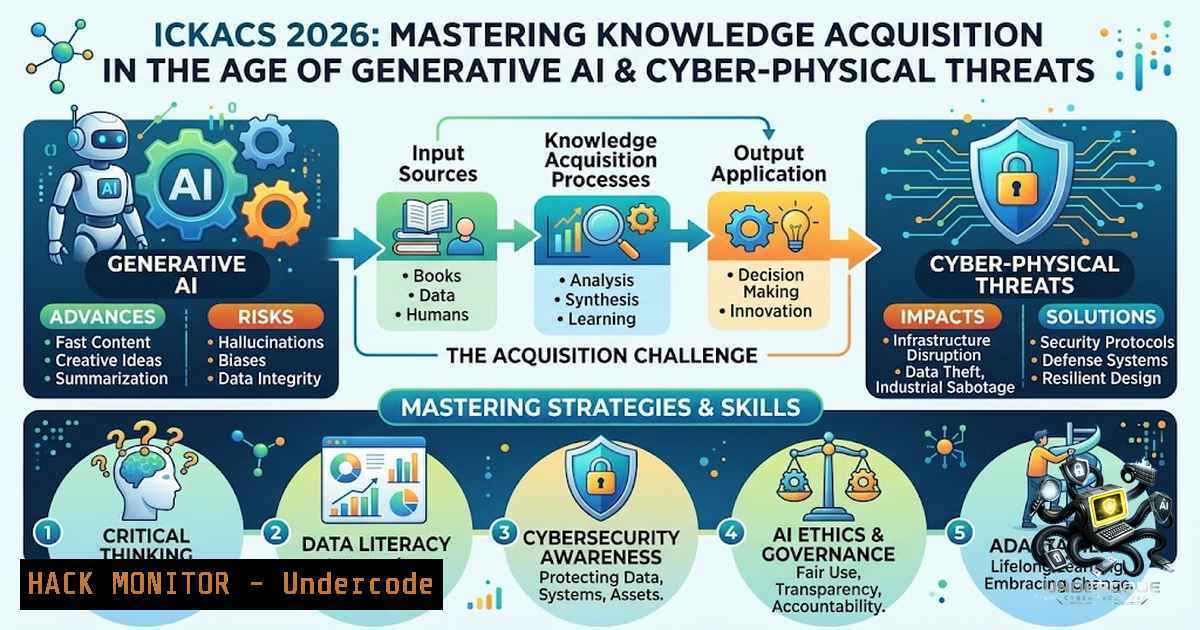
Knowledge acquisition—the process of extracting, structuring, and operationalizing information from disparate data sources—has emerged as the foundational challenge underpinning modern artificial intelligence, cybersecurity defense, and cloud-1ative architectures. As organizations race to deploy generative AI pipelines and zero-trust security frameworks, the ability to systematically acquire, validate, and protect knowledge assets determines competitive advantage and operational resilience. The International Conference on Knowledge Acquisition in Computer Science (ICKACS 2026), scheduled for 21–22 August 2026 at Kongunadu Arts and Science College, Coimbatore, addresses precisely this intersection by bringing together researchers, industry practitioners, and security architects to explore techniques, challenges, and emerging trends across AI, cybersecurity, blockchain, and cloud computing.
Learning Objectives
- Master the fundamental methodologies for knowledge representation, extraction, and validation in AI-driven systems, including ontology engineering and semantic web technologies.
- Implement practical security controls for knowledge acquisition pipelines, covering API security, data poisoning detection, and adversarial ML defense strategies.
- Deploy and harden cloud-based knowledge acquisition infrastructure using Infrastructure-as-Code (IaC), container security best practices, and zero-trust networking principles.
You Should Know
1. Knowledge Acquisition Pipelines: Architecture and Security Hardening
Knowledge acquisition in modern computer science encompasses the entire lifecycle from raw data ingestion to actionable intelligence. This process typically involves data collection from heterogeneous sources (IoT sensors, APIs, databases, web scraping), data transformation and normalization, knowledge representation (graphs, vectors, rule-based systems), and continuous validation against ground truth. However, each stage introduces attack surfaces that adversaries actively exploit—from prompt injection in LLM-based acquisition systems to data poisoning attacks that corrupt training corpora.
Step‑by‑step guide to securing a knowledge acquisition pipeline:
Step 1: Implement Input Validation and Sanitization
All data ingested into your acquisition pipeline must be validated against strict schemas. For API endpoints, enforce JSON Schema validation or Protobuf parsing.
 Python example using Pydantic for API payload validation
from pydantic import BaseModel, ValidationError
from typing import Optional

class KnowledgePayload(BaseModel):
source_id: str
content: str
metadata: Optional[bash] = {}
timestamp: int

@validator('content')
def content_not_empty(cls, v):
if not v or len(v) < 10:
raise ValueError('Content must be at least 10 characters')
return v
Step 2: Deploy API Gateway with Rate Limiting and Authentication
For RESTful knowledge ingestion endpoints, use a gateway that enforces OAuth2/OIDC authentication and rate limits to prevent DoS and credential stuffing.
 Kong API Gateway rate limiting configuration (declarative)
curl -i -X POST http://localhost:8001/services/your-service/plugins \
--data "name=rate-limiting" \
--data "config.minute=100" \
--data "config.hour=1000"
Step 3: Encrypt Data at Rest and in Transit
All knowledge artifacts stored in databases, object storage, or vector databases must be encrypted using AES-256-GCM for at-rest protection and TLS 1.3 for in-transit security.
 Linux: Encrypt a knowledge corpus file using OpenSSL
openssl enc -aes-256-gcm -salt -in knowledge_corpus.json -out knowledge_corpus.enc -pass pass:your_secure_key

Windows (PowerShell): Decrypt using .NET cryptography
$secureString = ConvertTo-SecureString "your_secure_key" -AsPlainText -Force
$encrypted = Get-Content -Path "knowledge_corpus.enc" -Raw
 (Decryption logic with System.Security.Cryptography)
Step 4: Implement Audit Logging for All Acquisition Activities
Maintain immutable audit trails of every knowledge ingestion, transformation, and access event. Forward logs to a centralized SIEM for real-time threat detection.
 Linux: Configure auditd for file access monitoring on knowledge repositories
auditctl -w /data/knowledge_repo/ -p rwxa -k knowledge_access
ausearch -k knowledge_access --start today
2. Securing AI/ML Knowledge Bases Against Adversarial Attacks
As knowledge acquisition increasingly relies on machine learning and generative AI, the security of training data, model weights, and inference pipelines becomes paramount. Adversaries can poison knowledge bases through carefully crafted inputs that corrupt model behavior, extract sensitive training data via membership inference attacks, or manipulate generative outputs through prompt injection. Defending against these threats requires a multi-layered approach spanning data provenance, model hardening, and runtime monitoring.
Step‑by‑step guide to hardening AI knowledge acquisition systems:
Step 1: Establish Data Provenance and Lineage Tracking
Every knowledge artifact must be cryptographically signed with its source, transformation history, and timestamp. Implement blockchain-based or Merkle-tree verification for critical knowledge assets.
 Python: Generate cryptographic hash for knowledge provenance
import hashlib
import json
from datetime import datetime

def generate_provenance(artifact_id, content, source, previous_hash=None):
provenance = {
"artifact_id": artifact_id,
"content_hash": hashlib.sha256(content.encode()).hexdigest(),
"source": source,
"timestamp": datetime.utcnow().isoformat(),
"previous_hash": previous_hash
}
provenance["signature"] = hashlib.sha256(
json.dumps(provenance, sort_keys=True).encode()
).hexdigest()
return provenance
Step 2: Deploy Adversarial Robustness Toolbox (ART) Defenses
Use IBM’s Adversarial Robustness Toolbox or similar frameworks to apply defensive distillation, adversarial training, and input pre-processing filters.
 ART example: Applying defensive distillation to a neural network classifier
from art.defences.trainer import AdversarialTrainer
from art.attacks.evasion import FastGradientMethod

Assume classifier and training data are loaded
trainer = AdversarialTrainer(classifier, attacks=FastGradientMethod(classifier, eps=0.2))
trainer.fit(x_train, y_train, nb_epochs=10)
Step 3: Implement Prompt Injection Detection for LLM-Based Acquisition
For systems using large language models to acquire knowledge from unstructured text, deploy prompt injection detectors that analyze input patterns for known adversarial prefixes, delimiter overflows, and instruction overriding attempts.
 Linux: Deploy a lightweight prompt sanitization proxy using modsecurity (OWASP CRS)
 Add custom rules to detect prompt injection patterns
echo 'SecRule ARGS "@contains ignore previous instructions" "id:100001,deny,status:403,msg:'Prompt Injection Detected'"' >> /etc/modsecurity/custom_rules.conf
Step 4: Continuous Model Monitoring with Drift Detection
Monitor model confidence scores, prediction distributions, and feature importance over time to detect data drift or adversarial shifts.
 Python: Monitor feature drift using Kolmogorov–Smirnov test
from scipy import stats
import numpy as np

def detect_drift(reference_distribution, current_sample, threshold=0.05):
ks_stat, p_value = stats.ks_2samp(reference_distribution, current_sample)
return p_value < threshold  Drift detected if p-value below threshold
3. Cloud-1ative Knowledge Acquisition: Infrastructure Hardening
Modern knowledge acquisition systems are deployed across hybrid and multi-cloud environments, leveraging containerized microservices, serverless functions, and distributed data lakes. Securing this infrastructure requires rigorous Identity and Access Management (IAM), network segmentation, and continuous vulnerability scanning.
Step‑by‑step guide to hardening cloud knowledge acquisition infrastructure:
Step 1: Enforce Least-Privilege IAM Policies
For AWS, Azure, or GCP, create granular IAM roles that restrict knowledge acquisition services to only the necessary S3 buckets, databases, and API endpoints.
// AWS IAM policy for a knowledge ingestion service
{
"Version": "2012-10-17",
"Statement": [
{
"Effect": "Allow",
"Action": ["s3:GetObject", "s3:PutObject"],
"Resource": "arn:aws:s3:::knowledge-acquisition-bucket/raw/"
},
{
"Effect": "Deny",
"Action": ["s3:DeleteBucket", "iam:"],
"Resource": ""
}
]
}
Step 2: Container Security Scanning and Runtime Protection
Scan all container images for known vulnerabilities before deployment using Trivy or Clair. Enforce runtime security with Falco or Sysdig.
 Linux: Scan a Docker image for CVEs using Trivy
trivy image your-registry/knowledge-acquisition:latest --severity HIGH,CRITICAL

Deploy Falco for runtime threat detection on Kubernetes
helm install falco falcosecurity/falco --set falco.jsonOutput=true --set falco.syslogOutput=false
Step 3: Implement Network Segmentation with Service Meshes
Deploy a service mesh (Istio or Linkerd) to enforce mTLS between knowledge acquisition microservices and implement fine-grained network policies.
 Kubernetes NetworkPolicy to restrict knowledge-base access
apiVersion: networking.k8s.io/v1
kind: NetworkPolicy
metadata:
name: knowledge-base-1etwork-policy
spec:
podSelector:
matchLabels:
app: knowledge-base
policyTypes:
- Ingress
ingress:
- from:
- podSelector:
matchLabels:
app: knowledge-ingestion
ports:
- protocol: TCP
port: 5432
Step 4: Automate Secrets Management
Never hardcode credentials. Use HashiCorp Vault, AWS Secrets Manager, or Azure Key Vault to dynamically provision database credentials and API keys.
 Linux: Retrieve a secret from HashiCorp Vault
vault kv get -field=password secret/knowledge-db

Inject secret into a Kubernetes pod via CSI driver
kubectl create secret generic knowledge-db-creds --from-literal=password=$(vault kv get -field=password secret/knowledge-db)
4. Blockchain for Immutable Knowledge Provenance
Blockchain technology offers a decentralized, tamper-evident ledger for recording knowledge acquisition events, ensuring data integrity and non-repudiation. This is particularly critical in regulated industries where audit trails of knowledge sources and transformations must be maintained for compliance.
Step‑by‑step guide to implementing blockchain-based knowledge provenance:
Step 1: Define Knowledge Asset Smart Contracts
Deploy a smart contract on Ethereum or Hyperledger Fabric that records each knowledge artifact’s hash, source, timestamp, and access history.
// Solidity smart contract for knowledge provenance
pragma solidity ^0.8.0;

contract KnowledgeProvenance {
struct KnowledgeAsset {
string artifactHash;
string source;
uint256 timestamp;
address owner;
}

mapping(string => KnowledgeAsset) public assets;
event AssetRegistered(string indexed artifactHash, string source, uint256 timestamp);

function registerAsset(string memory artifactHash, string memory source) public {
assets[bash] = KnowledgeAsset(artifactHash, source, block.timestamp, msg.sender);
emit AssetRegistered(artifactHash, source, block.timestamp);
}
}
Step 2: Integrate Blockchain Verification into Acquisition Pipeline
After ingesting and processing a knowledge artifact, compute its hash and record it on the blockchain. Any subsequent access or modification must be validated against the on-chain record.
 Python: Integrate with Web3.py for blockchain verification
from web3 import Web3

w3 = Web3(Web3.HTTPProvider('https://mainnet.infura.io/v3/YOUR_PROJECT_ID'))
contract = w3.eth.contract(address=contract_address, abi=contract_abi)

def verify_asset_on_chain(artifact_hash):
asset = contract.functions.assets(artifact_hash).call()
return asset[bash] > 0  Returns True if asset exists on-chain
Step 3: Implement Zero-Knowledge Proofs for Privacy-Preserving Verification
For sensitive knowledge assets, use ZK-SNARKs or ZK-STARKs to prove knowledge of an artifact without revealing its contents.
5. Network Security and IoT Knowledge Acquisition
With the proliferation of IoT devices generating massive streams of telemetry data, securing the network infrastructure that supports knowledge acquisition is non-1egotiable. Attackers frequently target IoT gateways, MQTT brokers, and edge nodes to intercept or manipulate knowledge streams.
Step‑by‑step guide to securing IoT knowledge acquisition networks:
Step 1: Deploy Secure MQTT with TLS and ACLs
Configure MQTT brokers (Mosquitto, EMQX) with TLS 1.3 encryption and fine-grained Access Control Lists (ACLs).
 Linux: Mosquitto ACL configuration
 /etc/mosquitto/acl.conf
user knowledge_ingestor
topic read/write sensors/+/temperature
topic read/write sensors/+/humidity

user knowledge_consumer
topic read sensors/+/temperature
topic read sensors/+/humidity
Step 2: Implement Network Intrusion Detection for IoT Traffic
Deploy Snort or Suricata with custom rules to detect anomalous IoT payloads, command injection attempts, and protocol violations.
 Linux: Suricata custom rule for MQTT anomaly detection
alert mqtt any any -> any any (msg:"MQTT Malformed Payload Detected"; mqtt.msg_len:>1024; sid:1000001;)
Step 3: Edge Node Hardening with SELinux/AppArmor
Restrict edge node processes to minimal required capabilities using mandatory access control.
 Linux: Enforce AppArmor profile for an IoT knowledge collector
aa-genprof /usr/local/bin/iot_collector
aa-enforce /usr/local/bin/iot_collector
What Undercode Say
- Knowledge acquisition is the new security perimeter. In 2026, the most valuable organizational asset is not data itself but the pipelines that acquire, validate, and operationalize it. Securing these pipelines requires treating knowledge as a critical infrastructure component, with the same rigor applied to network perimeters and identity systems.
-
Generative AI amplifies both capability and risk. While LLMs and foundation models dramatically accelerate knowledge acquisition from unstructured data, they introduce novel attack vectors—prompt injection, data poisoning, and model extraction—that traditional security controls cannot address. Organizations must invest in adversarial robustness testing and continuous red-teaming of AI acquisition systems.
The convergence of AI, cybersecurity, and cloud computing at ICKACS 2026 reflects an industry-wide recognition that knowledge acquisition can no longer be treated as a purely academic or data engineering concern. The techniques presented at this conference—from blockchain-based provenance to adversarial ML defenses—represent the practical toolkit that security architects and AI engineers must master. However, the rapid pace of innovation means that no single defensive strategy is sufficient; organizations must adopt defense-in-depth, continuous monitoring, and incident response playbooks specifically tailored to knowledge acquisition pipelines. The inclusion of industry professionals from ABN AMRO Bank, TCS, Honeywell, and IBM in the conference’s resource panel underscores the real-world urgency of these challenges.
Prediction
- +1 By 2028, regulatory frameworks will mandate blockchain-based provenance tracking for all AI training datasets and knowledge bases used in critical infrastructure, healthcare, and financial services, driving widespread adoption of the techniques showcased at ICKACS 2026.
-
-1 The commoditization of adversarial AI toolkits will lead to a surge in knowledge poisoning attacks against enterprise RAG (Retrieval-Augmented Generation) systems, potentially causing widespread misinformation and brand damage before defensive standards mature.
-
+1 The hybrid format of ICKACS 2026, combining online and offline participation, will accelerate global knowledge transfer and collaboration, particularly benefiting researchers and practitioners from developing economies who face travel constraints.
-
-1 Organizations that fail to integrate security into their knowledge acquisition lifecycles will experience data breaches costing an average of $4.5M per incident by 2027, as attackers increasingly target knowledge pipelines rather than traditional network perimeters.
▶️ Related Video (80% Match):
https://www.youtube.com/watch?v=-Hxj4l0JIy4
🎯Let’s Practice For Free:
🎓 Live Courses & Certifications:
Join Undercode Academy for Verified Certifications
🚀 Request a Custom Project:
Secure, high-velocity infrastructure and disruptive technological engineering. Contact our engineering team for high-tier development and proprietary systems:
[email protected]
💎 Smart Architecture | 🛡️ Secure by Design | ⭐ Trusted by Thousands
IT/Security Reporter URL:
Reported By: Gokul K – Hackers Feeds
Extra Hub: Undercode MoN
Basic Verification: Pass ✅


