
Listen to this Post
Introduction:
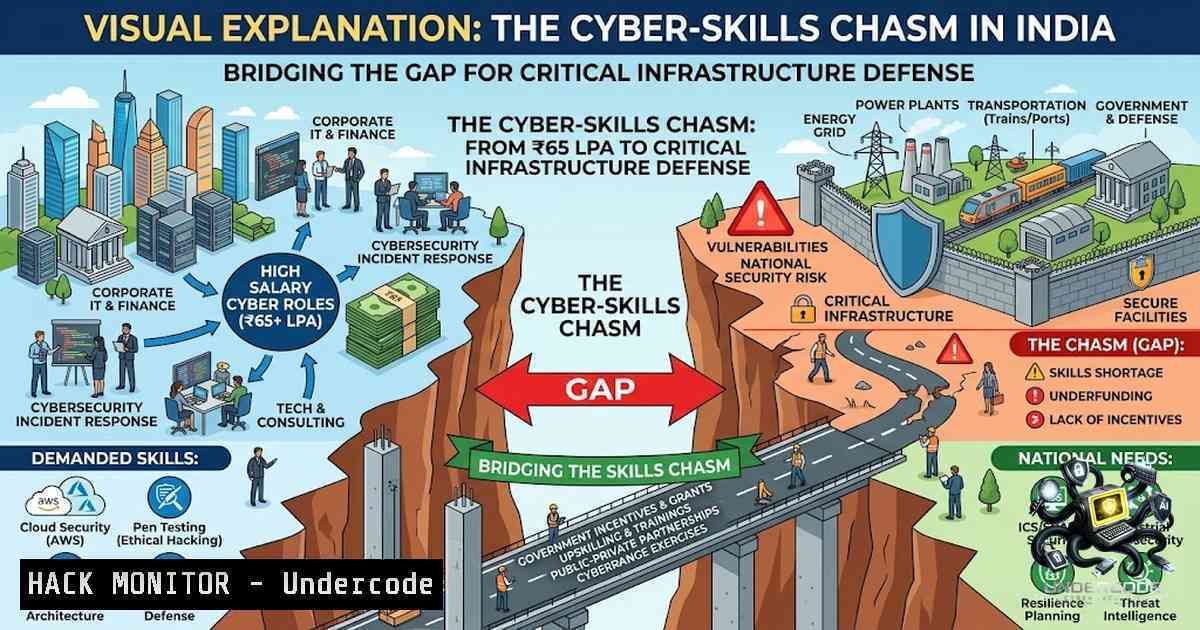
The Indian IT sector is currently experiencing a paradox; while job postings for cybersecurity and cloud roles surge, a critical skill shortage leaves enterprise networks dangerously exposed. This article transforms a standard recruitment list into a technical blueprint for engineers aiming to secure modern infrastructures, focusing on the practical hardening of DevOps pipelines, cloud-1ative environments, and endpoint systems. We dissect the required skills for roles like DevOps, Cloud, and SRE, moving beyond job titles to deliver actionable security configurations that command the premium ₹6.5–15 LPA salary bracket.
Learning Objectives:
- Implement a Zero-Trust architecture within a Kubernetes cluster using service meshes and network policies.
- Harden a multi-cloud (AWS/Azure/GCP) environment against common misconfigurations and API exploits.
- Automate security scanning in CI/CD pipelines to prevent vulnerable dependencies from reaching production.
You Should Know:
1. Hardening the DevOps Pipeline: Security as Code
The “DevOps Engineer” and “Site Reliability Engineer” roles are no longer just about uptime; they are the first line of defense against code-level intrusions. In 2026, a single compromised dependency in your `package.json` or `requirements.txt` can lead to a company-wide supply chain attack. To secure the pipeline, we must implement security gates that fail builds on critical vulnerabilities.
Step‑by‑step guide explaining what this does and how to use it:
Step 1: Integrate SAST (Static Application Security Testing)
Use open-source tools like Semgrep or SonarQube to scan source code for logic flaws and hardcoded secrets.
– Linux Command (Local Scan):
semgrep --config p/security-audit ./src
– CI/CD Integration (GitHub Actions):
- name: Semgrep Security Scan
uses: returntocorp/semgrep-action@v1
with:
config: p/security-audit
What this does: It parses the abstract syntax tree of your code to find injection points and insecure functions before runtime.
Step 2: Enforce SBOM (Software Bill of Materials)
Generate a list of all open-source components to check against the National Vulnerability Database (NVD).
– Command: `cyclonedx-bom -o bom.xml` to generate the SBOM.
– Windows (PowerShell) Alternative: Use `dotnet list package –vulnerable` for .NET environments to identify known vulnerabilities in NuGet packages.
2. Cloud Infrastructure Entitlement Management (CIEM)
The “Cloud Engineer – AWS / Azure / GCP” role demands more than just spinning up VMs; it requires mastering the principle of least privilege. The biggest threat in the cloud is over-permissioned service accounts. A compromised IAM role can lead to data exfiltration from S3 buckets or Azure Blob Storage.
Step‑by‑step guide explaining what this does and how to use it:
Step 1: Audit IAM Policies Programmatically
Use the AWS CLI to review policies attached to roles, identifying overly permissive actions (e.g., :).
– Linux/Windows CLI:
aws iam list-policies --only-attached --scope Local
aws iam get-policy-version --policy-arn <arn> --version-id <v1>
What this does: This enumerates active policies and checks for administrative access, flagging them for immediate remediation.
Step 2: Implement Resource-Based Policies
- Azure: Use Azure Policy to deny the creation of public-facing storage accounts.
{
"if": {
"field": "type",
"equals": "Microsoft.Storage/storageAccounts"
},
"then": {
"effect": "deny"
}
}
What this does: This prevents misconfigurations where developers accidentally expose sensitive data to the public internet.
3. API Security and Gateway Hardening
For “Full Stack” and “Backend Developers,” APIs are the new endpoints. OWASP API Top 10 (2026) highlights Broken Object Level Authorization (BOLA) and Excessive Data Exposure. Securing the API gateway is critical to prevent enumeration attacks where attackers manipulate IDs to view others’ data.
Step‑by‑step guide explaining what this does and how to use it:
Step 1: Implement Rate Limiting
Configure NGINX or a cloud-1ative gateway to throttle requests and prevent brute-force attacks on endpoints.
– NGINX Configuration (nginx.conf):
limit_req_zone $binary_remote_addr zone=api:10m rate=10r/m;
server {
location /api/ {
limit_req zone=api burst=5 nodelay;
proxy_pass http://backend;
}
}
What this does: This limits API calls to 10 requests per minute per IP address, mitigating DDoS and credential stuffing.
Step 2: Authentication Middleware Audit
Ensure your JWT validation includes the `aud` (audience) and `iss` (issuer) claims. Run a vulnerability scan on your REST APIs.
– Command: `zap-cli –target http://localhost:8080 quick-scan –spider`
What this does: This uses OWASP ZAP to spider the application and run an active scan looking for SQL injection and XSS flaws.
4. Securing the Database Administration Layer
“Database Administrators” handle the organization’s crown jewels. A misconfigured MongoDB or PostgreSQL instance is a prime target. Beyond patching, encryption at rest and in transit is non-1egotiable.
Step‑by‑step guide explaining what this does and how to use it:
Step 1: Encrypt Connections (TLS/SSL)
- PostgreSQL Configuration (
postgresql.conf):ssl = on ssl_cert_file = 'server.crt' ssl_key_file = 'server.key'
- Windows (SQL Server): Ensure `Force Encryption = Yes` in SQL Server Configuration Manager.
What this does: This ensures all data traveling between the application server and the database is encrypted, preventing MITM (Man-in-the-Middle) attacks.
Step 2: Audit Authentication Methods
Remove default credentials and disable `root` or `sa` remote logins. Implement role-based access control (RBAC) to restrict access to specific schemas.
- Incident Response for the IT Support / Network Engineer
The “System Administrator” and “Network Engineer” roles are on the front lines of incident detection. Knowing how to isolate a compromised host using network-level commands is vital.
Step‑by‑step guide explaining what this does and how to use it:
Step 1: Block Malicious IPs
- Linux (
iptables):iptables -A INPUT -s 192.168.1.100 -j DROP
- Windows Firewall (PowerShell):
New-1etFirewallRule -DisplayName "Block_IP" -Direction Inbound -RemoteAddress 192.168.1.100 -Action Block
What this does: This creates a rule that immediately drops packets from a suspicious IP.
Step 2: Kill Rogue Processes
- Linux: `pkill -f suspicious_script.py`
– Windows: `taskkill /IM malicious.exe /F`
What Undercode Say:
- Key Takeaway 1: The skill gap is not in coding proficiency but in secure coding. Employers are paying a premium for engineers who can write code that resists OWASP Top 10 attacks, particularly those who can validate inputs and implement proper authorization.
- Key Takeaway 2: The salary range of ₹6.5–15 LPA is a “base” for generalists. Specialists who can configure WAF rules, manage secrets with HashiCorp Vault, or implement eBPF-based security monitoring often command figures exceeding the upper bracket.
Analysis: The job listing highlights a demand for “DevOps” and “SRE” roles because these are the new security enforcers. In 2026, security is a distributed responsibility. The article emphasizes that knowing how to run a vulnerability scanner is insufficient; candidates must demonstrate they can respond to the “CVE-of-the-day” by patching production infrastructure without downtime. The focus on AI/ML and Data Engineering also points to the growing need to secure data pipelines against adversarial attacks and data poisoning.
Prediction:
- +1: Security automation will reach a parity where 60% of standard vulnerability patching will be handled by autonomous AI agents, reducing the burden on human engineers and increasing response times to zero-day exploits.
- -1: The widespread adoption of LLM-assisted coding will exponentially increase the volume of insecure code written, creating a “security debt” that will take years to clear and necessitate a massive hiring boom for security-specific remediation engineers.
- -1: A shortage of trained professionals for the “MLOps Engineer” role will lead to misconfigured ML environments, exposing proprietary models to the public internet and causing significant intellectual property theft in the next 18 months.
▶️ Related Video (88% Match):
🎯Let’s Practice For Free:
🎓 Live Courses & Certifications:
Join Undercode Academy for Verified Certifications
🚀 Request a Custom Project:
Secure, high-velocity infrastructure and disruptive technological engineering. Contact our engineering team for high-tier development and proprietary systems:
[email protected]
💎 Smart Architecture | 🛡️ Secure by Design | ⭐ Trusted by Thousands
IT/Security Reporter URL:
Reported By: Rajesh Raju – Hackers Feeds
Extra Hub: Undercode MoN
Basic Verification: Pass ✅


