Listen to this Post
Introduction:
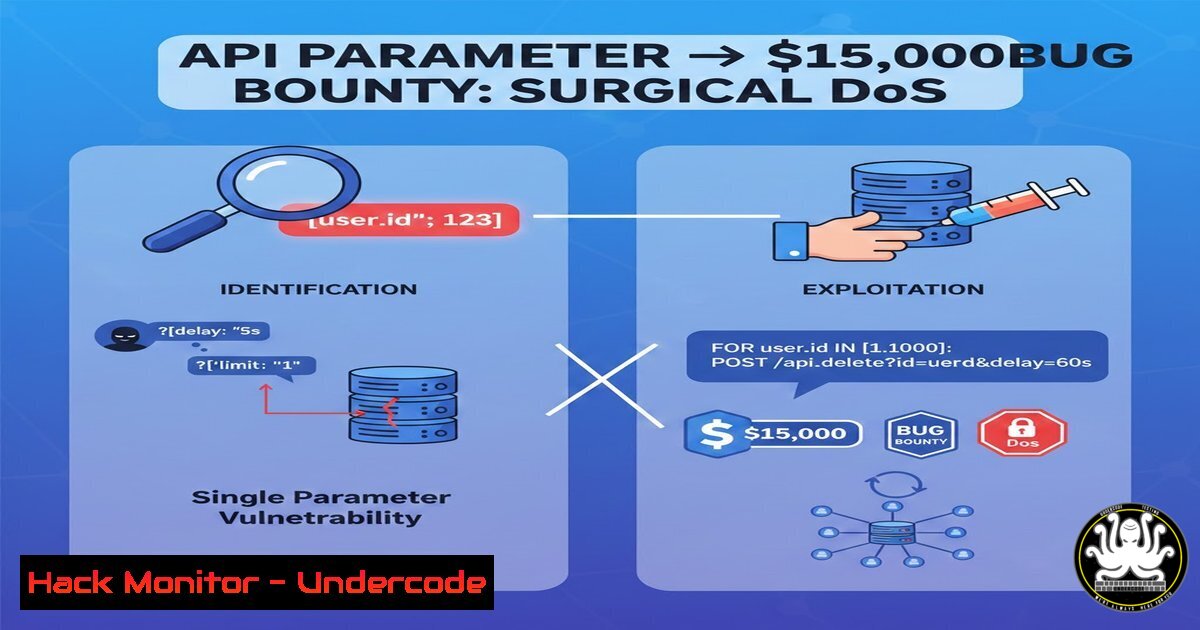
The era of brute-force Distributed Denial-of-Service (DDoS) attacks is being eclipsed by a more insidious threat: surgical Application Programming Interface (API) DoS attacks. These exploits don’t rely on massive bandwidth; they weaponize business logic flaws, where a single, carefully crafted request can cripple a backend by forcing it into a computationally exhaustive task. This modern attack vector, as demonstrated by security researchers landing significant bounties, requires a deep understanding of system architecture and is increasingly accelerated by artificial intelligence (AI) assisted reconnaissance.
Learning Objectives:
- Understand the fundamental difference between volumetric DDoS and logic-based API DoS attacks.
- Learn to identify common “logic leak” patterns in modern API endpoints.
- Integrate AI-assisted tools into a methodology for efficient vulnerability discovery.
You Should Know:
1. Deconstructing the “Logic Leak”: Beyond Brute Force
The core premise of a surgical API DoS is finding an endpoint where a small, valid input generates an exponentially large internal workload. Unlike flooding, this attack often looks like legitimate traffic, making it harder to detect and mitigate. It exploits flawed assumptions in application architecture, such as inefficient database queries, unconstrained graph traversal, or expensive server-side processing triggered by client input.
Think of an API endpoint GET /api/products?category=electronics. A normal request returns 100 products. However, if the parameter `category` is vulnerable to injection or triggers a recursive search without depth limits, a request like `GET /api/products?category=electronics’ OR ‘1’=’1` might force the database to join and scan every product table, exhausting CPU and memory.
2. The AI-Augmented Hunter’s Workflow
Manual API analysis is time-consuming. AI can dramatically speed up the reconnaissance phase. The workflow involves using tools to map the API surface, generate intelligent test cases, and highlight anomalous system responses.
Step-by-Step Guide:
- Step 1: Discovery & Mapping. Use tools like `katana` or `Burp Suite’s` crawler to enumerate all API endpoints.
Example using katana for deep discovery
katana -u https://target-api.com -o api_endpoints.txt
- Step 2: AI-Powered Analysis. Feed the endpoints into an AI security tool or a custom script using the `OpenAI API` or `Google Gemini API` to generate likely flawed parameter payloads. “Generate 10 test values for a ‘search’ parameter that might cause excessive database load or recursion.”
- Step 3: Targeted Fuzzing. Use a tool like `ffuf` with the AI-generated wordlist to probe for high-latency responses.
ffuf -w ai_payloads.txt -u https://target-api.com/api/search?query=FUZZ -t 50 -p 1.0 -mr "some_product" -H "Authorization: Bearer <token>"
Monitor response times; a significant delay indicates a potential logic leak.
3. Exploiting Query Parameter Catastrophes
One common pattern is parameter pollution or injection that leads to Cartesian products in database queries.
Step-by-Step Guide:
- Step 1: Identify multi-parameter endpoints. Look for endpoints with filters:
/api/users?role=admin&department=sales&status=active. - Step 2: Test for OR-based logic leaks. Send a payload that broadens the search unintentionally.
GET /api/users?role=admin' OR '1'='1&department=sales' OR '1'='1&status=active' OR '1'='1
- Step 3: Observe Database Load. If the application concatenates these parameters with `AND` but your injection changes it to
OR, the query might scan the entire user table multiple times. Use timing attacks to confirm.time curl -s "https://target.com/api/users?role=admin&department="
4. Weaponizing Batch Operations and Nested Objects
APIs that accept arrays or complex JSON objects are prime targets. An endpoint designed to fetch details for 10 items might break when sent 10,000.
Step-by-Step Guide:
- Step 1: Find Batch Endpoints. Look for `POST /api/products/details` with a body like
{"productIds": [101, 102]}. - Step 2: Craft a Malicious Payload. Send an array with an excessive number of IDs, or nested objects that trigger recursive processing.
{ "productIds": [1,2,3, ... , 10000] } - Step 3: Test for Recursion. If the API fetches related data for each item, the workload compounds. Also, test for recursive object references (e.g.,
"parent": {"child": {"parent": ...}}).
5. GraphQL and The Deep Query Problem
GraphQL APIs are particularly susceptible if they lack depth limiting. Attackers can request deeply nested relationships in a single query.
Step-by-Step Guide:
- Step 1: Introspect the Schema. Use a standard GraphQL introspection query to map available types and relationships.
- Step 2: Craft a Nested Query. Build a query that traverses relationships many levels deep.
query { users { posts { comments { author { posts { comments { ... Repeat many levels deep } } } } } } } - Step 3: Mitigation (For Defenders). Implement query cost analysis, depth limiting (e.g., using
graphql-depth-limit), and pagination.
- Windows & Linux: Simulating and Mitigating the Attack
From a defender’s perspective, you need to identify these attacks in your logs.
Step-by-Step Guide for Detection:
- On Linux (using log analysis with
awk): Parse API logs for requests with high execution time.Analyze NGINX logs for slow requests (>5 seconds) awk '$NF > 5 {print $1, $7, $NF}' /var/log/nginx/access.log | sort -k3 -nr | head -20 - On Windows (using PowerShell): Query Event Logs or application logs for similar patterns.
Get-WinEvent -LogName "Application" | Where-Object {$<em>.TimeCreated -lt (Get-Date).AddMinutes(-5) -and $</em>.Message -like "LongRunningQuery"} | Select-Object -First 10
- Building Defensive Logic: Rate Limiting and Work Estimators
Traditional rate limiting (requests/second) fails against surgical DoS. You must implement logic-aware limits.
Step-by-Step Guide for Defenders:
- Step 1: Implement Complexity Scoring. Assign a “cost” to different query parameters, array sizes, and query depths.
- Step 2: Enforce Limits per Request. Reject requests exceeding a predefined computational cost threshold.
- Step 3: Use Web Application Firewalls (WAF) with API Security. Configure rules to block excessively deep GraphQL queries or abnormally large batch operations. Tools like `ModSecurity` with OWASP Core Rule Set can be tuned for this.
What Undercode Say:
- The Hunter’s Edge is Architectural Empathy. The most successful bounty hunters don’t just throw payloads; they mentally reverse-engineer the developer’s intended data flow to find where it fractures under edge cases. AI now acts as a force multiplier for this cognitive process, generating hypotheses at scale.
- Defense Must Shift Left to Design. Mitigating these flaws cannot be bolted on later. Security must be integrated into the API design phase, enforcing strict limits on query complexity, mandating pagination, and incorporating cost analysis directly into the development lifecycle. The battle is now fought at the whiteboard, not just at the firewall.
Prediction:
The convergence of AI-powered offensive tooling and the proliferation of complex, interconnected APIs will create a new wave of stealthy, high-impact outages. In the next 2-3 years, we will see a significant rise in business logic-based DoS incidents that bypass traditional cloud DDoS protections. This will force a paradigm shift in defensive security, driving the widespread adoption of real-time API workload costing and AI-powered anomaly detection that understands application semantics, not just network traffic patterns. The role of the security engineer will increasingly involve modeling and stress-testing the logical boundaries of their own systems.
▶️ Related Video (76% Match):
🎯Let’s Practice For Free:
IT/Security Reporter URL:
Reported By: Shay Hagai – Hackers Feeds
Extra Hub: Undercode MoN
Basic Verification: Pass ✅


