Listen to this Post
Introduction:
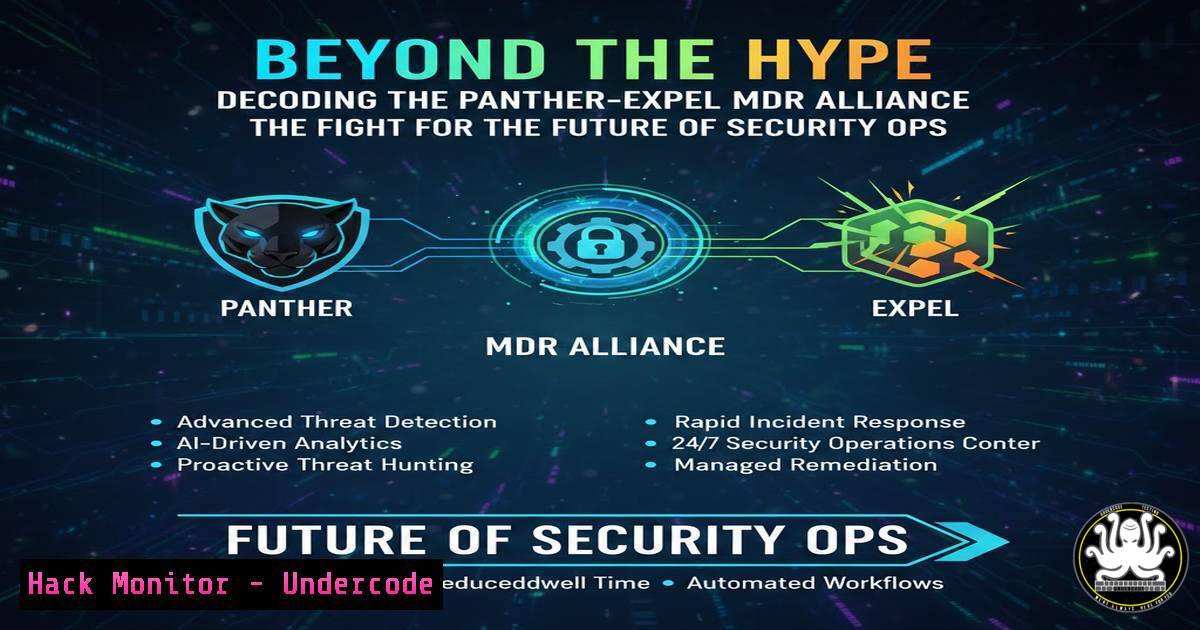
The recent integration between Panther’s cloud-native SIEM and Expel’s Managed Detection and Response (MDR) service is more than a simple partnership; it is a strategic maneuver in a high-stakes market facing existential pressure. As the global MDR sector grows at a CAGR of over 21% , providers are scrambling to solve a core dilemma: scaling detection quality and analysis amidst a crippling talent shortage and the rise of AI-driven autonomous security platforms . This alliance offers a glimpse into the next evolution of SecOps—a shift from centralized data lakes to federated, intelligent control planes.
Learning Objectives:
- Understand the technical architecture and operational benefits of the native Panther-Expel integration.
- Analyze the systemic limitations of traditional MDR that are driving industry innovation.
- Evaluate the emerging concepts of SecOps Mesh and AI SOCs as the future competitive landscape.
You Should Know:
1. The Architecture: From Polling to Event-Driven Integration
The technical core of this partnership is a shift from inefficient, delayed polling to an instant, event-driven workflow. Panther now delivers enriched alerts directly to Expel’s platform in real-time using a native webhook-based alert destination. When a detection rule fires, Panther sends an authenticated payload containing the alert and sampled event data for immediate context. This architectural decision reflects a modern “separation of concerns”: Panther acts as the scalable, code-defined detection engine, while Expel consumes these high-fidelity signals for human-led triage and response.
Step‑by‑step guide to the alert flow:
- Detection in Panther: A Python-based detection-as-code rule, such as one looking for anomalous AWS CloudTrail `ConsoleLogin` events without MFA, executes against ingested log data.
- Alert Generation: Upon a rule match, Panther creates an enriched alert. This includes the rule metadata, severity, and key event fields (e.g., user identity, source IP, timestamp).
- Event-Driven Dispatch: Panther immediately pushes this structured alert payload via a secure HTTPS webhook to a pre-configured endpoint in Expel’s platform. This eliminates the latency inherent in systems that rely on Expel periodically querying Panther’s API.
- Contextual Triage: Expel’s security analysts receive the alert within their interface with full context. They can leverage Expel’s own curated detection logic and, crucially, use Panther as an investigative resource to run deeper queries if needed.
- Response Orchestration: Expel manages the response, which may involve engaging the customer’s team, executing predefined playbooks, or initiating containment actions, all while maintaining sub-20-minute response time commitments.
-
Solving the MDR “Dirty Secret”: The Scale and Quality Challenge
The announcement hints at a “dirty secret” in the MDR market: the inability to scale detection quality. This is a well-documented industry pain point. Traditional MDR struggles with inconsistent analyst-led triage, slow escalation times, and “alert regurgitation”—where low-context alerts are passed back to the customer because the MDR lacks the depth to investigate. The Panther-Expel model attacks this by improving the input quality to analysts. By leveraging Panther’s strength in handling massive, cloud-scale data with precise detection logic, Expel analysts receive fewer, more relevant, and context-rich alerts. This transforms their role from basic triage to focused investigation, effectively scaling their effectiveness. -
The Strategic Pivot: Embracing a “Bring-Your-Own-Tech” (BYOT) Model
This integration is a clear endorsement of a “bring-your-own-technology” philosophy, a necessity in today’s heterogeneous cloud environments. For years, a standard MDR model involved ingesting all customer data into the provider’s own data lake or SIEM. This is now often impractical due to data gravity, sovereignty laws, and egress costs. The modern approach, exemplified here, is for the MDR to act as an orchestrator. Expel delivers its service within the customer’s chosen stack (Panther), deploying its detection content, monitoring alerts, and conducting investigations without requiring costly data duplication. This is a fundamental shift from being a platform competitor to becoming a platform accelerator. -
The Looming Disruption: The Rise of the AI SOC and Autonomous Control Planes
This partnership occurs against the backdrop of a more profound shift: the emergence of AI-powered Security Operations Centers (AI SOCs). These platforms aim to automate the investigative heavy lifting, using Large Language Models (LLMs) and behavioral analysis to correlate data, explain threats, and even generate new detection logic in seconds. They promise to address MDR’s human-scale limitations by offering instant, consistent, and transparent investigation at machine speed. The Panther-Expel integration can be seen as a hybrid step—enhancing human analysts with superior tooling—while the industry grapples with a future where AI agents may autonomously manage large portions of the detection-and-response loop. -
Building Your Own SecOps Mesh: The Concept of a Federated Control Plane
The future battleground may be the “control plane.” Visionary analyses suggest the MDR platform of tomorrow will not be a data lake, but a technology-agnostic control plane. This SecOps Mesh would feature:
Zero-Copy Detections: Analytics that query data in place via APIs (e.g., in the customer’s cloud tenant or SIEM) instead of copying it.
Operate-in-Place Playbooks: Automated response actions executed natively within the customer’s security tools (e.g., isolating a host via CrowdStrike or blocking an IP in a firewall).
A Federated View: A single pane of glass for managing posture, detections, and cases across diverse customer environments and vendors.
The Panther-Expel integration, with its API-driven, in-place operation, is a step toward this distributed architecture, moving away from the monolithic, centralized MDR platform of the past. -
Detection Engineering Transformed: From Artisanal Craft to AI-Augmented Code
Detection engineering—the craft of writing threat-hunting rules—is the core intellectual property of any MDR. Traditionally, it’s a slow, manual process prone to decay as attacker techniques evolve. The integration highlights a modern, code-first approach (Panther’s detection-as-code), but the next frontier is AI-augmentation. Forward-looking AI SOC platforms demonstrate how LLMs can generate draft detection rules from threat reports, automatically test them against telemetry, and adapt logic to minimize noise. This transforms detection engineering from a reactive art into a continuous, self-improving capability, a necessary evolution to defend against AI-augmented attacks.
What Undercode Say:
- Key Takeaway 1: The Panther-Expel integration is a tactical solution to a strategic problem. It directly addresses the immediate MDR pain points of alert quality and operational efficiency by creating a seamless, event-driven pipeline between best-of-breed tools. This delivers tangible value: faster MTTR, predictable costs, and preserved customer control.
- Key Takeaway 2: This partnership is a canary in the coal mine for the entire MDR industry. It validates the critical trends of BYOT adoption, distributed SecOps mesh architectures, and the urgent need to augment human analysts with superior automation and AI. Providers that cling to legacy, centralized data-ingestion models will find themselves increasingly irrelevant.
Analysis:
This move is less about Panther versus Splunk and more about defining the rules of engagement for the next decade of security operations. The market is bifurcating. On one path are traditional MDRs, enhancing human-led services with better integrations. On the other are nascent AI SOCs, betting on autonomous machine-speed analysis. The Panther-Expel model represents a sophisticated middle path—leveraging a highly automated, code-driven detection engine to empower human experts. However, it does not fully resolve the fundamental scalability limits of human cognition. The long-term victory will likely go to those who can most effectively and trustworthily blend deterministic forensic analysis (ground truth) with AI’s reasoning and automation scale, creating a truly resilient and adaptive security operation that can outpace both threat actors and legacy incumbents.
Prediction:
Within three to five years, the MDR market will undergo a significant stratification. “Legacy MDR” services, relying heavily on manual labor and centralized data, will become commoditized, competing largely on price. The premium tier will be dominated by “AI-Augmented MDR” providers (evolving from partnerships like Panther-Expel) and native “AI SOC” platforms. The winners will be those that successfully build and orchestrate the intelligent, federated control plane, making the underlying data location and tooling vendor irrelevant to security outcomes. The integration of deterministic security analytics with explainable, context-aware AI will become the new gold standard, rendering today’s debates about SIEM choice secondary to the intelligence of the operational layer above it.
▶️ Related Video (74% Match):
🎯Let’s Practice For Free:
IT/Security Reporter URL:
Reported By: Whlowe The – Hackers Feeds
Extra Hub: Undercode MoN
Basic Verification: Pass ✅


