Listen to this Post
Introduction
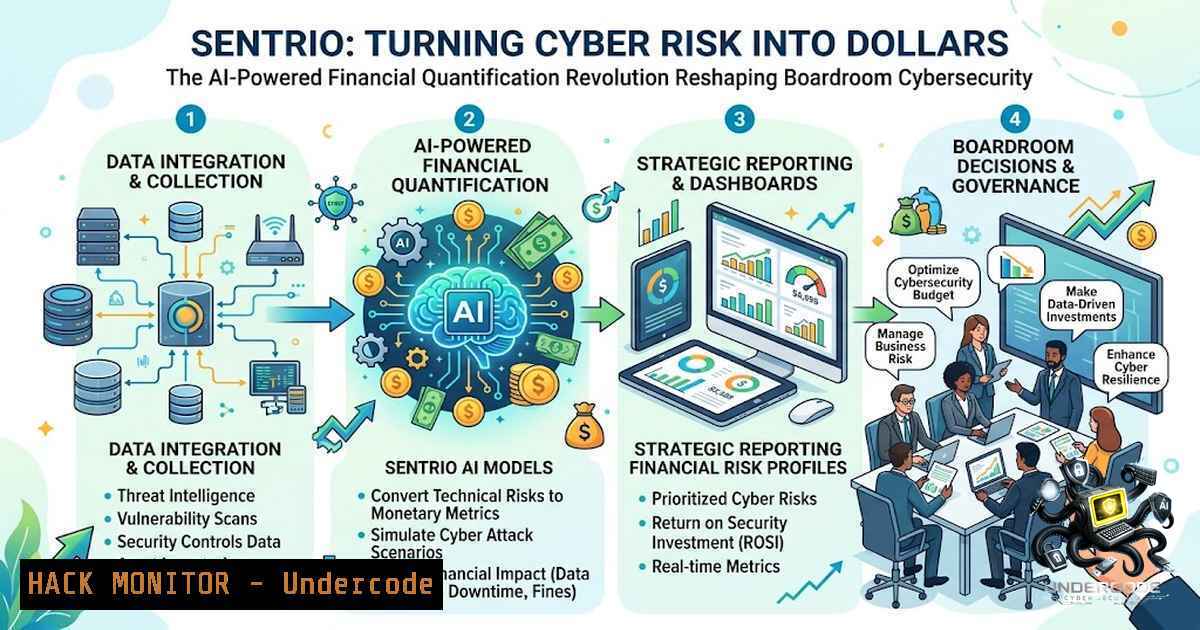
For decades, cybersecurity has been treated as a cost center—an operational necessity measured in technical metrics like CVSS scores, patch counts, and mean time to detection. But a fundamental shift is underway. The SEC’s 2023 cybersecurity disclosure rules (effective December 2023, with full compliance deadlines extending into 2026) now require public companies to disclose material cybersecurity incidents within four business days and articulate risk in financial terms that investors understand. Enter Sentrio, an AI platform led by CEO Ivan Lendner that translates cyber risk into dollar-denominated exposure, telling security and finance leaders exactly what a specific cyber scenario would cost the business—and which security investments cut the most risk per dollar spent. This article explores the technical underpinnings of cyber risk quantification (CRQ), provides hands-on implementation guidance, and examines how AI platforms like Sentrio are transforming cybersecurity from a cost center into a strategic investment vehicle.
Learning Objectives
- Understand the FAIR (Factor Analysis of Information Risk) methodology for quantifying cyber risk in financial terms, including loss event frequency, loss magnitude, and Annualized Loss Expectancy (ALE) calculations.
- Master SEC compliance requirements for cybersecurity incident disclosure under Form 8-K Item 1.05, including materiality determination and the four-business-day clock.
- Implement practical cyber risk quantification using open-source tools, Python libraries, and command-line utilities to calculate ROI on security investments.
- Deploy AI-powered risk platforms and integrate them with existing security infrastructure for continuous, board-ready financial risk reporting.
- The FAIR Model: Decomposing Cyber Risk into Dollars
The Factor Analysis of Information Risk (FAIR) model, developed by Jack Jones and maintained by the FAIR Institute, is the only international standard quantitative model for information security and operational risk. Unlike qualitative risk assessments that produce color-coded charts or numerical weighted scales, FAIR quantifies risk in financial terms, enabling data-driven decision-making.
Core Components of FAIR
FAIR decomposes risk into two primary factors:
Loss Event Frequency = The number of times an event is likely to occur within a specific period, derived from:
– Threat event frequency: How often a specific threat is likely to occur
– Vulnerability: The likelihood the threat would cause loss, based on the threat’s capabilities and the asset’s defenses
Loss Magnitude = The severity (scope and impact) of an event, comprising:
– Primary loss: Operational and financial costs directly caused by the threat actor or the organization’s response (asset repair, ransomware payments, lost productivity, incident response)
– Secondary loss: Operational and financial costs arising from third-party reactions (regulatory fines, data exposure notifications, reputational damage)
Calculating Annualized Loss Expectancy (ALE)
The foundational formula is:
ALE = (Asset Value × Exposure Factor) × Annual Rate of Occurrence (ARO)
Where:
- Asset Value = Total value of the asset at risk (USD)
- Exposure Factor = Fraction of asset value lost per incident (0.0–1.0)
- ARO = Number of incidents expected per year
Hands-On: Python Implementation
The `cyber-ale-calculator` library provides a production-ready implementation of FAIR methodology:
Installation:
pip install cyber-ale-calculator
Python Example:
from cyber_ale_calculator import calculate_ale, calculate_risk_reduction, risk_rating

Calculate ALE for a $2M database server with 40% exposure to ransomware,
 occurring approximately 0.75 times per year
ale = calculate_ale(asset_value=2_000_000, exposure_factor=0.4, aro=0.75)
print(f"Annual Loss Expectancy: ${ale:,.0f}")  $600,000

Evaluate an EDR tool that reduces ALE from $600K to $90K at $120K/year
result = calculate_risk_reduction(ale_before=600_000, ale_after=90_000,
control_cost=120_000)
print(f"Net benefit: ${result['net_benefit']:,.0f}")  $390,000
print(f"ROI: {result['roi_percent']:.0f}%")  325%
print(f"Payback: {result['payback_months']:.1f} months")  2.8 months
print(f"Risk tier: {risk_rating(ale)}")  medium
JavaScript Equivalent:
const { calculateAle, calculateRiskReduction, riskRating } =
require("cyber-ale-calculator");

const ale = calculateAle(2_000_000, 0.4, 0.75);
console.log(<code>Annual Loss Expectancy: $${ale.toLocaleString()}</code>); // $600,000

const result = calculateRiskReduction(600_000, 90_000, 120_000);
console.log(<code>ROI: ${result.roiPercent.toFixed(0)}%</code>); // 325%
Command-Line FAIR Analysis
For practitioners preferring CLI tools, the `evidentia` tool supports Open FAIR quantification:
 Install evidentia (if available) or use OpenFAIR Python tool
python3 openfair_calculator.py --asset "Customer Database" \
--threat "Ransomware" \
--output risk_report.json
Windows Threat Exposure Assessment
 Quick vulnerability assessment with built-in Windows tools
Get-HotFix | Select-Object HotFixID, InstalledOn
Get-WmiObject -Class Win32_LogicalDisk | Select-Object DeviceID, Size, FreeSpace

Export system information for risk analysis
systeminfo > system_audit.txt
Linux Vulnerability Scanning
 Quick vulnerability scan with Nmap
nmap --script vuln -Pn <target_IP>

List all listening services for asset inventory
sudo ss -tulpn | grep LISTEN

Check for known vulnerabilities in installed packages (Debian/Ubuntu)
sudo apt list --upgradable
 RHEL/CentOS/Fedora
sudo yum list updates
2. SEC Compliance: The Four-Day Materiality Clock
The SEC’s cybersecurity disclosure rules (Release Nos. 33-11216; 34-97989) require public companies to disclose material cybersecurity incidents on Form 8-K Item 1.05 within four business days of determining that an incident is material. This has profound implications for how organizations must quantify and report cyber risk.
Understanding Materiality in 2026
Materiality under Item 1.05 is not purely operational impact—it is whether a reasonable investor would consider the incident important in making an investment decision, factoring qualitative harms (reputation, customer confidence, regulator attention) alongside quantitative losses. The SEC’s Division of Corporation Finance consistently asks two questions in 2026 comment letters:
- What was the materiality analysis—documented contemporaneously, with named decision-makers—and why did it conclude the way it did?
- Where is the connective tissue between the incident and the registrant’s Item 106 disclosures about governance, risk management, and third-party oversight?
Building a Defensible Materiality Memo
A competent Item 1.05 filing typically states:
- When the registrant determined the incident was material
- The nature, scope, and timing of the incident
- The material impact or reasonably likely material impact on the registrant’s financial condition and operations
4. Any amendments expected as facts develop
Practical Implementation:
 Example: Automated materiality assessment using FAIR-derived metrics
def assess_materiality(ale_before, ale_after, revenue, materiality_threshold=0.05):
"""
Determine if a security incident is material based on financial impact.
SEC guidance suggests materiality thresholds typically span 4%-10% of revenue.
"""
financial_impact = ale_before - ale_after
impact_percentage = financial_impact / revenue
is_material = impact_percentage >= materiality_threshold

return {
"financial_impact": financial_impact,
"impact_percentage": impact_percentage,
"is_material": is_material,
"recommendation": "File Form 8-K Item 1.05" if is_material else "Monitor and reassess"
}

Example usage
revenue = 500_000_000  $500M annual revenue
ale_before = 12_000_000  $12M ALE before mitigation
ale_after = 3_000_000  $3M ALE after mitigation

result = assess_materiality(ale_before, ale_after, revenue)
print(f"Financial Impact: ${result['financial_impact']:,.0f}")
print(f"Impact Percentage: {result['impact_percentage']:.2%}")
print(f"Material: {result['is_material']}")
3. AI-Powered Cyber Risk Quantification Platforms
Platforms like Sentrio, Kovrr, and Quantara AI are automating CRQ by ingesting security data, correlating threats with business context, and producing dollar-denominated risk metrics.
How AI CRQ Platforms Work
Quantara AI’s approach exemplifies the architecture:
- Connect & Unify: Ingests and consolidates cyber, business, and threat data
- Correlate Exposure: Maps vulnerabilities, control maturity, threats, and loss trends using sources like Known Exploited Vulnerabilities (KEV), industry data, and business profiles
- Quantify Impact ($VaR): Converts exposures into dollar-denominated Value at Risk using real-time threat and financial loss data
- Recommend & Align: Prioritizes mitigation actions by ROI and Risk Reduction Impact (RRI), aligned to ERM frameworks
API Integration Example
 Example: Querying a CRQ platform API for risk assessment
curl -X POST https://api.crq-platform.com/v1/assess \
-H "Authorization: Bearer ${API_KEY}" \
-H "Content-Type: application/json" \
-d '{
"assets": ["customer_database", "payment_system"],
"threats": ["ransomware", "data_breach"],
"controls": ["EDR", "MFA", "encryption"]
}'
Python Integration
import requests
import json

def assess_cyber_risk(api_key, assets, threats, controls):
url = "https://api.crq-platform.com/v1/assess"
headers = {
"Authorization": f"Bearer {api_key}",
"Content-Type": "application/json"
}
payload = {
"assets": assets,
"threats": threats,
"controls": controls
}
response = requests.post(url, headers=headers, json=payload)
return response.json()

Example usage
risk_report = assess_cyber_risk(
api_key="YOUR_API_KEY",
assets=["customer_database", "payment_system"],
threats=["ransomware", "data_breach"],
controls=["EDR", "MFA", "encryption"]
)

print(f"VaR: ${risk_report['value_at_risk']:,.0f}")
print(f"Top Risk: {risk_report['top_risks'][bash]['scenario']}")
4. Calculating Return on Security Investment (ROSI)
Cyber risk quantification enables security leaders to calculate Return on Security Investment (ROSI)—the financial value of security spending measured by avoided losses against costs.
ROSI Formula
ROSI = (Reduction in Risk $ - Cost of Control) / Cost of Control
Where Reduction in Risk is the difference between ALE before and after implementing a control.
Practical Example: EDR Investment
from cyber_ale_calculator import calculate_ale, calculate_risk_reduction

Scenario: EDR tool evaluation
asset_value = 5_000_000  $5M in critical assets
exposure_factor = 0.35  35% exposure to ransomware
aro = 0.6  0.6 incidents per year

ALE before mitigation
ale_before = calculate_ale(asset_value, exposure_factor, aro)
print(f"ALE before: ${ale_before:,.0f}")  $1,050,000

ALE after EDR implementation (75% reduction)
ale_after = ale_before  0.25

EDR cost: $150,000/year
result = calculate_risk_reduction(ale_before, ale_after, 150_000)
print(f"Net benefit: ${result['net_benefit']:,.0f}")  $637,500
print(f"ROI: {result['roi_percent']:.0f}%")  425%
print(f"Payback: {result['payback_months']:.1f} months")  2.1 months
Linux Command: ROI Calculation Script
!/bin/bash
 cyber_roi.sh - Calculate cybersecurity investment ROI

ALE_BEFORE=1050000
ALE_AFTER=262500
CONTROL_COST=150000

Calculate ROI
REDUCTION=$((ALE_BEFORE - ALE_AFTER))
ROI=$(echo "scale=2; ($REDUCTION - $CONTROL_COST) / $CONTROL_COST  100" | bc)
echo "Risk Reduction: \$${REDUCTION}"
echo "ROI: ${ROI}%"
Windows PowerShell: ROI Calculation
 cyber_roi.ps1
$aleBefore = 1050000
$aleAfter = 262500
$controlCost = 150000

$reduction = $aleBefore - $aleAfter
$roi = (($reduction - $controlCost) / $controlCost)  100

Write-Host "Risk Reduction: $${reduction:N0}"
Write-Host "ROI: $($roi.ToString('F2'))%"
- NIST CSF 2.0 Integration with Cyber Risk Quantification
NIST CSF 2.0, released in February 2024, introduces the Govern function, which explicitly assigns risk quantification and visibility to governance structures. CRQ platforms like Sentrio align with NIST CSF 2.0 by providing quantified financial metrics that support board-level reporting.
Mapping FAIR to NIST CSF 2.0 Functions
| NIST CSF 2.0 Function | FAIR Integration |
|-||
| Govern (GV) | Risk quantification in financial terms; materiality assessment |
| Identify (ID) | Asset valuation, threat event frequency estimation |
| Protect (PR) | Control effectiveness measurement (FAIR-CAM) |
| Detect (DE) | Threat event frequency monitoring |
| Respond (RS) | Incident cost estimation (primary/secondary loss) |
| Recover (RC) | Business continuity cost-benefit analysis |
Implementation: NIST CSF 2.0 Risk Assessment Automation
 nist_csf_quantification.py
class NISTCSFQuantifier:
def <strong>init</strong>(self, asset_inventory, threat_intel):
self.assets = asset_inventory
self.threats = threat_intel

def assess_govern(self):
"""GV function: Quantify risk in financial terms"""
total_vulnerability = sum(a['value']  a['exposure'] for a in self.assets)
total_threat_frequency = sum(t['frequency'] for t in self.threats)
ale = total_vulnerability  total_threat_frequency
return {"ale": ale, "risk_appetite_aligned": ale < self.risk_appetite}

def assess_identify(self):
"""ID function: Asset valuation and threat identification"""
return {
"total_asset_value": sum(a['value'] for a in self.assets),
"top_threats": sorted(self.threats, key=lambda t: t['frequency'], reverse=True)[:3]
}
6. Board-Ready Cyber Risk Reporting
AI-powered CRQ platforms generate board-ready reports that translate technical findings into financial terms. Sentrio’s value proposition is particularly compelling for companies in regulated industries where boards and SEC disclosure rules now require risk to be stated in financial terms.
Report Structure for Executive Presentations
- Executive Summary: Total dollar exposure, risk appetite alignment
- Top Risk Scenarios: Ranked by financial impact with probability ranges
- Control Effectiveness: ROI of current and proposed controls
4. SEC Materiality Assessment: Incidents meeting materiality thresholds
- Investment Recommendations: Prioritized by risk reduction per dollar
Automated Reporting Script
 generate_board_report.py
def generate_board_report(risk_data, output_format="html"):
"""
Generate board-ready cyber risk report from quantified data.
"""
report = {
"executive_summary": {
"total_exposure": f"${risk_data['total_ale']:,.0f}",
"risk_appetite": f"${risk_data['risk_appetite']:,.0f}",
"gap": f"${risk_data['total_ale'] - risk_data['risk_appetite']:,.0f}"
},
"top_risks": [
{
"scenario": r['scenario'],
"financial_impact": f"${r['ale']:,.0f}",
"probability": f"{r['probability']:.1%}"
}
for r in risk_data['scenarios'][:5]
],
"control_roi": [
{
"control": c['name'],
"roi": f"{c['roi']:.0f}%",
"payback_months": f"{c['payback']:.1f}"
}
for c in risk_data['controls']
]
}
 Format and output
return report
What Undercode Say
- Cyber risk is now a financial reporting obligation, not just a technical concern. The SEC’s four-day disclosure rule means organizations must have quantifiable, defensible risk metrics ready at all times. Platforms like Sentrio provide the bridge between security telemetry and boardroom accountability.
-
AI-powered quantification transforms cybersecurity from a cost center into a strategic investment. By calculating ROI in dollar terms, security leaders can justify budgets with the same rigor as any other business function. A 325% ROI on an EDR investment (as demonstrated in our Python example) speaks louder than any technical metric.
-
The FAIR methodology provides the mathematical foundation for defensible risk quantification. With open-source tools like `cyber-ale-calculator` and
pycrq, organizations can implement FAIR without vendor lock-in, ensuring transparency and reproducibility. -
Integration with NIST CSF 2.0’s Govern function is becoming a compliance requirement. Boards are now explicitly accountable for cyber oversight, and quantified risk metrics are essential for fulfilling this duty.
-
The convergence of AI, regulatory pressure, and financial quantification is reshaping the cybersecurity industry. Companies that fail to adopt CRQ will struggle to meet SEC requirements, justify security spending, and communicate risk effectively to stakeholders.
Prediction
+1 The SEC’s cybersecurity disclosure rules will drive widespread adoption of AI-powered CRQ platforms by 2027, with the market for cyber risk quantification software exceeding $5 billion annually.
+1 Open-source FAIR implementations will become standard components of security toolchains, enabling smaller organizations to implement quantified risk management without enterprise software budgets.
-1 Organizations that delay CRQ adoption face increased regulatory scrutiny and potential enforcement actions. The SEC’s 2025-2026 comment letters demonstrate that “glowing” cybersecurity disclosures without quantified materiality analysis are no longer acceptable.
+1 Cyber insurance underwriters will increasingly require quantified risk assessments (VaR, ALE) as a condition for coverage, creating a new market for CRQ-as-a-service.
-1 The four-business-day disclosure clock creates significant operational pressure. Organizations without automated materiality assessment capabilities risk either under-disclosing (inviting SEC enforcement) or over-disclosing (triggering unnecessary market reactions).
+1 The integration of FAIR with MITRE ATT&CK and NIST CSF 2.0 will produce standardized, interoperable risk quantification frameworks, enabling industry-wide benchmarking and best practice sharing.
▶️ Related Video (76% Match):
🎯Let’s Practice For Free:
🎓 Live Courses & Certifications:
Join Undercode Academy for Verified Certifications
🚀 Request a Custom Project:
Secure, high-velocity infrastructure and disruptive technological engineering. Contact our engineering team for high-tier development and proprietary systems:
[email protected]
💎 Smart Architecture | 🛡️ Secure by Design | ⭐ Trusted by Thousands
IT/Security Reporter URL:
Reported By: Fuelaccelerator Cybersecurity – Hackers Feeds
Extra Hub: Undercode MoN
Basic Verification: Pass ✅


