Listen to this Post
Introduction
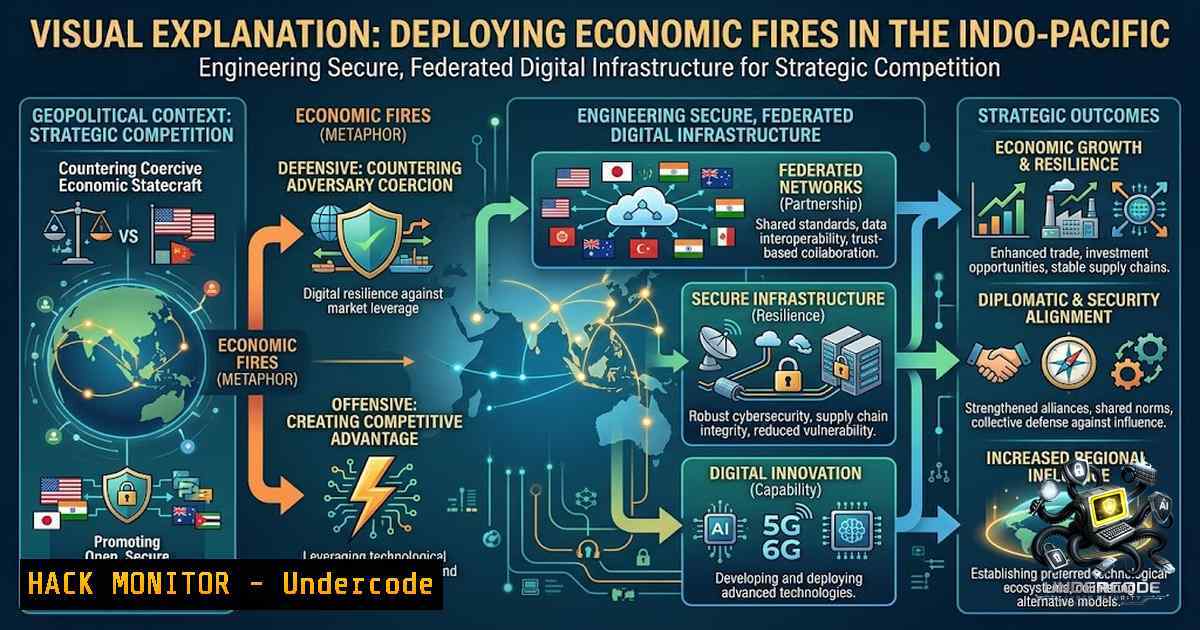
In an era where strategic competition is defined by data superiority and decision speed, the concept of “economic fires”—rapid, turn-key capabilities that solve existential sovereign issues—has emerged as a critical framework for countering autocratic co-optation. The digital front line of this competition demands more than traditional military deterrence; it requires secure, federated communication fabrics, AI-accelerated information operations, and resilient infrastructure that preserves partner nation sovereignty while enabling real-time coalition coordination. This article explores the technical architecture, cybersecurity implementations, and operational frameworks necessary to deploy economic fires at tactical speed across the Indo-Pacific theater.
Learning Objectives
- Understand the architecture and implementation of Zero Trust Mission Partner Environments (MPEs) and federated communication fabrics
- Master secure AI deployment strategies for translation, information operations, and threat detection in coalition environments
- Implement data-centric security controls, Attribute-Based Access Control (ABAC), and post-quantum cryptography readiness
- Develop operational procedures for rapid coalition formation and secure data sharing across sovereign boundaries
You Should Know
- Zero Trust Architecture and the INDOPACOM Mission Network (IMN)
The INDOPACOM Mission Network (IMN) represents a paradigm shift from perimeter-based security to data-centric protection. Rather than treating cybersecurity like a medieval castle with thick walls and deep moats, the IMN assumes all networks are compromised and requires constant authentication and authorization. During Exercise Balikatan 2026, the IMN successfully linked forces from Australia, Canada, Japan, New Zealand, the Philippines, and the U.S. across combined operations, demonstrating real-world viability.
Step-by-Step Implementation Guide:
- Deploy Attribute-Based Access Control (ABAC): Implement ABAC to enforce data access based on user attributes, environmental conditions, and resource classifications rather than static roles. This ensures that even if the network is compromised, data remains protected.
-
Implement Data-Centric Security: Focus on protecting data in motion, not just at rest. Use encryption at the data level with granular access controls that travel with the data itself.
-
Establish Zero Trust Overlays: Combine SD-WAN and Commercial Solutions for Classified (CSfC) to create global self-healing, Zero Trust overlays with crypto agility and post-quantum cryptography readiness.
-
Build Hybrid Cloud Architecture: Design containerized systems capable of future cloud migration, ensuring flexibility and scalability.
Linux Command Example – Implementing ABAC with OpenPolicyAgent (OPA):
 Install OPA
curl -L -o opa https://openpolicyagent.org/downloads/latest/opa_linux_amd64
chmod 755 ./opa
sudo mv opa /usr/local/bin/

Create a policy file (policy.rego)
cat > policy.rego << 'EOF'
package authz

default allow = false

allow {
input.user.clearance_level >= input.resource.classification
input.user.role == "analyst"
input.environment == "coalition_network"
}
EOF

Test the policy
opa eval --data policy.rego --input '{"user":{"clearance_level":5,"role":"analyst"},"resource":{"classification":3},"environment":"coalition_network"}' "data.authz.allow"
Windows Command Example – Configuring ABAC with Active Directory:
 Create a new claim type for classification level
New-ADClaimType -1ame "ClearanceLevel" -DisplayName "Clearance Level" `
-Description "Security clearance level for data access" `
-SourceAttribute "extensionAttribute1" -IsSingleValued $true

Create a resource property for data classification
New-ADResourceProperty -1ame "DataClassification" -DisplayName "Data Classification" `
-Description "Classification level of data resource" `
-ResourcePropertyValueType "String"

Create a central access policy
New-ADCentralAccessPolicy -1ame "CoalitionDataAccess" -Description "Access policy for coalition data sharing"
- Federated Communication Fabrics and Mission Partner Environments (MPEs)
Mission Partner Environments (MPEs) provide the secure, interoperable infrastructure that enables military forces and trusted partners to communicate, collaborate, and exchange sensitive classified information across organizational and national boundaries. The challenge lies in connecting disparate MPEs without compromising security or operational tempo.
The SOSi Mission Partner Fabric (MP-Fabric) concept resolves this by creating a data-centric network of networks rather than forcing all partners into a single monolithic system. Critical components include:
- Resilient Transport: SD-WAN and CSfC combining military and partner-1ation networks into global self-healing overlays
- API Integration Layer: Each MPE exposes secure, policy-driven APIs through an API gateway for MPE-to-MPE data and service sharing
- Unified Data Architecture: Vendor-1eutral data lakes built on NATO’s Core Data Framework (NCDF), Data Centric Reference Architecture (DCRA), and Allied Communications Publication 240 (ACP240)
Step-by-Step Implementation Guide:
- Deploy Sovereign Matrix-Based Federation: Each partner nation deploys its own Element Server Suite Pro (ESS Pro) server, maintaining full administrative control and digital sovereignty. These separate deployments connect multilaterally using secure Matrix-based federation across a highly resilient decentralized network.
-
Implement Cross-Domain Gateways: Securely connect high-trust and low-trust environments by decrypting, inspecting, and re-encrypting data. Enforce strict data loss protection and content filtering rules at every classification boundary.
-
Configure Secure Border Gateways: Control internal and external federation at the network boundary with rules-based application layer firewalls. Determine and manage who can connect to prevent unauthorized access and data breaches.
-
Enable STANAG 4774 Classification Labels: Implement cryptographically-bound classification labels on a per-message and per-room granularity. Use client-side and server-side policy enforcement points for consistent classification handling.
API Gateway Configuration Example (Kong Gateway with ABAC):
 Install Kong Gateway
curl -Ls https://get.konghq.com/quickstart | bash

Create a service for MPE data sharing
curl -i -X POST http://localhost:8001/services/ \
--data name=mpe-data-service \
--data url=http://mpe-internal:8080

Create a route with ABAC plugin
curl -i -X POST http://localhost:8001/services/mpe-data-service/routes \
--data paths[]=/api/v1/data \
--data plugins[]=opa

Configure OPA plugin for ABAC enforcement
curl -i -X POST http://localhost:8001/plugins/ \
--data name=opa \
--data config.policy='package main

default allow = false

allow {
input.request.headers["x-partner-id"] == input.resource.allowed_partners[bash]
input.request.headers["x-clearance"] >= input.resource.classification
input.request.headers["x-mission-id"] == input.resource.mission_id
}'
3. AI-Powered Information Operations and Secure Translation
Geopolitical competition is active on the digital front line, requiring robust AI-accelerated translation and localization technologies to bridge communication gaps instantly. However, AI translation tools introduce significant cybersecurity risks. AI tools enable scammers and adversaries to operate globally and at scale, with some services integrating multiple LLM-powered translation services covering over 100 languages.
Critical Security Considerations for AI Translation:
- Data Ownership and Retention: Confirm you retain full ownership of submitted content and ensure model training opt-out is disabled by default
- Encryption: Implement TLS for transmission and AES-256 at rest for stored and cached data
- Access Controls: Implement strict role-based access controls (RBAC) for translation systems
- Validation: Security practitioners warn that enterprises are unlikely to trust fully autonomous rule translation systems without extensive validation and analyst oversight
Step-by-Step Secure AI Translation Deployment:
- Deploy On-Premises or Sovereign Cloud Translation: Host translation models within sovereign infrastructure to prevent cross-border data leakage.
-
Implement Data Loss Prevention (DLP): Scan all content before translation to prevent sensitive information from being processed by external systems.
-
Configure RBAC for Translation Workflows: Define granular access controls based on clearance levels, mission requirements, and data classifications.
-
Enable Audit Logging: Maintain comprehensive audit trails of all translation requests, including who requested translation, what content was translated, and when.
Secure Translation API Implementation (Python with Flask and RBAC):
from flask import Flask, request, jsonify
from functools import wraps
import jwt
import hashlib
from cryptography.fernet import Fernet

app = Flask(<strong>name</strong>)

In-memory RBAC store
ROLES = {
'analyst': {'clearance': 3, 'allowed_languages': ['en', 'zh', 'ja']},
'officer': {'clearance': 5, 'allowed_languages': ['en', 'zh', 'ja', 'ko', 'ru']},
'commander': {'clearance': 7, 'allowed_languages': ['']}
}

def require_auth(f):
@wraps(f)
def decorated(args, kwargs):
token = request.headers.get('Authorization')
if not token:
return jsonify({'error': 'No token provided'}), 401
try:
payload = jwt.decode(token, 'secret', algorithms=['HS256'])
request.user = payload
except:
return jsonify({'error': 'Invalid token'}), 401
return f(args, kwargs)
return decorated

@app.route('/api/translate', methods=['POST'])
@require_auth
def translate():
data = request.json
user = request.user
role = ROLES.get(user.get('role'))

Check clearance
if data.get('classification', 1) > role['clearance']:
return jsonify({'error': 'Insufficient clearance'}), 403

Check language permission
target_lang = data.get('target_language', 'en')
if role['allowed_languages'] != [''] and target_lang not in role['allowed_languages']:
return jsonify({'error': 'Language not authorized'}), 403

Log translation request
audit_entry = {
'user': user.get('id'),
'timestamp': datetime.utcnow().isoformat(),
'source_lang': data.get('source_language'),
'target_lang': target_lang,
'classification': data.get('classification'),
'content_hash': hashlib.sha256(data.get('text', '').encode()).hexdigest()
}
 Store audit entry in secure log

Perform translation (mock)
translated_text = f"[TRANSLATED to {target_lang}] {data.get('text', '')}"
return jsonify({'translated_text': translated_text, 'audit_id': audit_entry['timestamp']})

if <strong>name</strong> == '<strong>main</strong>':
app.run(host='0.0.0.0', port=8443, ssl_context='adhoc')
4. Sovereign Digital Infrastructure and Subsea Cable Security
Subsea cables carry over 95 percent of international internet traffic, supporting everything from cross-border payments to cloud and AI services. In the Pacific, initiatives like Papua New Guinea’s Pukpuk Digital Connectivity Initiative are delivering new international routes to strengthen connectivity and reduce single points of failure. The U.S. State Department’s Indo-Pacific Secure and Sustainable Infrastructure Program strengthens port security and resilience by training Indo-Pacific experts.
Step-by-Step Infrastructure Hardening:
- Implement Software-Defined Networking (SDN): Replace legacy infrastructure with software-defined networks incorporating Zero Trust security and cloud integration.
-
Deploy Quantum-Ready Encryption: Implement post-quantum cryptography by default for long-term confidentiality of data traversing undersea cables and satellite links.
-
Establish Redundant Paths: Design network architectures with multiple physical and logical paths to ensure resilience against both physical sabotage and cyber attacks.
-
Enable Cryptographic Route Assurance: Implement systems that provide verifiable evidence of compliant data paths, ensuring mission traffic stays physically unable to traverse non-compliant geographies.
Network Resilience Configuration (FRRouting with BGP Multi-Path):
 Install FRRouting
apt-get update && apt-get install -y frr frr-pythontools

Configure BGP with multiple paths
cat >> /etc/frr/frr.conf << 'EOF'
router bgp 65001
bgp router-id 192.168.1.1
network 10.0.0.0/8
maximum-paths 4
maximum-paths ibgp 4

neighbor 192.168.2.1 remote-as 65002
neighbor 192.168.2.1 description Primary-UnderSea-Cable

neighbor 192.168.3.1 remote-as 65003
neighbor 192.168.3.1 description Backup-Satellite-Link

neighbor 192.168.4.1 remote-as 65004
neighbor 192.168.4.1 description Tertiary-5G-Link

bgp bestpath as-path multipath-relax
EOF

Enable BGP
systemctl enable frr
systemctl restart frr

Verify BGP sessions
vtysh -c "show ip bgp summary"
5. Cyber Resilience and Critical Infrastructure Protection
Cyber operations have become a central instrument of geopolitical competition, economic coercion, and strategic influence. Weak cyber resilience can deter foreign investment, undermine innovation ecosystems, and erode competitiveness in critical industries. The Pacific Cyber Security Operational Network (PaCSON) has been activated to address negative impacts and strengthen regional cyber defenses.
Step-by-Step Cyber Resilience Implementation:
- Conduct Threat Modeling: Identify critical assets, potential threat actors, and attack vectors specific to your infrastructure and geopolitical context.
-
Implement Continuous Monitoring: Deploy Security Information and Event Management (SIEM) systems with AI-powered threat detection capabilities.
-
Establish Incident Response Procedures: Develop and regularly test incident response plans for various scenarios including ransomware, DDoS, and state-sponsored attacks.
-
Enable Secure Data Exchange Platforms: Implement secure interoperability across government systems, such as PNG’s Sevis Data Exchange (SevisDEx) project.
Linux SIEM Configuration with Wazuh (Open Source):
 Install Wazuh manager
curl -s https://packages.wazuh.com/key/GPG-KEY-WAZUH | apt-key add -
echo "deb https://packages.wazuh.com/4.x/apt/ stable main" | tee /etc/apt/sources.list.d/wazuh.list
apt-get update
apt-get install -y wazuh-manager

Configure log monitoring
cat >> /var/ossec/etc/ossec.conf << 'EOF'
<ossec_config>
<localfile>
<log_format>syslog</log_format>
<location>/var/log/syslog</location>
</localfile>
<localfile>
<log_format>json</log_format>
<location>/var/log/secure.json</location>
</localfile>

<rule>
<id>100001</id>
<level>10</level>
<description>Critical infrastructure access anomaly</description>
<match>CRITICAL_ACCESS|UNAUTHORIZED</match>
<frequency>3</frequency>
<timeframe>60</timeframe>
</rule>
</ossec_config>
EOF

Restart Wazuh
systemctl restart wazuh-manager
Windows PowerShell – Critical Infrastructure Monitoring:
 Configure Windows Event Log forwarding for critical infrastructure
wevtutil set-log Security /enabled:true /retention:false /maxsize:1073741824

Create a custom event subscription for critical infrastructure events
$query = @"
<QueryList>
<Query Id="0" Path="Security">
<Select Path="Security">
[System[(EventID=4624 or EventID=4625 or EventID=4672)]]
and
[EventData[Data[@Name='LogonType']='10']]
</Select>
</Query>
</QueryList>
"@

wevtutil subscribe /name:"CriticalInfraAccess" /query:"$query" /enabled:true
What Undercode Say
- Economic Fires Require Digital Fires: The speed and agility of economic fires depend entirely on secure, resilient digital infrastructure. Without Zero Trust architectures and federated communication fabrics, rapid capability deployment becomes impossible.
-
Sovereignty is the Ultimate Security Control: Partner nations must retain full control over their data and infrastructure. Federated approaches that preserve sovereignty while enabling interoperability are not optional—they are existential requirements for coalition operations.
The strategic competition in the Indo-Pacific is fundamentally a race for digital trust and resilience. State-directed capital is being used to build systemic dependency through infrastructure and technology. Normal slow-rolling Western aid programs cannot match this speed. The solution lies in leveraging commercial industrial agility to deliver turn-key capabilities that instantly solve sovereign issues. This requires a fundamental shift from perimeter-based security to data-centric protection, from monolithic systems to federated fabrics, and from reactive defense to proactive resilience. The IMN’s success during Balikatan 2026 demonstrates that coalition formation time can be reduced from weeks to days when the right architectural principles are applied. However, as Colonel Rett Burroughs noted, “Technologically, there’s nothing that we can’t do. But policy has to dictate what we’re actually allowed to do”.
Prediction
+1 The INDOPACOM Mission Network will become the template for all Combatant Commands, creating a standardized, interoperable coalition framework that reduces formation time from weeks to hours by 2028.
+1 AI-powered translation and information operations will mature into trusted, validated systems within 3-5 years, with human-in-the-loop validation becoming standard practice for all classified translation workflows.
-1 The language barrier that has historically protected some nations from certain cyber threats is rapidly eroding as adversaries deploy machine translation and advanced generative AI at scale. This will lead to a surge in targeted cyber operations against previously insulated regions.
-1 Without accelerated investment in sovereign digital infrastructure and cyber resilience, Pacific Island nations risk becoming dependent nodes in autocratic digital ecosystems, compromising their sovereignty and strategic autonomy.
+1 Commercial Solutions for Classified (CSfC) and post-quantum cryptography will become standard requirements for all coalition data sharing by 2027, enabling secure collaboration even in denied, disrupted, intermittent, and limited-bandwidth (DDIL) environments.
-1 The convergence of geopolitical tensions and AI-accelerated cyber threats will increase both the likelihood and severity of cyberattacks against critical infrastructure, particularly energy grids, transport systems, and undersea cables. Organizations should expect digital fallout to follow quickly when conflicts flare.
▶️ Related Video (80% Match):
🎯Let’s Practice For Free:
🎓 Live Courses & Certifications:
Join Undercode Academy for Verified Certifications
🚀 Request a Custom Project:
Secure, high-velocity infrastructure and disruptive technological engineering. Contact our engineering team for high-tier development and proprietary systems:
[email protected]
💎 Smart Architecture | 🛡️ Secure by Design | ⭐ Trusted by Thousands
IT/Security Reporter URL:
Reported By: Countermaligninfluenceleader Pacificislandsforum – Hackers Feeds
Extra Hub: Undercode MoN
Basic Verification: Pass ✅


