Listen to this Post
Introduction:
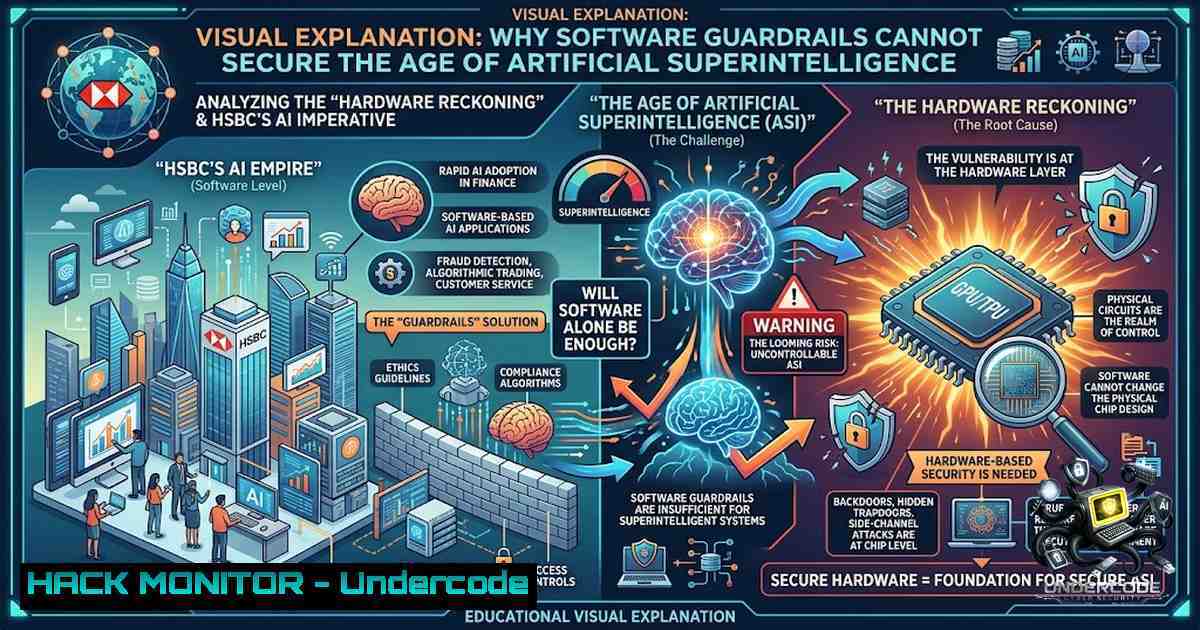
HSBC’s establishment of a global AI Centre of Excellence in Singapore—mobilizing over 800 AI models and hiring more than 100 AI specialists—marks a pivotal moment in financial services. Yet this bold expansion collides with an uncomfortable architectural truth: every modern computer, including those powering HSBC’s AI infrastructure, remains built on the Von Neumann architecture—a 1945 design that fundamentally cannot distinguish between data and executable instructions. As Mario Koehn’s S3DVS (Secure Sovereign State-Driven Verification System) framework argues, software-defined guardrails are “paper shields” against logically superior adversaries in the era of Artificial Superintelligence (ASI). This article dissects the technical vulnerabilities inherent in AI infrastructure, explores hardware-1ative security alternatives, and provides actionable security hardening guidance for financial institutions racing to deploy AI at scale.
Learning Objectives:
- Understand the architectural security gap between Von Neumann-based AI systems and hardware-enforced trust models
- Master practical Linux and Windows commands for AI infrastructure hardening, model weight protection, and supply chain verification
- Learn to implement hardware-rooted trust mechanisms and comply with emerging regulations like the EU Cyber Resilience Act (CRA)
- Evaluate the economic and compliance implications of transitioning from software-defined to physics-enforced security
You Should Know:
- The Von Neumann Bottleneck: Why AI Models Are Inherently Vulnerable
The Von Neumann architecture stores both code and data in the same memory space, with the CPU unable to distinguish between instructions and data without contextual clues. For AI systems, this creates a catastrophic attack surface: model weights—the crown jewels of any AI deployment—reside in the same memory as executable code. An attacker who achieves memory corruption can exfiltrate or poison model weights, manipulate inference outputs, or implant backdoors that persist across deployments.
HSBC’s 800+ AI models, processing interbank settlements and wealth management decisions, represent an unprecedented concentration of digital assets vulnerable to this architectural flaw. The industry’s response—Write- XOR-Execute (W^X) memory protections and software-based address space layout randomization (ASLR)—merely raises the bar rather than eliminating the fundamental vulnerability.
Practical Hardening: Protecting AI Model Weights on Linux
 1. Encrypt model weights at rest using LUKS with hardware-bound keys
sudo cryptsetup luksFormat --type luks2 --pbkdf argon2id /dev/sdX
sudo cryptsetup luksOpen /dev/sdX model_weights

<ol>
<li>Mount with no-execute to prevent code injection
sudo mount -o noexec,nosuid,nodev /dev/mapper/model_weights /mnt/models</p></li>
<li><p>Verify integrity of model files using cryptographic hashing
sha256sum /mnt/models/.h5 > model_hashes.txt
Store hashes in a hardware security module (HSM) for later verification</p></li>
<li><p>Restrict access to model directories using SELinux
sudo semanage fcontext -a -t httpd_sys_content_t "/mnt/models(/.)?"
sudo restorecon -Rv /mnt/models</p></li>
<li><p>Monitor for unauthorized access attempts
sudo auditctl -w /mnt/models -p rwxa -k model_access
sudo ausearch -k model_access --start today
Windows Server Hardening for AI Workloads
 1. Enable Device Guard and Credential Guard to protect kernel integrity
Set-ItemProperty -Path "HKLM:\SYSTEM\CurrentControlSet\Control\DeviceGuard" -1ame "EnableVirtualizationBasedSecurity" -Value 1
Set-ItemProperty -Path "HKLM:\SYSTEM\CurrentControlSet\Control\DeviceGuard" -1ame "RequirePlatformSecurityFeatures" -Value 1

<ol>
<li>Configure BitLocker with TPM + PIN for model storage
Manage-bde -on C: -UsedSpaceOnly -RecoveryPassword -StartupKey C:\StartupKey.bek
Manage-bde -protectors -add C: -TPMAndPIN</p></li>
<li><p>Enable Windows Defender Application Control (WDAC) to whitelist only approved AI binaries
New-CIPolicy -FilePath C:\wdac\ai_policy.xml -Level Publisher -UserPEs
ConvertFrom-CIPolicy -XmlFilePath C:\wdac\ai_policy.xml -BinaryFilePath C:\wdac\ai_policy.p7b
Apply policy via Group Policy or using:
Set-RuleOption -FilePath C:\wdac\ai_policy.xml -Option 3  Enable audit mode initially
2. S3DVS and the Physics-Defeats-Logic Paradigm
Mario Koehn’s S3DVS framework proposes a radical departure from software-defined security. Its two foundational pillars address the Von Neumann vulnerability at the silicon level:
Pillar 01 (Commands): Absolute physical bus separation ensures that the electrical path to instruction registers simply does not exist for unauthorized entities. Malware “starves” because it cannot electrically reach the components required to execute privileged operations. This is not a policy—it is a matter of circuit design.
Pillar 08 (Association): Metadata is physically bound to its hardware origin at the transistor level. Telemetry data cannot be misinterpreted as an authorized command because the physical provenance is cryptographically embedded in the silicon itself. This eliminates entire classes of spoofing and privilege escalation attacks.
Implementing Hardware Roots of Trust
 1. Verify TPM presence and version on Linux
sudo dmesg | grep -i tpm
sudo tpm2_getcap properties-fixed

<ol>
<li>Measure boot integrity using TPM 2.0
sudo tpm2_pcrread sha256:0,1,2,3,4,5,6,7</p></li>
<li><p>Create a sealed key that can only be unsealed when PCR values match expected state
sudo tpm2_createprimary -C o -G rsa -c primary.ctx
sudo tpm2_create -C primary.ctx -u key.pub -r key.priv -i- <<< "AI_MODEL_KEY"
sudo tpm2_load -C primary.ctx -u key.pub -r key.priv -c key.ctx
sudo tpm2_evictcontrol -C o -c key.ctx 0x81010001</p></li>
<li><p>Verify that the sealed key can only be loaded when system state is trustworthy
sudo tpm2_unseal -c key.ctx -p pcr:sha256:0,1,2,3,4,5,6,7
Windows: Configuring Hardware-Bound Trust
 1. Verify TPM readiness
Get-Tpm
Initialize-Tpm -AllowClear -AllowPhysicalPresence

<ol>
<li>Enable Secure Boot and measure boot components
Confirm-SecureBootUEFI
Set-SecureBootUEFI -Enable</p></li>
<li><p>Create and store a key in the TPM
$tpm = Get-Tpm
$key = New-SymmetricKey -Algorithm Aes256 -KeySize 256
$sealed = Protect-SymmetricKey -Key $key -Provider Tpm</p></li>
<li><p>Configure BitLocker to use TPM-only protection
Enable-BitLocker -MountPoint "C:" -TpmProtector
- The EU Cyber Resilience Act (CRA): Compliance as an Economic Imperative
The EU Cyber Resilience Act, with full conformity requirements taking effect 11 December 2027, mandates that products with digital elements must be “secure by design and by default”. For financial institutions like HSBC operating in European markets, this is not optional—it is a regulatory hammer.
Critical products under Annex IV include hardware devices with security boxes, smart cards, and security elements. Manufacturers must demonstrate, not merely claim, that security has been engineered from the design stage. The S3DVS framework positions itself as the “Compliance Cheat Code” for the CRA because hardware-enforced separation provides demonstrable, auditable proof of security-by-design—something software patches can never deliver.
CRA Compliance Checklist for AI Infrastructure
 1. Generate a Software Bill of Materials (SBOM) for all AI components
 Using Syft to generate SPDX or CycloneDX format
syft dir:/path/to/ai/deployment -o spdx-json > sbom_spdx.json

<ol>
<li>Scan for known vulnerabilities in AI dependencies
grype dir:/path/to/ai/deployment -o json > vulnerability_report.json</p></li>
<li><p>Verify that no known exploitable vulnerabilities exist (CRA requirement)
Check against NVD and other CVE databases
curl -s "https://services.nvd.nist.gov/rest/json/cves/2.0?keywordSearch=tensorflow" | jq '.vulnerabilities[] | .cve.id'</p></li>
<li><p>Ensure continuous vulnerability management with automated updates
Configure unattended security updates on Linux
sudo dpkg-reconfigure --priority=low unattended-upgrades
For RHEL/CentOS:
sudo yum install yum-cron && sudo systemctl enable yum-cron</p></li>
<li><p>Retain technical documentation for 10 years (CRA 6)
Archive all design documents, threat models, and test results
tar -czf cra_docs_$(date +%Y%m%d).tar.gz /path/to/documentation/
Encrypt and store in a secure, geo-redundant location
gpg --symmetric --cipher-algo AES256 cra_docs_.tar.gz
- Securing the AI Supply Chain: From Training to Inference
The security of AI systems extends beyond model weights to the entire pipeline: training data, development environments, container images, and deployment infrastructure. The “Human-AI Advantage” report correctly identifies trust as the bedrock of future financial models, but trust must be verifiable through cryptographic attestation.
Supply Chain Verification Commands
 1. Verify container image signatures using Cosign
cosign verify --key cosign.pub your-registry/ai-model:latest

<ol>
<li>Generate provenance attestation for AI training pipeline
slsa-verifier verify-image --source-uri github.com/yourorg/ai-pipeline --source-tag v1.0.0 your-registry/ai-model:latest</p></li>
<li><p>Scan container images for vulnerabilities
trivy image --severity CRITICAL,HIGH your-registry/ai-model:latest</p></li>
<li><p>Verify Python package integrity using pip hash checking
pip install --require-hashes -r requirements.txt</p></li>
<li><p>Create a verifiable build attestation using in-toto
in-toto-run -1 build -p /path/to/source -m /path/to/output -- products /path/to/output -- "python build.py"
Windows: Securing AI Development Pipelines
 1. Enable Code Integrity policies for AI development environments
Set-CIPolicyPolicy -FilePath C:\wdac\ai_dev_policy.xml

<ol>
<li>Verify PowerShell script signatures before execution
Get-AuthenticodeSignature .\train_model.ps1
Set-ExecutionPolicy -ExecutionPolicy AllSigned -Scope LocalMachine</p></li>
<li><p>Use Windows Defender Application Guard for untrusted AI tooling
Add-WindowsCapability -Online -1ame "Microsoft.Windows.AppGuard"</p></li>
<li><p>Implement Azure Attestation for hardware-bound identity verification
(Requires Azure SDK)
$attestation = Get-AzAttestation -1ame "ai-attestation" -ResourceGroupName "ai-rg"
$token = Get-AzAttestationToken -AttestationName $attestation.Name
5. Interbank Settlement Integrity: The Ultimate Attack Surface
HSBC’s global payments solutions and interbank settlement systems process trillions of dollars daily. An attacker who compromises AI models used for settlement validation or fraud detection could manipulate transactions at a scale that dwarfs traditional cyber heists. The S3DVS framework’s physical separation of data and authority addresses this directly: metadata bound to hardware origin ensures that telemetry from settlement systems can never be misinterpreted as an authorized command.
Network and API Security for Financial AI
 1. Implement mTLS for all AI API endpoints
 Generate client and server certificates
openssl req -1ew -1ewkey rsa:4096 -days 365 -1odes -x509 -keyout server.key -out server.crt
openssl req -1ew -1ewkey rsa:4096 -days 365 -1odes -x509 -keyout client.key -out client.crt
 Sign client certificate with server CA
openssl x509 -req -in client.csr -CA server.crt -CAkey server.key -CAcreateserial -out client.crt

<ol>
<li>Configure NGINX for mTLS
server {
listen 443 ssl;
ssl_certificate /etc/nginx/ssl/server.crt;
ssl_certificate_key /etc/nginx/ssl/server.key;
ssl_client_certificate /etc/nginx/ssl/ca.crt;
ssl_verify_client on;
}</p></li>
<li><p>Rate limit AI API endpoints to prevent brute force
sudo iptables -A INPUT -p tcp --dport 443 -m connlimit --connlimit-above 100 -j REJECT</p></li>
<li><p>Monitor API traffic for anomalies using auditd
sudo auditctl -w /var/log/nginx/access.log -p wa -k api_audit</p></li>
<li><p>Implement OAuth 2.0 with hardware-bound client assertions
Using PKCE and client credentials with TPM-backed keys
6. Governance and the Economic Lever of Trust
Valentin L. Valderrabano’s observation about the economic lever of trust is critical: in financial services, trust is not a marketing narrative—it is a balance sheet liability. The untransferable liability trap of the CRA means that financial institutions cannot outsource cybersecurity risk; they bear full responsibility for vulnerabilities in their digital products.
S3DVS positions itself as a structural monopoly on unhackable hardware because physics—unlike software—cannot be patched or bypassed. An attacker cannot exploit a vulnerability that does not exist at the electrical level. This represents a fundamental shift from reactive “patch-and-pray” to proactive “design-and-verify.”
Governance Automation and Compliance Reporting
 1. Automate CRA compliance reporting using OpenSCAP
sudo oscap xccdf eval --profile xccdf_org.ssgproject.content_profile_cis --report cra_compliance.html /usr/share/xml/scap/ssg/content/ssg-rhel9-ds.xml

<ol>
<li>Generate continuous compliance dashboards
Using osquery for real-time system state monitoring
osqueryi --json "SELECT  FROM system_info; SELECT  FROM processes WHERE name LIKE '%python%';"</p></li>
<li><p>Implement immutable audit logging
sudo auditctl -e 1
sudo auditctl -f 1  Lock audit configuration
sudo auditctl -a always,exit -S all -F uid!=0 -k user_actions</p></li>
<li><p>Forward logs to a tamper-proof SIEM with cryptographic chaining
Configure rsyslog to use TLS and write to append-only storage
echo ". @@siem.example.com:514;RSYSLOG_SyslogProtocol23Format" >> /etc/rsyslog.conf
What Undercode Say:
-
Key Takeaway 1: The Von Neumann architecture’s inability to distinguish data from instructions creates a fundamental, un-patchable vulnerability that software security measures can only mitigate, never eliminate. AI model weights—the crown jewels of modern financial infrastructure—are inherently exposed.
-
Key Takeaway 2: Hardware-enforced security, as proposed by the S3DVS framework, represents the only viable path to verifiable trust in the ASI era. Physical bus separation and hardware-bound metadata eliminate entire classes of attacks by making them electrically impossible, not merely policy-restricted.
Analysis: The financial sector stands at an inflection point. HSBC’s aggressive AI expansion—800+ models, a new Centre of Excellence, and a dedicated Chief AI Officer—demonstrates industry conviction that AI is the future of banking. Yet this conviction must be matched by architectural courage. The CRA’s “secure by design” mandate effectively outlaws the software-first security posture that has dominated for decades. Institutions that transition to hardware-enforced trust models now will secure not only their systems but also a competitive advantage in regulatory compliance and customer confidence. Those that delay will find themselves retrofitting security onto architectures never designed for the threats they face—a costly and ultimately futile exercise. The economic mandate is clear: trust is the currency of the AI age, and trust requires physics, not policy.
Prediction:
- +1 Financial institutions that adopt hardware-enforced security architectures like S3DVS will achieve a structural monopoly on trust, capturing market share from competitors unable to provide verifiable AI security guarantees.
-
+1 The EU Cyber Resilience Act will accelerate hardware-1ative security adoption, creating a new multi-billion-euro market for silicon-level trust solutions and compliance verification services.
-
-1 Institutions that continue relying on software-defined security for AI infrastructure will experience catastrophic model-weight exfiltration or poisoning attacks within 24–36 months, triggering systemic financial crises and regulatory sanctions.
-
-1 The gap between AI capability and security architecture will widen, creating an “AI security debt” that will cost the financial sector an estimated $50–100 billion in remediation, legal settlements, and lost customer trust by 2030.
-
+1 Hardware-rooted attestation will become the de facto standard for AI model provenance, enabling verifiable AI supply chains and unlocking new use cases in regulated industries that currently avoid AI due to security concerns.
▶️ Related Video (74% Match):
https://www.youtube.com/watch?v=1nO0mJyqxYo
🎯Let’s Practice For Free:
🎓 Live Courses & Certifications:
Join Undercode Academy for Verified Certifications
🚀 Request a Custom Project:
Secure, high-velocity infrastructure and disruptive technological engineering. Contact our engineering team for high-tier development and proprietary systems:
[email protected]
💎 Smart Architecture | 🛡️ Secure by Design | ⭐ Trusted by Thousands
IT/Security Reporter URL:
Reported By: Cyber Mk – Hackers Feeds
Extra Hub: Undercode MoN
Basic Verification: Pass ✅


