Listen to this Post
Introduction:
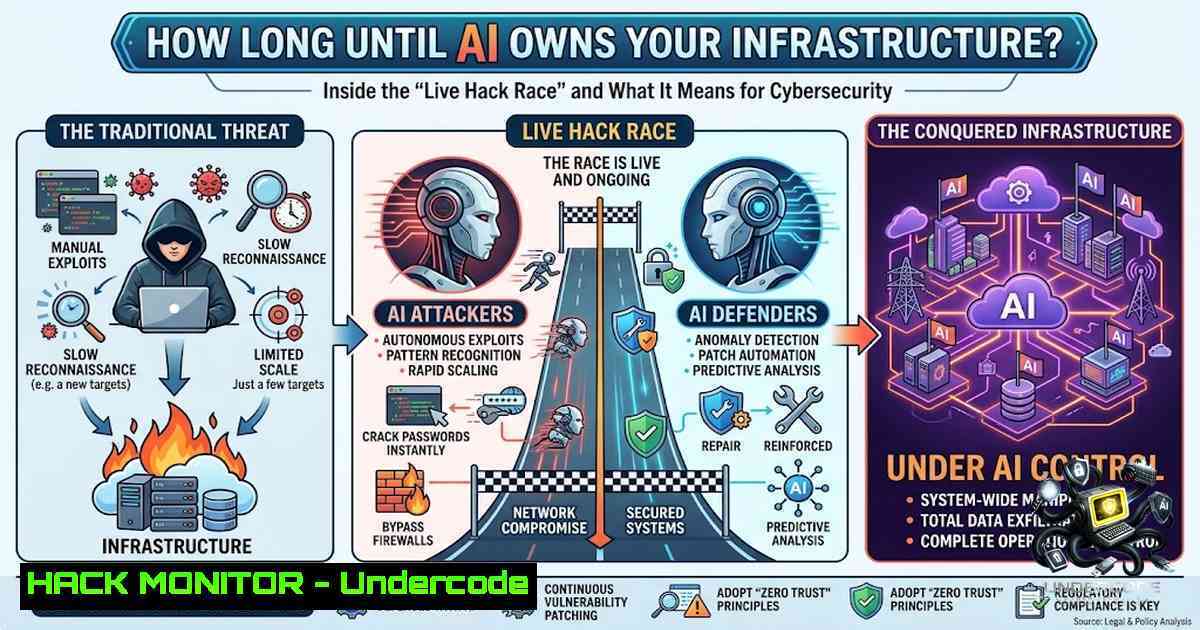
The cybersecurity industry has spent decades building walls, but the adversary has just acquired a battering ram that thinks, adapts, and executes at machine speed. When the world’s strongest bug hunters deploy attacking AI against live infrastructure, the question is no longer if they will break in, but how many seconds it will take. This article dissects the live event where elite hackers race their AIs to compromise a multi-stage vulnerable infrastructure for a $3,000 crypto prize—and reveals how blue teams can evolve from reactive analysts into a unified, machine-speed defensive mind.
Learning Objectives:
- Understand the compressed attack timeline of AI-orchestrated breaches and why human-paced defense is structurally defeated.
- Learn how autonomous red team agents discover, chain, and execute exploits in under 90 seconds.
- Master the defensive shift from vulnerability management to continuous attack path mitigation using AI-driven blue team frameworks.
- Acquire practical Linux/Windows commands and tool configurations for real-time exposure discovery and attack path disruption.
You Should Know:
- The Machine-Speed Kill Chain: Why Traditional SOCs Are Obsolete
Agentic offensive systems do not just find exposures—they triage them, score them against active exploitation data, identify viable attack paths, chain attacks together, and execute without a human analyst in the loop. A kill chain that used to take a sophisticated adversary days or weeks now executes in minutes. The gap is not in the finding; the gap is in what happens next, and how fast it happens.
Human-paced incident response is structurally defeated by machine-speed offense. Not weakened. Not disadvantaged. Structurally defeated. A SOC running ticket-based workflows and sequential investigation steps cannot operate at the velocity this threat demands. It is a physics problem.
Step‑by‑step guide to understanding the AI kill chain:
- Reconnaissance (Seconds): AI agents scan external perimeters, internal networks, and web applications. In the Armadin–TENEX.ai live test, 26,000 autonomous agents targeted over 25,000 services and generated 17 million offensive actions.
- Exploit Selection & Chaining (Milliseconds): The AI queries a RAG knowledge base—containing 5,395 offensive security documents from GTFOBins, Atomic Red Team, and HackTricks—to select and sequence known vectors.
- Execution (Under 90 seconds): Autonomous SSH compromise occurs in approximately 90 seconds. The AI adapts based on defense responses.
- Lateral Movement & Data Staging (Minutes): The agent maps attack paths, harvests credentials, and stages data for exfiltration.
Linux Command to Simulate Attack Path Discovery:
 Use BloodHound to map Active Directory attack paths
sudo bloodhound --1o-sandbox
 Collect data with SharpHound on Windows, then analyze in BloodHound UI

Use Ligolo-1g for pivoting simulation
./ligolo-1g -autoconnect -bind 0.0.0.0:11601
Windows PowerShell for Reconnaissance Simulation:
 Enumerate domain users and groups
Get-ADUser -Filter  -Properties  | Select-Object Name, SamAccountName, LastLogonDate
Get-ADGroup -Filter  | Select-Object Name, GroupCategory, GroupScope

Check for unquoted service paths (privilege escalation vector)
Get-WmiObject win32_service | Where-Object {$<em>.PathName -like ' ' -and $</em>.PathName -1otlike '"'} | Select-Object Name, PathName, StartName
- Attack Path Mitigation: Finding and Cutting the Feasible Routes
The strategic logic of preemptive exposure management is straightforward: find the attack paths before the attacker does, eliminate the ones that lead to your most valuable assets, and do it continuously so that the picture never goes stale. The real change isn’t a new category of cyber tool—it’s your blue team finally thinking as one mind.
Feasible’s approach demonstrates how attack paths get uncovered and cut before attackers reach them. This requires moving from periodic penetration tests to continuous adversarial validation.
Step‑by‑step guide to implementing continuous attack path mitigation:
1. Asset Discovery & Attack Surface Mapping:
Use ARPSyndicate’s Puncia CLI to map external attack surfaces and identify exposed subdomains:
 Install Puncia
pip3 install puncia

Query subdomains for your domain
puncia subdomain yourcompany.com subdomains.txt

Query replica domains for brand protection
puncia replica yourcompany.com replicas.txt
2. Vulnerability & Exploit Intelligence:
Query the Exploit Observer database for known exploits affecting your stack:
 Search for exploits related to a CVE
puncia exploit CVE-2024-XXXXX

Generate automated vulnerability advisory
puncia summarize "https://nvd.nist.gov/vuln/detail/CVE-2024-XXXXX" advisory.md
3. Attack Path Modeling:
Deploy AI-driven attack path mapping tools. The ARGUS framework provides continuous red teaming and exploitability prioritization running at the speed of attacker reconnaissance.
4. Automated Remediation:
Use blue team agents with a five-phase defensive methodology: Audit, Detect, Analyze, Remediate, Harden. The DefenseSandbox restricts operations to whitelisted defensive tools:
 Deploy defensive tool whitelist (Linux)
sudo apt-get install auditd fail2ban iptables lynis rkhunter chkrootkit aide ossec

Configure iptables to block known malicious IPs
sudo iptables -A INPUT -s <malicious-ip> -j DROP
sudo iptables-save > /etc/iptables/rules.v4
5. Continuous Monitoring & Retesting:
Implement a red team → blue team loop that auto-patches vulnerable families and measures failure reduction.
3. Autonomous Blue Team Operations: The ARGUS Framework
The agentic threat is not a better phishing email. It is a fundamental compression of the attack timeline. The answer is not to work faster—it is to build systems that operate at the right speed and know when to hand control to a human.
ARGUS (Autonomous Response and Governance for Unified Security) is an operational framework designed to respond at machine speed within a governance framework that makes autonomous action trustworthy rather than reckless.
Step‑by‑step guide to deploying autonomous blue team capabilities:
1. Telemetry Ingestion at Scale:
In the TENEX.ai deployment, the platform ingested and triaged 101,169 alerts and reconstructed the full attack chain across 231 billion raw events in real time. This would traditionally require 2,400 analyst hours.
2. LLM-Assisted Patch Generation:
Deploy a blue team agent with LLM-assisted patch generation framework and rollback support:
 Example: Automated fail2ban configuration update based on detected patterns
sudo fail2ban-client set sshd banip <attacking-ip>
sudo fail2ban-client reload
3. MITRE D3FEND Integration:
Use defensive knowledge retrieval aligned with MITRE D3FEND to counter specific adversary techniques.
4. Scoring & Continuous Improvement:
Evaluate performance across weighted security dimensions: time-to-compromise vs. time-to-detect, patch effectiveness, and stealth metrics.
Windows Command for Automated Defense:
 Enable advanced audit policies
auditpol /set /category:"Logon/Logoff" /subcategory:"Logon" /success:enable /failure:enable
auditpol /set /category:"Object Access" /subcategory:"File System" /success:enable /failure:enable

Deploy Windows Defender ATP advanced features
Set-MpPreference -EnableNetworkProtection Enabled
Set-MpPreference -EnableControlledFolderAccess Enabled
Set-MpPreference -AttackSurfaceReductionRules_Ids <rule-ids> -AttackSurfaceReductionRules_Actions Enabled
- AI Offense Trains AI Defense: The Closed-Loop Security Paradigm
The future of Security Operations Centers lies in closed-loop AI cycles where machine-speed offensive probing continuously trains and refines machine-speed defensive detection algorithms. This is not theory—it is happening now.
Step‑by‑step guide to building a closed-loop AI security system:
1. Deploy Autonomous Red Team:
Use the Dissensus AI framework with a dual-agent architecture where autonomous red team and blue team agents compete in isolated environments:
 Kubernetes-1ative deployment
kubectl apply -f red-team-agent.yaml
kubectl apply -f blue-team-agent.yaml
2. RAG-Enhanced Offensive Knowledge:
The red team agent uses a RAG server with semantic search over 5,395 offensive security documents and FAISS L2 search over 327 MITRE ATT&CK techniques.
3. Real-Time Defense Tuning:
The blue team analyzes red team actions and auto-generates defensive rules:
 Example: Generate iptables rules from detected attack patterns
python3 generate_defense_rules.py --attack-log /var/log/redteam_actions.log --output /etc/iptables/rules.v4
4. Continuous Retesting:
Re-run attacks and measure failure reduction.
5. The Human-in-the-Loop Evolution
AI agents handle the heavy lifting of parsing billions of raw telemetry events, while human operators remain accountable for high-level decision-making, strategic containment, and escalation. This is the evolution, not the elimination, of the security analyst role.
Step‑by‑step guide to implementing human-governed AI security:
1. Define Governance Frameworks:
Establish rules for when AI can act autonomously and when human approval is required.
2. Implement Escalation Protocols:
Configure AI systems to escalate high-severity or ambiguous findings to human analysts.
3. Continuous Training:
Use AI-generated attack simulations to train human analysts on emerging threats.
4. Metrics & Accountability:
Track AI performance, false positive rates, and human intervention frequency.
- API Security in the Age of AI Orchestrated Attacks
Prompt injection is ranked the number-one risk for LLM-integrated applications by OWASP, allowing attackers to hide instructions inside content that an AI system will process. AI-orchestrated attacks select and sequence known vectors, while AI-generated attacks produce novel traffic patterns at query speed.
Step‑by‑step guide to securing APIs against AI attacks:
1. Implement Strict Input Validation:
 Python example: Sanitize LLM inputs
def sanitize_prompt(user_input):
blocked_patterns = ['system', 'instruction', 'ignore', 'override']
for pattern in blocked_patterns:
if pattern.lower() in user_input.lower():
return "Input blocked: suspicious pattern detected"
return user_input
2. Deploy AI-Aware WAF:
Traditional WAFs are not designed to handle AI-generated attack vectors. Deploy WAFs with LLM-specific rule sets.
3. Rate Limiting & Anomaly Detection:
 Nginx rate limiting for API endpoints
limit_req_zone $binary_remote_addr zone=api_limit:10m rate=10r/s;
location /api/ {
limit_req zone=api_limit burst=20 nodelay;
}
4. Monitor for Novel Attack Patterns:
Use AI to detect anomalous traffic that doesn’t match known signatures.
7. Cloud Hardening Against Autonomous Threats
Experimental evaluation shows that proactive attack-path disruption approaches achieve an average disruption rate of 82.6%, outperforming detection-centric baselines by up to 25% while maintaining low runtime overhead.
Step‑by‑step guide to cloud hardening:
1. Implement Zero Trust Architecture:
- Enforce least-privilege access
- Implement micro-segmentation
- Use continuous authentication
2. Continuous Exposure Discovery:
 AWS: Use AWS Inspector to continuously scan for vulnerabilities
aws inspector2 start-scan --resource-arn <resource-arn>

Azure: Use Microsoft Defender for Cloud
az security assessment-metadata list
3. Infrastructure as Code Security Scanning:
 Scan Terraform files for misconfigurations
tfsec --1o-color ./terraform/

Scan Kubernetes manifests
kube-score score ./k8s/
4. Automated Patching:
 Linux: Automated security updates
sudo apt-get update && sudo apt-get upgrade -y
sudo unattended-upgrades -d

Windows: Use Windows Update for Business
Get-WindowsUpdate -Install -AcceptAll
What Undercode Say:
- Key Takeaway 1: The speed of AI-driven attacks renders traditional, human-paced incident response structurally obsolete. The kill chain that once took weeks now executes in minutes—defense must operate at the same machine speed or fail.
-
Key Takeaway 2: The real paradigm shift is not about adopting a new tool category but about transforming blue teams into a unified, continuously learning entity that thinks as one mind. Attack path mitigation must be continuous, preemptive, and AI-driven.
Analysis: The live AI hack race is not a gimmick—it is a harbinger of the new normal. Organizations that continue to rely on annual penetration tests and manual SOC workflows will be breached, not because their defenses are weak, but because their response time is measured in minutes while the adversary operates in milliseconds. The solutions exist: autonomous red teaming, AI-driven attack path mapping, continuous validation, and machine-speed defense orchestration. The question is not whether to adopt these capabilities, but how quickly. The CISOs who treat this as an existential imperative will survive; those who view it as a vendor trend will become case studies.
Prediction:
- +1 The autonomous AI security market will surpass $50 billion by 2028 as enterprises rush to deploy machine-speed defense frameworks.
- +1 Continuous adversarial validation (“Hyperattacks”) will become a compliance requirement within 3 years, rendering annual penetration tests obsolete.
- -1 Organizations that fail to adopt AI-driven defense will experience a 300% increase in successful breaches by 2027, as threat actors fully weaponize autonomous attack swarms.
- +1 The human analyst role will evolve from reactive triage to strategic AI governance, creating higher-value, higher-paying security positions.
- -1 API-driven AI applications will become the primary attack vector, with prompt injection and AI-generated novel attacks outpacing traditional WAF capabilities.
- +1 Open-source frameworks like Dissensus AI and ARGUS will democratize autonomous security testing, enabling small teams to deploy enterprise-grade AI defense.
- -1 The cybersecurity skills gap will widen as AI defense requires new skill sets that traditional training programs do not yet address.
- +1 Blue team AI agents will achieve parity with red team AI agents within 18 months, enabling true machine-speed cyber warfare parity.
- -1 Ransomware attacks leveraging AI will increase by 200%, with autonomous AI selecting and customizing polymorphic malware for each target environment.
- +1 The “one mind” blue team concept will become the industry standard, with AI-enabled collaboration tools replacing siloed security operations.
▶️ Related Video (78% Match):
🎯Let’s Practice For Free:
🎓 Live Courses & Certifications:
Join Undercode Academy for Verified Certifications
🚀 Request a Custom Project:
Secure, high-velocity infrastructure and disruptive technological engineering. Contact our engineering team for high-tier development and proprietary systems:
[email protected]
💎 Smart Architecture | 🛡️ Secure by Design | ⭐ Trusted by Thousands
IT/Security Reporter URL:
Reported By: About This – Hackers Feeds
Extra Hub: Undercode MoN
Basic Verification: Pass ✅


