Listen to this Post
Introduction:
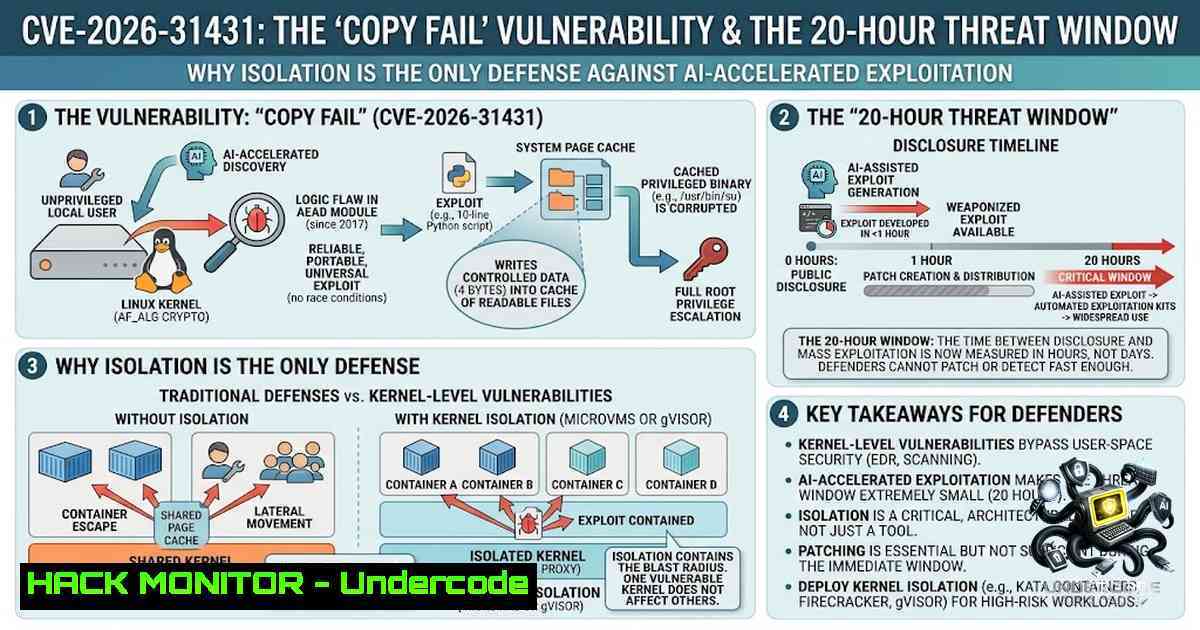
The cybersecurity industry has long operated under the assumption that patch management—while imperfect—provides a reasonable buffer between vulnerability disclosure and active exploitation. The CrowdStrike 2026 Threat Hunting Report has shattered that assumption. With 88% of publicly disclosed vulnerabilities with proof-of-concept (PoC) code now exploited within 48 hours, and nation-state actors weaponizing critical flaws in under 20 hours, the traditional patch cycle has become obsolete. The CVE-2026-31431 “Copy Fail” Linux kernel privilege escalation vulnerability serves as the definitive case study: publicly disclosed on April 29, 2026, a PoC emerged the same day, and within 20 hours, the Belarus-linked threat actor UMBRAL BISON was deploying it at scale, with 94% of observed attacks occurring in the first 24 hours. This is the new reality: the window to patch before exploitation has effectively closed.
Learning Objectives:
- Understand the technical mechanics of CVE-2026-31431 (Copy Fail) and why it enables reliable, deterministic root privilege escalation across all major Linux distributions.
- Analyze the CrowdStrike 2026 Threat Hunting Report findings on exploitation windows, AI-accelerated attacks, and the 88% statistic that defines the modern threat landscape.
- Implement practical detection, mitigation, and isolation strategies—including Linux commands, configuration changes, and zero-trust architecture principles—to defend against sub-24-hour exploit timelines.
1. Understanding CVE-2026-31431: The “Copy Fail” Vulnerability
CVE-2026-31431, dubbed “Copy Fail,” is a local privilege escalation (LPE) vulnerability residing in the Linux kernel’s `algif_aead` cryptographic interface. The flaw has been present in the kernel since 2017, affecting every mainstream Linux distribution including Ubuntu 24.04, Amazon Linux 2023, RHEL 10.1, and SUSE 16. The vulnerability allows an unprivileged local user to gain root privileges by writing four controlled bytes into the page cache of any readable file. The exploit chains the `AF_ALG` crypto API socket interface with the `splice()` system call to achieve a 4-byte write into the page cache. This is sufficient to target a setuid binary (by default /usr/bin/su), patch it in memory—non-persistently, but the resulting root shell is fully functional—and hand back a root prompt.
What makes this vulnerability exceptionally dangerous is its reliability. Unlike many privilege escalation flaws that require winning race conditions or meddling with kernel-specific offsets, Copy Fail is deterministic and works consistently across environments. The original Python exploit is only 732 bytes, and variants are already emerging. Beyond local privilege escalation, the bug can also enable container escape, as the page cache is shared across containers on the same host.
Step-by-Step Detection and Mitigation:
Detection:
- Monitor Process Chains: The original Python exploit leaves visible artifacts. Watch for characteristic command lines where `sh -c` spawns privileged utilities directly (
su,sudo,mount,umount,passwd,gpasswd,chfn,chsh,newgrp,fusermount3). The tell is the process chain: Python → shell → privileged binary. - Behavioral Monitoring: Track unexpected UID changes between parent and child processes, particularly when the initiating binary is unfamiliar or inconsistent with your environment’s normal process baseline.
Mitigation:
- Disable the `algif_aead` Kernel Module: Before patching, the most practical mitigation is to disable the `algif_aead` kernel module. This breaks almost nothing on the vast majority of systems, as
dm-crypt, LUKS, kTLS, IPsec, OpenSSL, and SSH all use the in-kernel crypto API directly without going throughAF_ALG.Check if the module is loaded lsmod | grep algif_aead Blacklist the module echo "blacklist algif_aead" >> /etc/modprobe.d/blacklist.conf Remove the module if loaded modprobe -r algif_aead
- Apply the Kernel Patch: The patch is mainline commit
a664bf3d603d, reverting the 2017 in-place optimization that introduced the flaw. Most major distributions are shipping it now. Check your distribution’s security advisory and apply the updated kernel package immediately.For Debian/Ubuntu sudo apt update && sudo apt upgrade linux-image-$(uname -r) For RHEL/CentOS sudo yum update kernel For SUSE sudo zypper patch
- Use Community Tools: Tools like `copyfail-guard` provide zero-dependency Python CLIs that check whether a host appears exposed to CVE-2026-31431 without running an exploit, and can apply conservative temporary mitigations.
-
The CrowdStrike 2026 Threat Hunting Report: Exploitation Windows Collapse to Hours
The CrowdStrike 2026 Threat Hunting Report, covering threat activity observed from July 2025 through June 2026, paints a stark picture of the modern threat landscape. Drawing on intelligence and telemetry from CrowdStrike’s OverWatch managed threat-hunting team, the report reveals that 88% of observed exploitation of vulnerabilities with a public PoC occurred within 48 hours of release during the first half of 2026. This is not an isolated trend—it represents the new standard operating pace for nation-state and eCrime actors.
China-1exus adversaries VAULT PANDA and GENESIS PANDA are now launching deliberate attacks within 24 hours of disclosure, faster than most enterprise IT teams can even assess a vulnerability, let alone patch it. The Belarus-linked UMBRAL BISON exploited CVE-2026-31431 within 20 hours, with 94% of related attack events recorded on the first day. The React2Shell vulnerability generated 800 investigative leads and confirmed over 80 victim organizations within four days of disclosure.
Step-by-Step: Building a 24-Hour Incident Response Playbook
- Accelerate Vulnerability Triage: Traditional 30-day patch cycles are obsolete. Implement a 4-hour SLA for critical vulnerability assessment. For vulnerabilities with public PoC, assume active exploitation is imminent.
- Deploy Virtual Patching: Use Web Application Firewalls (WAFs), intrusion prevention systems (IPS), and runtime application self-protection (RASP) to apply virtual patches while kernel or application patches are being qualified.
- Implement Canary Deployment: For critical patches, deploy to a small subset of systems first, monitor for stability issues, then rapidly expand to the entire fleet. Automate this process using infrastructure-as-code and CI/CD pipelines.
- Leverage Threat Intelligence Feeds: Subscribe to real-time threat intelligence feeds that provide early warning of active exploitation. CrowdStrike OverWatch, for example, detected the mass deployment of the CVE-2026-31431 exploit the day after disclosure.
- Conduct Regular Tabletop Exercises: Simulate a 24-hour exploitation scenario to test your team’s ability to detect, contain, and remediate under extreme time pressure.
-
AI as a Tool, Target, and Force Multiplier for Adversaries
The CrowdStrike 2026 report reveals that AI is now embedded across modern adversary operations. Threat actors are using AI to generate payloads and shell commands, exploit AI infrastructure, and abuse enterprise large language models (LLMs). In one documented LLMJacking campaign, attackers sent nearly 200,000 AI model requests in two minutes, resulting in large-scale financial and operational impact.
AI agent-triggered detection leads now grow at 2.5 times the rate of human-triggered leads, showing how AI is accelerating both attacks and the volume of activity security teams must investigate. The DPRK-1exus STARDUST CHOLLIMA injected a malicious npm package into 131 trusted Mastra AI frameworks, demonstrating how the AI ecosystem has become the next supply chain battleground. During the first half of 2026, 87% of identified software registry threats involved malicious npm packages.
Step-by-Step: Securing AI Infrastructure
- Inventory AI Assets: Identify all AI models, training data, API endpoints, and LLM integrations in your environment. Treat them as critical assets requiring the same security controls as production systems.
- Implement Access Controls: Apply zero-trust principles to AI infrastructure. Use identity-based access controls, API keys with least privilege, and monitor for anomalous usage patterns.
- Monitor for LLMJacking: Deploy monitoring to detect abnormal API request volumes, unusual model access patterns, and unexpected compute usage. Set thresholds for alerts (e.g., >10,000 requests per minute).
- Secure the Supply Chain: For AI frameworks and dependencies, implement software composition analysis (SCA) to detect malicious packages. Consider using private registries or mirroring trusted repositories.
- Conduct AI-Specific Red Teaming: Test your AI infrastructure against adversarial attacks, including prompt injection, model extraction, and data poisoning.
4. Isolation as the Ultimate Defense
When the patch window closes to hours, what remains under control is what happens after a compromise. Traditional security assumed that isolation meant multiple dedicated physical machines—an expensive and impractical approach. KERYS Software’s secure virtualization technology changes this paradigm.
KERYS Software enables multiple isolated environments to run on a single machine with unprecedented workload isolation. By separating dedicated CPU cores for the hypervisor and VMs, and applying encryption at the hypervisor level, the solution prevents side-channel attacks without slowing the machine. Each environment has dedicated network access, and administrators can enforce granular security policies per domain. The architecture is cyber-secure by design, using zero-trust principles and confidential computing.
Step-by-Step: Implementing Isolation with KERYS Software
- Assess Workload Criticality: Identify which workloads require the highest level of isolation (e.g., development environments, sensitive data processing, CI/CD runners).
- Deploy Secure Virtualization: Implement KERYS Software’s YS::Desktop to create isolated environments on user workstations and servers.
- Configure Network Isolation: Assign dedicated Ethernet ports to specific virtual machines for sensitive operations, ensuring no cross-contamination.
- Enforce Zero-Trust Policies: Configure each domain with its own security policy, limiting access based on the principle of least privilege.
- Monitor for Cross-Environment Anomalies: Use centralized console management to detect and respond to suspicious activity across isolated environments.
-
The New Threat Landscape: Vishing, Supply Chain, and Cloud Exploitation
The CrowdStrike 2026 report highlights multiple vectors that are compounding the risk posed by rapid exploitation. Vishing intrusions increased by 2x in the first half of 2026 compared to the second half of 2025. eCrime groups CORDIAL SPIDER and SNARKY SPIDER used vishing to exfiltrate data from SaaS applications and compromise single sign-on accounts. In one incident, SNARKY SPIDER moved from account takeover to data theft in under five minutes. Monthly device code phishing attempts jumped 15x in the past six months.
Cloud-conscious eCrime activity surged 171%, as adversaries executed credential theft, cryptomining, LLM abuse, and digital financial asset theft. The eCrime actor ALTERED SPIDER compromised more than 300 software dependencies in a single day to harvest credentials and pivot into cloud environments. CrowdStrike now tracks 290 named adversary groups, a significant increase from previous years.
Step-by-Step: Defending Against Multi-Vector Attacks
- Deploy Identity Threat Detection: Monitor for anomalous authentication patterns, including device code phishing attempts and unusual SSO activity.
- Implement Zero-Trust Network Access (ZTNA): Restrict access to cloud resources based on identity and context, not network location.
- Secure SaaS Applications: Enforce multi-factor authentication (MFA), conditional access policies, and continuous session monitoring.
- Conduct Supply Chain Security Audits: Regularly review dependencies, use SCA tools, and consider using software bills of materials (SBOMs).
- Educate Users on Vishing: Conduct regular security awareness training that covers voice-based social engineering attacks.
What Undercode Say:
- The 20-hour threat window is the new normal. CVE-2026-31431 demonstrated that nation-state actors can weaponize a vulnerability within hours of disclosure. Organizations that cannot patch in under 24 hours must adopt alternative defenses.
- AI is accelerating both attacks and defense. While adversaries use AI to generate payloads and scale operations, security teams can leverage AI for detection and response. The key is to stay ahead of the automation curve.
- Isolation is no longer a luxury—it’s a necessity. When patch cycles fail, containment becomes the primary defense. Secure virtualization technologies like KERYS Software provide practical isolation without the cost of dedicated hardware.
- The supply chain is the new battleground. With 87% of registry threats involving malicious npm packages, organizations must secure their development pipelines and AI framework dependencies.
- Identity is the perimeter. With vishing, device code phishing, and SSO compromise on the rise, zero-trust identity controls are essential to prevent lateral movement and data theft.
The analysis reveals that the cybersecurity industry is at an inflection point. The traditional model of “patch within 30 days” is no longer viable when adversaries operate on a 20-hour timeline. Organizations must shift to a defense-in-depth strategy that assumes compromise is inevitable and focuses on containment, isolation, and rapid detection. The CrowdStrike 2026 Threat Hunting Report is not a prediction—it is a description of what is already happening. The question is not whether your organization will be targeted, but whether you will be prepared when the next 20-hour vulnerability is disclosed.
Prediction:
- -1: The exploitation window will continue to shrink as AI-powered vulnerability research and exploit generation tools become commoditized. Expect sub-12-hour exploitation timelines by 2027.
- -1: The AI supply chain will become a primary attack vector, with malicious packages targeting AI frameworks becoming as common as npm malware is today.
- +1: Secure virtualization and isolation technologies will become standard enterprise infrastructure, driven by the failure of traditional patch management to keep pace with adversary speed.
- -1: Vishing and social engineering will increasingly bypass technical controls, requiring a fundamental shift toward identity-centric zero-trust architectures.
- +1: Organizations that adopt AI-driven detection and response, combined with isolation-first architectures, will gain a significant advantage over adversaries operating at machine speed.
▶️ Related Video (78% Match):
🎯Let’s Practice For Free:
🎓 Live Courses & Certifications:
Join Undercode Academy for Verified Certifications
🚀 Request a Custom Project:
Secure, high-velocity infrastructure and disruptive technological engineering. Contact our engineering team for high-tier development and proprietary systems:
[email protected]
💎 Smart Architecture | 🛡️ Secure by Design | ⭐ Trusted by Thousands
IT/Security Reporter URL:
Reported By: Erikklarsson Isolation – Hackers Feeds
Extra Hub: Undercode MoN
Basic Verification: Pass ✅


