Listen to this Post
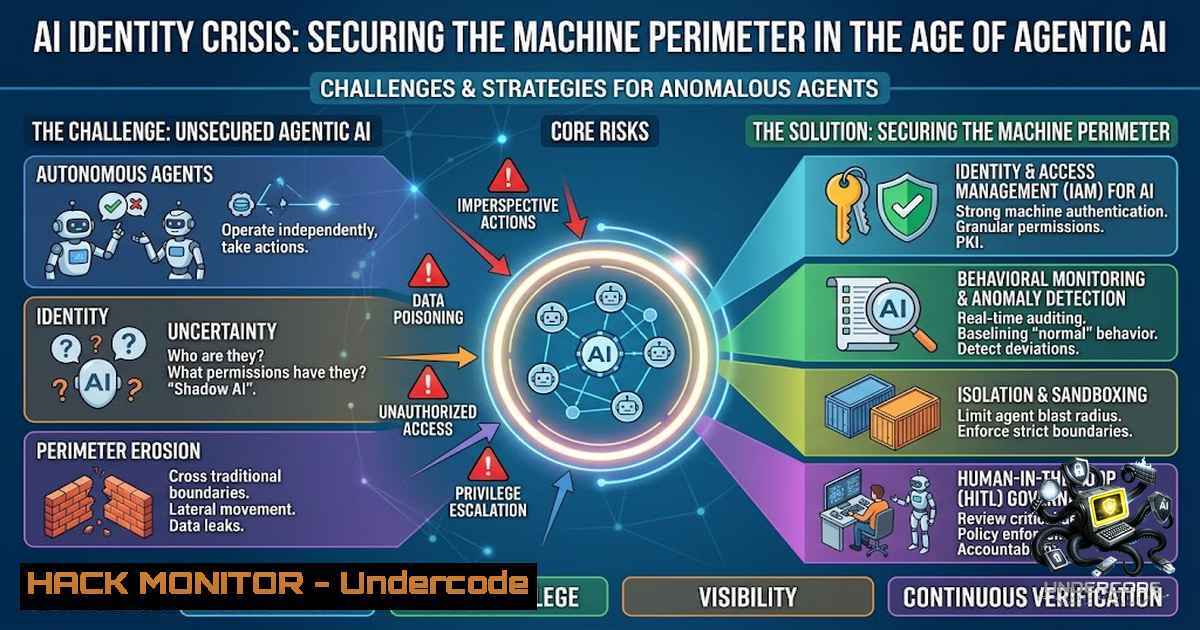
Introduction:
The cybersecurity perimeter has fundamentally dissolved—not at the office door, but at the identity layer. As organizations race to deploy generative AI and autonomous agents, they are simultaneously handing these digital workers the keys to critical systems faster than they can establish guardrails. With machine identities now outnumbering human employees by a staggering 82-to-1 ratio, the question is no longer “Who is accessing my data?” but “What entity—human, machine, or AI agent—is accessing my data, and can I trust it?”
Learning Objectives:
- Understand the expanded identity attack surface introduced by AI agents and machine identities
- Learn practical frameworks for securing generative AI usage and non-human identities
- Master attack path validation techniques to proactively identify and remediate AI-driven vulnerabilities
You Should Know:
- The 82:1 Identity Crisis – Why Machine Identities Are the New Perimeter
The traditional security perimeter—firewalls, VPNs, and physical access controls—no longer defines the boundary of your organization. Today, the perimeter is defined by identity, and not just the human kind. Palo Alto Networks has designated 2026 as the “Year of the Defender,” reflecting a fundamental shift in how security must be approached. For every human identity, an enterprise may now have dozens of machine identities—service accounts, API keys, OAuth clients, workload identities, and AI agents—automatically created, rarely tracked, and often left behind with indefinite standing privileges.
This “82:1 Crisis” represents the most significant open door in cybersecurity history. Attackers have already noticed: compromised machine credentials are now among the most common initial access vectors in major breaches. According to the 2026 Unit 42 Global Incident Response Report, identity weaknesses were at the heart of nearly 90% of all investigations. Why bother breaking in when you can simply log in using a compromised service account?
The challenge is compounded by speed. Unit 42 research indicates that the time from an attacker’s initial action to full data theft has decreased to just 72 minutes—four times faster than the previous year. At that velocity, traditional “triage and ticket” approaches are obsolete.
Step-by-Step: Discovering and Inventorying Non-Human Identities
Before you can secure machine identities, you must discover them. Here’s a practical approach using native tools:
Linux – Discovering Service Accounts and Cron Jobs:
 List all system users (UID < 1000 typically indicates service accounts)
awk -F: '$3 < 1000 {print $1, $3}' /etc/passwd

Find all cron jobs running under non-human accounts
for user in $(awk -F: '$3 < 1000 {print $1}' /etc/passwd); do
crontab -u $user -l 2>/dev/null && echo "Cron for $user"
done

Identify running processes by non-human users
ps -eo user,pid,cmd --1o-headers | awk '$1 ~ /^(systemd|mysql|postgres|nginx|www-data|apache)/'

Find SSH keys belonging to service accounts
find /home -1ame ".ssh" -type d -exec ls -la {} \; 2>/dev/null
Windows – Discovering Service Accounts and Managed Identities:
 List all service accounts (accounts with SPN or used as service logon)
Get-ADUser -Filter {Enabled -eq $true} -Properties ServicePrincipalName |
Where-Object { $_.ServicePrincipalName -1e $null } |
Select-Object Name, SamAccountName, ServicePrincipalName

Find all Windows services running under non-human accounts
Get-WmiObject Win32_Service | Where-Object {
$<em>.StartName -1otlike "LocalSystem" -and
$</em>.StartName -1otlike "NT AUTHORITY" -and
$<em>.StartName -1otlike "NT SERVICE" -and
$</em>.StartName -1otlike ".\"
} | Select-Object Name, StartName, State

Enumerate all scheduled tasks running under service accounts
Get-ScheduledTask | ForEach-Object {
$task = $_
$task.Principal.UserId
} | Select-Object -Unique
Cloud – AWS IAM Roles and Service Accounts:
 List all IAM roles (potential machine identities)
aws iam list-roles --query 'Roles[].[RoleName, Arn]' --output table

Find roles with attached policies (privileged access)
aws iam list-attached-role-policies --role-1ame <ROLE_NAME>

Identify unused IAM roles (dormant identities)
aws iam get-credential-report --query 'Content' --output text |
base64 -d | cut -d, -f1,4,9,11 | grep -v "not_supported"
- Agentic AI – Machines That Think, Act, and Attack
Unlike traditional AI that generates text or insights, agentic AI gives large language models “arms and legs,” enabling them to take real actions on behalf of humans. These autonomous agents can log into systems, execute workflows, interact with APIs, and make decisions about data and security operations. Each carries credentials, tokens, or entitlements—each represents a new non-human identity with real privileges in your environment.
This introduces a critical challenge: replicated privilege at machine speed. A single employee using an AI agent could unknowingly multiply their access tenfold, creating a web of high-privilege entities acting semi-independently under their account. Combined with existing service account sprawl, the attack surface expands dramatically—where a single compromised agent or API key can move laterally across environments with devastating speed.
BeyondTrust research found that enterprise AI agents are growing more than 460% year over year, with almost none assigned an owner, their privileges rarely reviewed or rightsized, and their credentials seldom rotated or retired. A Semperis global study revealed that only 65% of organizations say AI identities are fully registered, authenticated, and authorized in a formal system—and 6% admit they do not track them at all.
Step-by-Step: Securing AI Agent Identities
Implement Zero Standing Privileges (ZSP) for AI Agents:
 Linux: Use temporary credentials with short-lived tokens
 AWS CLI example - assume role with session duration limit
aws sts assume-role \
--role-arn arn:aws:iam::123456789012:role/AIAgentRole \
--role-session-1ame AIAgent-Session-$(date +%s) \
--duration-seconds 3600

Export temporary credentials (valid for 1 hour)
export AWS_ACCESS_KEY_ID=<TEMP_ACCESS_KEY>
export AWS_SECRET_ACCESS_KEY=<TEMP_SECRET_KEY>
export AWS_SESSION_TOKEN=<TEMP_SESSION_TOKEN>
Azure – Managed Identities with Time-Bound Access:
 Azure CLI: Get access token for a managed identity with specific resource
az account get-access-token \
--resource https://vault.azure.net \
--query accessToken \
--output tsv

Assign a time-limited role to an AI agent identity
az role assignment create \
--assignee <AI_AGENT_PRINCIPAL_ID> \
--role "Reader" \
--scope /subscriptions/<SUBSCRIPTION_ID>/resourceGroups/<RG> \
--condition "@resource[?(@.resourceType=='Microsoft.Compute/virtualMachines')]"
Implement Certificate-Based Machine Identity:
Certificate-based machine identity is considered the most durable foundation for securing AI agents at the identity layer, providing continuous trust verification that persists across the full agent lifecycle.
 Generate a machine identity certificate (self-signed for testing)
openssl req -x509 -1ewkey rsa:4096 -keyout agent.key -out agent.crt \
-days 365 -1odes -subj "/CN=ai-agent-001.company.com/O=Security"

Verify certificate for agent authentication
openssl x509 -in agent.crt -text -1oout | grep -E "Subject:|Not Before|Not After"
- AI-Driven Attack Path Validation – Thinking Like the Adversary
Modern attackers do not operate in silos. They chain together vulnerabilities, identities, misconfigurations, exposed services, and weak controls. Horizon3.ai’s NodeZero platform exemplifies this approach, autonomously testing web applications and identifying attack paths that chain application vulnerabilities, credential theft, lateral movement, cloud access, and data exposure.
The platform provides continuous adversarial exposure validation by uncovering exploitable weaknesses, credential exposures, privilege escalation risks, and chained attack paths across enterprise environments. What previously required days or weeks of manual penetration testing effort can now be performed continuously and at machine speed.
Step-by-Step: AI-Powered Attack Path Analysis with Open-Source Tools
Deploy Attack Path Predictor (GitHub):
The Attack Path Predictor tool uses graph theory and machine learning to identify the most viable attack paths within a network infrastructure.
 Clone the repository
git clone https://github.com/anveeksh/attack-path-predictor.git
cd attack-path-predictor

Backend setup
cd backend
pip install -r requirements.txt
python app.py
 API server runs on http://localhost:5001

Frontend setup (in separate terminal)
cd frontend
npm install
npm start
 Web interface opens at http://localhost:3000
Import Network Scan Data for Attack Path Analysis:
 Run an Nmap scan to discover network assets
nmap -sV -sC -oA network_scan 192.168.1.0/24

Import the Nmap XML output into Attack Path Predictor
 (Upload via the web interface or use the API)
curl -X POST http://localhost:5001/api/upload \
-F "file=@network_scan.xml" \
-F "type=nmap"
Generate Attack Path Predictions:
 Python script to analyze attack paths programmatically
import requests
import json

Load network topology data
with open('network_topology.json', 'r') as f:
topology = json.load(f)

Request attack path predictions
response = requests.post(
'http://localhost:5001/api/predict',
json={'topology': topology}
)

Parse and display prioritized attack paths
paths = response.json()
for path in paths['attack_paths'][:5]:  Top 5 most probable paths
print(f"Path: {' → '.join(path['nodes'])}")
print(f"Success Probability: {path['probability']:.2%}")
print(f"MITRE ATT&CK Techniques: {', '.join(path['mitre_techniques'])}")
4. Defending the Generative AI Supply Chain
Generative AI creates entirely new attack surfaces that traditional security tools were not designed to address. The OWASP GenAI Data Security Risks and Mitigations 2026 guide provides a critical analysis of the unique data security challenges posed by widespread GenAI adoption.
Key threats include:
- Prompt Injection: Attackers manipulate AI models through carefully crafted inputs to bypass safeguards
- Data Poisoning: Malicious training data compromises model integrity
- Model Inversion: Attackers extract sensitive training data through repeated queries
- Supply Chain Vulnerabilities: Compromised third-party models or dependencies
Step-by-Step: Implementing GenAI Security Controls
Implement Prompt Security and AI Firewalls:
SentinelOne provides Prompt Security with an AI firewall mechanism that offers full visibility, dynamic blocking, zero-latency protection, unified governance, and bidirectional security inspection.
 Example AI firewall policy configuration (YAML)
policy:
name: "GenAI_Access_Control"
rules:
- name: "Block_PII_Exfiltration"
condition: "prompt contains (SSN|email|phone|credit_card)"
action: "block"
response: "This request contains sensitive data and has been blocked."

<ul>
<li>name: "Allow_Sanctioned_Tools_Only"
condition: "tool not in [AzureOpenAI, AWS_Bedrock, Google_Vertex]"
action: "block"
response: "Use only approved generative AI tools."
Azure OpenAI Service Security Configuration:
 Enable network isolation for Azure OpenAI
az cognitiveservices account update \
--1ame <OPENAI_ACCOUNT> \
--resource-group <RG> \
--default-action Deny \
--1etwork-rules @network_rules.json

Enable customer-managed keys for encryption
az cognitiveservices account update \
--1ame <OPENAI_ACCOUNT> \
--resource-group <RG> \
--encryption-key-source Microsoft.Keyvault \
--encryption-key-vault <KEY_VAULT_URI> \
--encryption-key-1ame <KEY_NAME>
Monitor AI Model Inputs and Outputs:
 Python: Audit logging for GenAI interactions
import logging
import json
from datetime import datetime

def log_ai_interaction(user_id, model, prompt, response, risk_score):
log_entry = {
"timestamp": datetime.utcnow().isoformat(),
"user_id": user_id,
"model": model,
"prompt_hash": hashlib.sha256(prompt.encode()).hexdigest(),
"response_length": len(response),
"risk_score": risk_score,
"sanctioned_tool": check_tool_approval(model)
}
logging.info(json.dumps(log_entry))
 Feed into SIEM for correlation
- The Autonomous Insider – When Trusted Tools Become Attack Vectors
The insider threat landscape has fundamentally changed. It’s no longer just the disgruntled employee; it’s the “Autonomous Insider”—an AI chatbot handling sensitive HR records or a trusted automation tool with privileged access. If an attacker compromises such an agent through prompt injection or a malicious API call, that “trusted helper” starts exfiltrating private data at machine speed.
Step-by-Step: Detecting and Mitigating Autonomous Insider Threats
Monitor AI Agent Activity with SIEM Integration:
 Python: Monitor AI agent behavior anomalies
from datetime import datetime, timedelta

def detect_anomalous_agent_behavior(agent_logs):
anomalies = []
baseline_requests = 100  Average daily requests
baseline_data_volume = 10  1024  1024  10MB average

for agent in agent_logs:
daily_requests = len(agent['requests'])
daily_data = sum(r['data_size'] for r in agent['requests'])

if daily_requests > baseline_requests  3:
anomalies.append(f"ALERT: {agent['id']} - Request volume spike ({daily_requests}x)")
if daily_data > baseline_data_volume  5:
anomalies.append(f"ALERT: {agent['id']} - Data exfiltration risk ({daily_data/1024/1024:.1f}MB)")

Check for suspicious API calls
for req in agent['requests']:
if 'export' in req['endpoint'] or 'download' in req['endpoint']:
if req['data_size'] > 1024  1024:  >1MB
anomalies.append(f"CRITICAL: {agent['id']} - Large data export detected")

return anomalies
Implement Agentic AI Governance Controls:
BeyondTrust’s NHI Governance solution extends privileged access discipline to non-human identities, enabling organizations to establish ownership, enforce least privilege, govern AI agents, and reduce risk across service accounts, API keys, and workload identities.
Key implementation steps:
- Discover all non-human and AI identities across cloud, SaaS, endpoints, and on-premises
- Assign ownership to every identity (no unowned identities)
3. Review and rightsize privileges—remove unused permissions
4. Rotate credentials regularly and retire unused identities
5. Monitor agent activity with full audit trails
6. Building Cyber Resilience Through Unified Identity Security
Gartner predicts that by 2027, 40% of AI data breaches will stem from improper cross-border use of generative AI. Organizations must adopt an identity-first security approach that treats AI agents as distinct digital actors with their own managed identities.
Step-by-Step: Building a Unified Identity Security Framework
Consolidate Human, Machine, and AI Identities:
Organizations should consolidate human, machine, and AI identities within a unified framework, adopting Zero Standing Privileges (ZSP) where no agent should have “always-on” access.
Implement Continuous Authentication:
 Azure AD Conditional Access for AI agents
az rest --method patch \
--url "https://graph.microsoft.com/v1.0/identity/conditionalAccess/policies" \
--headers 'Content-Type=application/json' \
--body '{
"displayName": "AI Agent Conditional Access",
"state": "enabled",
"conditions": {
"applications": {"includeApplications": ["all"]},
"users": {"includeGroups": ["AI_Agents_Group"]},
"signInRiskLevels": ["high", "medium"]
},
"grantControls": {
"operator": "AND",
"builtInControls": ["mfa", "compliantDevice"],
"termsOfUse": "AI_Agent_ToU"
},
"sessionControls": {
"signInFrequency": {"value": 1, "type": "hours"},
"applicationEnforcedRestrictions": {"isEnabled": true}
}
}'
Implement Identity-Driven Recovery Readiness:
A Semperis study revealed that globally only 32% of organizations are very confident they could regain control if AI exposes admin credentials. Organizations must implement:
– Regular identity recovery drills
– Backup of identity infrastructure (Active Directory, Entra ID, Okta)
– Automated credential rotation
– Incident response playbooks specifically for identity compromises
What Undercode Say:
- Identity is the new perimeter – With 82 machine identities for every human, the security perimeter has shifted from the network edge to the identity layer. Organizations must govern non-human identities with the same rigor applied to human privileged access.
-
Visibility is the hardest problem – Most organizations cannot confidently answer how many non-human identities exist, what privileges they hold, or which are linked to AI agents. Discovery must be the first step before any governance controls can be implemented.
-
Speed kills – Attackers now move from initial access to data theft in 72 minutes. Organizations need unified platforms that can detect and respond in seconds, not hours. The “Silo Tax” of juggling multiple consoles is measured in millions of dollars per hour of downtime.
-
AI agents are digital coworkers – Treat AI agents as autonomous coworkers with their own identities, not just tools. They require the same privileged access management, monitoring, and governance as human employees.
-
Attack paths chain across domains – Web application vulnerabilities are rarely the final objective; they are the front door. Organizations must test attack paths that chain across applications, infrastructure, cloud, and identity. Traditional siloed testing is no longer sufficient.
Prediction:
-
+1 Identity Security Platforms Will Consolidate – By 2027, organizations will consolidate human, machine, and AI identity management into unified platforms, eliminating the fragmented approach that creates security gaps.
-
+1 AI-Powered Red Teaming Will Become Continuous – Annual penetration testing will be replaced by continuous, autonomous attack path validation, reducing the window of exposure from months to minutes.
-
-1 The “Autonomous Insider” Will Drive Major Breaches – Within 18 months, a Fortune 500 company will suffer a significant data breach caused by a compromised AI agent with excessive privileges, exposing the gap between AI deployment and identity governance.
-
-1 Machine Identity Sprawl Will Outpace Security Controls – The 82:1 ratio of machine to human identities will continue to grow, with organizations struggling to maintain visibility and control over their expanding non-human identity surface.
-
+1 Regulatory Frameworks Will Mandate AI Identity Governance – Governments will introduce regulations requiring organizations to inventory, govern, and audit non-human and AI identities, driving accelerated adoption of identity security solutions.
-
-1 AI-Enabled Adversaries Will Accelerate Attack Speed – Unit 42’s 72-minute window will shrink further as AI-enabled adversaries automate attack chains, reducing the time to data theft to under 30 minutes.
▶️ Related Video (82% Match):
https://www.youtube.com/watch?v=26VPCuPEpAM
🎯Let’s Practice For Free:
🎓 Live Courses & Certifications:
Join Undercode Academy for Verified Certifications
🚀 Request a Custom Project:
Secure, high-velocity infrastructure and disruptive technological engineering. Contact our engineering team for high-tier development and proprietary systems:
[email protected]
💎 Smart Architecture | 🛡️ Secure by Design | ⭐ Trusted by Thousands
IT/Security Reporter URL:
Reported By: Jan Van – Hackers Feeds
Extra Hub: Undercode MoN
Basic Verification: Pass ✅


