Listen to this Post
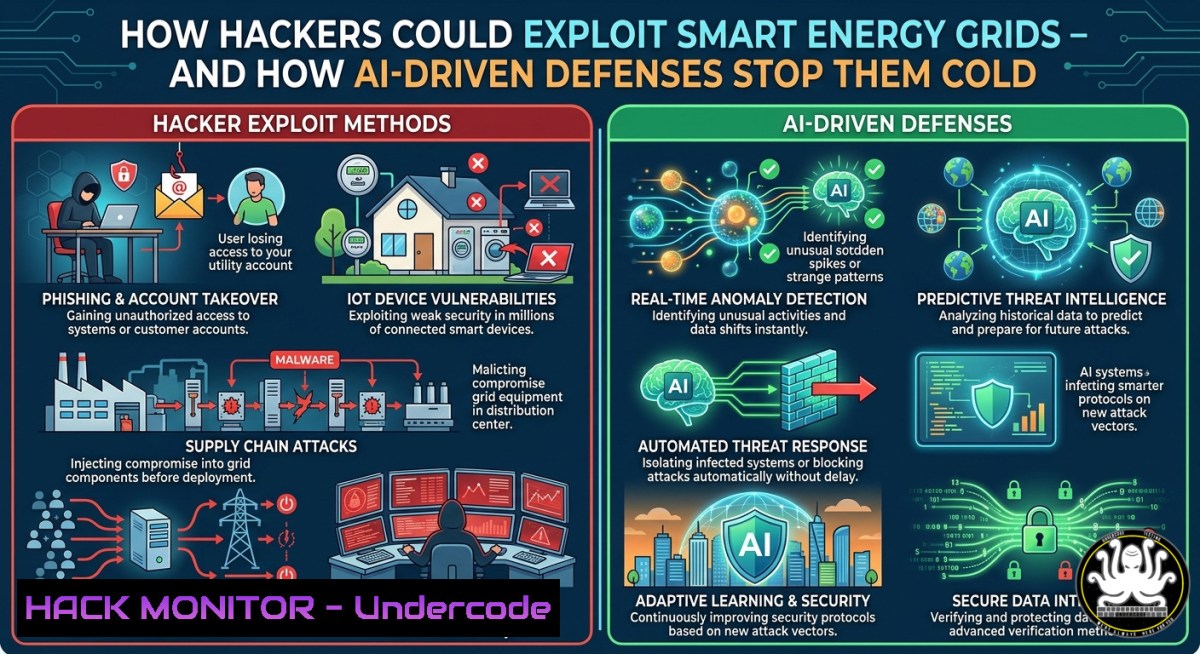
Introduction:
Modern energy companies like Tari Electra are rapidly adopting smart grids, IoT sensors, and AI-driven management systems to improve efficiency and reliability. However, this digital transformation introduces critical cybersecurity risks—from API vulnerabilities in remote terminal units (RTUs) to adversarial machine learning attacks on load forecasting models. Understanding how to harden these systems is essential for preventing blackouts, data theft, and ransomware that targets operational technology (OT).
Learning Objectives:
- Identify common attack vectors in smart energy infrastructure, including insecure SCADA APIs and unauthenticated Modbus traffic.
- Apply Linux and Windows commands to detect anomalies in industrial control system (ICS) logs and network flows.
- Implement AI-based intrusion detection and cloud hardening techniques for hybrid energy management platforms.
You Should Know:
1. Passive Reconnaissance on Energy Management APIs
Many smart energy platforms expose REST APIs for real‑time consumption data and device control. Attackers first scan for open endpoints. Use these commands to simulate an audit of your own energy API gateway.
Step‑by‑step guide:
- Linux (curl & nmap) – Enumerate API endpoints and test for missing authentication:
Scan for common energy API paths
nmap -p 443 --script http-enum -sV api.tarielectra.example

Test endpoint without token
curl -X GET https://api.tarielectra.example/v1/meters/data -H "Content-Type: application/json"
- Windows (PowerShell) – Check for exposed Swagger docs or debug endpoints:
Invoke-WebRequest -Uri "https://api.tarielectra.example/swagger/v1/swagger.json" -Method Get
If the API returns data without an API key, it’s vulnerable. Mitigate by enforcing OAuth2 with short‑lived JWTs and rate‑limiting per IP.
2. Hardening Modbus/TCP Against OT Intrusions
Legacy SCADA systems often use Modbus/TCP (port 502) with zero encryption or authentication. Attackers can write to coils and holding registers to disrupt grid stability.
Step‑by‑step guide – firewall rules & Modbus proxy configuration:
– Linux (iptables) – Restrict Modbus access to trusted SCADA servers only:
sudo iptables -A INPUT -p tcp --dport 502 -s 192.168.10.0/24 -j ACCEPT
sudo iptables -A INPUT -p tcp --dport 502 -j DROP
– Windows Defender Firewall – Allow only specific IPs:
New-NetFirewallRule -DisplayName "Modbus Restrict" -Direction Inbound -Protocol TCP -LocalPort 502 -RemoteAddress 192.168.10.10 -Action Allow
New-NetFirewallRule -DisplayName "Modbus Block Others" -Direction Inbound -Protocol TCP -LocalPort 502 -Action Block
– Advanced mitigation – Deploy a Modbus proxy (e.g., using `mbpoll` + socat) that logs all function codes and rejects writes to critical holding registers (e.g., breaker control addresses).
3. Detecting AI Model Poisoning in Load Forecasting
Smart grids use machine learning to predict demand. Adversaries can inject malicious data points during training, causing the model to under‑forecast and trigger brownouts.
Step‑by‑step guide – validate training data integrity:
- Python script (run on Linux ML server) to compute statistical drift:
import pandas as pd from scipy.stats import ks_2samp historical = pd.read_csv('historical_load.csv') new_batch = pd.read_csv('daily_batch.csv') statistic, p_value = ks_2samp(historical['load_mw'], new_batch['load_mw']) if p_value < 0.05: print("Alert: Distribution shift detected – possible poisoning.") - Tool configuration – Use `Alibi Detect` (open‑source) to monitor real‑time feature drift in production pipelines.
- Mitigation – Implement robust aggregation (trimmed mean or median) and periodic retraining on cryptographically signed historical data.
4. Cloud Hardening for IoT Meter Aggregators
Smart meters push data to cloud hubs (AWS IoT Core, Azure IoT Hub). Misconfigured IAM roles and unencrypted MQTT topics are common entry points.
Step‑by‑step guide – secure IoT cloud architecture:
- AWS CLI – Enforce TLS 1.3 and certificate‑based authentication:
aws iot update-ca-certificate --certificate-id arn:aws:iot:... --new-status ACTIVE --set-as-active
aws iot attach-policy --policy-name DenyUnencryptedMQTT --target <cert_arn>
- Azure CLI – Disable local authentication and require managed identities:
az iot hub device-identity update --device-id meter123 --hub-name MyHub --set authentication.type="certificateAuthority"
- Audit command (Linux) – Check for open MQTT ports on edge gateways:
ss -tuln | grep 1883 Plaintext port – should be blocked; use 8883 (TLS)
- Simulating a Ransomware Attack on an Energy Control Room (Safe Lab)
Understanding attack paths helps defenders prioritise patches. Use this isolated lab scenario to emulate ransomware that encrypts historian databases.
Step‑by‑step guide (Linux VM, do not run on production):
– Create test file – `echo “grid status data” > /var/lib/historian/data.db`
– Simulate encryption – `openssl enc -aes-256-cbc -salt -in data.db -out data.db.enc -k “malicious”`
– Detection – Monitor file integrity with `aide` (Advanced Intrusion Detection Environment):
sudo aideinit
sudo mv /var/lib/aide/aide.db.new.gz /var/lib/aide/aide.db.gz
sudo aide --check | grep "data.db"
– Mitigation – Implement immutable backups (AWS S3 Object Lock, Azure Blob immutable storage) and deploy EDR with ransomware rollback (e.g., CrowdStrike, SentinelOne).
6. Securing Microgrid Controller APIs with Mutual TLS
Modern microgrid controllers use REST APIs for remote dispatch. Without mTLS, man‑in‑the‑middle attacks can replay commands to disconnect solar farms.
Step‑by‑step guide – configure mTLS on an NGINX reverse proxy (Linux):
server {
listen 443 ssl;
ssl_certificate /etc/nginx/ssl/server.crt;
ssl_certificate_key /etc/nginx/ssl/server.key;
ssl_client_certificate /etc/nginx/ssl/ca.crt;
ssl_verify_client on;
location /api/ {
proxy_pass https://microgrid-controller:8080;
}
}
Test with `curl –cert client.crt –key client.key https://api.gateway/api/status`. Without a valid client certificate, the request is rejected.
What Undercode Say:
- Key Takeaway 1: Smart energy companies focus on reliability and innovation, but their expanding attack surface (APIs, Modbus, ML models) is often overlooked until a breach causes physical impact.
- Key Takeaway 2: Defenses must be layered – network segmentation, cryptographic authentication, AI anomaly detection, and immutable backups – because a single vulnerability in an unauthenticated endpoint can lead to full OT compromise.
Analysis: The Tari Electra post highlights unity and progress, yet the energy sector’s digital shift demands equal commitment to cybersecurity. Attackers are already scanning for exposed Modbus ports and poorly secured IoT cloud endpoints. By integrating the commands and configurations above into regular patching and training (e.g., SANS ICS410, GIAC GICSP), organisations can celebrate holidays without fearing a cyber‑induced blackout. AI itself becomes both a target and a shield – adversarial ML can blind forecasting, but drift detection and robust aggregation keep the grid stable.
Prediction: Within 18 months, AI‑powered autonomous response systems will become standard in energy grid security, cutting incident response from hours to milliseconds. However, attackers will shift to poisoning the very data those AI defenders rely on, leading to a new arms race in cryptographic proof‑of‑training and federated learning for OT environments. Companies that invest now in secure‑by‑design energy platforms will not only power the future but also own its resilience.
▶️ Related Video (78% Match):
🎯Let’s Practice For Free:
IT/Security Reporter URL:
Reported By: Eidaladha Eidmubarak – Hackers Feeds
Extra Hub: Undercode MoN
Basic Verification: Pass ✅
🎓 Live Courses & Certifications:
Join Undercode Academy for Verified Certifications
🚀 Request a Custom Project:
Secure, high-velocity infrastructure and disruptive technological engineering. Contact our engineering team for high-tier development and proprietary systems:
[email protected]


