Listen to this Post
Introduction:
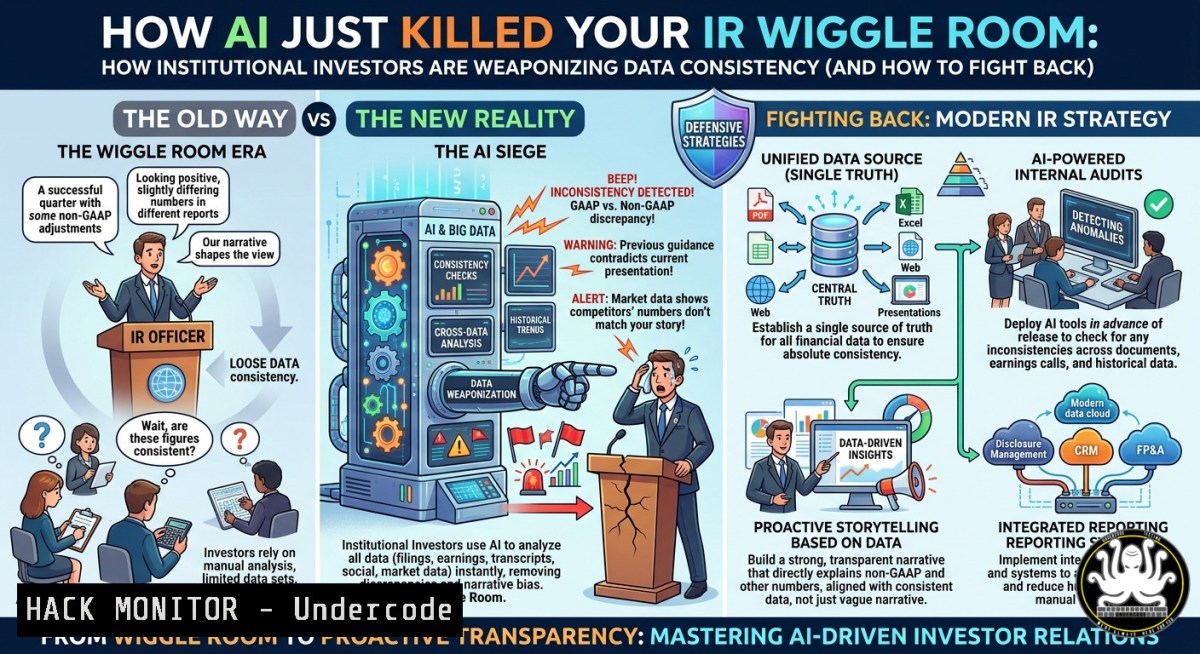
Artificial intelligence is fundamentally reshaping investment decision-making by cross-referencing earnings calls, sustainability reports, and board compositions in seconds—exposing contradictions that once hid between different audiences. For investor relations (IR) teams, this means the loss of narrative wiggle room as AI-driven institutional investors, passive funds, and sell-side researchers demand perfect data consistency across every public disclosure.
Learning Objectives:
- Understand how AI models analyze and cross-reference corporate disclosures to identify inconsistencies
- Implement secure data pipelines and API hardening to protect IR data integrity
- Apply adversarial AI mitigation techniques and cloud security controls for financial analytics workloads
You Should Know:
- The Consistency Trap: How AI Cross-References Your Public Data
AI investment tools now automatically compare your earnings call transcripts against sustainability filings, board meeting minutes, and market signals. Any mismatch—even a subtle rephrasing of risk factors—triggers a red flag. To understand your own exposure, you can build a basic cross-referencing pipeline using open-source LLMs.
Step‑by‑step guide (Linux):
 Install required packages
pip install pandas openai requests beautifulsoup4

Download sample earnings transcript (example)
curl -o earnings.txt https://example.com/transcript.txt

Extract key claims using a local LLM (e.g., Ollama)
ollama pull llama3.2
ollama run llama3.2 "Extract all forward-looking statements from this transcript: $(cat earnings.txt)" > claims.json

Compare with sustainability report
python3 -c "
import json
with open('claims.json') as f, open('sustainability.txt') as s:
claims = json.load(f)
report_text = s.read()
mismatches = [c for c in claims if c.lower() not in report_text.lower()]
print(f'Found {len(mismatches)} potential contradictions')
"
This script helps IR teams identify where their own narrative drifts across documents before investors do.
2. Attack Surface of AI Investment Models
AI models used by institutional investors are vulnerable to data poisoning, model inversion, and adversarial examples. Attackers could subtly alter public IR data to manipulate AI-driven trading decisions. Defending requires understanding your model supply chain.
Step‑by‑step guide (Windows/Linux):
- Windows PowerShell – Check file integrity after disclosure:
Get-FileHash earnings_release.pdf -Algorithm SHA256
Store hash in secure ledger; re-run after distribution
- Linux – Test for model inversion (using TensorFlow Privacy):
pip install tensorflow-privacy
python3 -c "
from tensorflow_privacy.privacy.analysis import compute_dp_sgd_privacy
Estimate privacy loss from a sentiment analysis model trained on IR data
n = 10000  number of samples
batch_size = 256
noise_multiplier = 1.1
epochs = 5
delta = 1e-5
epsilon = compute_dp_sgd_privacy.compute_dp_sgd_privacy(n, batch_size, noise_multiplier, epochs, delta)
print(f'Privacy budget ε = {epsilon:.2f}')
"
Low epsilon indicates strong resistance to model inversion; high epsilon means your data could be reconstructed by adversarial investors.
3. Hardening Your IR Data Against AI Scrutiny
Proactive data governance—not obfuscation—is the answer. Implement cryptographic integrity checks, timestamped audit logs, and version-controlled disclosures so that any change is trackable and explainable.
Step‑by‑step guide (cross‑platform):
- Linux – Create an immutable disclosure ledger:
Generate GPG key and sign each release
gpg --full-generate-key
gpg --detach-sign --armor Q3_2024_report.pdf
Verify later
gpg --verify Q3_2024_report.pdf.asc Q3_2024_report.pdf
- Windows – Enable PowerShell transcription for all IR file modifications:
Start-Transcript -Path "C:\IR_Audit\disclosure_changes.log" -Append
Set-Acl -Path "C:\IR_Data" -AclObject (Get-Acl -Path "C:\IR_Data")
Stop-Transcript
Regularly review these logs for unauthorized changes that could be exploited by AI scrapers.
4. API Security for Financial Data Feeds
Many AI investment tools ingest real-time IR data via REST APIs. Unsecured endpoints can leak sensitive information or be poisoned. Implement JWT authentication, rate limiting, and input validation.
Step‑by‑step guide (testing API security with `curl`):
 Test for missing authentication
curl -X GET https://your-ir-api.com/v1/earnings -H "Content-Type: application/json"
 Should return 401; if 200, patch immediately

Check for SQL injection on a parameter
curl "https://your-ir-api.com/v1/search?q=' OR '1'='1" -v

Implement a secure endpoint example using Flask (Python)
python3 -c "
from flask import Flask, request, jsonify
from functools import wraps
import jwt

app = Flask(<strong>name</strong>)
app.config['SECRET_KEY'] = 'complex-secret'

def token_required(f):
@wraps(f)
def decorated(args, kwargs):
token = request.headers.get('Authorization')
if not token:
return jsonify({'message': 'Token missing'}), 401
try:
jwt.decode(token, app.config['SECRET_KEY'], algorithms=['HS256'])
except:
return jsonify({'message': 'Invalid token'}), 401
return f(args, kwargs)
return decorated

@app.route('/v1/earnings', methods=['GET'])
@token_required
def get_earnings():
return jsonify({'data': 'Q3 results here'}), 200

if <strong>name</strong> == '<strong>main</strong>':
app.run(ssl_context='adhoc')
"
Deploy behind an API gateway with rate limits (e.g., 100 requests/minute per IP).
5. Cloud Hardening for AI Analytics Workloads
IR data processed in cloud environments (AWS, Azure) faces risks from misconfigured storage buckets, excessive IAM roles, and unencrypted data pipelines. Audit your cloud posture with native CLI tools.
Step‑by‑step guide (AWS CLI):
 List all S3 buckets with public access
aws s3api list-buckets --query 'Buckets[?PublicAccessBlockConfiguration==<code>null</code>]'

Enable default encryption on a bucket
aws s3api put-bucket-encryption --bucket ir-data-bucket --server-side-encryption-configuration '{
"Rules": [
{"ApplyServerSideEncryptionByDefault": {"SSEAlgorithm": "AES256"}}
]
}'

Enforce MFA for IAM users accessing IR data
aws iam update-account-password-policy --require-uppercase-characters --require-lowercase-characters --require-numbers --minimum-password-length 14
Azure CLI equivalent:
az storage account list --query "[?contains(primaryEndpoints.blob, 'ir')].name"
az storage account update --name irstorage --resource-group ir-rg --encryption-services blob
Run these audits weekly to prevent data leaks that AI scrapers could exploit.
- Vulnerability Exploitation: How Adversarial AI Can Mislead Investors
Attackers can generate adversarial examples—subtly altered IR disclosures that fool sentiment analysis models. Understanding this helps IR teams defend against AI-driven market manipulation.
Step‑by‑step guide (Python – FGSM attack on a sentiment model):
import torch
import torch.nn as nn
import torch.optim as optim

Simple sentiment model (placeholder)
class SentimentNet(nn.Module):
def <strong>init</strong>(self):
super().<strong>init</strong>()
self.fc = nn.Linear(100, 2)
def forward(self, x):
return self.fc(x)

model = SentimentNet()
 Assume x is a vectorized sentence from an IR press release
x = torch.randn(1, 100)
y_true = torch.tensor([bash])  positive sentiment

Fast Gradient Sign Method
loss_fn = nn.CrossEntropyLoss()
x.requires_grad = True
output = model(x)
loss = loss_fn(output, y_true)
model.zero_grad()
loss.backward()
epsilon = 0.1
x_adv = x + epsilon  x.grad.sign()

print(f"Original prediction: {torch.argmax(model(x))}")
print(f"Adversarial prediction: {torch.argmax(model(x_adv))}")
To mitigate, ensemble multiple models or use adversarial training on your own IR data.
- Training Courses to Upskill IR Teams and IT Staff
IR professionals must now speak the language of AI security and data consistency. Recommended training courses include:
– AI for Finance: MIT’s “AI in Investment Management” (edX)
– Cybersecurity for Investor Relations: (ISC)² CC certification
– Data Ethics & Governance: IAPP’s “AI Governance Professional”
– Cloud Security for Financial Data: AWS Security Specialty or Azure Security Engineer
Self-study command (Linux) to monitor AI model drift:
 Install EvidentlyAI for model monitoring
pip install evidently
python3 -c "
import pandas as pd
from evidently import ColumnMapping
from evidently.report import Report
from evidently.metrics import ColumnDriftMetric
 Compare current quarter disclosures vs last quarter
ref_data = pd.read_csv('last_quarter_disclosures.csv')
curr_data = pd.read_csv('curr_quarter_disclosures.csv')
report = Report(metrics=[ColumnDriftMetric(column_name='sentiment_score')])
report.run(reference_data=ref_data, current_data=curr_data)
report.save_html('drift_report.html')
"
Deploy this weekly to catch inconsistencies before AI investors do.
What Undercode Say:
- Key Takeaway 1: Consistency is now a vulnerability. AI investment models automatically flag any narrative drift between your earnings calls, sustainability filings, and board minutes. The old practice of tailoring messages to different audiences has become a liability.
- Key Takeaway 2: Proactive data governance and cryptographic integrity checks are the new IR superpowers. By implementing immutable disclosure ledgers, API security, and adversarial training, IR teams can turn AI scrutiny into a competitive advantage rather than a threat.
Analysis (Undercode’s extended view): The shift described at the AIRA Annual Conference is not just about speed—it is about the loss of interpretive flexibility. Historically, IR teams relied on human analysts missing subtle contradictions across hundreds of pages. AI collapses that gap. Institutional investors now deploy natural language processing and knowledge graphs to cross‑reference every public word. Consequently, IR teams must adopt a “zero‑contradiction” discipline. This requires technical controls: automated drift detection, signed disclosures, and real‑time consistency checks. Failure to do so will result in automated downgrades by AI‑driven funds, loss of credibility, and potential regulatory scrutiny for misleading disclosures. The smartest IR leaders are already hiring data engineers and forensic accountants to validate their own narratives before release. In three years, “AI‑ready IR” will be a standard job requirement.
Prediction:
Within 24 months, major stock exchanges will mandate machine‑readable, cryptographically signed disclosures to prevent AI‑discovered contradictions. Regulators will deploy their own AI auditors to scan public filings for inconsistencies, leading to a new class of enforcement actions. Simultaneously, hedge funds will weaponize adversarial AI to create synthetic contradictions—forcing IR teams to invest in defensive AI monitoring as a non‑negotiable operational expense. The future of investor relations is not storytelling; it is verifiable, consistent, and secure data engineering.
▶️ Related Video (68% Match):
🎯Let’s Practice For Free:
IT/Security Reporter URL:
Reported By: Aira2026 Investorrelations – Hackers Feeds
Extra Hub: Undercode MoN
Basic Verification: Pass ✅
🎓 Live Courses & Certifications:
Join Undercode Academy for Verified Certifications
🚀 Request a Custom Project:
Secure, high-velocity infrastructure and disruptive technological engineering. Contact our engineering team for high-tier development and proprietary systems:
[email protected]


