
Listen to this Post
Introduction:
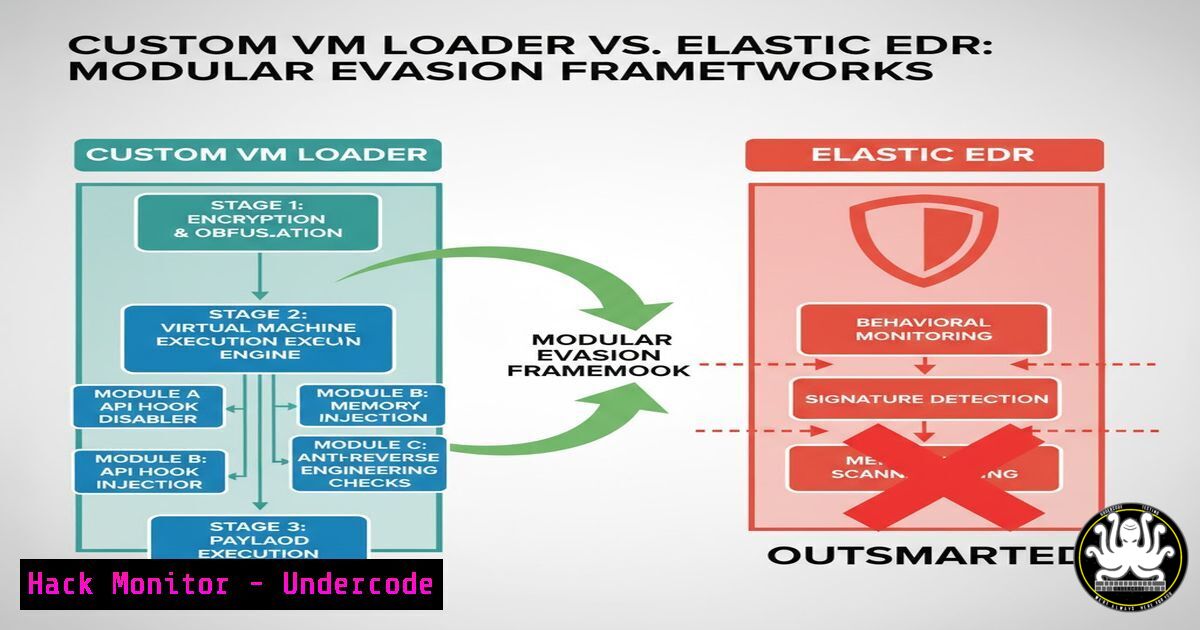
In the constant arms race between red team operators and endpoint detection and response (EDR) solutions, the ability to evade heuristic analysis and behavioral detection has become the holy grail of adversary simulation. Recent developments in modular Virtual Machine (VM) based loaders have demonstrated that it is possible to execute unmodified, “vanilla” command-and-control (C2) beacons—specifically Havoc—against fully enabled Elastic EDR without triggering any alerts. This advancement shifts the focus from modifying the malware itself to manipulating the execution environment and the loader’s architecture, utilizing sophisticated evasion techniques at the kernel and user-land levels.
Learning Objectives:
- Understand the architecture of a modular VM loader and how it isolates malicious payloads from the EDR’s inspection surface.
- Analyze the specific evasion techniques used to bypass Elastic EDR’s “prevent” mode with an unmodified Havoc beacon.
- Learn how to implement and test custom sleep obfuscation, API unhooking, and stack spoofing techniques in a controlled lab environment.
You Should Know:
1. The Anatomy of a Modular VM-Based Loader
The core innovation in this updated framework is its modularity. Instead of relying on a monolithic payload, the loader acts as an orchestrator that can “plug in” various evasion modules. At its heart, it leverages hardware-assisted virtualization or lightweight user-land hooks to create a sandboxed execution space. This allows the loader to intercept system calls (syscalls) made by the beacon and manipulate the data returned to the EDR.
Step‑by‑step guide: Setting up a basic syscall interception framework (Linux perspective)
While the original project is Windows-centric, understanding syscall interception is crucial. On Linux, this is often done with ptrace. For Windows red teaming, we replicate this using dynamic syscall resolution.
1. Extract Syscall Numbers: Use a tool like `SysWhispers2` to generate assembly stubs that invoke system calls directly from user land, bypassing the Windows API (ntdll.dll) where EDRs typically place hooks.
 Example: Generating syscalls for NtAllocateVirtualMemory and NtProtectVirtualMemory
python3 syswhispers.py -f NtAllocateVirtualMemory,NtProtectVirtualMemory -o syscalls
2. Integrate into Loader: The loader calls these generated stubs instead of the standard Windows APIs. This prevents the EDR from seeing the call at the user-land hook point.
3. Execution Flow: Shellcode (Havoc Beacon) -> Loader -> Direct Syscall -> Kernel. The EDR, relying on its user-land hooks, misses the context switch entirely.
- Bypassing Elastic EDR with Sleep Obfuscation and Beacon Stomping
Elastic EDR, like many next-gen AVs, monitors memory segments for changes in permissions (e.g., from RW to RX) and scans the contents of heap memory during idle periods (beacon check-ins). The “vanilla” Havoc beacon is typically memory-resident and readable. The VM loader counters this by implementing advanced sleep obfuscation.
Step‑by‑step guide: Implementing Sleep Obfuscation (Conceptual PowerShell for testing)
Note: This is a simplified demonstration of the concept; production versions use C/C++ and ROP chains.
1. Encrypt Beacon in Memory: Before the beacon “sleeps” (waits for the next C2 check-in), the loader encrypts the beacon’s memory section.
2. Change Memory Permissions: The loader changes the memory page permissions from RX (Execute-Read) to RW (Read-Write) or No Access.
// Pseudo-code concept
void SleepObfuscation(SIZE_T size, LPVOID beaconAddress) {
// 1. Change Permissions to RW
VirtualProtect(beaconAddress, size, PAGE_READWRITE, &oldProtect);

// 2. Encrypt the beacon content (simple XOR)
for (int i = 0; i < size; i++) {
((PBYTE)beaconAddress)[bash] ^= 0xFA; // XOR Key
}

// 3. Change Permissions to NO ACCESS (or RW) to prevent scanning
VirtualProtect(beaconAddress, size, PAGE_NOACCESS, &oldProtect);

// 4. Sleep (EDR cannot scan PAGE_NOACCESS memory)
Sleep(5000); // 5 seconds

// 5. Revert: Change Permissions to RW, Decrypt, Change to RX
VirtualProtect(beaconAddress, size, PAGE_READWRITE, &oldProtect);
for (int i = 0; i < size; i++) {
((PBYTE)beaconAddress)[bash] ^= 0xFA; // Decrypt
}
VirtualProtect(beaconAddress, size, PAGE_EXECUTE_READ, &oldProtect);
}
3. Result: During the sleep interval, the beacon is either encrypted or inaccessible, evading memory scans.
3. API Unhooking and HammerPants Technique
Most EDRs hook user-land APIs in `ntdll.dll` and `kernel32.dll` to monitor process behavior. The modular loader can “unhook” these DLLs by loading fresh, clean copies from disk (ntdll.dll) directly into memory, overwriting the hooked sections. Combined with the “HammerPants” technique (spoofing the return address on the stack to avoid call stack detection), the loader ensures that even if a syscall is monitored, the call stack appears to originate from a legitimate, signed Microsoft binary rather than the malicious loader.
Step‑by‑step guide: Unhooking ntdll.dll (Windows command perspective – Lab Setup)
1. Identify Hooked DLLs: Use a tool like `Process Hacker` to view loaded modules of your process.
2. Simulate Unhooking (Manual): In a lab environment, to test if detections are hook-based, you can suspend the process and attempt to replace the `.text` section.
 This is NOT a direct command, but a debugger command (WinDbg)
 Find base address of ntdll: lm m ntdll
 Read fresh copy from disk and compare with in-memory copy.
3. Automation in Code: The loader performs the following at runtime:
– Opens a handle to C:\Windows\System32\ntdll.dll.
– Reads the clean `.text` section.
– Calculates the address of the hooked `.text` section in the current process.
– Uses `WriteProcessMemory` or `NtWriteVirtualMemory` (via direct syscall) to overwrite the hooked bytes with the clean bytes.
4. Configuring the Havoc C2 for Minimal Footprint
Since the loader allows the use of a “vanilla” beacon, the configuration of the Havoc C2 framework itself becomes critical. The team server must be configured to use egress profiles that mimic legitimate traffic (HTTPS with valid JA3/S signatures) to avoid network detection, complementing the endpoint evasion.
Step‑by‑step guide: Hardening Havoc C2 Profiles
- Modify the Havoc Profile: Edit the profile file (e.g.,
/havoc/client/profiles/havoc.yaotl).
2. Configure HTTPS Listener:
 Example Snippet for HTTPS Evasion
Name: "EvasiveHTTPS"
Listener: "https"
Hosts:
- "cdn.cloudflare-tls.com"  Mimic a CDN
Port: 443
TLS:
Cert: "server.crt"  Use a valid, signed certificate from a free CA
Key: "server.key"
JA3: "771,4865-4866-4867-49195-49199-49196-49200-...-10-11"  Mimic Chrome JA3
3. Restart Listener: Load the profile in the Havoc client to apply the stealthier network configuration.
What Undercode Say:
- Key Takeaway 1: The era of relying solely on packed or obfuscated malware is over; modern evasion requires a deep understanding of the operating system’s internals (syscalls, memory management, VAD) to manipulate what the EDR sees.
- Key Takeaway 2: The success of a “vanilla” beacon against a top-tier EDR like Elastic proves that detection engineers must now focus on correlation of events across the kill chain (process creation + network connection + unusual memory allocation) rather than relying on specific malware signatures.
Analysis:
This development represents a significant leap in red team tradecraft. By abstracting the evasion logic into a modular loader, operators can now quickly adapt to new EDR signatures without recompiling their core implants. The ability to run unmodified beacons suggests that the detection gap has shifted from the payload to the loader’s execution context. For defenders, this means that monitoring for the loader’s behavior—such as unusual VM allocation, thread creation anomalies, and direct syscall invocation—is now more critical than scanning for known beacon strings. The framework’s mention of “post-exp stuff” implies that even interactive actions (like file browsing or token manipulation) can be proxied through this clean environment, making traditional behavior-based alerts ineffective if they are not correlated with the initial loader’s PID.
Prediction:
In the next 12-18 months, we will see EDR vendors respond by moving detection logic further into the kernel (kernel callbacks) and leveraging eBPF-like capabilities on Windows (once available) to monitor raw syscalls regardless of their origin. Simultaneously, red team frameworks will adopt “position-independent code” (PIC) loaders that are generated per-execution, making them impossible to signature and forcing a complete shift towards AI-driven behavioral analysis that understands the “intent” of a sequence of syscalls, rather than just the syscalls themselves.
▶️ Related Video (78% Match):
🎯Let’s Practice For Free:
IT/Security Reporter URL:
Reported By: Arthur Minasyan – Hackers Feeds
Extra Hub: Undercode MoN
Basic Verification: Pass ✅


