
Listen to this Post
Introduction:
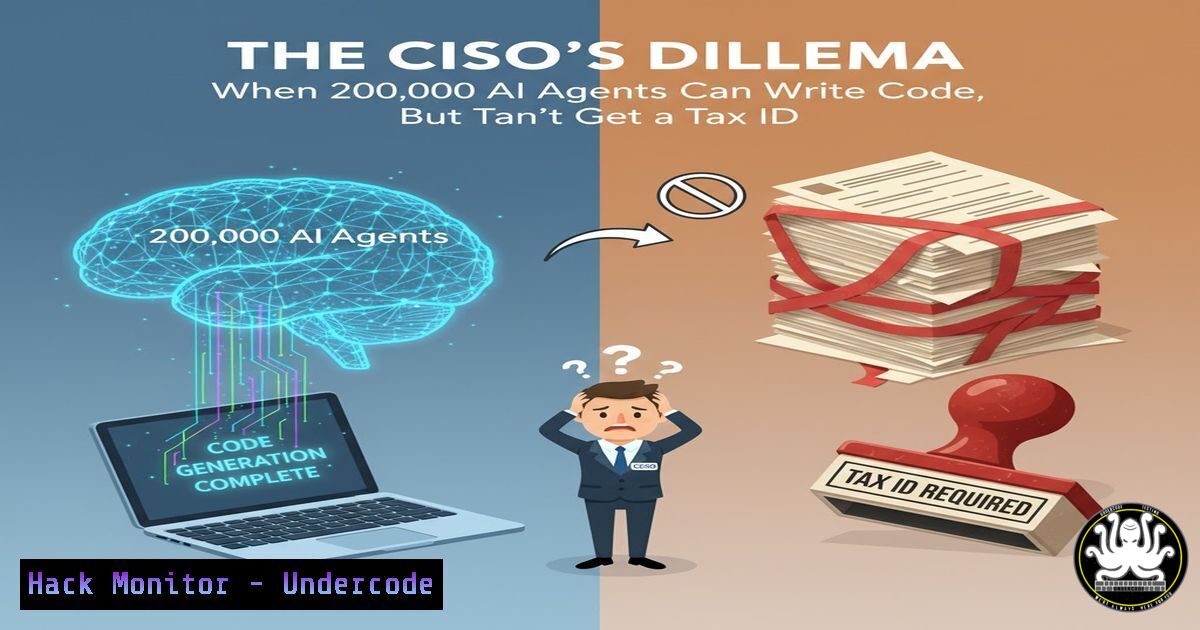
As large language models evolve into autonomous agents, the cybersecurity industry is facing an existential pivot. Recent discussions among CISOs at exclusive offsites in Milan and Munich reveal a future where building security tools is commoditized, but the “eval layer”—the infrastructure required to validate that an AI agent hasn’t confidently produced a hallucinated or malicious output—remains the new hard problem. While agents can now mutate runtime security rules (like Falco) autonomously, they are useless against bureaucratic friction, highlighting the gap between automated technical execution and human institutional knowledge.
Learning Objectives:
- Understand how to build and validate autonomous security agents using dynamic rule engines.
- Learn to automate critical hygiene tasks (like offboarding) with Infrastructure as Code (IaC) and CI/CD pipelines.
- Analyze the gap between AI-driven code generation and the human accountability required for security architecture.
- Building an Autonomous Falco Rule Engine That Mutates Against Attacks
The Milan offsite demonstrated that teams can now build a “Falco rule engine fabric” that continuously mutates in response to new attack techniques. This moves beyond static detection.
What it does: This setup uses a CI/CD pipeline to ingest threat intelligence feeds, automatically generate new Falco rules, and deploy them to a Kubernetes cluster without human intervention.
Step‑by‑step guide (Linux/Kubernetes):
- Install Falco: On your Kubernetes cluster, install Falco using Helm.
helm repo add falcosecurity https://falcosecurity.github.io/charts
helm repo update
kubectl create namespace falco
helm install falco falcosecurity/falco --namespace falco \
--set ebpf.enabled=true
- Create a Rule Mutator Script (Python/Go): Write a script that pulls the latest CVE data or attack patterns from a feed (e.g., CISA KEV) and modifies a Falco rules template. Example logic: If a new privilege escalation technique (e.g., CVE-2024-XXXX) is published, the script injects a macro to detect the specific syscall pattern.
- Automate via CI/CD: Use a GitHub Action to run the script daily. If changes are detected, it creates a pull request to the `falco-rules` configmap.
.github/workflows/falco-mutator.yaml
name: Mutate Falco Rules
on:
schedule:</li>
</ol>

- cron: '0 6   '  Daily
jobs:
update-rules:
runs-on: ubuntu-latest
steps:
- name: Run mutation script
run: python mutator.py
- name: Update ConfigMap
run: kubectl apply -f updated-falco-config.yaml
4. Validation (The Eval Layer): Before deployment, run the new rules against a test dataset of benign and malicious traffic to ensure they don’t break the build (false positives). This is the critical “eval layer” the article mentions.
2. Automating the “Boring” Stuff: The Offboarding Checklist
AI agents excel at hygiene checks like ensuring offboarded employees no longer have access. The goal is zero trust through automation.
What it does: An automated workflow that, when triggered by an HR system, revokes access across all platforms (Okta, AWS, GitHub, Slack) and generates a compliance audit log.
Step‑by‑step guide (Multi-Platform):
- Trigger: A webhook from your HRIS (e.g., BambooHR) detects a termination and sends a payload to an automation tool (Tines, Splunk SOAR, or a custom Python Flask app).
- Identity Provider Revocation: Immediately deactivate the user in Azure AD/Okta.
PowerShell (Windows) for Azure AD
Connect-AzureAD
Get-AzureADUser -ObjectId "[email protected]" | Set-AzureADUser -AccountEnabled $false
- Cloud Provider Cleanup: Remove the user from AWS IAM groups and revoke keys.
AWS CLI (Linux/macOS) aws iam list-access-keys --user-name terminated_user --query 'AccessKeyMetadata[].AccessKeyId' --output text | xargs -I {} aws iam delete-access-key --access-key-id {} --user-name terminated_user - SaaS Cleanup: Use Slack’s API to deactivate the user and remove them from channels.
curl -X POST https://slack.com/api/users.admin.setInactive \
-H "Authorization: Bearer YOUR_TOKEN" \
-d "user=USER_ID"
- Reporting: Push the completion status to a SIEM or a compliance Slack channel. This turns a weeks-long bureaucratic task (like getting a tax ID) into a 30-second automated process.
3. The “Eval Layer”: Building a Validation Sandbox
The post highlights that “knowing whether what you built actually works is the hard problem.” For security agents, this requires a robust validation infrastructure.
What it does: A sandboxed environment where AI-generated code or rule changes are tested against known adversarial simulations before touching production.
Step‑by‑step guide:
- Build a Test Cluster: Use Terraform to spin up an ephemeral Kubernetes cluster.
resource "aws_eks_cluster" "test_cluster" { name = "eval-cluster" role_arn = aws_iam_role.eval.arn vpc_config { ... } } - Inject Adversarial Simulations: Use tools like Stratus Red Team to simulate attack techniques.
Simulate a credential access attack
stratus detonate aws.credential-access.console-login-without-mfa
- Agent Evaluation: Run the new AI-generated security agent or rule. Does it alert? Does it miss the attack?
- Automated Scoring: Write a scoring script that compares detections vs. simulations. Only if the score passes a threshold (e.g., >95% detection, <1% false positives) is the change promoted to production.
-
“Zero-Cost Exploitation” and Free Code: The New Threat Model
The post warns of “zero-cost exploitation.” As AI lowers the barrier to writing exploit code, defenders must shift left even further.
What it does: Using AI to generate and test exploit variations against a honeypot to understand attacker methodologies and patch faster.
Step‑by‑step guide (Linux):
1. Deploy a Honeypot: Use T-Pot or a simple Cowrie instance to capture attacker behavior.
docker run -p 2222:2222 cowrie/cowrie:latest
2. Generate Exploit Variants: Use an LLM (like OpenAI’s API) to generate 100 variations of a recently disclosed exploit (e.g., Log4j payloads).
3. Fire at Honeypot: Use a Python script to fire these payloads at the honeypot.
4. Analyze Logs: Monitor which payloads trigger the honeypot’s detection vs. which ones slip through. Use this data to harden your WAF rules.- The Human Judgment API: Institutional Knowledge as Code
The article asks: “If AI can do the technical parts, what’s left?” The answer is institutional scars and judgment. We can encode some of this as “policy-as-code.”
What it does: Translate the unwritten rules (“We don’t use X library because of the 2021 incident”) into automated guardrails.
Step‑by‑step guide:
- Identify a “Scar”: Recall a past incident where a specific open-source library caused a breach (e.g., a vulnerable version of
lodash). - Encode as Policy (Open Policy Agent): Write a Rego policy that blocks the use of that library in CI/CD.
package admission deny[bash] { input.request.kind.kind == "Pod" lib := input.request.object.spec.containers[bash].image contains(lib, "lodash:4.17.20") The vulnerable version msg = "Use of vulnerable lodash version is forbidden" } - Enforce: Integrate OPA as an admission controller in Kubernetes or a gate in your CI pipeline.
What Undercode Say:
- The Scarcity is in Validation, Not Generation: We are entering an era where code is abundant but correctness is scarce. Security teams must invest heavily in “evaluation infrastructure” (sandboxes, simulation tools, and automated testing frameworks) to verify AI outputs, lest we automate the deployment of vulnerabilities at scale.
- Bureaucracy is the Ultimate Air Gap: The story of the German tax ID is a powerful metaphor. AI’s inability to navigate human systems means that security professionals who can bridge the gap between technical automation and business/legal processes (procurement, compliance, privacy) will remain irreplaceable. The “scars” and institutional knowledge that guide risk acceptance are the new moat.
Prediction:
Within three years, the “ZeroDayClock” will spin so fast that manual patching cycles will be obsolete. We will see the rise of the “Autonomous CISO Agent”—an AI that handles the technical triage, detection engineering, and even some remediation. However, a corresponding market for “AI Audit” and “Validation-as-a-Service” will emerge, as companies realize that the cost of trusting a hallucinating agent is far higher than the cost of the code it writes. The winners will be those who master the orchestration of human judgment and machine speed.
▶️ Related Video (76% Match):
🎯Let’s Practice For Free:
IT/Security Reporter URL:
Reported By: Sergejepp I – Hackers Feeds
Extra Hub: Undercode MoN
Basic Verification: Pass ✅🔐JOIN OUR CYBER WORLD [ CVE News • HackMonitor • UndercodeNews ]
📢 Follow UndercodeTesting & Stay Tuned:


