Listen to this Post
Introduction:
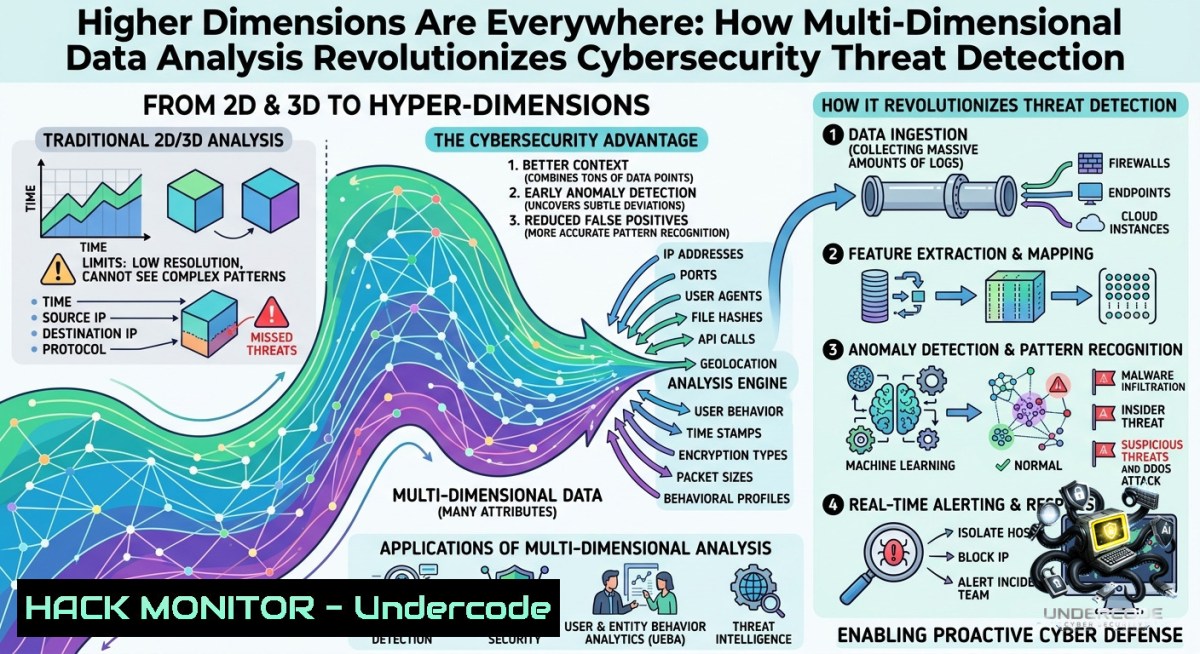
In cybersecurity, threats rarely exist in isolation; they manifest across multiple layers of an IT environment—network logs, endpoint telemetry, user behavior, and cloud configurations. Analyzing these “higher dimensions” of data allows defenders to uncover stealthy attack patterns that evade traditional flat-file correlation. This article extracts actionable technical insights from recent discussions on dimensional analytics, mapping them to real-world security operations, AI-driven training, and hands-on hardening techniques.
Learning Objectives:
– Apply multi-dimensional feature extraction to detect anomalous network traffic using Python and SIEM queries.
– Implement Linux/Windows commands to enrich security telemetry with contextual dimensions (time, user, process tree).
– Configure an AI-based anomaly detection pipeline that leverages dimensionality reduction for threat hunting.
You Should Know:
1. Extracting Higher-Dimensional Telemetry from Linux and Windows Logs
The core idea: traditional log analysis looks at events as points in time (one dimension). Adding dimensions like process lineage, network socket states, and file system hashes creates a hyper-dimensional space where outliers indicate compromise.
Linux – Enrich Audit Logs with Process Ancestry
Use `ausearch` to pull events and `pstree` to add the parent-child dimension:
 Search for suspicious execve calls and map process tree
ausearch -m execve -ts recent | grep "comm=" | while read line; do
pid=$(echo $line | grep -oP 'pid=\K[0-9]+')
echo "Process tree for PID $pid:"
pstree -p $pid
done
Windows – Add User Session and Privilege Dimensions
PowerShell to correlate security event ID 4624 (logon) with subsequent process creation (4688):
Get-WinEvent -FilterHashtable @{LogName='Security'; ID=4624} | ForEach-Object {
$logonId = $_.Properties[bash].Value
Get-WinEvent -FilterHashtable @{LogName='Security'; ID=4688} | Where-Object {
$_.Properties[bash].Value -eq $logonId
} | Select-Object TimeCreated, @{n='NewProcess';e={$_.Properties[bash].Value}}
}
Step‑by‑step guide
1. Collect baseline logs over 7 days to define normal dimensional ranges.
2. Use `jq` to flatten JSON logs (e.g., from Suricata or Sysmon) into CSV with columns for timestamp, user, PID, parent PID, source IP, destination IP, and port.
3. Compute pairwise correlations – sudden deviation in (user, process) dimension often indicates lateral movement.
2. AI-Powered Anomaly Detection Using Dimensionality Reduction (PCA/t-SNE)
Higher dimensions create sparsity, making traditional threshold alerts noisy. Principal Component Analysis (PCA) compresses dimensions while preserving variance – anomalies appear as points far from the principal hyperplane.
Python Implementation with Scikit-learn
import pandas as pd
from sklearn.decomposition import PCA
from sklearn.preprocessing import StandardScaler

 Load enriched log data (features: hour_of_day, login_count, unique_processes, outbound_conns)
df = pd.read_csv('telemetry.csv')
scaler = StandardScaler()
scaled = scaler.fit_transform(df)

pca = PCA(n_components=3)
reduced = pca.fit_transform(scaled)
 Compute reconstruction error
reconstructed = pca.inverse_transform(reduced)
mse = ((scaled - reconstructed)2).mean(axis=1)
anomalies = df[mse > mse.quantile(0.99)]
print(f"Detected {len(anomalies)} high-dimensional outliers")
Training Course Suggestion – “Applied Machine Learning for SOC Analysts” (SANS SEC595 or equivalent) covers real-time feature engineering and PCA on streaming data.
Step‑by‑step guide
1. Normalize numerical dimensions (logon count, bytes transferred, process frequency).
2. Apply PCA and keep components explaining ≥95% variance.
3. Monitor the reconstruction error – a sudden spike indicates a new adversarial dimension (e.g., beaconing over HTTPS).
4. Integrate with SIEM using a custom alert rule when z-score of reconstruction error > 3.
3. Cloud Hardening Through Multi-Dimensional IAM Policies
AWS, Azure, and GCP logs capture identity dimensions: IP, region, resource type, and API call. Attackers often try to flatten these dimensions (e.g., using a single compromised key from a new location). Defend by enforcing dimension‑aware policies.
AWS Example – Conditional Access Based on Two Dimensions
{
"Version": "2012-10-17",
"Statement": [{
"Effect": "Deny",
"Action": "ec2:RunInstances",
"Condition": {
"StringNotEqualsIfExists": {
"aws:SourceIp": "192.168.0.0/16",
"aws:RequestedRegion": "us-east-1"
},
"BoolIfExists": {"aws:MultiFactorAuthPresent": false}
}
}]
}
Mitigation & Exploitation Note – Attackers bypass dimension controls by combining valid dimensions (e.g., using a VPN inside the source IP range but with a spoofed region). Audit with CloudTrail:
aws cloudtrail lookup-events --lookup-attributes AttributeKey=EventName,AttributeValue=RunInstances --query 'Events[].CloudTrailEvent' | jq '.[] | fromjson | .userIdentity, .sourceIPAddress, .requestParameters'
Step‑by‑step guide
1. Enumerate all IAM actions used in your environment over 30 days.
2. Classify each action into required dimensions (IP, MFA, resource tag, time of day).
3. Create deny rules that require at least 2 independent dimensions for sensitive APIs.
4. Use AWS Config to detect policies missing dimension constraints.
4. Vulnerability Exploitation in Hyper-Dimensional Data Streams (Real-Time SIEM Evasion)
Attackers manipulate dimensions to cause alert collisions – for example, flooding logs with high-cardinality dimensions (randomized usernames) to overwhelm correlation engines. This is a “dimensionality attack.”
Detection via Cardinality Limiting in Splunk or Elastic
Elasticsearch query to detect excess distinct values in a dimension:
{
"aggs": {
"high_card_users": {
"cardinality": { "field": "user.name" }
},
"threshold_check": {
"bucket_script": {
"buckets_path": { "card": "high_card_users" },
"script": "params.card > 10000 ? 1 : 0"
}
}
}
}
Linux Mitigation – Rate Limit Syslog Dimensions
Use `iptables` hashlimit to drop logs from a single source that exceed 500 distinct usernames per minute:
iptables -A INPUT -p udp --dport 514 -m hashlimit --hashlimit-1ame log_flood \
--hashlimit-above 500/minute --hashlimit-burst 1000 --hashlimit-mode srcip,dstport \
-j DROP
Step‑by‑step guide
1. Profile normal dimension cardinality per minute for each log source.
2. Configure SIEM alerts for cardinality spikes > 3 standard deviations above baseline.
3. Deploy an edge filter (Logstash or Fluentd) to drop events that introduce more than 1,000 new dimension values per minute.
4. Test by simulating a randomized username attack using `python -c “for i in range(10000): print(f’user{i}’)” | nc -u target 514`.
5. Training Course Integration – Building a Cyber Range for High-Dimensional Defense
Offensive and defensive teams need practice with multi-dimensional data. A recommended lab: deploy ELK stack + Zeek (formerly Bro) on a small network, then generate attacks that vary along dimensions (time jitter, process hopping, IP rotation).
Lab Setup Commands
 Deploy Zeek with extended dimension logging
sudo zeek -e 'redef Log::default_rotation_interval = 1hr;' -C -i eth0
 Convert conn.log to dimensional CSV
zeek-cut id.orig_h id.resp_h proto service duration orig_bytes resp_bytes < conn.log > conn_dims.csv
Windows Training Module – Use Sysmon config to capture 20+ dimensions:
<Sysmon>
<EventFiltering>
<ProcessCreate onmatch="include">
<CommandLine condition="contains">-enc</CommandLine>
</ProcessCreate>
</EventFiltering>
</Sysmon>
Then visualize with `Get-SysmonEvent | Group-Object -Property User, ParentProcess, DestinationIP | Sort-Object Count`.
Step‑by‑step guide
1. Provision three VMs: attacker (Kali), victim (Windows 10), and SIEM (Ubuntu with ELK).
2. Install Zeek and Sysmon, forwarding logs to ELK.
3. Launch a simulated multi‑stage attack: phishing → PowerShell Empire → C2 over random ports.
4. Use Kibana’s heatmap to correlate dimensions (time, process, source IP).
5. Build an ML model (H2O or Spark) that scores each event’s dimensional rarity.
What Undercode Say:
– Key Takeaway 1: Higher dimensions are not abstract math – they are a practical lens for stacking otherwise mundane logs into a decisive threat detection matrix.
– Key Takeaway 2: Defensive success hinges on balancing dimension richness (reducing false negatives) with computational cardinality controls (preventing DOS on your SIEM).
– Analysis: Most security teams only look at 3-5 dimensions (time, IP, user, action). By expanding to 10+ dimensions (process tree entropy, TLS SNI, registry delta, memory protection flags), you can detect zero‑day living‑off‑the‑land attacks that mimic normal behavior in any single dimension but not in aggregate. The post’s emphasis on “higher dimensions are everywhere” mirrors how modern EDRs like CrowdStrike and Microsoft Defender for Endpoint internally represent behaviors as high‑dimensional vectors. However, the real skill gap is operational: writing queries and training models that handle sparsity without overfitting. Practical courses like “Data Science for Cybersecurity” (by SANS or Cybrary) bridge this gap. The commands and pipelines provided above give analysts a repeatable methodology to move from flat logs to hyper‑dimensional hunting.
Prediction:
– +1 Integration of large language models (LLMs) with vector databases will automatically expand log dimensions by generating contextual embeddings (e.g., “similar command lines to known ransomware”), reducing manual feature engineering by 80% by 2026.
– -1 Adversarial machine learning will evolve to craft “dimension‑poisoning” attacks that inject carefully biased data points, causing PCA reconstruction error thresholds to become blind to actual intrusions – requiring robust outlier-robust PCA methods.
– +1 Open‑source cyber ranges (like Security Onion’s new Hyper‑Dimensional Hunting edition) will include pre‑built dashboards for t‑SNE and UMAP visualizations, lowering the barrier for junior analysts.
– -1 Organizations that fail to adopt dimension‑aware IAM policies will see a 3x increase in privilege escalation incidents, as attackers exploit single‑factor dimension controls (e.g., relying solely on source IP).
▶️ Related Video (84% Match):
🎯Let’s Practice For Free:
🎓 Live Courses & Certifications:
[Join Undercode Academy for Verified Certifications](https://undercode.co.uk/certifications/)
🚀 Request a Custom Project:
Secure, high-velocity infrastructure and disruptive technological engineering. Contact our engineering team for high-tier development and proprietary systems:
[[email protected]](mailto:[email protected])
💎 Smart Architecture | 🛡️ Secure by Design | ⭐ Trusted by Thousands
IT/Security Reporter URL:
Reported By: [Higher Dimensions](https://www.linkedin.com/posts/higher-dimensions-are-everywhere-even-if-ugcPost-7469291461411414016-scYn/) – Hackers Feeds
Extra Hub: Undercode MoN
Basic Verification: Pass ✅
🔐JOIN OUR CYBER WORLD [ CVE News • HackMonitor • UndercodeNews ]
[💬 Whatsapp](https://undercode.help/whatsapp) | [💬 Telegram](https://t.me/UndercodeCommunity)
📢 Follow UndercodeTesting & Stay Tuned:
[𝕏 formerly Twitter 🐦](https://x.com/undercodeupdate) | [@ Threads](https://www.threads.net/@undercodetesting) | [🔗 Linkedin](https://www.linkedin.com/company/undercodetesting/) | [🦋BlueSky](https://bsky.app/profile/undercode.bsky.social)


