
Listen to this Post
Introduction:
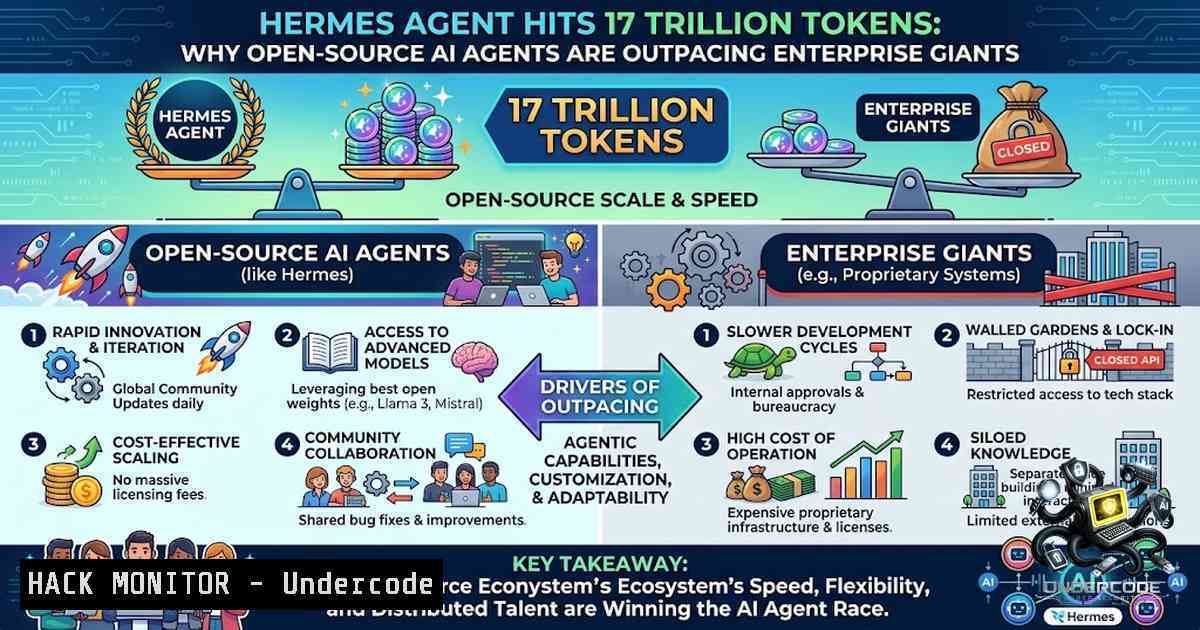
The AI landscape witnessed a seismic shift when Nous Research’s Hermes Agent, an open-source autonomous CLI agent, processed over 17 trillion tokens through OpenRouter, ranking 1 across the entire platform and single-handedly consuming nearly as many tokens as the next 49 applications combined in a single week. This milestone signals more than just impressive usage statistics—it marks the commoditization of foundational models and the ascendancy of agentic architectures that orchestrate specialized models to deliver real-world outcomes rather than merely benchmark scores.
Learning Objectives & Secrets:
- Objective 1: Master the Hermes Agent + OpenRouter Integration – Learn to deploy a production-grade autonomous agent that routes across 400+ models from 70+ providers through a single API key, with automatic failover and zero-completion insurance.
-
Objective 2 Secret: Optimize Model Selection with Context-Aware Routing – Most setups require at least 64K context tokens; the system prompt plus tool schemas consume significant window space before any conversation begins. Use `openrouter/auto` for market-driven routing or `openrouter/pareto-code` with a minimum coding score threshold (starting at 0.65) to automatically select the cheapest model that meets quality requirements.
-
Objective 3 Secret: Implement Cost-Saving Auxiliary Offloading – Offload side tasks like titling, vision, and compression to cheaper models such as Gemini Flash while reserving premium models like Claude Sonnet for core reasoning, cutting costs without degrading main workflow quality.
You Should Know:
1. Installation & Initial Configuration
The Hermes Agent runs directly in the terminal and is MIT-licensed—free to use, with costs only for the tokens consumed through your provider.
Step‑by‑step guide:
Linux / macOS / WSL2:
curl -fsSL https://raw.githubusercontent.com/NousResearch/hermes-agent/main/scripts/install.sh | bash
This works on Linux, macOS, WSL2, and Termux. Windows support through native PowerShell is still in early beta.
Interactive Setup (Recommended):
hermes model
This launches an interactive model picker that walks you through provider selection and model configuration.
Quick Setup (Direct Config Path):
hermes config set OPENROUTER_API_KEY sk-or-...
hermes chat --provider openrouter --model '~anthropic/claude-sonnet-latest'
Replace `sk-or-…` with your actual OpenRouter API key. The `~` prefix tells OpenRouter to resolve to the latest model in that family.
Manual Configuration (Advanced):
Secrets are stored in `~/.hermes/.env`:
OPENROUTER_API_KEY=your-api-key-here
Model and provider settings live in `~/.hermes/config.yaml`:
model:
provider: openrouter
default: ~anthropic/claude-sonnet-latest
Never commit the `.env` file to version control.
Verification:
After running hermes chat, you should see the Hermes Agent prompt showing your connected provider and selected model.
Common Errors:
- 401 / “provider not found” : API key not saved correctly or typo in provider name—rerun setup
- “No API key” : Verify `~/.hermes/.env` has the key
- Context errors at startup : Switch to a model with at least 64K context
2. Provider Routing, Fallback Chains & Auxiliary Models
Once connected, routing in `~/.hermes/config.yaml` determines cost, reliability, and failure handling.
Provider Routing Controls:
provider_routing:
sort: throughput  Options: throughput, price, latency
only: [bash]  Allowlist
ignore: [bash]  Blocklist
order: [anthropic, google]  Explicit priority
data_collection: deny  Prevents prompt logging by providers
The `:nitro` suffix maps to `sort: throughput` (prioritizing speed); `:floor` maps to `sort: price` (choosing cheapest provider).
Fallback Chains (Mid-Session Failover):
fallback_providers:
- provider: openrouter
model: ~anthropic/claude-sonnet-latest
- provider: openrouter
model: ~google/gemini-flash-latest
When the primary provider fails (5xx errors or rate limits), OpenRouter automatically routes to the next entry without losing conversation context or memory.
Auxiliary Model Offloading:
auxiliary:
title:
provider: openrouter
model: ~google/gemini-flash-latest
vision:
provider: openrouter
model: ~google/gemini-flash-latest
compression:
provider: openrouter
model: ~google/gemini-flash-latest
There’s no reason to use a high-cost model like Claude Sonnet for simple tasks like generating conversation titles. Offload these to cheaper models while keeping the main workflow unchanged.
3. Pareto Code Router: Automated Cost Optimization
For coding tasks, `openrouter/pareto-code` automatically selects the cheapest model that still meets a minimum quality bar.
model:
provider: openrouter
model: openrouter/pareto-code
openrouter:
min_coding_score: 0.65
The coding score ranges from 0.0 to 1.0:
- Lower it for routine edits where speed and cost matter more than precision
- Raise it for complex refactors where correctness is more important than saving tokens
Combine this with auxiliary offloading and `:floor` routing for maximum cost efficiency. OpenRouter also provides 25+ free models across several providers for hobby use.
4. Context Length Management
Most Hermes Agent configurations need at least 64K context tokens. Models with smaller windows often fail to start because the system prompt plus tool schemas already consume a significant portion before any conversation begins.
Check model context sizes:
Visit openrouter.ai/models and filter by context length.
Model ID Format:
| Model ID | What It Resolves To |
|-||
| `~anthropic/claude-sonnet-latest` | Latest Claude Sonnet (default) |
| `~google/gemini-flash-latest` | Latest Gemini Flash (cheap, fast) |
| `deepseek/deepseek-v4-flash` | DeepSeek’s fast chat model |
| `openrouter/auto` | Auto-routing driven by market spend share |
The `~` prefix automatically resolves to the latest version of a model family.
5. Monitoring, Troubleshooting & Security
Unified Activity Dashboard:
All activity goes through a single API key, making everything visible at openrouter.ai/activity with filters for model and time range.
Security Best Practices:
- Set `data_collection: deny` in provider routing to prevent prompt logging
- Store API keys in `~/.hermes/.env` and never commit to version control
- Rotate keys regularly via openrouter.ai/keys
Troubleshooting Reference:
| Problem | Fix |
||–|
| “No API key” / provider not found | Verify `~/.hermes/.env` has key or rerun setup |
| 401 / 403 errors | Check key validity and credit balance |
| Model not responding | Verify model ID matches valid provider/model-1ame |
| Context errors at startup | Switch to model with 64K+ context |
If a model works in other setups but refuses to start in Hermes Agent, it’s usually the 64K context requirement rather than a misconfiguration.
What Undercode Say:
- Key Takeaway 1: The model is becoming a commodity—intelligence is getting cheaper and interchangeable. Hermes routes across 400+ models swapped with a config change. The winners won’t own a marginally smarter model; they’ll build agents that resolve tickets, close books, run diligence, and ship code.
-
Key Takeaway 2: The future is small and specialized—fleets of SLMs and domain-focused models, each tuned for a specific job. A 405B model is overkill for classifying an invoice or routing a ticket. Smaller, cheaper, faster models—fine-tuned on your own data—handle the bulk, calling frontier models only for the hard 10%.
The center of gravity is shifting from “how capable is the model” to “what real work did this agent finish for a real user or enterprise team.” Trillions of tokens is just the democratic market voting early with its API calls. Enterprises need latency, cost, privacy, and reliability—all pointing the same way: an orchestra of specialized SLMs, conducted by agents that know which one to call and when. The infrastructure is still young, the patterns are still forming, and we’re only beginning to see what happens when open models get wired into persistent, tool-using, self-improving agents.
Prediction:
- +1 Enterprise AI budgets will shift dramatically from model licensing to agent orchestration platforms, creating a new multi-billion dollar market for agent infrastructure and observability tools within 18-24 months.
-
+1 Open-source agents like Hermes will accelerate the democratization of AI automation, enabling small teams to deploy capabilities that previously required massive engineering resources—leveling the competitive playing field across industries.
-
-1 The commoditization of models will compress margins for proprietary LLM providers, forcing consolidation and potentially reducing investment in frontier model research as the economic incentive shifts downstream to agentic applications.
-
+1 Specialized SLMs fine-tuned on enterprise data will become the dominant deployment pattern, with frontier models reserved for the “hard 10%” of tasks—reducing inference costs by 70-90% for most production workloads.
-
-1 Organizations that continue optimizing for “model choice” rather than “agent outcomes” will fall behind competitors who embrace agentic architectures, creating a widening gap in automation maturity across the enterprise landscape.
▶️ Related Video (80% Match):
https://www.youtube.com/watch?v=0TV2yenS33U
🎯Let’s Practice For Free:
🎓 Live Courses & Certifications:
Join Undercode Academy for Verified Certifications
🚀 Request a Custom Project:
Secure, high-velocity infrastructure and disruptive technological engineering. Contact our engineering team for high-tier development and proprietary systems:
[email protected]
💎 Smart Architecture | 🛡️ Secure by Design | ⭐ Trusted by Thousands
IT/Security Reporter URL:
Reported By: https://lnkd.in/p/euD8K4N4 – Hackers Feeds
Extra Hub: Undercode MoN
Basic Verification: Pass ✅


