
Listen to this Post
Introduction:
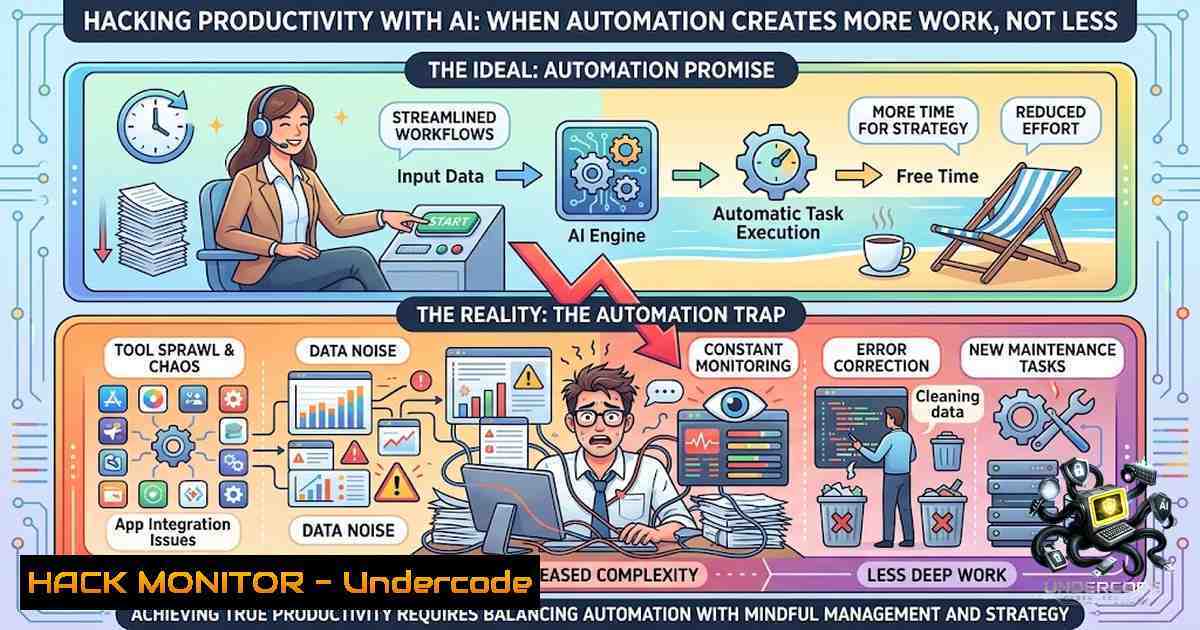
The cybersecurity industry has long grappled with a productivity paradox: AI tools automate tedious, repetitive tasks, yet the volume of work somehow continues to expand. As the CISO Series recently explored in their Super Cyber Friday session “Hacking Productivity with AI,” the critical question isn’t whether AI saves time—it’s whether it simply moves the work around. Security leaders are discovering that while AI accelerates alert triage, threat hunting, and reporting, it simultaneously creates new demands: managing AI agents, validating their outputs, and building guardrails against hallucinations and autonomous errors. According to Splunk’s 2026 CISO Report, 68% of CISOs now prioritize investing in AI-based cybersecurity capabilities, with 39% of adopters strongly agreeing that agentic AI has increased their teams’ reporting speed. Yet the journey from productivity promise to practical reality requires navigating a complex landscape of technical implementation, human trust, and operational risk.
Learning Objectives & Secrets:
- Objective 1: Master the AI-Augmented SOC Workflow. Learn to integrate AI agents into security operations without creating alert fatigue or analyst burnout. The secret lies in using AI for tier-1 triage while keeping human analysts focused on high-judgment investigations. Tools like Sumo Logic’s Dojo AI SOC Analyst Agent and Datadog’s Bits AI Security Analyst now deliver context-aware response recommendations, not just raw alerts.
-
Objective 2 Secret Tip: Implement “Bounded Autonomy” with Neurosymbolic Guardrails. The secret to safe AI deployment is constraining agent actions through multi-stage validation pipelines. The Agent-Lock framework introduces SOC-specific constraints that sanitize untrusted log fields and enforce multi-principal change-control approvals before any autonomous action executes. This prevents the “confused deputy” problem where agents misuse API credentials after being tricked by malicious inputs.
-
Objective 3 Secret Tip: Build a “Detection Quality Feedback Loop.” Early 2026 marked a shift from AI experiments to autonomous operations. The secret is creating continuous feedback mechanisms where agents learn from analyst corrections. When an analyst overrides an agent’s decision, that action becomes training data—improving future accuracy while maintaining human oversight.
You Should Know:
- The Agentic SOC Revolution: What’s Actually Happening in 2026
The security operations center is undergoing its most significant transformation since the advent of SIEM. At RSA Conference 2026, CrowdStrike, Cisco, and Palo Alto Networks all launched AI agents capable of analyzing incidents, making decisions, and executing tasks independently. Google Cloud released three agentic AI capabilities for its security operations platform, automating core analyst tasks including threat detection engineering, threat hunting, and third-party context gathering. Fortinet’s FortiSOC now unifies SIEM, SOAR, UEBA, case management, threat intelligence, and ITDR into a single AI-driven SaaS platform.
But here’s the catch: these agents don’t eliminate work—they transform it. Security teams now spend significant time “training” agents, tuning their precision, and using other agents to check the work of their AI counterparts. The question shifts from “Can AI do this?” to “How do we trust AI to do this safely?”
Step-by-Step: Deploying an AI Security Agent with Guardrails
 Linux - Set up API gateway with rate limiting for AI agent calls
 Install and configure Kong API Gateway
curl -Ls https://get.konghq.com/quickstart | bash
kong start

Configure rate limiting to prevent agent abuse
curl -X POST http://localhost:8001/services/ai-agent/plugins \
--data "name=rate-limiting" \
--data "config.minute=100" \
--data "config.policy=local"

Windows PowerShell - Monitor agent API calls with audit logging
Get-WinEvent -LogName "Security" | Where-Object { $_.Message -match "AI Agent" } |
Export-Csv -Path "C:\SecurityLogs\AgentAudit.csv" -1oTypeInformation

Validate agent outputs with a secondary model (hallucination detection)
curl -X POST https://api.guardrail-service.com/v1/validate \
-H "Content-Type: application/json" \
-d '{"agent_output": "...", "confidence_threshold": 0.85}'
- The Hallucination Problem: Why AI Agents Lie and How to Catch Them
Hallucinations remain the single greatest barrier to autonomous AI adoption in security. Context gaps are the root cause—agents lack full visibility into your environment’s unique configurations, policies, and threat landscape. Gartner predicts that by the end of 2026, 40% of enterprise applications will embed task-based AI agents, making hallucination mitigation critical.
The solution requires five guardrail layers: data foundation validation, input sanitization, runtime constraint enforcement, output verification, and human oversight. NeMo Guardrails and Amazon Bedrock Guardrails now ship grounding detectors specifically for hallucination detection on RAG outputs. Giskard’s new sovereign guardrail platform blocks unsafe answers and behaviors in real-time.
Step-by-Step: Implementing Hallucination Detection
 Python - Hallucination detection using semantic similarity
from sentence_transformers import SentenceTransformer
from sklearn.metrics.pairwise import cosine_similarity
import numpy as np

model = SentenceTransformer('all-MiniLM-L6-v2')

def detect_hallucination(agent_claim, source_evidence, threshold=0.7):
claim_embedding = model.encode([bash])
evidence_embedding = model.encode([bash])
similarity = cosine_similarity(claim_embedding, evidence_embedding)[bash][bash]
return {
"similarity_score": similarity,
"is_hallucination": similarity < threshold,
"confidence": "low" if similarity < 0.5 else "medium" if similarity < 0.7 else "high"
}

Example: Verify an agent's claim about a vulnerability
result = detect_hallucination(
"CVE-2026-1234 affects all versions",
"NVD database shows CVE-2026-1234 affects versions 2.0-2.5 only"
)
print(f"Hallucination detected: {result['is_hallucination']}")
 Linux - Set up real-time output validation with grounding check
 Using AWS Bedrock Guardrails CLI
aws bedrock update-guardrail \
--guardrail-id "guard-abc123" \
--grounding-config '{"sources": ["s3://security-knowledge-base/"], "threshold": 0.8}'
3. Autonomous Agents and the Junior Analyst Dilemma
If AI agents now perform the work of junior analysts, what happens to the next generation of security professionals? This question, raised in the CISO Series discussion, strikes at the heart of workforce development. The answer isn’t elimination—it’s elevation. Junior analysts transition from manual alert triage to agent oversight, validation, and exception handling. They become “AI handlers” who understand both security operations and AI behavior.
Training programs are evolving accordingly. The Certified AI Security Professional (CAISP) course now covers AI supply chain risks, differential privacy, federated learning, and robust AI model deployment. Carnegie Mellon’s SEI offers a Leadership in AI for Cybersecurity certificate focusing on AI fundamentals and statistical methods applied to security. Virginia Tech’s AI-Powered Cybersecurity Certificate program integrates AI and ML fundamentals for SIEM, SOAR, and detection.
Step-by-Step: Building an AI-Augmented SOC Training Program
 YAML - SOC training curriculum for AI-human collaboration
training_curriculum:
phase_1: "AI Literacy"
- "Understanding LLM architectures and limitations"
- "Prompt engineering for security use cases"
- "Recognizing hallucination patterns"
phase_2: "Agent Oversight"
- "Validating agent recommendations"
- "Override decision protocols"
- "Incident escalation procedures"
phase_3: "Advanced Operations"
- "Tuning agent precision and recall"
- "Building custom security agents"
- "Agent-to-agent verification workflows"
- API Security in the Age of Autonomous Agents
As AI agents gain API access to SIEM, SOAR, ticketing systems, and cloud infrastructure, API security becomes paramount. The “confused deputy” problem—where an agent is tricked into misusing its API credentials—represents a critical attack vector. Adversa AI researchers recently identified “GuardFall,” a structural flaw in how AI coding agents guard against dangerous shell commands.
Step-by-Step: Securing Agent API Access
 Linux - Implement OAuth2 with scoped permissions for AI agents
 Using oauth2-proxy with minimal scope
oauth2-proxy \
--provider=oidc \
--client-id=agent-client \
--client-secret=secure-secret \
--scope="security:read incidents:write" \
--allowed-role="ai-agent" \
--upstream=http://localhost:8080

Windows PowerShell - Audit agent API calls with detailed logging
 Enable advanced audit policy for agent service accounts
auditpol /set /subcategory:"Detailed Tracking" /success:enable /failure:enable
Get-WinEvent -LogName "Security" -FilterXPath "[System[EventID=4624]]" |
Where-Object { $<em>.Properties[bash].Value -match "agent-svc" } |
Select-Object TimeCreated, @{N='Account';E={$</em>.Properties[bash].Value}}

Implement API key rotation for agent credentials
 Schedule weekly rotation using Azure Key Vault
az keyvault secret set \
--vault-1ame security-vault \
--1ame agent-api-key \
--value $(openssl rand -base64 32)
5. Cloud Hardening for AI Workloads
AI agents processing security data in the cloud introduce unique hardening requirements. Fortinet’s FortiSOC and similar platforms now unify cloud-delivered security operations. However, the shared responsibility model extends to AI agent behavior—organizations must harden not just infrastructure, but the agent’s decision-making boundaries.
Step-by-Step: Cloud Hardening for AI Security Agents
 AWS - Restrict agent IAM permissions with condition keys
{
"Version": "2012-10-17",
"Statement": [
{
"Effect": "Allow",
"Action": "securityhub:GetFindings",
"Resource": "",
"Condition": {
"StringEquals": {
"aws:ResourceTag/Environment": "production",
"aws:PrincipalTag/Role": "ai-agent"
},
"IpAddress": {
"aws:SourceIp": "10.0.0.0/8"
}
}
}
]
}

Azure - Implement conditional access for AI agent identities
az rest --method patch \
--url "https://graph.microsoft.com/v1.0/identity/conditionalAccess/policies" \
--headers "Content-Type=application/json" \
--body '{"displayName":"AI Agent Access Control","conditions":{"applications":{"includeApplications":["all"]},"users":{"includeUsers":["agent-service-principal"]}},"grantControls":{"operator":"OR","builtInControls":["mfa","compliantDevice"]}}'

GCP - VPC Service Controls for agent API calls
gcloud access-context-manager perimeters create ai-agent-perimeter \
--title="AI Agent Security Perimeter" \
--resources="projects/security-project" \
--restricted-services="securitycenter.googleapis.com,bigquery.googleapis.com"
- Vulnerability Exploitation and AI: The -7 Day Problem
Mandiant’s 2026 report reveals a staggering reality: the mean time to exploit vulnerabilities has dropped to an estimated -7 days—meaning exploitation now occurs before a patch is even released. AI agents are both part of the problem (attackers using AI to accelerate exploitation) and the solution (defenders using AI to identify and mitigate vulnerabilities faster).
Step-by-Step: AI-Powered Vulnerability Prioritization
 Python - AI-driven vulnerability scoring with exploitation likelihood
import pandas as pd
from sklearn.ensemble import RandomForestClassifier

def prioritize_vulnerabilities(vuln_data):
 Features: CVSS score, exploit availability, public proof-of-concept age
features = ['cvss_score', 'exploit_available', 'poc_age_days', 'vendor_patch_status']
model = RandomForestClassifier(n_estimators=100)
 ... training logic

Output prioritized list with AI-predicted exploitation probability
return prioritized_list

Linux - Automate vulnerability scanning with AI prioritization
nuclei -t cves/ -json | jq '.[] | select(.info.severity=="critical")' |
python3 -c "
import sys, json
for line in sys.stdin:
vuln = json.loads(line)
if 'exploit' in vuln['info'] and vuln['info']['exploit'] == 'available':
print(f\"PRIORITY: {vuln['info']['name']} - Exploit available\")
"
What Undercode Say:
- Key Takeaway 1: AI doesn’t eliminate work—it elevates it. The productivity paradox means security teams must prepare for new roles: AI trainers, validation engineers, and guardrail architects. Organizations that invest in these capabilities will outperform those that simply deploy AI and expect magic.
-
Key Takeaway 2: Trust is built through bounded autonomy, not blind delegation. The most successful AI deployments implement multi-layer guardrails—from input validation to output verification—and maintain human oversight for high-stakes decisions. The question isn’t “Can AI do this?” but “How do we verify it did it correctly?”
The CISO Series discussion highlights a fundamental truth: agentic AI in cybersecurity is not about replacement but augmentation. Security leaders must navigate the tension between automation’s promise and its practical demands. The organizations that succeed will be those that treat AI agents as junior teammates requiring training, supervision, and continuous feedback—not as silver bullets. As one participant noted, “It’s a process everyone has to go through”. The journey from skepticism to comfort requires deliberate investment in guardrails, training, and cultural change. Those who embrace this reality will find AI transforms their SOC from reactive to proactive. Those who don’t will find themselves drowning in a sea of automated alerts with no one left to interpret them.
Prediction:
- +1 Agentic AI will reduce Mean Time to Detect (MTTD) by 60-70% across mature SOCs by 2028, as autonomous agents continuously correlate alerts and hunt threats without human intervention.
-
+1 The “AI Handler” role will become the fastest-growing cybersecurity job category by 2027, with salaries exceeding traditional SOC analysts as organizations compete for talent that understands both security operations and AI behavior.
-
-1 Organizations that deploy AI agents without proper guardrails will experience catastrophic incidents—agents autonomously deleting critical assets, misconfiguring firewalls, or exposing sensitive data—leading to regulatory fines and reputational damage.
-
-1 The security skills gap will widen as junior analysts lose traditional hands-on experience, creating a generation of security professionals who understand AI outputs but lack foundational investigative skills.
-
+1 Standardization efforts like ExtraHop’s Agentic SOC Alliance will create interoperable security agent ecosystems, enabling organizations to mix and match agents from different vendors while maintaining consistent governance.
-
-1 Attackers will increasingly target AI agents themselves—through prompt injection, data poisoning, and adversarial inputs—creating an entirely new attack surface that most organizations are unprepared to defend.
-
+1 By 2028, AI agents will handle 80% of tier-1 SOC functions, allowing human analysts to focus exclusively on complex, multi-vector attacks that require contextual judgment and creative thinking.
▶️ Related Video (86% Match):
https://www.youtube.com/watch?v=7zPQV1BSH_k
🎯Let’s Practice For Free:
🎓 Live Courses & Certifications:
Join Undercode Academy for Verified Certifications
🚀 Request a Custom Project:
Secure, high-velocity infrastructure and disruptive technological engineering. Contact our engineering team for high-tier development and proprietary systems:
[email protected]
💎 Smart Architecture | 🛡️ Secure by Design | ⭐ Trusted by Thousands
IT/Security Reporter URL:
Reported By: https://lnkd.in/p/enAYGMMz – Hackers Feeds
Extra Hub: Undercode MoN
Basic Verification: Pass ✅


