
Listen to this Post
Introduction:
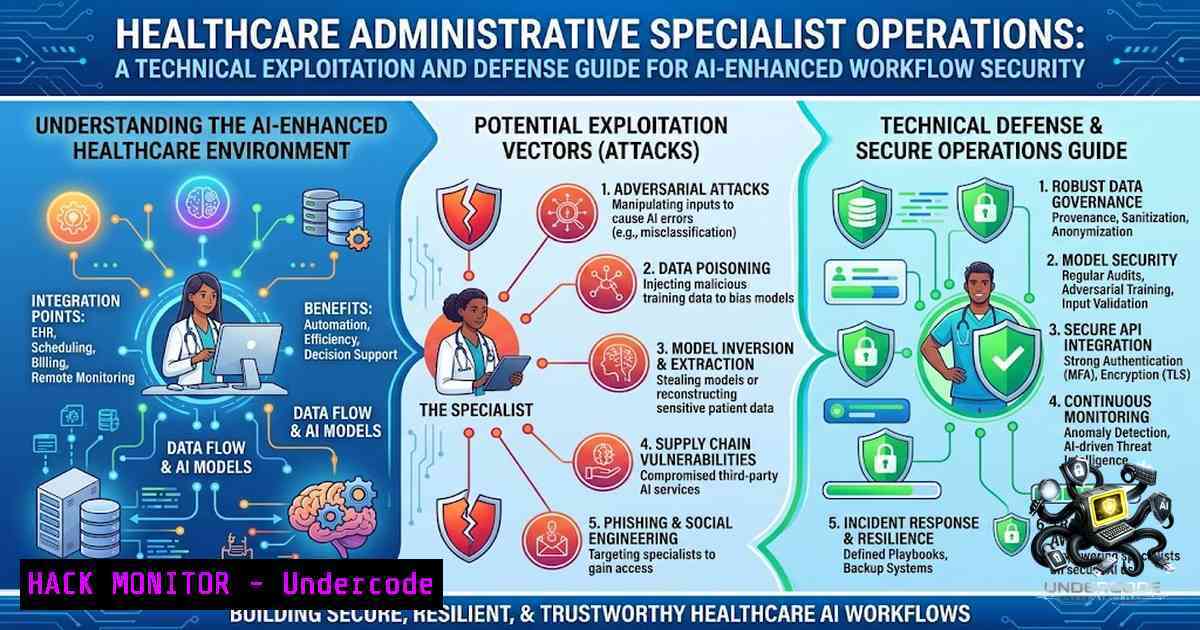
The integration of AI and automated workflow systems into healthcare administration has created a complex attack surface where credentialing, payer portal access, and revenue cycle management intersect with critical patient data. As organizations like Mercor bridge elite talent with AI research labs, the administrative roles handling prior authorizations, claims, and payment posting become prime targets for credential harvesting, API abuse, and business logic exploitation. This article provides a technical deep-dive into securing healthcare administrative operations against modern cyber threats while optimizing workflows through AI-driven automation.
Learning Objectives & Secrets:
- Objective 1: Payer Portal Security Hardening – Implement multi-factor authentication and session management controls to prevent unauthorized access to insurance claims and patient eligibility systems.
- Objective 2 Secret Tip: Automated Workflow Exploitation Prevention – Deploy anomaly detection algorithms to identify unusual patterns in prior authorization submissions, flagging potential credential misuse or automated bot attacks on revenue cycle APIs.
- Objective 3 Secret Tip: Revenue Cycle API Security – Use JWT validation and request signing to protect remittance and payment posting endpoints from man-in-the-middle attacks and data tampering.
You Should Know:
1. Securing Payer Portals and Credentialing Systems
Healthcare administrative specialists interact daily with payer portals for eligibility verification, claim status checks, and prior authorization submissions. These portals often expose REST APIs and legacy SOAP services that are vulnerable to injection attacks, session fixation, and insecure direct object references (IDOR).
Step-by-Step Guide for Hardening Payer Portal Access:
- Step 1: Enforce conditional access policies using Azure AD or Okta to restrict login attempts based on geolocation and device fingerprinting.
- Step 2: Implement IP whitelisting for known administrative workstations using the following Windows PowerShell command to block unauthorized IPs:
New-1etFirewallRule -DisplayName "Block_PayerPortal_Unauthorized" -Direction Inbound -Action Block -RemoteAddress 192.168.1.100-192.168.1.200
- Step 3: Use OAuth 2.0 with PKCE (Proof Key for Code Exchange) for mobile and remote access to prevent authorization code interception.
- Step 4: Regularly audit API logs using ELK Stack or Splunk to detect repeated failed authentication attempts:
sudo grep "401" /var/log/nginx/access.log | awk '{print $1}' | sort | uniq -c | sort -1r - Step 5: Deploy a Web Application Firewall (WAF) rule to block SQL injection attempts on portal search fields (e.g., member ID, NPI number).
2. Automating Prior Authorization with Security in Mind
AI-driven tools are increasingly used to automate prior authorization workflows, reducing manual effort but introducing risks around data leakage and prompt injection if LLMs are integrated.
Step-by-Step Guide for Secure Automation:
- Step 1: Sanitize all inputs to prior authorization APIs using regex filtering in Python:
import re
def sanitize_input(input_string):
return re.sub(r'[^\w\s-]', '', input_string)
- Step 2: Encrypt sensitive fields (e.g., patient IDs, diagnosis codes) using AES-256-GCM before transmission over TLS 1.3.
- Step 3: Set up rate limiting on authorization endpoints to prevent brute-force enumeration of authorization IDs:
iptables -A INPUT -p tcp --dport 443 -m connlimit --connlimit-above 50 -j REJECT
- Step 4: Use a secrets management tool like HashiCorp Vault to rotate API keys for payer integrations every 24 hours.
- Step 5: Implement audit trails that log every authorization decision, including AI confidence scores, for forensic analysis.
3. Claims and Revenue Cycle API Security
Claims submission and remittance processing involve sensitive financial data. APIs handling these transactions must be protected against CSRF, JSON injection, and parameter pollution attacks.
Step-by-Step Guide for API Hardening:
- Step 1: Validate all JSON payloads against a strict schema using AJV (Another JSON Schema Validator) in Node.js:
const Ajv = require('ajv'); const ajv = new Ajv(); const schema = { type: 'object', properties: { claimAmount: { type: 'number' } }, required: ['claimAmount'] }; const validate = ajv.compile(schema); - Step 2: Sign outgoing API requests using HMAC-SHA256 with a shared secret to prevent tampering:
echo -1 "POST|/claims|timestamp" | openssl dgst -sha256 -hmac "your-secret-key"
- Step 3: Implement circuit breakers in microservices (e.g., using Resilience4j) to prevent cascade failures during claim surges.
- Step 4: Use Linux `tcpdump` to monitor for suspicious outbound traffic from claims processors:
sudo tcpdump -i eth0 port 443 -w claims_traffic.pcap
- Step 5: Regularly test for business logic flaws by performing role-based access control (RBAC) audits to ensure only finance personnel can modify payment posting entries.
4. Credentialing and Enrollment Process Hardening
Provider credentialing involves verifying licenses, DEA registrations, and NPI numbers—an attacker who compromises this workflow can insert fake providers into the system for fraudulent billing.
Step-by-Step Guide for Credentialing Security:
- Step 1: Use blockchain-based verifiable credentials (W3C standard) for immutable provider identity validation.
- Step 2: Automate NPI validation against the NPPES NPI Registry API with a timeout handler in Python:
import requests try: response = requests.get('https://npiregistry.cms.hhs.gov/api/', params={'number': '1234567890'}, timeout=5) response.raise_for_status() except requests.exceptions.Timeout: print("NPI validation timed out, fallback to manual review") - Step 3: Enforce certificate-based authentication for enrollment systems using mutual TLS (mTLS).
- Step 4: Schedule weekly Linux `cron` jobs to compare credential expiration dates against a warning threshold:
0 9 1 /usr/local/bin/check_credential_expiry.sh
- Step 5: Conduct tabletop exercises to simulate credential theft and test incident response times.
5. AI Integration and Workflow Optimization Security
AI models assisting with administrative workflows are vulnerable to data poisoning and adversarial attacks that can skew decision-making on approvals and denials.
Step-by-Step Guide for AI Security:
- Step 1: Implement differential privacy when training models on patient data to prevent membership inference attacks.
- Step 2: Monitor model drift using statistical tests (e.g., Kolmogorov-Smirnov) in MLflow:
mlflow models predict -m model_uri --data input.json --drift-threshold 0.05
- Step 3: Restrict AI model API endpoints with API keys and rate limiting to prevent excessive querying.
- Step 4: Use Explainable AI (XAI) frameworks like SHAP to interpret model outputs and detect anomalies.
- Step 5: Automate security scanning of container images used for AI deployments using Trivy:
trivy image healthcare-ai-worker:latest --severity HIGH,CRITICAL
6. Remote Work Security for Administrative Staff
As the role is remote, securing endpoints and VPNs is critical to prevent credential theft and man-in-the-middle attacks during payer portal sessions.
Step-by-Step Guide for Remote Endpoint Security:
- Step 1: Enforce endpoint detection and response (EDR) tools like CrowdStrike or Microsoft Defender for Endpoint on all administrative laptops.
- Step 2: Configure VPN split-tunneling to route only healthcare traffic through the corporate network, reducing attack surface.
- Step 3: Use Windows `gpupdate` to apply Group Policy Objects (GPOs) that disable USB storage and enforce screen locks after 5 minutes:
Set-ItemProperty -Path "HKCU:\Control Panel\Desktop" -1ame "ScreenSaveTimeOut" -Value 300
- Step 4: Deploy phishing-resistant FIDO2 security keys for admin access to Google Workspace and Microsoft 365.
- Step 5: Conduct monthly remote security awareness training with simulated phishing campaigns targeting healthcare administrative staff.
7. Claims Management and Payment Posting Integrity
Ensuring timely payment posting and remittance alignment requires secure data transfer and reconciliation processes.
Step-by-Step Guide for Payment Posting Security:
- Step 1: Hash all remittance files using SHA-256 and verify checksums on receipt:
sha256sum remittance_oct2026.csv > checksum.txt
- Step 2: Use GPG encryption for email attachments containing EOB (Explanation of Benefits) data.
- Step 3: Implement a reconciliation dashboard that flags discrepancies between clinical charges and posted payments using anomaly detection algorithms.
- Step 4: Set up Syslog-1g to forward all payment posting logs to a centralized SIEM for real-time alerting.
- Step 5: Regularly audit user access to payment systems and revoke inactive accounts using Linux
userdel:sudo userdel -r inactive_admin
What Undercode Say:
- Key Takeaway 1: Healthcare administrative roles are no longer back-office functions; they are cybersecurity frontline positions where credential management and API security are paramount. The integration of AI amplifies both efficiency and risk, demanding continuous monitoring and hardening.
- Key Takeaway 2: Automation without security is a recipe for disaster—prior authorization and claims processing must be built on a foundation of zero-trust architecture, including mTLS, JWT validation, and encrypted data pipelines.
Expected Output:
Introduction:
The convergence of AI-powered automation and healthcare administrative workflows has created a new class of cyber risks targeting credentialing, claims management, and payer portal integrations. As organizations hire specialists to optimize operations, attackers are simultaneously developing sophisticated techniques to exploit weak authentication, insecure APIs, and misconfigured AI models. This article provides actionable technical defenses to protect revenue cycle systems while maintaining operational efficiency.
What Undercode Say:
- Key Takeaway 1: The future of healthcare administration lies in proactive security automation—integrating SIEM alerts, AI anomaly detection, and cryptographic verification into daily workflow tools.
- Key Takeaway 2: Cross-training administrative staff in cybersecurity basics and incident response is as critical as technical controls, as human error remains the largest attack vector.
Prediction:
- +1: AI-driven automation will reduce claims processing errors by 40% while enabling real-time fraud detection through machine learning on transaction patterns.
- -1: Without stringent API security and zero-trust adoption, healthcare organizations face a 200% increase in credential-based breaches targeting payer portals within the next 18 months.
- +1: Blockchain-based credentialing will gain mainstream adoption, reducing provider enrollment time and eliminating fake provider insertion attacks.
- -1: Remote work expansion will continue to expose administrative endpoints to phishing and VPN vulnerabilities, necessitating continuous EDR and FIDO2 deployment.
- +1: Regulatory frameworks like HIPAA will evolve to mandate AI security audits, driving innovation in explainable AI and differential privacy for healthcare workflows.
▶️ Related Video (80% Match):
🎯Let’s Practice For Free:
🎓 Live Courses & Certifications:
Join Undercode Academy for Verified Certifications
🚀 Request a Custom Project:
Secure, high-velocity infrastructure and disruptive technological engineering. Contact our engineering team for high-tier development and proprietary systems:
[email protected]
💎 Smart Architecture | 🛡️ Secure by Design | ⭐ Trusted by Thousands
IT/Security Reporter URL:
Reported By: https://lnkd.in/p/e4RiZxeD – Hackers Feeds
Extra Hub: Undercode MoN
Basic Verification: Pass ✅


