
Listen to this Post
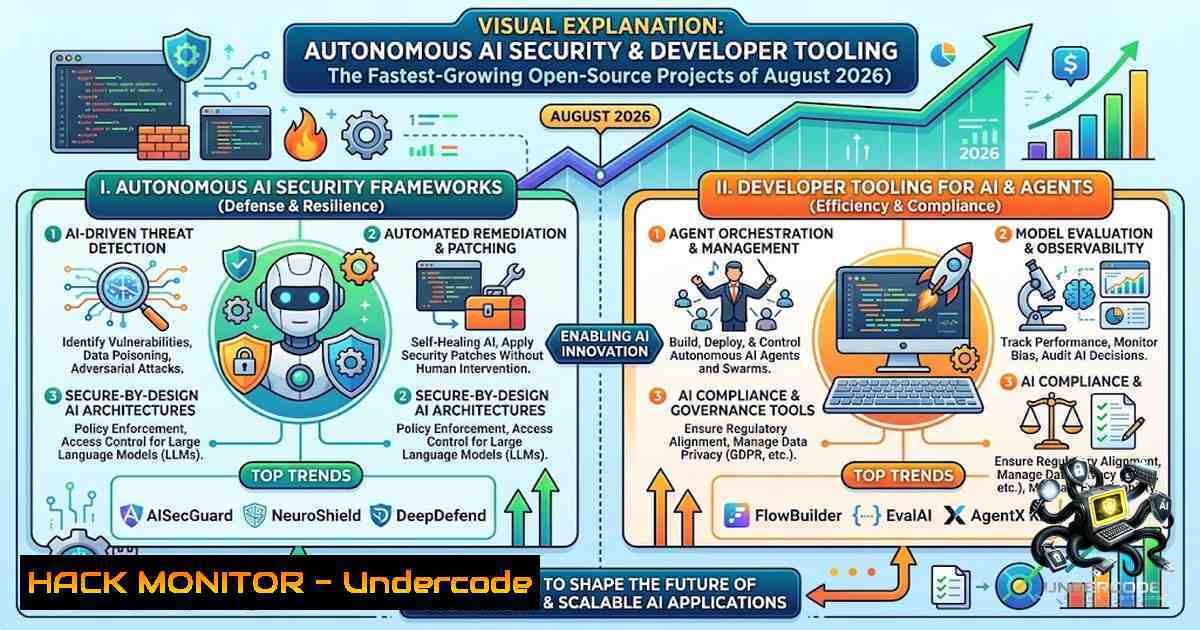
Introduction:
The convergence of large language models (LLMs) and offensive security has given rise to a new class of autonomous AI agents capable of performing complex reconnaissance, vulnerability research, and red teaming operations with minimal human intervention. Simultaneously, the open-source ecosystem around AI development frameworks—particularly DeepSeek Harness (DSH)—has exploded with plugins, desktop clients, and handbooks designed to streamline local AI workflows. This article examines the fastest-growing AI projects tracked by PullRepo as of August 28, 2026, with a focus on Cybermes (an autonomous offensive security framework), the DeepSeek Harness ecosystem, and HFlow (a robotics data pipeline SDK). We provide technical deep-dives, installation guides, and security considerations for each.
Learning Objectives & Secrets:
- Objective 1: Understand how multi-model LLM orchestration enables autonomous security operations, including attack surface discovery, zero-false-positive exploit validation, and automated CVSS v3.1 reporting.
- Objective 2 (Secret Tip): Leverage the DeepSeek Harness “everything is a plugin” architecture to build custom security automation workflows—combine dsh-agent-teams for multi-agent red teaming with dsh-chat-import to resume conversations from 13 different coding agents.
- Objective 3 (Secret Tip): For robotics and Physical AI pipelines, HFlow’s MCAP-based architecture with topic-group chunking reduces training I/O costs dramatically—each episode records provenance metadata, enabling full traceability from raw collection to training-ready datasets.
1. Cybermes: Autonomous Offensive Security Agent Framework
Cybermes is an enterprise-grade autonomous security research agent built upon the Hermes Agent runtime. With a growth score of 85.50 and over 600 stars, it has rapidly gained traction among security professionals. The framework bridges modern LLM reasoning with automated offensive security workflows, combining multi-step reasoning, a deep skill matrix of 50+ modules, and multi-source knowledge retrieval from PayloadsAllTheThings, HackTricks, and Claude-BugHunter.
Step-by-Step Installation & Quick Start:
Method 1: Docker Compose (Recommended)
 Clone the repository
git clone https://github.com/Zyrexnn/Cybermes.git
cd Cybermes

Start with Docker Compose
docker-compose up -d

Access the web interface at http://localhost:3080
Method 2: Native Host Setup
 Install dependencies (requires Node.js >= 22)
npm install -g @deepseek-ai/dsh

Clone and run
git clone https://github.com/Zyrexnn/Cybermes.git
cd Cybermes
npm install
npm start
Telegram Bot Integration allows operators to control Cybermes remotely via Telegram commands. The framework includes a local validation mode with a mock target for safe testing before deployment.
Security Consideration: Cybermes is designed for authorized environments only. The Hermes Agent runtime has known sandbox escape vectors—specifically, `node:vm` is not a security boundary, and workflow/dynamic plugins can escape isolation. Organizations should deploy Cybermes in isolated containers with strict network egress controls.
- DeepSeek Harness (DSH) Ecosystem: Plugins, Handbooks & Desktop Clients
DeepSeek Harness (DSH) is DeepSeek’s official open-source Agent runtime, released on August 13, 2026, built on an “everything is a plugin” philosophy. The ecosystem has grown rapidly, with multiple high-growth projects:
- 0xsline/awesome-deepseek-harness (⭐679): Curated directory of plugins, tools, and infrastructure
- dsh-handbook (⭐443): Comprehensive guide covering installation, plugin development, performance tuning, and real-world case studies
- dsh-desktop (⭐600+): Local AI desktop workspace bundling DSH with pre-verified community plugins
Step-by-Step: Deploying a Local DSH Workspace
Option A: Quick CLI Install
 Install DSH (requires Node.js >= 22)
npx -y @deepseek-ai/dsh web

Open browser to http://127.0.0.1:3080
 Or run headless tasks
dsh --profile headless "Your prompt here"
Option B: DSH Desktop (Windows/macOS)
- Download the installer from dshdesktopstation.com
- Run the `.dmg` (macOS) or `.exe` (Windows) installer
- Launch the application—it automatically starts a local Harness instance on a random loopback port
4. The interface includes:
- Official DSH Web for sessions, agents, tools, and skills
- Better Sidebar with file tree, code editor, Git, terminal, and web tabs
- Plugin market for discovering and installing community plugins
- Multi-agent teams (v0.2.0+) with task boards and dependency-aware planning
Plugin Highlight: dsh-chat-import
This plugin imports full-fidelity conversation histories from 13 coding agents—including Claude Code, Codex, ChatGPT, Cursor, Gemini, Hermes, and Kimi—as resumable DSH sessions. This enables security teams to:
– Preserve investigation trails across multiple AI tools
– Reverse-export findings back to Claude Code
– Maintain a unified knowledge base across red team operations
Security Advisory for DSH: The dsh-handbook FAQ explicitly warns that the sandbox has real escape surfaces—node:vm is not a security boundary. For production deployments, implement OS-level isolation and avoid running DSH with elevated privileges.
- HFlow: Open-Source SDK for Physical AI Data Pipelines
HFlow, developed by Hebbian Robotics (YC S26), is an open-source SDK for building scalable multimodal data-quality pipelines for robotics and Physical AI. With a growth score of 51.90 and over 170 stars, it addresses the critical challenge of processing large-scale robotics data. HFlow implements the infrastructure described in Dyna Robotics’ “Training Dyna-2 at million-hour scale” paper.
Step-by-Step: Building a Robotics Data Pipeline with HFlow
Installation
 In a virtual environment
pip3 install hflow
Quickstart: Synthesize a Test Episode
from hflow import Pipeline, Episode

Define a simple pipeline with transforms, quality checks, and enrichments
pipeline = Pipeline()
pipeline.add_transform(lambda x: x  2)
pipeline.add_quality_check(lambda x: x > 0)
pipeline.add_enrichment(lambda x: {"processed": x})

Run on a synthetic episode (camera + state streams)
episode = Episode.from_synthetic()
result = pipeline.run(episode)
Processing Real MCAP Data
 HFlow uses MCAP as the input/output container
 MCAP is natively recorded by ROS 2 and opens directly in Foxglove/Rerun
from hflow import load_mcap, save_mcap

episode = load_mcap("path/to/episode.mcap")
processed = pipeline.run(episode)
save_mcap(processed, "path/to/processed.mcap")
Key Architectural Features:
- Provenance Tracking: Each processed episode records schema, pipeline, and tool versions, plus source URI, making it traceable to its origin
- Topic-Group Chunking: Camera streams and state streams never share a chunk—training samples cost one read per group instead of one per topic
- Visible Pipeline Graph: Renders Airflow DAGs for monitoring task status
4. Hardware-Accelerated AI Inference: Apex-Inference-Chip
SigmanticAI’s apex-inference-chip showcases an innovative design for running a real LLM (Qwen2.5-0.5B) on FPGA. With a growth score of 36.05 and over 600 stars, it demonstrates significant performance gains through hardware-specific optimizations. This project highlights the increasing trend toward edge-optimized AI inference, particularly relevant for secure, air-gapped deployments where cloud LLM APIs cannot be used.
5. LeadGen: Automated Multi-Tenant Generative UI System
Tubban1’s leadgen automates website and cloud infrastructure generation using Next.js 14, OpenAI, Neon DB, Vercel, and GoDaddy APIs. With a growth score of 40.43, it represents the growing intersection of AI, infrastructure-as-code, and automated deployment—a trend with significant implications for DevSecOps pipelines.
What Undercode Say:
- Key Takeaway 1: The Cybermes framework represents a paradigm shift in offensive security—moving from heuristic scanners to LLM-reasoned, context-aware agents that dynamically formulate attack plans. However, the Hermes Agent sandbox escape vulnerabilities demand rigorous isolation controls; organizations must treat these agents as potentially adversarial code and deploy them in network-isolated environments with strict egress filtering.
-
Key Takeaway 2: The DeepSeek Harness ecosystem’s explosive growth (1804 plugins, 780 discussion threads) signals a broader trend: local, self-hosted AI development environments are becoming the default for security-conscious organizations. The dsh-handbook’s 39 FAQ entries, many addressing security and sandboxing concerns, underscore the community’s focus on making AI agents production-ready and auditable.
Analysis: The convergence of LLM orchestration with security automation (Cybermes), local AI development environments (DSH ecosystem), and robotics data infrastructure (HFlow) points to a unified theme: AI is transitioning from a cloud-centric API service to a locally deployable, extensible, and security-hardened infrastructure layer. The growth scores (85.50 for Cybermes, 74.24 for DSH ecosystem) confirm that developers and security teams are actively building the tooling needed to operationalize AI in production environments. However, the sandbox escape warnings and the known Hermes Agent abuse by threat actors serve as critical reminders: AI agents are powerful tools that require the same rigorous security controls as any other production system.
Prediction:
- -1: The Hermes Agent framework, having been weaponized by threat actors to autonomously scan for and exploit exposed servers, will face increased scrutiny and potential regulatory restrictions. Organizations that deploy Cybermes or similar autonomous offensive security tools without proper isolation and authorization controls risk legal liability and reputational damage.
-
+1: The DSH ecosystem’s “everything is a plugin” architecture will catalyze the development of an open, interoperable standard for AI agent runtimes. This will accelerate enterprise adoption of local AI assistants by enabling organizations to build, share, and audit agent capabilities across teams without vendor lock-in.
-
+1: HFlow’s open-source implementation of Dyna’s million-hour-scale robotics infrastructure will democratize Physical AI development, enabling smaller robotics companies and research labs to build production-grade data pipelines without the capital expenditure previously required for proprietary solutions.
-
-1: The proliferation of autonomous AI agents—both defensive (Cybermes) and offensive (Hermes Agent abuse)—will outpace the development of governance frameworks. Organizations that treat AI agents as “just another tool” rather than as potentially autonomous, decision-making systems will face significant security incidents in the next 12-18 months.
▶️ Related Video (80% Match):
https://www.youtube.com/watch?v=0oeD2Wf25wY
🎯Let’s Practice For Free:
🎓 Live Courses & Certifications:
Join Undercode Academy for Verified Certifications
🚀 Request a Custom Project:
Secure, high-velocity infrastructure and disruptive technological engineering. Contact our engineering team for high-tier development and proprietary systems:
[email protected]
💎 Smart Architecture | 🛡️ Secure by Design | ⭐ Trusted by Thousands
IT/Security Reporter URL:
Reported By: https://lnkd.in/p/e66XB6wG – Hackers Feeds
Extra Hub: Undercode MoN
Basic Verification: Pass ✅


