
Listen to this Post
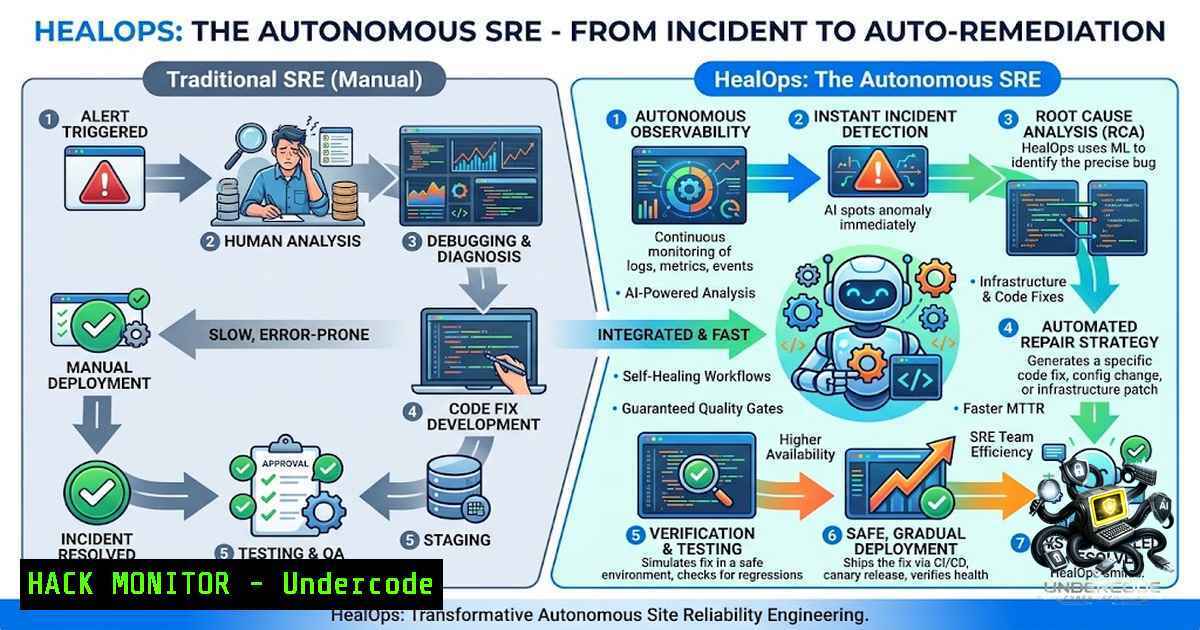
Introduction:
The promise of AI in software engineering has always been speed — faster code generation, faster debugging, faster delivery. But as LinearB’s 2026 Software Engineering Benchmarks Report reveals, that promise hits a wall at the pull request review stage: AI-generated PRs sit unclaimed 4.6x longer than human-written ones. The bottleneck has simply shifted from writing code to reviewing it. HealOps, an autonomous Site Reliability Engineering (SRE) agent, addresses this head-on by delivering not just a root-cause diagnosis but a fully reviewed pull request with evidence, regression tests, and a complete audit trail — so the human engineer reviews a diagnosis, not just a diff.
Learning Objectives & Secrets:
- Objective 1: Understand the AI Code Review Bottleneck. Learn why AI-generated pull requests face longer review delays and lower acceptance rates (32.7% vs. 84.4% for manual PRs), and how autonomous agents can bridge the trust gap by attaching evidence to every change.
-
Objective 2 Secret Tip: Parallel Hypothesis Testing. HealOps doesn’t guess — it runs multiple hypotheses simultaneously, correlating logs, traces, and configurations across Datadog, Grafana, Sentry, and CloudWatch. The fix arrives only after three theories are ruled out with evidence and one is confirmed.
-
Objective 3 Secret Tip: The “Incident In, Diff Out” Pipeline. From alert ingestion to pull request creation, HealOps automates the entire investigative loop. The PR includes the minimal diff, a regression test, and a verifiable canary run — so the on-call engineer can merge with confidence, not guesswork.
- The Code Review Bottleneck: Why AI PRs Sit Idle 4.6x Longer
LinearB’s 2026 report analyzed 8.1 million pull requests across 4,800+ organizations and found that AI-assisted PRs are 2.6x larger than human-written ones. Reviewers approach these large, AI-generated diffs with skepticism — and rightfully so. The data shows AI-generated PRs have an acceptance rate of just 32.7% compared to 84.4% for manual PRs.
Why this happens:
- Reviewers lack confidence in AI-generated code without supporting context.
- Large diffs are cognitively expensive to review thoroughly.
- Without evidence of testing and validation, reviewers hesitate to approve.
What HealOps does differently:
HealOps attaches a complete investigation trail to every PR — the hypotheses tested, the evidence for each, the root cause determination, and the regression test that proves the fix works. The engineer isn’t reviewing a blind diff; they’re reviewing a documented diagnosis.
- Parallel Hypothesis Investigation: How HealOps Reasons in Seconds, Not Hours
Manual incident investigation is sequential: open a dashboard, eyeball a chart, page a colleague, repeat. HealOps fans the investigation out across every candidate failure mode simultaneously.
Step-by-step guide to parallel investigation:
- Alert ingestion — HealOps reads the page from Datadog, Grafana, Sentry, CloudWatch, or PagerDuty.
- Context assembly — Pulls 14 minutes of logs, 9 services, and 412 traces (as in one real incident example).
- Hypothesis generation — Spawns 4+ hypotheses simultaneously (e.g., bad deploy, DB connection pool exhaustion, upstream provider issue, cache stampede).
- Evidence collection — Each hypothesis is tested against telemetry data (CloudTrail, pg_stat_activity, metrics).
- Confirmation — The moment one hypothesis is decisively confirmed, HealOps stops and discards the others with evidence.
Real example from HealOps:
- Hypothesis: DB connection pool exhausted — confirmed against 40 minutes of CloudTrail + pg_stat_activity
- Bad deploy — refuted (git history quiet for 14 hours)
- Upstream provider — refuted (downstream peers green)
- Cache stampede — refuted (hit-rate unchanged)
- Confirmed in 8 seconds — three branches discarded with evidence, one survived with proof
- The Heal Loop: From Alert to Reviewed Pull Request
HealOps doesn’t stop at root-cause identification. It ships the fix.
Step-by-step: The complete Heal Loop
Step 01 — Detect:
- Ingests alerts from Datadog, Grafana, Sentry, CloudWatch, or PagerDuty
- Performs severity triage and deduplication
- Produces: scoped incident, owning service, blast radius
Step 02 — Investigate:
- Pulls logs, traces, and configs
- Tests hypotheses in parallel
- Isolates root cause with evidence
Step 03 — Fix:
- Generates the minimal diff (e.g.,
fix(payments-worker): close DB connection on retry-after-error) - Attaches regression test that reproduces the leak
- Verifies fix on canary (e.g., 320ms p99 for 12 minutes)
Step 04 — Pull Request:
- Opens a reviewed PR on GitHub
- Includes: root cause, evidence trail URL, regression test, canary verification
- Co-authored-by: heal-agent
The result: One PR to review, evidence attached. Nothing merges without that human review.
4. The Tools HealOps Plugs Into
HealOps integrates with the stack your team already runs:
| Category | Tools |
|||
| Alerting & Incident Management | PagerDuty |
| Monitoring & Metrics | Datadog, Grafana, CloudWatch |
| Error Tracking | Sentry |
| Source Control | GitHub |
| Orchestration | Kubernetes |
| Cloud | AWS |
| Collaboration | Slack |
This read‑only, human‑in‑the‑loop architecture ensures HealOps has access to investigate and propose fixes, but the merge button remains with the engineering team.
5. Linux/Windows Commands for Incident Investigation
While HealOps automates this entire flow, here are the commands SREs traditionally use to investigate the types of issues HealOps handles:
Linux — Database Connection Pool Investigation:
 Check PostgreSQL active connections
psql -c "SELECT pid, usename, application_name, client_addr, state, query
FROM pg_stat_activity WHERE state = 'active';"

Monitor connection count over time
watch -1 2 'psql -t -c "SELECT count() FROM pg_stat_activity;"'

Check for idle connections holding resources
psql -c "SELECT pid, usename, state, query FROM pg_stat_activity
WHERE state = 'idle in transaction';"
Linux — Log Analysis & Trace Correlation:
 Tail logs with grep for error patterns
tail -f /var/log/application.log | grep -E "ERROR|FATAL|timeout|pool"

Correlate timestamps across services
grep "2026-08-23T11:05" /var/log/service-a.log /var/log/service-b.log

Check Kubernetes pod logs for a specific service
kubectl logs -f deployment/checkout-api --tail=100 | grep -i error
Windows — Event Log & Performance Monitoring:
 Get recent application errors
Get-WinEvent -LogName Application -MaxEvents 50 | Where-Object { $_.LevelDisplayName -eq "Error" }

Check active network connections
netstat -ano | findstr ESTABLISHED

Monitor process memory usage
Get-Process | Sort-Object WorkingSet -Descending | Select-Object -First 10
Kubernetes — Service Health Checks:
 Check pod status and restart counts
kubectl get pods -1 production -o wide

Describe a failing pod for detailed events
kubectl describe pod <pod-1ame> -1 production

Check service latency (using kubectl port-forward and curl)
kubectl port-forward service/checkout-api 8080:80 &
curl -w "Total: %{time_total}s\n" -o /dev/null -s http://localhost:8080/health
- API Security & Cloud Hardening in the HealOps Context
HealOps operates with read‑only access to your infrastructure and requires secure integrations with each tool. Here are key security considerations:
API Security Best Practices:
- Use OAuth 2.0 or API keys with minimal scopes for HealOps integrations
- Rotate credentials regularly and store them in secrets managers (AWS Secrets Manager, HashiCorp Vault)
- Audit all API calls — HealOps logs every investigation step
Cloud Hardening Commands (AWS CLI):
 Audit IAM roles and policies
aws iam list-roles --query 'Roles[?contains(RoleName, <code>healops</code>)]'

Check CloudTrail for unusual API activity
aws cloudtrail lookup-events --lookup-attributes AttributeKey=EventName,AttributeValue=AssumeRole

Verify S3 bucket permissions (read-only access)
aws s3api get-bucket-policy --bucket your-bucket-1ame
Kubernetes RBAC Hardening:
 HealOps service account with read-only permissions
apiVersion: v1
kind: ServiceAccount
metadata:
name: healops-reader
namespace: production

apiVersion: rbac.authorization.k8s.io/v1
kind: ClusterRole
metadata:
name: healops-reader
rules:
- apiGroups: [""]
resources: ["pods", "services", "configmaps", "events"]
verbs: ["get", "list", "watch"]
- Vulnerability Exploitation & Mitigation: The DB Pool Exhaustion Case
The example from HealOps’ documentation — DB connection pool exhaustion — is one of the most common production outages.
How it happens:
- A retry is scheduled before `close()` runs on the database connection
- Connections leak over time
- Pool hits maximum, new requests queue and time out
- p99 latency spikes from 1.5s to 6.2s
Exploitation pattern (how attackers or bad code trigger this):
– Rapid retry storms during transient failures
– Missing `finally` blocks that close connections
– Long-running transactions that never commit or roll back
Mitigation (the HealOps fix):
// Before (leaky)
func processOrder(ctx context.Context) error {
conn, err := db.Pool.Acquire(ctx)
if err != nil {
return err
}
// If retry is scheduled before conn.Close() runs, connection leaks
// ... process logic ...
return nil
}

// After (fixed)
func processOrder(ctx context.Context) error {
conn, err := db.Pool.Acquire(ctx)
if err != nil {
return err
}
defer conn.Close() // Ensures connection is always released
// ... process logic ...
return nil
}
Regression test (as attached by HealOps):
func TestConnectionLeakOnRetry(t testing.T) {
// Simulate 1000 concurrent requests with retry logic
// Verify connection count returns to baseline after all requests complete
// Fail if any connections remain open after 2 seconds
}
What Undercode Say:
- Key Takeaway 1: AI isn’t slowing down code review because it writes bad code — it’s slowing down review because it writes large code without context or evidence. HealOps solves this by making every PR a documented investigation, not a blind diff.
-
Key Takeaway 2: The future of SRE isn’t replacing humans — it’s augmenting them with auditable, parallel reasoning. HealOps doesn’t merge automatically; it hands the on-call engineer a reviewed, tested, evidence-backed PR. The human still owns the merge button, but they no longer own the 20–40 minutes of context-gathering per incident.
Analysis: The HealOps model addresses a fundamental tension in modern DevOps: AI generates code faster than humans can review it. By attaching evidence, ruling out alternative hypotheses, and shipping regression tests alongside fixes, HealOps builds the trust that AI-generated PRs currently lack. The 4.6x review delay isn’t a bug in AI — it’s a signal that engineers are rightfully skeptical. HealOps removes that skepticism by making the investigation transparent and verifiable.
Prediction:
- +1 HealOps and similar agentic SRE platforms will become standard in enterprise DevOps within 24–36 months, reducing Mean Time To Resolution (MTTR) from minutes to seconds.
-
+1 The “evidence-attached PR” pattern will become an industry best practice, with CI/CD pipelines requiring telemetry correlation before AI-generated PRs can be submitted.
-
-1 Teams that adopt AI coding tools without also adopting evidence-layer tooling (like HealOps) will see worse delivery metrics — more PRs, longer review cycles, and lower merge rates.
-
-1 The 4.6x review delay could widen as AI coding adoption exceeds 88%, creating a reviewer burnout crisis unless autonomous investigation tools are deployed alongside code generators.
-
+1 The “Incident In, Diff Out” paradigm will shift on-call culture from reactive firefighting to proactive, evidence-driven engineering — making on-call rotations more sustainable and less stressful.
▶️ Related Video (78% Match):
https://www.youtube.com/watch?v=03AGqso-wfs
🎯Let’s Practice For Free:
🎓 Live Courses & Certifications:
Join Undercode Academy for Verified Certifications
🚀 Request a Custom Project:
Secure, high-velocity infrastructure and disruptive technological engineering. Contact our engineering team for high-tier development and proprietary systems:
[email protected]
💎 Smart Architecture | 🛡️ Secure by Design | ⭐ Trusted by Thousands
IT/Security Reporter URL:
Reported By: https://lnkd.in/p/e9dT4ARv – Hackers Feeds
Extra Hub: Undercode MoN
Basic Verification: Pass ✅


