
Listen to this Post
Introduction:
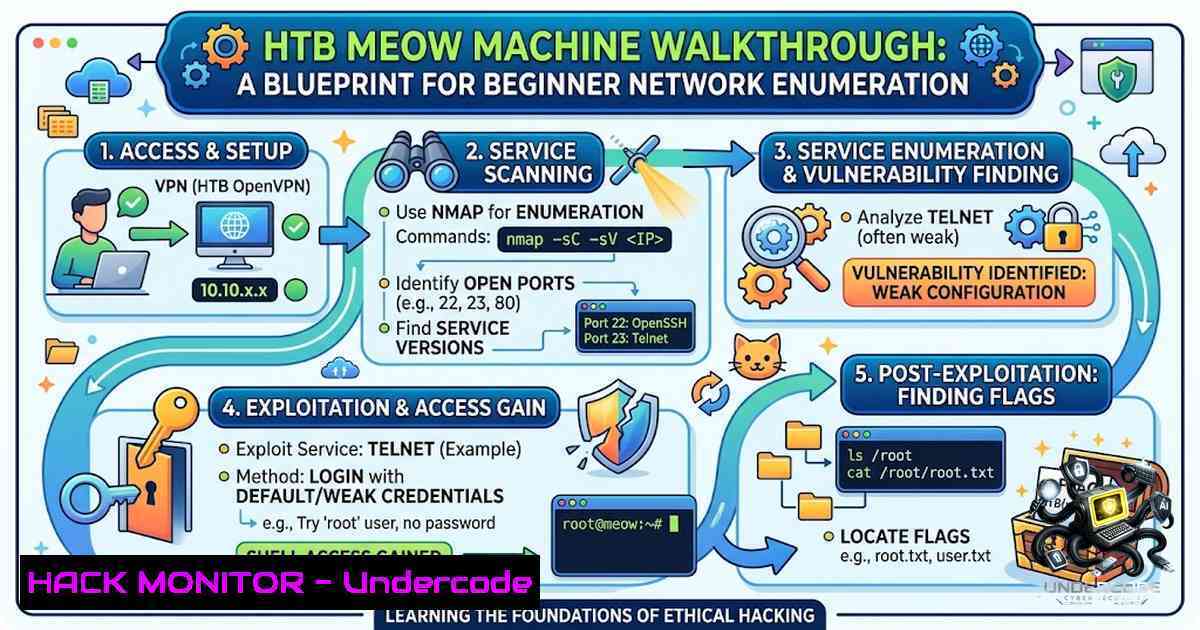
Network enumeration is the cornerstone of any cybersecurity assessment, serving as the initial reconnaissance phase where attackers and defenders alike map out potential entry points into a system. The Hack The Box (HTB) “Meow” machine exemplifies this principle perfectly, offering a “Very Easy” environment where beginners can safely practice identifying open ports, probing services, and understanding how seemingly simple misconfigurations can lead to full system compromise. This article breaks down the methodology applied to the Meow machine, transforming a basic CTF exercise into a repeatable framework for professional vulnerability assessment.
Learning Objectives & Secrets:
- Objective 1: Master the Nmap scanning lifecycle to identify open ports and services on a target machine without triggering alarms or wasting time.
- Objective 2 Secret Tip: Use the `-sV` and `-sC` flags together in Nmap to not only detect service versions but also run default scripts that reveal critical misconfigurations like default credentials.
- Objective 3 Secret Tip: Always check for legacy, insecure protocols (FTP, Telnet) first; their outdated security mechanisms often provide the quickest initial foothold during enumeration.
You Should Know:
1. Advanced Nmap Scanning for Service Discovery
While a basic `nmap -p-` scan reveals open ports, the secret lies in granular scanning phases. For the Meow machine, a quick scan likely revealed port 23 (Telnet) and port 21 (FTP). To efficiently replicate this, use the following command to scan common ports first, then dive deeper: nmap -T4 -p- -A [bash]. The `-A` flag enables OS detection, version detection, script scanning, and traceroute. This aggressive but effective approach gives a comprehensive overview in a single sweep. For Windows environments, consider using `nmap.exe` via PowerShell or the Zenmap GUI for a visual representation. In practice, always save your scan outputs using `-oN` for normal output or `-oX` for XML to maintain logs for reporting and comparison.
2. Identifying and Exploiting Telnet Misconfigurations
Telnet is a clear-text protocol that transmits credentials and data unencrypted. If port 23 is open, it often presents an easy vector. To connect, simply use the command telnet [bash]. In the Meow machine, this likely prompts for a login. The common secret tip is to test default credentials—a universal “root” with no password (root and press enter) is a known Achilles’ heel in many basic configurations. If successful, you gain immediate shell access. For Linux users, this command is native; Windows users can install the Telnet Client via “Turn Windows features on or off” in the Control Panel. Once connected, quickly check your user privilege with `whoami` and list directory contents with `ls -la` to confirm your level of control. This step illustrates the danger of legacy services in modern networks, especially in IoT and internal test environments.
3. FTP Enumeration and Anonymous Login
FTP (port 21) is another service frequently misconfigured. Beyond basic connection, you should attempt an anonymous login using the credentials `anonymous:anonymous` or ftp:ftp. The command `ftp [bash]` opens the session. Once logged in, use `ls` to list files, and `get [bash]` to download any interesting files. In a professional assessment, you would analyze these files for hardcoded credentials or configuration data. For Linux, the `ftp` client is standard; Windows users can use the built-in `ftp` command in Command Prompt. The key lesson here is not just connecting, but understanding the data accessible and how it can pivot your attack. For example, a downloaded `.bash_history` file could reveal past commands and hidden directory structures.
4. Using SSH as a Stepping Stone
While the Meow machine might not have SSH enabled immediately, it is a crucial service to understand. If you find port 22 open, it indicates a potential for more stable and encrypted remote access. The lesson here is that if you gain credentials from an insecure service like Telnet, you should test those same credentials against SSH. This is a common lateral movement technique. Command example: ssh root@[bash]. The secret tip is to use the `-p` option if the SSH port is non-standard. If you have a username, you can also brute-force with tools like Hydra: hydra -l root -P passwords.txt ssh://[bash], though this should only be done in authorized testing environments. Properly hardening SSH by disabling root login and using key-based authentication is the professional mitigation.
- The Power of Basic Linux Commands for Post-Exploitation
Once a shell is obtained, understanding the environment is critical. Use `pwd` to check your current directory, `id` to see your user and group IDs, and `uname -a` for system information. To escalate privileges, you can check for world-writable files or SUID binaries withfind / -perm -u=s -type f 2>/dev/null. For the Meow machine, the flag is likely found in the `/root` directory, accessible only by the root user. The command `cat /root/flag.txt` would retrieve it. This reinforces the fundamental principle that enumeration does not stop at network boundaries; it continues into the file system. For Windows, equivalent commands would bewhoami,systeminfo, anddir.
6. Mitigation Strategies and Hardening
From a blue team perspective, this machine illustrates the need for service disabling, network segmentation, and strong authentication policies. To secure a Linux server, you would disable Telnet using `systemctl disable telnet.socket` and remove the package. For FTP, disabling anonymous access and enforcing SSL/TLS (FTPS) is vital. SSH should be configured to disallow root login (PermitRootLogin no) and use key pairs. Additionally, regular vulnerability scanning with tools like OpenVAS or Nessus can detect these simple misconfigurations before an attacker does. In AWS or Azure, ensuring that security groups block unnecessary ports and that network ACLs restrict access is paramount.
What Undercode Say:
- Key Takeaway 1: The path to privilege escalation often begins with the simplest overlooked service. Default credentials on Telnet or FTP are an inexcusable risk in production but an excellent teaching tool for foundational enumeration.
- Key Takeaway 2: The CTF methodology of “try everything” translates directly to professional work; persistent, thorough scanning and persistent attempts to connect to every open port are the bedrock of a solid pentesting report.
The Meow machine is more than just a game; it’s a microcosm of enterprise security failures. It reminds us that while advanced exploits exist, the majority of breaches still stem from basic misconfigurations—open ports, default passwords, and unencrypted protocols. The analysis shows that security is a layered approach: from securing the perimeter to hardening internal services and continuous monitoring. This exercise pushes the mindset that every service, no matter how small, is a potential vector, and that understanding the fundamentals of networking and command-line tools is non-1egotiable for any IT professional, regardless of whether they are on the red or blue team. It emphasizes that penetration testing is not just about hacking but about building a systematic workflow that uncovers vulnerabilities logically, ensuring comprehensive coverage during any assessment.
Prediction:
+1: As cloud-1ative environments and containerization grow, the fundamental skills practiced here—network enumeration and service probing—will evolve but remain essential, with tools like Nmap being adapted for container scanning.
+1: The increasing automation of compliance checks will make the detection of services like Telnet and anonymous FTP an automated, near-instantaneous process in CI/CD pipelines, reducing human oversight errors.
-1: However, the “very easy” exploitation path may lead some beginners to underestimate the complexity of modern enterprise networks, where services are often hidden behind proxies, firewalls, and IDS/IPS systems that would flag such basic enumeration attempts.
+1: The resurgence of interest in legacy systems due to IoT and OT (Operational Technology) will make these basic skills highly relevant again, as many industrial systems still rely on these insecure protocols, requiring a new generation of engineers to understand their risks.
▶️ Related Video (88% Match):
🎯Let’s Practice For Free:
🎓 Live Courses & Certifications:
Join Undercode Academy for Verified Certifications
🚀 Request a Custom Project:
Secure, high-velocity infrastructure and disruptive technological engineering. Contact our engineering team for high-tier development and proprietary systems:
[email protected]
💎 Smart Architecture | 🛡️ Secure by Design | ⭐ Trusted by Thousands
IT/Security Reporter URL:
Reported By: https://lnkd.in/p/eD3zuKNJ – Hackers Feeds
Extra Hub: Undercode MoN
Basic Verification: Pass ✅


