
Listen to this Post
Introduction:
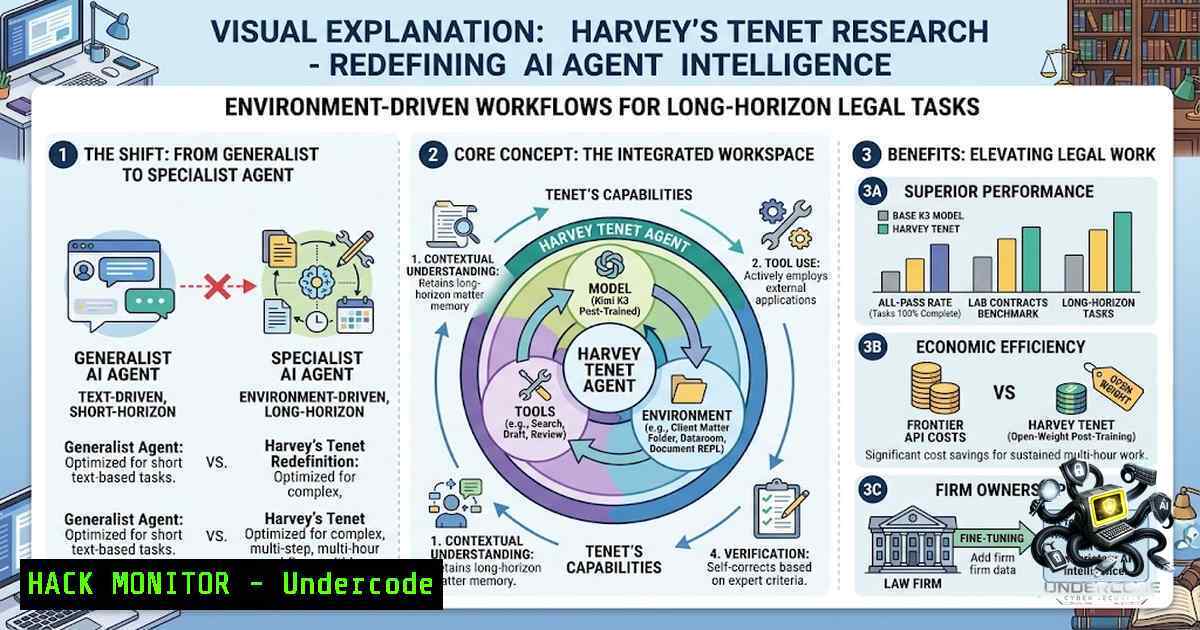
The prevailing discourse surrounding artificial intelligence has predominantly fixated on model parameters, benchmark scores, and raw computational power. However, Harvey’s recent research on the Tenet model challenges this paradigm, suggesting that a model’s operational environment—comprising tools, context, memory, and feedback loops—is as critical to its performance as its underlying weights. In the context of cybersecurity and IT, this shift from isolated model capability to integrated system design has profound implications for automating complex tasks like vulnerability management, incident response, and compliance auditing.
Learning Objectives & Secrets:
- Objective 1: Understand the “System Over Model” Paradigm – Learn why the combination of Model + Tools + Context + Memory + Environment + Feedback dictates real-world AI utility more than raw intelligence scores.
- Objective 2 Secret Tips: Implement Recursive Delegation for Massive Contexts – Discover how to leverage sub-agents and recursive language models to handle operational contexts exceeding 80 million tokens, such as entire codebases or multi-terabyte log files.
- Objective 3 Secret Tips: Build Rubric-Driven Evaluation Pipelines – Master the creation of binary pass/fail criteria (similar to Harvey’s 50+ criteria) to objectively measure AI agent performance in security workflows, ensuring consistent and verifiable outcomes.
You Should Know:
1. The Architecture of a Realistic Agent Environment
Harvey’s Tenet was not merely fine-tuned on legal texts; it was trained within a simulated ecosystem that mimics the complexities of human workflows. This environment consists of three core components: a specific task (e.g., contract review), a client matter containing relevant documents (akin to a SIEM data lake), and an expert rubric defining success criteria. For cybersecurity, this translates to creating environments where an AI agent is given a task (e.g., “analyze firewall logs for anomalies”), a data source (the log repository), and a rubric (e.g., “must identify all CVE-2024-XXXX patterns, prioritize by CVSS score, and generate a remediation report”). The average task in this environment contains around 50 binary pass/fail criteria, teaching the model to navigate deterministic logic gates—a principle directly transferable to scripting security automations.
Step‑by‑Step Guide: Building a Basic Rubric-Driven Security Agent
- Define the Task: “Identify misconfigured S3 buckets in a cloud environment.”
- Gather Context: Use AWS CLI to list buckets:
aws s3api list-buckets --query "Buckets[].Name". - Create the Rubric: Establish a Python dictionary with keys:
PublicAccess,EncryptionEnabled,VersioningEnabled. - Implement Checks: Use `boto3` to evaluate each criterion.
import boto3 client = boto3.client('s3') for bucket in buckets: acl = client.get_bucket_acl(Bucket=bucket) if 'AllUsers' in str(acl): print(f"FAIL: {bucket} is public") - Feedback Loop: Feed the results (pass/fail) back into the model to refine future queries, mimicking Harvey’s reinforcement learning stage.
2. Recursive Delegation and Sub-Agents for Massive Scale
One of the most intriguing aspects of Harvey’s research is the handling of M&A diligence tasks that involve up to 80 million tokens of context. To manage this, they experimented with Recursive Language Models (RLMs) and delegation strategies. Instead of forcing a single model to process an entire dataset, the system delegates sub-tasks to specialized agents. This is analogous to a Security Operations Center (SOC) where a Lead Analyst delegates port scanning to one tool, vulnerability assessment to another, and log correlation to a third. The “manager” agent synthesizes the findings.
Step‑by‑Step Guide: Implementing Agent Delegation for Log Analysis
1. Setup: Install `langchain` and `crewai` for orchestration.
2. Define Agents:
LogParser: Extracts specific error codes from massive log files usinggrep -c "ERROR" /var/log/syslog.ThreatIntel: Queries VirusTotal API for hashes found in the logs.
- Delegation Logic: The Manager agent identifies the task, splits the log file using
split -l 10000 large_log.log, and dispatches chunks to `LogParser` instances. - Recursive Refinement: If the `LogParser` encounters an unknown error, it requests the `ThreatIntel` agent to search for that pattern in CVE databases.
- Synthesis: The Manager aggregates outputs into a single JSON report, demonstrating how delegation drastically reduces processing time for large datasets.
-
Environment as Part of the Intelligence: The Feedback Loop
Harvey’s post emphasizes that capability is not just the model’s weights but the combination of model, tools, context, memory, environment, and feedback. In IT, this is the difference between running a vulnerability scanner and having an AI that learns from the scanner’s output, checks the patch status, queries the change management database, and automatically creates Jira tickets—all while adjusting its strategy based on previous successful patching cycles. This continuous feedback loop hardens the environment itself.
Step‑by‑Step Guide: Configuring Continuous Feedback for Cloud Hardening
- Tool Integration: Connect your AI agent to AWS Security Hub via API.
- Memory: Use a vector database (e.g., Pinecone) to store past security findings and their resolutions.
- Feedback Mechanism: Implement a rule that if a specific vulnerability (e.g., CVE-2023-1234) is found and patched successfully, the agent updates its memory to prioritize that patch in the future.
-
Automation: Create a script that uses `aws ec2 describe-instances` to fetch instances, cross-references with the memory database, and applies `aws ssm send-command` for patching.
-
The Technical Shift: From Benchmarks to Workflow Completion
The research indicates that Tenet completes nearly twice as many held-out tasks as the base model. This is a critical cybersecurity lesson: a model’s ability to complete a “workflow” (e.g., full incident response lifecycle) is more valuable than its score on a multiple-choice exam. For defenders, this means evaluating AI tools not by their MTurk accuracy but by their “Mean Time to Remediation” (MTTR) in a controlled playbook.
Step‑by‑Step Guide: Testing an AI’s Workflow Completion Capabilities
- Simulate an Attack: Use `Metasploit` to deploy a payload in an isolated lab environment.
- Deploy AI Agent: Feed the SIEM alerts to the agent.
- Monitor Actions: The agent should ideally: (a) Identify the attack vector, (b) Query threat intelligence, (c) Suggest isolation commands (
iptables -A INPUT -s $IP -j DROP), and (d) Generate a post-incident report. - Evaluate Rubric: Score the agent on 10 criteria (e.g., “Did it identify the CVE?”, “Did it prioritize correctly?”). Harvey’s use of “all-pass rate” translates to ensuring every single criterion is met before the workflow is considered successful.
5. Mitigating AI Hallucinations in Critical Systems
While Harvey focuses on legal environments, the cybersecurity equivalent of a “hallucination” is a false positive or a missed critical alert. To counter this, the Tenet research implies using high-fidelity rubrics with hundreds of binary criteria. In practice, this means building “guardrail” scripts that validate AI suggestions against actual system states before execution.
Step‑by‑Step Guide: Implementing Guardrails for AI-Generated Firewall Rules
- Generate Rule: AI suggests
sudo ufw allow from 192.168.1.0/24 to any port 22.
2. Validation:
- Check if the subnet overlaps with existing critical infrastructure.
- Ensure the rule doesn’t conflict with internal security policies (e.g., `test-ssh` script that checks if the IP belongs to an allowed vendor list).
- Staging: Apply the rule to a staging firewall first using
ufw --dry-run. - Binary Check: If all checks pass, the agent executes `sudo ufw allow` and logs the change. If any fail, the agent recalls the previous “all-pass” criteria to refine its suggestion.
What Undercode Say:
- Key Takeaway 1: The “System is the Intelligence” paradigm shift necessitates a move away from isolated model evaluation towards robust, environment-centric performance metrics. In cybersecurity, this means that an AI’s ability to effectively utilize tools (like Wireshark or Splunk) and remember past incidents (context) defines its success far more than its parameter count.
- Key Takeaway 2: Recursive delegation is not just a performance booster; it is a necessity for handling enterprise-scale data. The 80-million-token context window is a reality in M&A and large-scale log analysis. Implementing sub-agents and delegation patterns is the only scalable way to maintain low latency and high accuracy in these scenarios.
Prediction:
- +1 We will witness a surge in “Agent Harnesses” and specialized environments developed by AI vendors, moving the competitive landscape from proprietary model weights to proprietary workflow orchestration systems.
- +1 Cybersecurity frameworks (e.g., MITRE ATT&CK) will evolve to include “AI Agent” behavior metrics, allowing organizations to benchmark not just the detection but the automated remediation capabilities of their security stacks.
- -1 The complexity of these systems introduces a larger attack surface. If an attacker compromises the “memory” or “feedback” mechanisms of an agent, they could poison the entire workflow, leading to systemic failures in critical infrastructure.
- -1 The reliance on hundreds of binary criteria in rubrics creates a brittle system that may fail unpredictably in edge cases that fall outside the predefined criteria, requiring constant human oversight.
- +1 Recursive Delegation will become a standard API feature for cloud providers, enabling AI agents to naturally break down complex security audits into manageable tasks, significantly reducing the workload on SOC teams.
▶️ Related Video (88% Match):
🎯Let’s Practice For Free:
🎓 Live Courses & Certifications:
Join Undercode Academy for Verified Certifications
🚀 Request a Custom Project:
Secure, high-velocity infrastructure and disruptive technological engineering. Contact our engineering team for high-tier development and proprietary systems:
[email protected]
💎 Smart Architecture | 🛡️ Secure by Design | ⭐ Trusted by Thousands
IT/Security Reporter URL:
Reported By: https://lnkd.in/p/e7fcNRPE – Hackers Feeds
Extra Hub: Undercode MoN
Basic Verification: Pass ✅


