
Listen to this Post
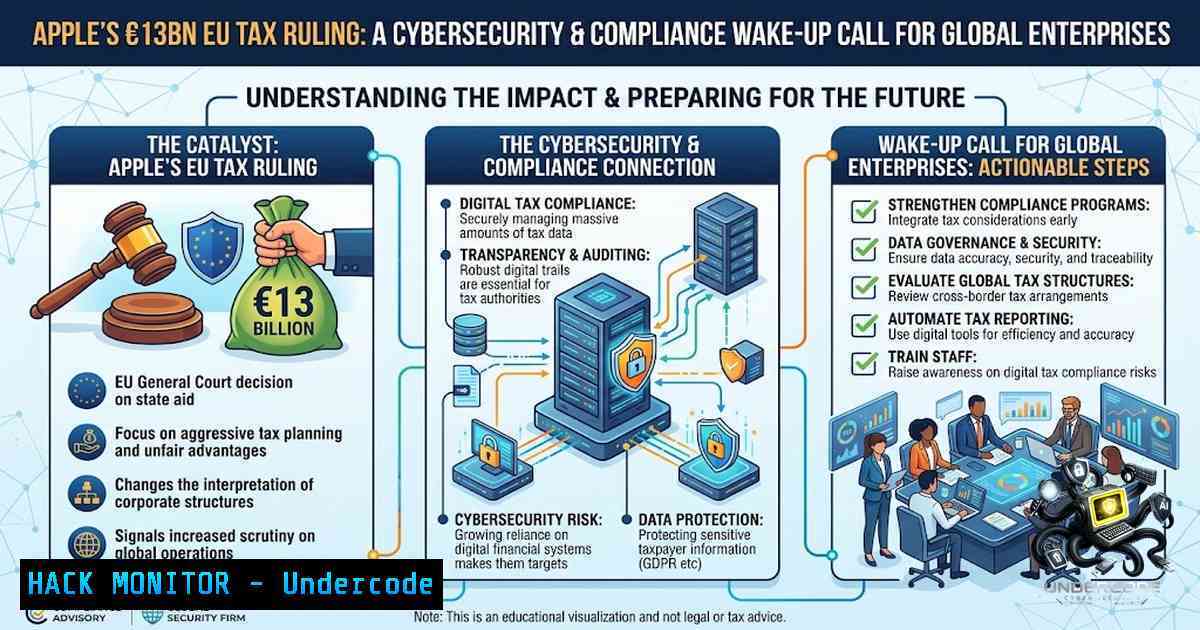
Introduction:
Apple’s recent disclosure that it paid 40% of its global corporate income taxes—$17.1 billion—to Ireland, a country housing merely 3% of its workforce, has reignited debates on international tax avoidance and corporate transparency. This follows the European Union’s top court ruling in 2024 that Ireland granted Apple unlawful state aid, ordering the recovery of up to €13 billion in back taxes. For cybersecurity and IT professionals, this isn’t just a financial story; it’s a critical case study in data sovereignty, regulatory compliance (GDPR, EU directives), and the security implications of complex multinational data flows and financial structures.
Learning Objectives & Secrets:
- Objective 1: Understand the Technical Intersection of Tax Compliance and Data Residency. Learn how EU regulations like the Digital Services Tax and GDPR force companies to rethink where they store and process data, directly impacting cloud architecture and security postures.
- Objective 2 (Secret Tip): Leverage Financial Data for Threat Intelligence. Secret: Analysts can use publicly disclosed country-by-country financial reports (like Apple’s) to identify anomalous transaction patterns that may indicate fraud, money laundering, or internal data breaches. Treat financial logs as a high-value security data source.
- Objective 3 (Secret Tip): Automate Compliance Monitoring. Secret: Implement automated scripts to monitor regulatory changes (e.g., EU tax rulings) and cross-reference them with your organization’s data residency maps. This proactive approach can prevent costly compliance failures and associated reputational damage.
You Should Know:
- The “Double Irish” Legacy and Modern Data Compliance
The now-defunct “Double Irish” tax arrangement allowed Apple to channel profits through Irish subsidiaries to minimize taxes. While the structure was closed in 2015, its legacy highlights a critical lesson for IT: data flows follow financial flows. Where your company books profit often dictates where its data is legally considered to be “at rest.” This has profound implications for GDPR, as data stored in a low-tax jurisdiction might have different legal protections than data in a high-tax one.
Step‑by‑Step Guide: Mapping Data Residency to Financial Entities
- Inventory Financial Entities: List all legal subsidiaries and their countries of incorporation.
- Map Data Stores: Identify which cloud regions and on-premise data centers serve each subsidiary.
- Correlate with Tax Filings: Cross-reference your data map with country-by-country tax reports to ensure data location matches the legal entity’s declared tax residence.
- Assess Compliance Risk: For each data store, verify compliance with local regulations (e.g., GDPR’s Chapter V on international transfers).
- Remediate: If discrepancies are found, initiate a data migration project or restructure legal entity assignments.
2. Hardening Cloud Architectures Against Regulatory Shifts
The EU’s aggressive stance on corporate taxation signals a broader trend of tightening regulatory scrutiny. For cloud architects, this means designing systems that are geographically agile. If a ruling forces a sudden shift in where profits (and thus data) are recognized, your infrastructure must be able to move data or redirect traffic without compromising security.
Step‑by‑Step Guide: Implementing Geo-Fencing and Dynamic Routing
- Define Geo-Policies: Use cloud provider tools (e.g., AWS Organizations SCPs, Azure Policy) to restrict resource deployment to approved regions.
- Implement Dynamic Traffic Routing: Use a global load balancer (e.g., AWS Global Accelerator, Azure Front Door) to route user traffic based on their origin and the current compliance status of your data centers.
- Automate Data Classification: Deploy a Data Loss Prevention (DLP) solution that can tag data based on its sensitivity and origin.
- Test Failover Scenarios: Simulate a regulatory event where a specific region must be “shut down” and confirm that traffic and data replication can be redirected to a compliant region within RTO/RPO.
-
Financial Data as a Security Data Source (SIEM Integration)
The Apple case shows how financial disclosures can reveal risk. Security teams should integrate financial transaction logs into their SIEM (Security Information and Event Management) systems. Unusual spikes in inter-company transfers, payments to new vendors, or changes in tax jurisdictions can be early indicators of Business Email Compromise (BEC) or internal fraud.
Step‑by‑Step Guide: Integrating Financial Logs into SIEM
- Identify Data Sources: Connect your ERP (e.g., SAP, Oracle) and banking APIs to your SIEM.
- Create Baselines: Use machine learning to establish normal patterns for inter-company transfers and tax payments.
- Set Alerts: Configure alerts for deviations (e.g., a transfer exceeding 10% of the average monthly volume).
- Correlate with Threat Intel: Enrich financial alerts with threat intelligence feeds to check if recipient bank accounts are known to be malicious.
4. AI-Powered Anomaly Detection in Financial Operations
AI can be used to detect sophisticated tax avoidance schemes or financial irregularities that might indicate a deeper compromise. By training models on historical financial data, organizations can flag transactions that don’t fit the expected pattern, similar to how AI is used to detect network intrusions.
Step‑by‑Step Guide: Deploying a Financial Anomaly Detection Model
- Data Preparation: Extract clean, labeled financial transaction data from your data warehouse.
- Feature Engineering: Create features like transaction amount, frequency, counterparty country, and time of day.
- Model Selection: Use an Isolation Forest or Autoencoder for unsupervised anomaly detection.
- Training: Train the model on a 12-month period of “normal” data.
- Deployment and Monitoring: Deploy the model to score real-time transactions and flag anomalies for review by both the finance and security teams.
5. API Security for Financial Data Exchanges
Inter-company financial data is often exchanged via APIs. Securing these APIs is paramount. The Apple case underscores that financial data is highly sensitive and a prime target for attackers.
Linux/Windows Commands for API Security Testing:
- Linux (using `curl` to test for API vulnerabilities):
Test for excessive data exposure
curl -X GET "https://api.finance.company.com/v1/transactions?limit=1000" -H "Authorization: Bearer <token>"

Test for SQL injection on a financial parameter
curl -X GET "https://api.finance.company.com/v1/accounts?id=1' OR '1'='1" -H "Authorization: Bearer <token>"

Test for insecure direct object references (IDOR)
curl -X GET "https://api.finance.company.com/v1/invoice/12345" -H "Authorization: Bearer <token>"
- Windows (using PowerShell to test API rate limiting):
Send multiple requests to test rate limiting
1..100 | ForEach-Object {
Invoke-RestMethod -Uri "https://api.finance.company.com/v1/balance" -Headers @{Authorization="Bearer <token>"}
}
6. Vulnerability Exploitation & Mitigation in Financial Systems
Attackers often target financial systems to manipulate transactions or steal data for insider trading. Common vulnerabilities include weak authentication, lack of encryption for data in transit, and insecure direct object references (IDOR) in financial portals.
Step‑by‑Step Guide: Hardening Financial Applications
- Enforce MFA: Implement multi-factor authentication for all financial system access.
- Encrypt Data in Transit: Enforce TLS 1.3 for all internal and external financial APIs.
- Implement Fine-Grained Access Control: Use attribute-based access control (ABAC) to ensure users can only see the financial data necessary for their role.
- Conduct Regular Penetration Testing: Specifically target financial modules with both internal and external penetration tests.
- Monitor for Data Exfiltration: Implement egress filtering to prevent large, unauthorized data transfers from financial databases.
What Undercode Say:
- Key Takeaway 1: The Apple-Ireland case is a stark reminder that cybersecurity is inseparable from legal and financial compliance. IT teams must work closely with legal and finance to understand the data flow implications of corporate structures.
- Key Takeaway 2: Proactive monitoring of financial data and regulatory changes is a critical, yet often overlooked, security control. Treating financial logs as a security data source can uncover fraud and breaches that traditional IT logs might miss.
Analysis (10 lines):
The Apple case isn’t just about taxes; it’s a blueprint for how global enterprises operate in a fragmented regulatory landscape. For security professionals, this highlights the need for “Regulatory Technology” (RegTech) that can automate compliance checks and alert on deviations. The EU’s willingness to pursue retroactive fines sets a precedent that makes historical data compliance a liability. This pushes organizations to adopt immutable, auditable logging for all financial and data residency decisions. Furthermore, the concentration of profits in Ireland creates a single point of failure—not just financially, but also in terms of data sovereignty. A data breach in that jurisdiction could have outsized consequences. The case also underscores the power of AI in sifting through vast financial datasets to detect both external threats and internal malfeasance. Ultimately, the lines between tax strategy, data security, and national security are blurring, demanding a more holistic, cross-functional approach to enterprise risk management.
Prediction:
- +1 Increased adoption of “compliance-as-code” frameworks, where regulatory changes (like tax rulings) are automatically translated into infrastructure policies, reducing human error and response time.
- +1 Growth in the market for AI-driven financial anomaly detection tools, as organizations seek to replicate the success of AI in network security for their financial operations.
- -1 A potential fragmentation of the global internet as countries impose data localization laws in response to tax avoidance, increasing complexity and cost for multinational IT operations.
- -1 Heightened risk of state-sponsored cyber espionage targeting financial and tax data of major corporations, as this data becomes a geopolitical asset.
- -1 Smaller enterprises may struggle to keep up with the compliance burden, leading to a competitive disadvantage and increased risk of regulatory fines.
▶️ Related Video (80% Match):
🎯Let’s Practice For Free:
🎓 Live Courses & Certifications:
Join Undercode Academy for Verified Certifications
🚀 Request a Custom Project:
Secure, high-velocity infrastructure and disruptive technological engineering. Contact our engineering team for high-tier development and proprietary systems:
[email protected]
💎 Smart Architecture | 🛡️ Secure by Design | ⭐ Trusted by Thousands
IT/Security Reporter URL:
Reported By: https://lnkd.in/p/ePAyKacw – Hackers Feeds
Extra Hub: Undercode MoN
Basic Verification: Pass ✅


