Listen to this Post
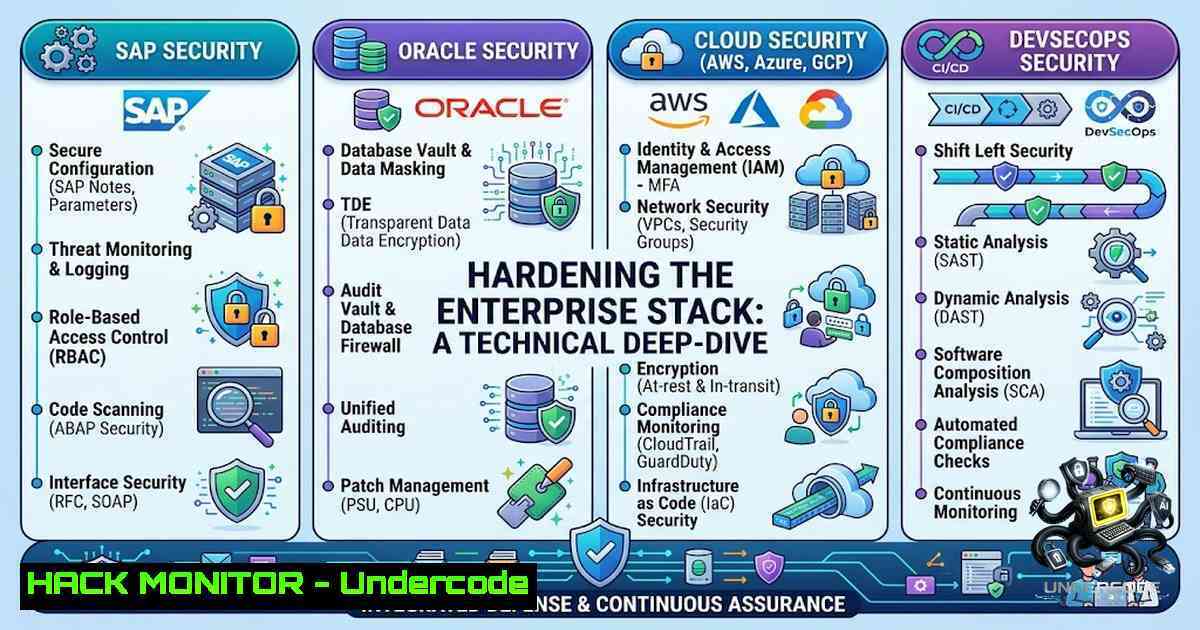
Introduction:
In the modern enterprise, security is no longer a siloed function but an integrated discipline spanning legacy ERP systems, cloud infrastructure, and modern application frameworks. As organizations rush to adopt DevOps and cloud-1ative architectures, they often leave critical vulnerabilities in their SAP landscapes, Oracle databases, and CI/CD pipelines. This article provides a comprehensive, command-level guide to hardening the entire enterprise technology stack—from SAP ASE and Oracle 19c to AWS, Azure, Spring Boot, and .NET Core—offering actionable steps for security engineers, cloud architects, and DevSecOps practitioners.
Learning Objectives:
- Master SAP ASE and Oracle database security hardening through specific system commands and profile configurations
- Implement least-privilege access controls and encryption across AWS and Azure cloud environments
- Secure modern application frameworks (Spring Boot, .NET Core) against dependency vulnerabilities and deserialization attacks
- Build a DevSecOps pipeline with automated SAST, SCA, and secret scanning gates
You Should Know:
- SAP ASE Security Hardening: From Defaults to Defense
SAP Adaptive Server Enterprise (ASE) remains a cornerstone of many enterprise landscapes, yet its default configuration often presents a significant attack surface. Hardening begins with role-based access control and auditing.
Step-by-step guide:
After logging into the operating system with the initial `sa` account, execute the following commands to establish a secure baseline:
isql -Usa
sp_audit "security", "all", "all", "on"
sp_audit "all", "sa_role", "all", "on"
sp_audit "all", "sso_role", "all", "on"
sp_configure "auditing", 1
These commands enable auditing for server-wide security events and all actions performed by users with `sa_role` (system administrator) or `sso_role` (system security officer). Next, create individual logins with granular roles rather than sharing the `sa` account:
create login rsmith with password 'complex_password'
grant role sso_role to rsmith
sp_locklogin sa, "lock"
Locking the `sa` login forces administrators to assume roles through their own credentials, enabling full accountability. For ABAP systems in SAP Enterprise Cloud Services, implement compliant password policies using transaction SECPOL. Critical profile parameters must be set as follows:
| Profile Parameter | ECS Value | Description |
||||
| `login/fails_to_session_end` | 3 | Invalid attempts until session ends |
| `login/fails_to_user_lock` | 6 | Failed attempts before user lock |
| `login/min_password_ing` | 15 | Minimum password length |
| `login/min_password_digits` | 1 | Minimum digits in password |
| `login/password_change_waittime` | 1 | Wait time between password changes |
These settings are mandatory for security and audit compliance. Additionally, secure the SAPXPG mechanism (transactions SM49/SM69) which allows execution of OS-level commands from within SAP—a frequent vector for privilege escalation.
- Oracle Database Hardening on Linux: Layers of Defense
Oracle databases on Linux require hardening at both the OS and database layers. Begin with operating system-level controls.
Step-by-step guide:
Create dedicated Oracle user and groups following the principle of least privilege:
groupadd oinstall
groupadd dba
useradd -g oinstall -G dba -m oracle
passwd oracle
Configure resource limits in `/etc/security/limits.conf`:
oracle soft nproc 2047
oracle hard nproc 16384
oracle soft nofile 1024
oracle hard nofile 65536
Harden SSH access by editing `/etc/ssh/sshd_config`:
PermitRootLogin no
PubkeyAuthentication yes
PasswordAuthentication no
Port 2222
Restrict network access using firewalld—only open the database listener port (1521) and the custom SSH port:
firewall-cmd --permanent --add-port=1521/tcp
firewall-cmd --permanent --add-port=2222/tcp
firewall-cmd --reload
At the database layer, protect the data dictionary:
ALTER SYSTEM SET O7_DICTIONARY_ACCESSIBILITY=FALSE SCOPE=SPFILE;
Enforce strong password policies via a custom profile:
ALTER PROFILE DEFAULT LIMIT
PASSWORD_VERIFY_FUNCTION verify_function_11G
PASSWORD_LIFE_TIME 90
FAILED_LOGIN_ATTEMPTS 5
PASSWORD_LOCK_TIME 1/24;
Enable comprehensive auditing:
ALTER SYSTEM SET audit_trail='DB,EXTENDED' SCOPE=SPFILE;
Configure network encryption and integrity checks in `sqlnet.ora`:
SQLNET.ENCRYPTION_SERVER=REQUIRED
SQLNET.ENCRYPTION_TYPES_SERVER=(AES256)
SQLNET.CRYPTO_CHECKSUM_SERVER=REQUIRED
SQLNET.CRYPTO_CHECKSUM_TYPES_SERVER=(SHA256)
TCP.VALIDNODE_CHECKING=YES
TCP.INVITED_NODES=('192.168.1.10','10.0.0.5')
Finally, secure the listener with a password:
lsnrctl
set current_listener LISTENER
change_password
save_config
- AWS CLI Security: Least Privilege in the Cloud
AWS CLI access is often the weakest link in cloud security. Misconfigured credentials can lead to catastrophic data exposure.
Step-by-step guide:
Never embed long-lived access keys. Use IAM roles and named profiles for environment separation:
aws configure --profile dev-account
aws configure --profile prod-account
Audit existing permissions regularly:
aws iam get-user
aws iam list-attached-user-policies
aws iam list-user-policies --user-1ame your-username
Enforce MFA for sensitive operations by adding a condition to IAM policies. Use short-lived session tokens:
aws sts get-session-token --serial-1umber arn:aws:iam::account-id:mfa/username --token-code 123456
Enable CloudTrail and monitor for unusual activity. Rotate access keys every 90 days:
aws iam create-access-key --user-1ame username
aws iam delete-access-key --access-key-id OLD_KEY_ID --user-1ame username
For automated compliance, deploy AWS Config managed rules covering IAM, encryption, networking, and logging. Apply STIG settings to EC2 instances using the Systems Manager command document:
aws ssm send-command --document-1ame "AWSEC2-ConfigureSTIG" --instance-ids "i-1234567890abcdef0"
4. Azure Security Hardening: PowerShell-Driven Compliance
Azure environments require systematic auditing against the CIS Microsoft Azure Foundations Benchmark.
Step-by-step guide:
Install the Azure PowerShell module and authenticate:
Install-Module -1ame Az -AllowClobber -Force
Connect-AzAccount
Run a comprehensive security audit script that checks IAM, MFA, storage security, network security groups, Microsoft Defender, and logging:
.\azure_security_audit.ps1
For specific subscriptions or custom output paths:
.\azure_security_audit.ps1 -SubscriptionId "your-subscription-id"
.\azure_security_audit.ps1 -OutputPath "C:\Reports\azure_audit.html"
The script produces a color-coded HTML report with remediation commands for each failed control. Critical CIS controls include MFA for privileged accounts, HTTPS-only storage, disabling public blob access, and restricting RDP/SSH from the internet.
Enable advanced threat protection for storage and CosmosDB accounts:
Enable-AzSecurityAdvancedThreatProtection -ResourceId "/subscriptions/.../resourceGroups/.../providers/Microsoft.Storage/storageAccounts/..."
For SQL managed instances, enable advanced data security:
Enable-AzSqlInstanceAdvancedDataSecurity -ResourceGroupName "rg-1ame" -InstanceName "sql-instance"
Always use private endpoints for PaaS services and store secrets in Azure Key Vault with soft delete enabled.
5. Spring Boot Security: Hardening the Defaults
Spring Boot’s auto-configuration convenience can widen the attack surface. The biggest risks are exposed Actuator endpoints and unpatched framework dependencies.
Step-by-step guide:
Lock down Actuator endpoints—expose only `health` and info, never “:
management:
endpoints:
web:
exposure:
include: health,info
server:
port: 9001
Require authentication on management endpoints and bind them to an internal port.
Enforce HTTPS and set security headers:
@Bean
SecurityFilterChain filterChain(HttpSecurity http) throws Exception {
http
.requiresChannel(c -> c.anyRequest().requiresSecure())
.headers(h -> h
.httpStrictTransportSecurity(hsts -> hsts
.includeSubDomains(true)
.maxAgeInSeconds(31536000))
.contentSecurityPolicy(csp -> csp
.policyDirectives("default-src 'self'")));
return http.build();
}
Keep Spring Boot starters patched. Inherit the BOM and stay current:
<parent>
<groupId>org.springframework.boot</groupId>
<artifactId>spring-boot-starter-parent</artifactId>
<version>3.3.5</version>
</parent>
Avoid overriding managed dependency versions without a specific reason. The Spring4Shell (CVE-2022-22965) and Spring Cloud Function SpEL (CVE-2022-22963) flaws underscored the criticality of staying near the current release line.
6. .NET Core Security: Dependency Risk and Deserialization
Most .NET breaches stem from vulnerable NuGet dependencies or insecure deserialization.
Step-by-step guide:
Enable NuGet audit and treat warnings as build errors:
<PropertyGroup>
<NuGetAudit>true</NuGetAudit>
<NuGetAuditMode>all</NuGetAuditMode>
<NuGetAuditLevel>low</NuGetAuditLevel>
<TreatWarningsAsErrors>true</TreatWarningsAsErrors>
</PropertyGroup>
Run explicit vulnerability listing in CI pipelines:
dotnet list package --vulnerable --include-transitive
Prevent insecure deserialization. `BinaryFormatter` is obsolete and removed in .NET 9—do not pull the compatibility shim. Avoid polymorphic deserialization with Newtonsoft.Json:
// Dangerous: attacker controls which type gets instantiated
var settings = new JsonSerializerSettings { TypeNameHandling = TypeNameHandling.All };
var obj = JsonConvert.DeserializeObject<Payload>(userInput, settings);
Prefer `System.Text.Json` with explicit `
` attributes and discriminator allow-lists.

Never hardcode secrets in source code. Use `dotnet user-secrets` for development and Azure Key Vault or environment variables for production. Explicitly add `[bash]` or `[bash]` on every controller—ambiguous authentication is a security hole.

For containerized .NET apps, use multi-stage builds, non-root containers, and pin base image versions.

<ol>
<li>Building a DevSecOps Pipeline: Security Gates in CI/CD</li>
</ol>

A DevSecOps pipeline embeds security checks into existing CI/CD stages, blocking risky changes before deployment.

<h2 style="color: yellow;">Step-by-step guide:</h2>

Stage 1: Pre-commit secret scanning — Catch credentials before they land in the repository:

[bash]
scan-secrets:
runs-on: ubuntu-latest
steps:
- uses: actions/checkout@v4
with:
fetch-depth: 0
- name: Scan for secrets
run: gitleaks detect --source . --redact --exit-code 1
The `–exit-code 1` flag turns warnings into build failures.
Stage 2: Software Composition Analysis (SCA) — Scan the full transitive dependency tree:
sca:
runs-on: ubuntu-latest
steps:
- uses: actions/checkout@v4
- name: Build and resolve dependencies
run: mvn -B dependency:resolve
- name: Software composition analysis
run: sca-scan --fail-on high --sbom sbom.json
Stage 3: Static Application Security Testing (SAST) — Use a curated ruleset to avoid drowning in false positives:
sast:
runs-on: ubuntu-latest
steps:
- uses: actions/checkout@v4
- name: Static analysis
run: semgrep ci --config auto --error
For container image scanning, integrate Trivy with `–exit-code 1` to block deployments with critical vulnerabilities. The goal is a pipeline where security runs on every change, not as a separate late-stage review.
What Undercode Say:
- Key Takeaway 1: Enterprise security requires a layered approach spanning legacy systems (SAP, Oracle), cloud platforms (AWS, Azure), and modern frameworks (Spring Boot, .NET). Each layer has unique hardening commands and configurations that must be implemented systematically.
- Key Takeaway 2: The most cost-effective vulnerability to fix is one that never reaches production. DevSecOps pipelines with automated secret scanning, SCA, and SAST gates catch issues at the commit stage, saving organizations from costly post-deployment remediation.
Analysis: The convergence of traditional IT and cloud-1ative development has created a fragmented security landscape. SAP and Oracle databases, often considered “legacy,” remain mission-critical and require rigorous hardening—yet they are frequently overlooked in favor of cloud security. Meanwhile, cloud providers like AWS and Azure offer powerful native security tools, but misconfigurations remain the leading cause of breaches. Modern frameworks like Spring Boot and .NET Core introduce convenience but also dependency risks that demand disciplined patch management. Finally, DevSecOps pipelines are not optional—they are the mechanism that enforces security at speed. Organizations that master this full stack will not only reduce their attack surface but also build the resilient, audit-ready infrastructure that regulators and customers demand.
Prediction:
- +1 The integration of AI-powered security scanning into CI/CD pipelines will accelerate, enabling real-time vulnerability remediation without human intervention.
- +1 Cloud providers will continue to expand their native security posture management (CSPM) capabilities, reducing the need for third-party tools.
- -1 The complexity of securing hybrid environments (on-prem SAP/Oracle + multi-cloud) will drive a surge in demand for specialized security engineers, widening the talent gap.
- -1 Supply chain attacks targeting NuGet, Maven, and npm ecosystems will increase, forcing organizations to adopt zero-trust dependency policies.
▶️ Related Video (80% Match):
🎯Let’s Practice For Free:
🎓 Live Courses & Certifications:
Join Undercode Academy for Verified Certifications
🚀 Request a Custom Project:
Secure, high-velocity infrastructure and disruptive technological engineering. Contact our engineering team for high-tier development and proprietary systems:
[email protected]
💎 Smart Architecture | 🛡️ Secure by Design | ⭐ Trusted by Thousands
IT/Security Reporter URL:
Reported By: Chittoor Sreedevi – Hackers Feeds
Extra Hub: Undercode MoN
Basic Verification: Pass ✅


