Listen to this Post
Introduction:
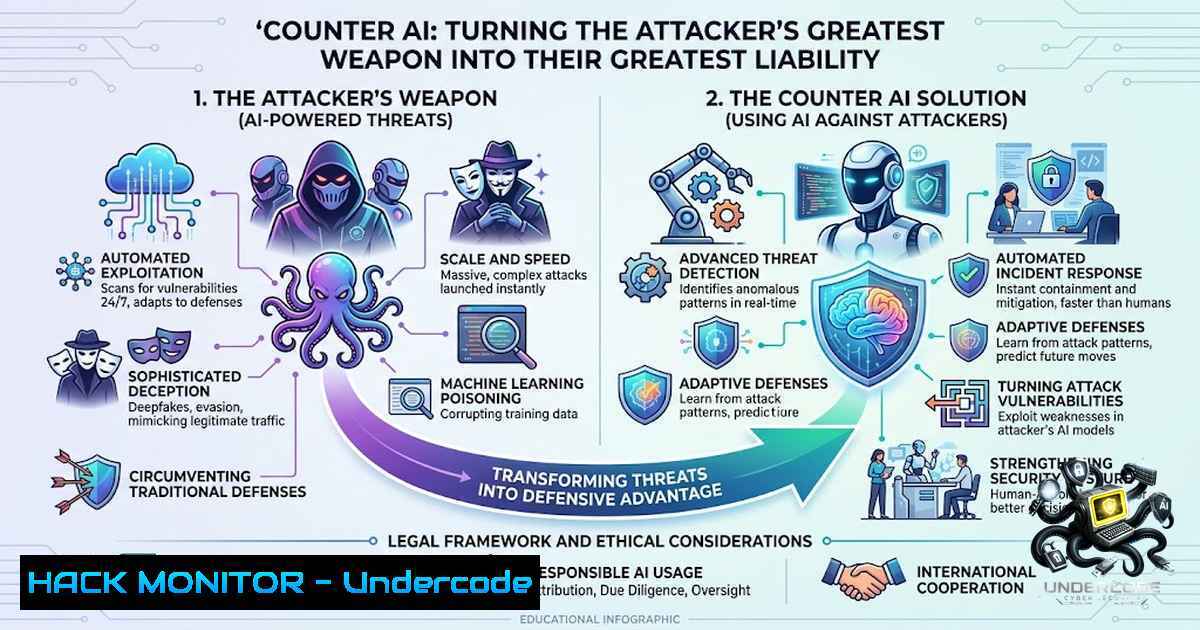
The first phase of AI-powered cyber warfare has irreversibly shifted the strategic advantage to attackers. AI-driven threats now operate at machine speed, capable of choosing when, where, and how to strike—leaving even AI-augmented defenders perpetually reacting. To counter this asymmetry, the next generation of cyber defense must transcend merely matching speed; it must weaponize the attacker’s own automation against them—a paradigm known as Counter AI.
Learning Objectives:
- Understand the fundamental asymmetry of AI-powered cyberattacks and why traditional defense strategies fail.
- Learn the principles of Counter AI and how to turn attacker automation into a strategic liability.
- Gain practical knowledge of defensive AI architectures, including Agentic AI, Automated Moving Target Defense (AMTD), and deception techniques.
You Should Know:
1. The Asymmetry of Machine-Speed Warfare
The fundamental problem in modern cybersecurity is no longer the sophistication of the attack, but the speed at which it occurs. In 2025, the average breakout time from initial access to lateral movement dropped to under 30 minutes, with the fastest cases measured in seconds. Attackers can now discover and weaponize vulnerabilities in minutes instead of weeks. Many vulnerabilities are now exploited within 24 hours of public disclosure—often before organizations even know they’re exposed.
This “cybersecurity speed gap”—the difference between how fast attackers act and how quickly defenders can respond—is growing rapidly. Human operators simply cannot react fast enough to stop autonomous, AI-driven attacks that can execute multi-stage kill chains in minutes or even seconds. Attackers control the timing, location, and initiative, forcing defenders into a perpetual reactive posture.
Counter AI Strategy: Attack to Defend
“Attack to Defend” is a proactive approach that uses continuous validation, adversary emulation, and control testing to uncover weaknesses and attack paths before attackers do. Rather than waiting for threats to emerge, organizations apply the same techniques adversaries use to strengthen defenses.
Step-by-Step Guide: Implementing Attack to Defend
- Deploy an Adversary Emulation Platform: Use tools that behave like autonomous attackers to identify vulnerabilities in your environment. This mimics how AI-powered attackers would probe your defenses.
-
Map Attack Paths: Once vulnerabilities are identified, map potential attack paths that adversaries could exploit. This provides a clear picture of your most critical risk areas.
-
Implement Defensive Tradecraft: Based on the attack paths identified, deploy specific defensive controls to protect critical assets. This might include network segmentation, access controls, or application-level protections.
-
Continuous Validation: Run emulation exercises continuously, not just periodically. AI-powered attackers don’t take breaks—neither should your validation efforts.
2. Advanced Zero Trust Architecture for AI Environments
Zero trust must extend to every entity on the network, including traditional applications, AI-enabled applications, and the infrastructure that powers them. In AI environments, non-human actors are increasingly making or triggering decisions. AI agents need identities, context-aware access controls, and continuous validation just like human users.
Key Zero Trust Implementation Steps for AI Environments:
- Authenticate Every API Call: Every API should authenticate automated agents before allowing them to connect, act, or move data.
-
Enforce Strict, Data-Centric Access Controls: Implement least privilege and micro-segmentation across all resources, including AI models and training data.
-
Accelerate Detection and Response: Zero trust architectures naturally pair with AI-driven emulation, enabling validation of new controls under realistic pressure.
-
Integrate All Pillars: Tightly integrate identity, device, network, application, and data pillars. Without that integration, you don’t have effective defense.
3. Automated Moving Target Defense (AMTD)
AMTD is one of the most promising architectural countermeasures against autonomous AI agents. AI-powered attackers rely on a “world model”—a static understanding of network topology, services, and vulnerabilities. AMTD breaks this model by dynamically and unpredictably changing the attack surface.
AMTD Implementation Guide:
- Identify Critical Assets: List your crown jewels—systems, data, and services that are vital to your operations.
-
Define Mutation Parameters: Determine which aspects of your attack surface can be dynamically changed. This may include IP addresses (using dynamic DNS services), network ports (for internal services), or even file paths and system configurations.
-
Implement a Mutation Engine: Deploy a tool or script that automatically rotates these parameters on a schedule or when suspicious activity is detected.
Linux Example – Dynamic Port Rotation using iptables:
!/bin/bash
 Random port rotation script for AMTD
NEW_PORT=$(shuf -i 8000-8999 -1 1)
iptables -t nat -A PREROUTING -p tcp --dport 80 -j REDIRECT --to-port $NEW_PORT
echo "Web service now listening on port $NEW_PORT"
Windows Example – PowerShell Network Configuration Rotation:
 Randomize network configuration parameters
$newIP = "192.168.1." + (Get-Random -Minimum 100 -Maximum 254)
New-1etIPAddress -InterfaceAlias "Ethernet" -IPAddress $newIP -PrefixLength 24
Write-Host "IP address rotated to $newIP"
- Monitor and Log: Ensure all mutations are fully logged. This data is critical for analyzing attacker behavior and optimizing your Counter AI strategy.
-
Test in a Staging Environment: Before deploying AMTD to production, test its impact on legitimate users and services to ensure business continuity.
4. Agentic AI Defense: The Vellox Paradigm
The industry is moving toward a new class of defensive tools that are “agentic”—meaning they can act autonomously to achieve a goal. Booz Allen’s Vellox suite exemplifies this shift—an AI-1ative product suite built to fight AI with AI.
Vellox Product Suite Overview:
- Vellox Reverser (Generally Available): Malware reverse engineering and threat intelligence that automates exhaustive analysis of complex threats, producing actionable defensive recommendations in minutes.
-
Vellox Ranger (Limited Preview): Detection engineering that autonomously maps customer environments to surface and block adversary activity, reducing dwell time and cutting false positives.
-
Vellox Striker (Limited Preview): Emulates the AI-powered adversary to assess critical security gaps and train customer models to detect sophisticated threats.
-
Vellox Navigator (Launching Soon): Continuous monitoring, controls assessment, and risk mitigation to autonomously interpret and control enterprise compliance in real time.
-
Vellox Responder (Launching Soon): Autonomous security remediation to identify, contain, and remediate threats across cloud, infrastructure, and application layers prior to detection.
Implementation Strategy for Agentic AI Defense:
-
Integrate with Existing Stacks: Vellox products are designed to work within existing technology stacks, minimizing disruption while maximizing defensive capability.
-
Train on Real Adversary Behaviors: Models must be trained on real adversary behaviors, enabling defenders to predict, detect, and respond to advanced threats with extraordinary velocity and precision.
-
Close the Speed Gap: The goal is not just faster detection, but to outpace attackers by pairing machine-speed automation with models trained by elite cyber operators.
-
AI-Enabled Cyber Operations: Moving from Manual to Automated Response
At AI speed, teams cannot rely on linear workflows; detection, investigation, and response must occur in parallel. Organizations must be prepared to act on partial information, using automated containment triggers when evidence meets predefined thresholds.
Automated Response Implementation:
- Define Automated Containment Triggers: Establish clear thresholds for when automated containment should be triggered (e.g., detection of known adversary indicators, anomalous lateral movement patterns).
-
Implement Parallel Workflows: Design workflows that allow detection, investigation, and response to happen simultaneously rather than sequentially.
-
Use AI for Alert Triage: Deploy AI agents that can autonomously analyze and prioritize alerts, reducing the burden on human analysts.
-
Continuous Improvement: Regularly review automated response actions and refine triggers based on lessons learned from incidents.
What Undercode Say:
-
Key Takeaway 1: The cybersecurity speed gap is the defining challenge of our era. Attackers now operate at machine speed, and human-centric defenses are obsolete. The only way to close this gap is through AI-1ative defense systems that can match and outmaneuver AI-powered adversaries.
-
Key Takeaway 2: Counter AI represents a fundamental shift from speed-centric to control-centric defense. By turning attacker automation into a liability through techniques like AMTD, deception, and agentic AI, defenders can regain the strategic advantage. The goal is no longer to run faster—it’s to change the game entirely.
Analysis: The transition from human-speed to machine-speed cyber warfare demands a complete rethinking of defensive strategies. Traditional approaches that rely on faster detection alone are insufficient—attackers will always have the advantage of choosing when and where to strike. Counter AI offers a path forward by weaponizing the attacker’s own strengths against them. Automated Moving Target Defense disrupts the attacker’s world model, making their AI agents less effective. Agentic AI defense platforms like Vellox enable defenders to operate at machine speed while leveraging decades of adversary tradecraft. The organizations that successfully implement these strategies will not only survive the AI-powered threat landscape—they will thrive in it. However, this requires significant investment in new capabilities, retraining of security teams, and a cultural shift toward autonomous, AI-1ative operations. The pivot from speed to control is not just a technical change—it’s a strategic imperative.
Expected Output:
Introduction:
The first phase of AI-powered cyber warfare has irreversibly shifted the strategic advantage to attackers. AI-driven threats now operate at machine speed, capable of choosing when, where, and how to strike—leaving even AI-augmented defenders perpetually reacting. To counter this asymmetry, the next generation of cyber defense must transcend merely matching speed; it must weaponize the attacker’s own automation against them—a paradigm known as Counter AI.
What Undercode Say:
- Key Takeaway 1: The cybersecurity speed gap is the defining challenge of our era. Attackers now operate at machine speed, and human-centric defenses are obsolete. The only way to close this gap is through AI-1ative defense systems that can match and outmaneuver AI-powered adversaries.
- Key Takeaway 2: Counter AI represents a fundamental shift from speed-centric to control-centric defense. By turning attacker automation into a liability through techniques like AMTD, deception, and agentic AI, defenders can regain the strategic advantage. The goal is no longer to run faster—it’s to change the game entirely.
Prediction:
- +1 Organizations that successfully implement Counter AI strategies will gain a significant competitive advantage, as they will be able to detect and neutralize threats before they cause damage, reducing incident response costs and reputational harm.
- +1 The adoption of agentic AI defense platforms like Vellox will accelerate, creating a new market for AI-1ative cybersecurity solutions and driving innovation in defensive AI technologies.
- -1 Attackers will respond by developing more sophisticated AI techniques designed to evade Counter AI measures, leading to an ongoing AI arms race between attackers and defenders.
- -1 Organizations that fail to adopt Counter AI strategies will face increasingly severe breaches, as AI-powered attackers continue to exploit the widening speed gap.
▶️ Related Video (86% Match):
🎯Let’s Practice For Free:
🎓 Live Courses & Certifications:
Join Undercode Academy for Verified Certifications
🚀 Request a Custom Project:
Secure, high-velocity infrastructure and disruptive technological engineering. Contact our engineering team for high-tier development and proprietary systems:
[email protected]
💎 Smart Architecture | 🛡️ Secure by Design | ⭐ Trusted by Thousands
IT/Security Reporter URL:
Reported By: Cavella Boozallen – Hackers Feeds
Extra Hub: Undercode MoN
Basic Verification: Pass ✅


