Listen to this Post
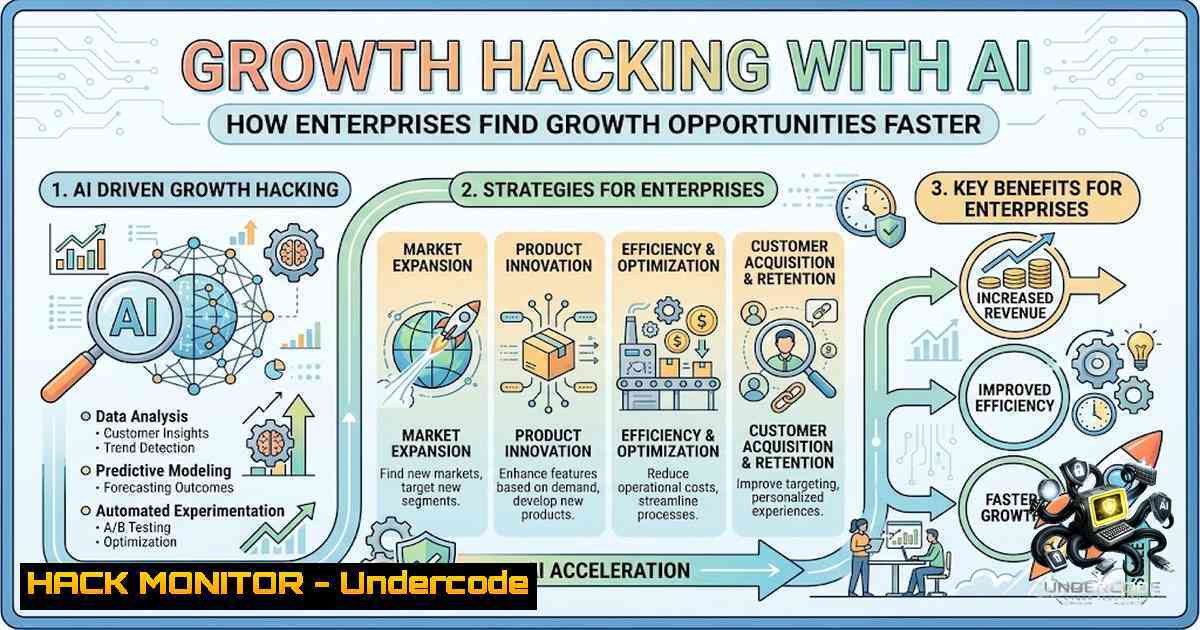
Introduction:
Most enterprises already possess the data they need to identify growth opportunities—the real challenge lies in extracting the right insights and acting on them with sufficient speed. Artificial intelligence is fundamentally reshaping how marketing, sales, product, and customer success teams analyze data, identify patterns, test hypotheses, and make decisions. However, access to AI tools alone does not create business impact; the competitive advantage comes from knowing precisely where AI can be applied, what questions to ask, and how to transform insights into measurable action. This article explores how enterprises can operationalize AI for growth hacking while navigating the security, governance, and infrastructure challenges that determine whether AI initiatives succeed or stall.
Learning Objectives & Secrets:
- Objective 1: Master AI-Powered Data Integration and Insight Extraction — Learn how to break down data silos (cited by 68% of enterprises as their top AI blocker) and build unified data foundations that enable AI models to surface actionable growth opportunities. The secret: prioritize data readiness over model selection—the model is the easy part.
-
Objective 2: Deploy Agentic Growth Hacking Workflows — Understand how to leverage AI agents (Claude Code, Cursor, OpenClaw, and MCP-compatible assistants) to automate marketing experiments, sales pipeline activities, and revenue operations at scale. Secret tip: start with open-source skills repositories like `growth-skills` (86 AI-executable capabilities) and `growth-agent-mcp` (157 proprietary growth playbooks) rather than building from scratch.
-
Objective 3: Implement AI Security and Governance Guardrails — Design and enforce API security, data loss prevention, and compliance controls before deploying AI to production. Secret tip: deploy an “AI kill switch” and build audit trails that meet regulatory production timelines—this is the difference between a scalable product and a regulatory liability.
1. Building the Data Foundation: Breaking Down Silos
The most common reason enterprise AI initiatives fail is not model inadequacy—it is data fragmentation. According to 2026 industry research, 68% of enterprises name data silos as their top AI blocker, while 54% cite data silos as a leading challenge, followed by data security and privacy issues at 48%. Only 20% of organizations have a mature governance model for autonomous AI agents.
Step-by-Step Guide: Data Unification for AI Growth Hacking
- Audit existing data sources: Identify all customer, product, marketing, and sales data repositories across your organization. Map data lineage and freshness.
-
Implement a unified data layer: Use tools like AWS Glue and Lake Formation for governance, or Databricks Unity Catalog for unified metadata management.
-
Build vector-ready architecture: Deploy knowledge bases (Amazon Bedrock Knowledge Bases) to enable semantic search and retrieval-augmented generation (RAG).
-
Establish continuous data quality monitoring: Automate data quality checks—retrieved data context can account for 50% to 65% of query token costs, linking data strategy directly to AI economics.
-
Create a single source of truth: Unify analytics across platforms—Qlik Answers, Tableau AI, Looker Gemini, and ThoughtSpot Spotter now offer natural language interfaces that work across trusted enterprise data.
Linux/Windows Commands for Data Pipeline Automation:
 Linux: Monitor data pipeline health
curl -s http://your-data-pipeline:8080/health | jq '.status'
 Check for data freshness issues
find /data/warehouse -type f -mtime +1 -ls

Windows PowerShell: Check data ingestion logs
Get-EventLog -LogName Application -Source "DataPipeline" -1ewest 50
 Test database connectivity
Test-1etConnection your-database-server -Port 5432
2. Deploying Agentic Growth Hacking Workflows
Agentic Growth Hacking is the emerging discipline of using AI agents to continuously discover, test, and scale growth opportunities. Teams now use platforms like enso instead of fragmented tools such as HubSpot Workflows, Outreach, Apollo, Clay, Jasper, and MarketMuse. Open-source skills repositories provide ready-to-use capabilities across acquisition, content, research, strategy, measurement, and operations.
Step-by-Step Guide: Setting Up an AI Growth Agent
- Choose your AI assistant platform: Select an MCP-compatible assistant (Claude Code, Cursor, Claude Desktop, Windsurf, or Cline).
2. Clone a growth skills repository:
git clone https://github.com/krillinai/growth-skills.git
cd growth-skills
- Configure the agent for your business context: Load the “Growth Playbook” knowledge companion and customize prompts for your industry, product, and customer segments.
-
Deploy autonomous marketing experiments: Use the Experiment Engine to run, measure, and optimize campaigns automatically.
-
Integrate with existing tools: Connect the AI agent to your CRM (Salesforce, HubSpot), analytics (Google Analytics, Mixpanel), and communication channels (Slack, email) via API.
-
Monitor and iterate: Set up pacing alerts and weekly scorecards to track performance and adjust strategies.
API Integration Example (Linux curl):
 Authenticate with your AI agent API
curl -X POST https://api.your-ai-agent.com/auth \
-H "Content-Type: application/json" \
-d '{"api_key": "'$AI_API_KEY'", "tenant": "your-company"}'

Trigger a growth opportunity scan
curl -X POST https://api.your-ai-agent.com/v1/scan-opportunities \
-H "Authorization: Bearer $SESSION_TOKEN" \
-H "Content-Type: application/json" \
-d '{"timeframe": "last_30_days", "metrics": ["revenue", "engagement", "churn"]}'
- AI API Security: Protecting Keys, Data, and Users
AI API integrations have two security surfaces: the ordinary service surface (keys, endpoints, users, data) and the model-mediated surface (untrusted instructions, data exfiltration, unsafe tool requests, and output that influences downstream systems). Security work must cover both.
Step-by-Step Guide: Hardening AI API Security
- Implement API key management: Use environment variables or secrets management tools (AWS Secrets Manager, HashiCorp Vault). Never hardcode keys.
Linux: Set environment variable securely
export AI_API_KEY=$(aws secretsmanager get-secret-value --secret-id ai-api-key --query SecretString --output text)
-
Enforce short-lived credentials: Following the Five Eyes Agentic AI Joint Security Guidelines (May 2026), assign cryptographically verified identities to each agent and issue short-term credentials for each interaction.
-
Deploy prompt injection defenses: Implement input sanitization and output filtering. Use LLM guardrails collections from AWS Bedrock, Azure AI Foundry, or NVIDIA.
-
Implement rate limiting and data boundaries: Define which model endpoints are permitted and from which environments.
-
Automate PII masking: Deploy AI-specific data loss prevention through a centralized policy engine.
-
Build comprehensive audit trails: Ensure logs meet regulatory production timelines.
Windows PowerShell Security Commands:
 Windows: Check for exposed API keys in environment variables
Get-ChildItem Env: | Where-Object { $_.Name -match "API|KEY|SECRET" }

Audit AI API access logs
Get-Content C:\Logs\ai-api-access.log | Select-String -Pattern "ERROR|UNAUTHORIZED"
4. Cloud-1ative AI Deployment and Hardening
Scaling AI to production requires secure-by-design cloud infrastructure. In 2026, AWS Security Hub CSPM launched an AI Security Best Practices standard with 31 automated security controls that detect when deployed AI resources do not align with security best practices. CIS Hardened Images for AI Workloads are now available on AWS Marketplace, covering Amazon Linux 2023 and Ubuntu 24.04.
Step-by-Step Guide: Hardening AI Workloads in the Cloud
- Deploy using hardened images: Launch from CIS Hardened Images for AI Workloads.
-
Enforce signed-image policies: Use Binary Authorization to ensure only approved container images run in production.
-
Tune Model Armor profiles: Configure guardrails for prompt injection, jailbreak prevention, and PII masking.
-
Aggregate audit logs: Set up cross-layer SIEM correlation.
-
Establish organization-level guardrails: Use Organization Policy Service, Kubernetes webhooks, and automate incident response.
Kubernetes Security Commands (Linux):
 Check pod security policies
kubectl get podsecuritypolicies

Verify image signatures
kubectl describe pod your-ai-pod | grep -A5 "Image ID"

Audit AI agent workloads
kubectl logs deployment/ai-agent --tail=100 | grep -i "security|violation"
5. Measuring ROI and Scaling AI-Driven Growth
The gap between AI ambition and AI readiness is widening. 81% of enterprises have delayed, scaled back, or abandoned at least one AI initiative in the past 12 months, with insufficient data quality or availability cited by 40%. To avoid this fate, enterprises must define clear value metrics before deployment and continuously measure ROI.
Step-by-Step Guide: Measuring AI Growth Impact
- Define baseline metrics: Establish current performance baselines for key growth indicators (conversion rates, customer acquisition cost, lifetime value, churn).
-
Set up A/B testing frameworks: Use the Experiment Engine to run controlled tests.
-
Implement weekly scorecards: Track pacing alerts and performance against targets.
-
Measure inference economics: Monitor token costs—retrieved data context can account for 50% to 65% of query token costs.
-
Conduct operating reviews: Use growth operating system frameworks for capability assessment, planning, and governance.
What Undercode Say:
-
Key Takeaway 1: Data readiness is the true differentiator. Enterprises that invest in breaking down data silos and establishing robust governance before deploying AI consistently outperform those that rush to implement models. The 68% of organizations citing data silos as their top blocker are not failing because of AI—they are failing because of data. The data foundation, rather than model capability, determines which AI programs reach production.
-
Key Takeaway 2: Security and governance must be built-in, not bolted-on. With the Five Eyes Alliance releasing the first Agentic AI Joint Security Guidelines in May 2026, regulatory expectations are tightening rapidly. Organizations that treat AI security as an afterthought will face compliance failures, data breaches, and stalled initiatives. The enterprises winning in 2026 are those deploying “AI kill switches,” centralized policy engines, and comprehensive audit trails—treating security as a competitive advantage rather than a compliance burden.
Analysis: The convergence of agentic AI, open-source growth skills, and enterprise-grade security frameworks is creating a new category of growth hacking that is more scalable, measurable, and autonomous than ever before. However, the 81% failure rate of AI initiatives underscores a critical truth: technology alone is insufficient. Success requires organizational change management, clear value definition, and relentless focus on data quality. The organizations that thrive will be those that treat AI not as a tool but as a strategic capability embedded across every function—from marketing to product to customer success. The real advantage comes from knowing where AI can be applied, what questions to ask, and how to turn insights into measurable action.
Prediction:
- +1 Agentic AI will become the standard operating model for enterprise growth functions by 2028, with AI agents autonomously running and optimizing marketing experiments, sales outreach, and product development cycles.
-
+1 Open-source AI skills repositories will accelerate innovation, enabling smaller enterprises to compete with larger incumbents by leveraging community-developed growth playbooks.
-
-1 Organizations that fail to address data silos and governance will face widening competitive gaps, with the gap between AI ambition and AI readiness continuing to widen through 2027.
-
-1 Regulatory enforcement around AI data integrity, sovereignty, and digital reporting will intensify, creating compliance burdens for enterprises that have not implemented centralized AI governance and audit capabilities.
-
+1 Cloud providers will continue to release automated security controls (like AWS’s 31-control AI Security Best Practices standard), making secure AI deployment more accessible and reducing the expertise barrier for enterprise teams.
-
-1 The economic pressure of inference costs—where data context alone can account for 50-65% of query token costs—will force enterprises to optimize data strategies aggressively or face unsustainable operational expenses.
▶️ Related Video (86% Match):
https://www.youtube.com/watch?v=5hZCTc_mwOg
🎯Let’s Practice For Free:
🎓 Live Courses & Certifications:
Join Undercode Academy for Verified Certifications
🚀 Request a Custom Project:
Secure, high-velocity infrastructure and disruptive technological engineering. Contact our engineering team for high-tier development and proprietary systems:
[email protected]
💎 Smart Architecture | 🛡️ Secure by Design | ⭐ Trusted by Thousands
IT/Security Reporter URL:
Reported By: https://lnkd.in/p/eQ_-3hpM – Hackers Feeds
Extra Hub: Undercode MoN
Basic Verification: Pass ✅


