Listen to this Post
Introduction:
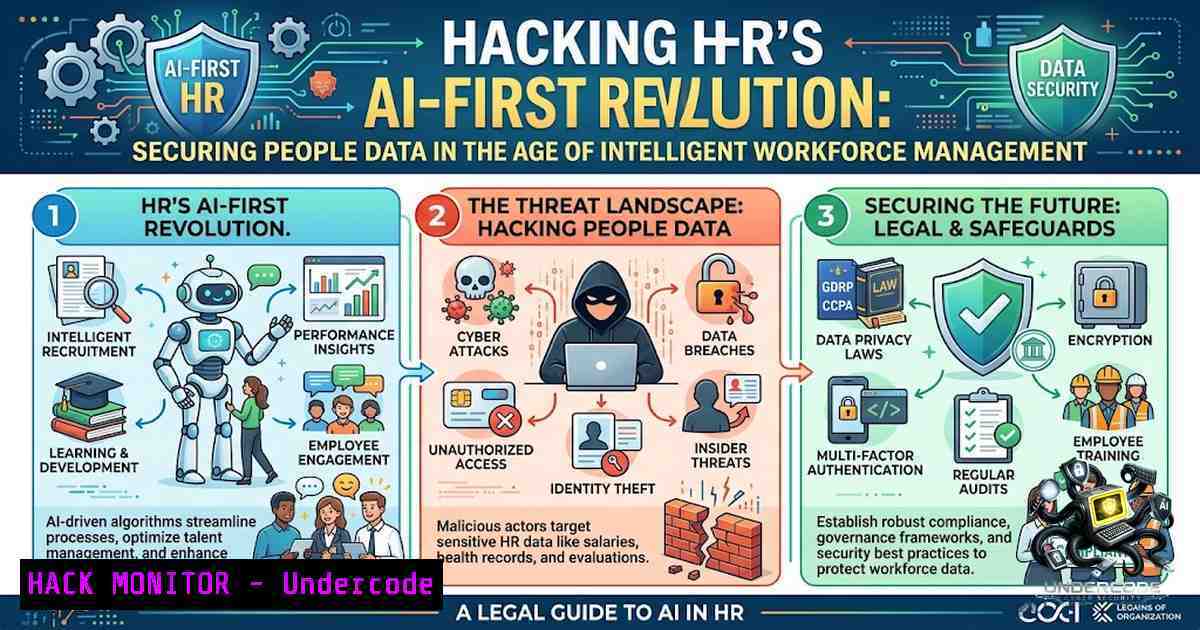
The integration of artificial intelligence into human resources is reshaping how organizations manage talent, but this digital transformation introduces significant cybersecurity and data privacy challenges. As Hacking HR expands its community in New Zealand, HR professionals must now navigate the complex intersection of people operations, AI-driven decision-making, and the protection of sensitive employee data. This article explores the technical and security implications of AI adoption in HR, providing actionable guidance for building secure, compliant, and resilient people technology ecosystems.
Learning Objectives:
- Understand the cybersecurity risks associated with AI-powered HR tools and people analytics platforms
- Master data protection frameworks and encryption standards for sensitive employee information
- Implement secure API integrations between HR systems and AI services
- Develop incident response protocols for HR data breaches and AI system compromises
- Apply compliance controls aligned with global privacy regulations (GDPR, CCPA, PIPEDA)
1. AI in HR: The Security Perimeter Challenge
Hacking HR’s curriculum emphasizes practical applications of artificial intelligence, including building knowledge-base chatbots, multi-agent systems, and connected operations systems. While these innovations drive efficiency, they also expand the attack surface for cyber threats. HR systems now house the most sensitive organizational data—social security numbers, health information, performance evaluations, and compensation details—making them prime targets for ransomware, insider threats, and nation-state espionage.
Step‑by‑step guide to securing HR AI systems:
Linux (Ubuntu/Debian) – Implement real-time file integrity monitoring for HR data stores:
 Install AIDE (Advanced Intrusion Detection Environment)
sudo apt-get install aide
 Initialize the database
sudo aideinit
 Move the database to the default location
sudo mv /var/lib/aide/aide.db.new /var/lib/aide/aide.db
 Run a manual integrity check
sudo aide --check
 Schedule daily checks via cron
sudo crontab -e
 Add: 0 2    /usr/bin/aide --check | mail -s "AIDE Daily Report" [email protected]
Windows (PowerShell) – Audit HR folder permissions and identify excessive access:
 Generate comprehensive permission report for HR shared drives
$hrPath = "\hrserver\shared\hrdata"
Get-ChildItem -Path $hrPath -Recurse | ForEach-Object {
$acl = Get-Acl $<em>.FullName
$acl.Access | ForEach-Object {
[bash]@{
Path = $</em>.FullName
Identity = $<em>.IdentityReference
Rights = $</em>.FileSystemRights
Type = $_.AccessControlType
}
}
} | Export-Csv -Path "hr_permissions_audit.csv" -1oTypeInformation

Identify orphaned SIDs (deleted users with lingering access)
$orphanedSIDs = Get-ChildItem -Path $hrPath -Recurse | Get-Acl | ForEach-Object {
$<em>.Access | Where-Object { $</em>.IdentityReference -match "S-1-5-21" }
}
Cloud (AWS CLI) – Audit IAM roles and policies for HR system access:
 List all IAM users with access to HR-related S3 buckets
aws iam list-users --query 'Users[].UserName' --output text | while read user; do
aws iam list-attached-user-policies --user-1ame $user --query 'AttachedPolicies[].PolicyName' --output text
done

Check for overly permissive policies
aws iam list-policies --scope Local --query 'Policies[?PolicyName.contains(@, <code>HR</code>)]' --output json | jq '.[] | select(.PolicyName | contains("HR"))'
- API Security: The Glue Between HR and AI Ecosystems
Modern HR platforms integrate with dozens of third-party AI services—from resume parsers to sentiment analysis tools. Each API connection represents a potential vulnerability. Hacking HR’s platform itself demonstrates this interconnected model, offering community feeds, learning pods, and discussion forums that rely on secure API architecture. The OWASP API Security Top 10 provides a critical framework for HR technology leaders.
Step‑by‑step guide to hardening HR API integrations:
Linux – Implement API rate limiting and request validation with NGINX:
 /etc/nginx/nginx.conf - API Gateway configuration
http {
limit_req_zone $binary_remote_addr zone=hrapp:10m rate=10r/s;

server {
location /api/hr/ {
limit_req zone=hrapp burst=20 nodelay;
limit_req_status 429;

Validate JWT tokens
auth_request /auth/validate;

CORS security headers
add_header X-Content-Type-Options "nosniff" always;
add_header X-Frame-Options "DENY" always;
add_header Content-Security-Policy "default-src 'none'; script-src 'self'";
}
}
}
Windows (PowerShell) – Monitor API endpoint health and detect anomalies:
 Set up API monitoring with thresholds
$apiEndpoints = @(
"https://hr-api.internal/v1/employees",
"https://ai-sentiment.hr.local/v2/analyze",
"https://talent-matching.hr.local/v3/match"
)

foreach ($endpoint in $apiEndpoints) {
try {
$response = Invoke-WebRequest -Uri $endpoint -Method Head -TimeoutSec 5
$status = $response.StatusCode
$latency = $response.Headers["X-Response-Time"]

Log to Windows Event Log
Write-EventLog -LogName "Application" -Source "HR-API-Monitor" -EventId 1001 -Message "Endpoint: $endpoint | Status: $status | Latency: $latency"
} catch {
 Trigger alert for anomalies
Send-MailMessage -To "[email protected]" -Subject "API Alert: $endpoint" -Body $_.Exception.Message
}
}
API Authentication Best Practices (OAuth 2.0 with PKCE):
 Python example for secure OAuth 2.0 PKCE flow for HR system integrations
import secrets
import hashlib
import base64

Generate PKCE code verifier and challenge
code_verifier = secrets.token_urlsafe(64)
code_challenge = base64.urlsafe_b64encode(
hashlib.sha256(code_verifier.encode('utf-8')).digest()
).decode('utf-8').rstrip('=')

Token exchange with client credentials and PKCE
def get_hr_api_token(client_id, client_secret, auth_code, code_verifier):
 Implementation using requests library
pass
- Data Privacy and Encryption: Protecting the Crown Jewels
Hacking HR’s community spans over 300,000 professionals across 50+ countries, each generating and sharing sensitive people data. Compliance with GDPR, CCPA, and emerging AI-specific regulations requires robust encryption at rest and in transit, coupled with granular access controls and comprehensive audit trails.
Step‑by‑step guide to implementing HR data encryption:
Linux – Encrypt HR database backups using LUKS and GPG:
 Create encrypted volume for HR backup storage
sudo cryptsetup luksFormat /dev/sdb1
sudo cryptsetup luksOpen /dev/sdb1 hr_encrypted_volume
sudo mkfs.ext4 /dev/mapper/hr_encrypted_volume
sudo mount /dev/mapper/hr_encrypted_volume /mnt/hr_backups

Encrypt specific HR data exports with GPG
gpg --full-generate-key  Generate key if not exists
gpg --encrypt --recipient "[email protected]" hr_employee_export.csv
Windows (PowerShell) – Enable BitLocker and EFS for HR data protection:
 Enable BitLocker on HR data drives
Enable-BitLocker -MountPoint "D:" -EncryptionMethod XtsAes256 -UsedSpaceOnly -SkipHardwareTest

Configure EFS for specific HR folders
$hrFolders = @("C:\HR\EmployeeRecords", "C:\HR\Payroll", "C:\HR\PerformanceReviews")
foreach ($folder in $hrFolders) {
cipher /e /s:$folder
 Add recovery agent
cipher /r:HR_Recovery_Agent
cipher /adduser /certhash:HR_Recovery_Agent.cer $folder
}

Audit EFS usage
Get-WinEvent -LogName Security -FilterXPath "[System[EventID=4663]]" | Where-Object { $_.Message -match "EFS" }
Database (PostgreSQL) – Implement column-level encryption for PII:
-- Enable pgcrypto extension
CREATE EXTENSION IF NOT EXISTS pgcrypto;

-- Create encrypted employee table
CREATE TABLE employee_secure (
id UUID PRIMARY KEY DEFAULT gen_random_uuid(),
employee_id TEXT UNIQUE,
name TEXT,
ssn TEXT ENCRYPTED WITH (ALGORITHM = 'AES-256-CBC'),
salary NUMERIC ENCRYPTED,
health_data JSONB ENCRYPTED,
created_at TIMESTAMP DEFAULT CURRENT_TIMESTAMP
);

-- Create encryption key management function
CREATE OR REPLACE FUNCTION rotate_encryption_key()
RETURNS VOID AS $$
BEGIN
-- Re-encrypt data with new key
UPDATE employee_secure
SET ssn = pgp_sym_encrypt(pgp_sym_decrypt(ssn, current_setting('app.old_key')), current_setting('app.new_key'));
END;
$$ LANGUAGE plpgsql;
4. Multi-Agent System Security: Securing AI Orchestration
Hacking HR’s curriculum includes building multi-agent systems, reflecting the growing trend toward AI agent orchestration in HR. These systems—where multiple AI agents collaborate on tasks like resume screening, interview scheduling, and candidate matching—introduce unique security challenges including agent impersonation, prompt injection, and data leakage across agent boundaries.
Step‑by‑step guide to securing multi-agent HR systems:
Container Security (Docker) – Isolate AI agents with minimal privileges:
 Dockerfile for HR AI Agent with security hardening
FROM python:3.11-slim

Create non-root user
RUN useradd -m -s /bin/bash hragent && \
mkdir -p /app/data && \
chown -R hragent:hragent /app

Drop all capabilities, add only what's needed
RUN setcap 'cap_net_bind_service=+ep' /usr/local/bin/python

Run as non-root user
USER hragent
WORKDIR /app

Security: Read-only root filesystem
VOLUME ["/app/data"]
Linux – Implement network segmentation for AI agent communication:
 Create network namespace for AI agents
sudo ip netns add hr_ai_agents

Set up veth pair for controlled communication
sudo ip link add veth0 type veth peer name veth1
sudo ip link set veth1 netns hr_ai_agents

Apply eBPF-based filtering using bpftrace
sudo bpftrace -e 'kprobe:security_socket_connect {
if (str(arg1) == "untrusted-ai-service") {
printf("Blocked connection to untrusted AI service\n");
return -1;
}
}'
Python – Implement agent authentication and message validation:
import jwt
from datetime import datetime, timedelta
from pydantic import BaseModel, ValidationError

Agent identity validation schema
class AgentIdentity(BaseModel):
agent_id: str
agent_type: str  screening, matching, scheduling, analytics
tenant_id: str
capabilities: list[bash]

JWT-based agent authentication
def validate_agent_token(token: str, expected_tenant: str) -> bool:
try:
payload = jwt.decode(token, secrets.JWT_SECRET, algorithms=["HS256"])
 Validate tenant isolation
if payload.get('tenant_id') != expected_tenant:
return False
 Check token expiration
if datetime.fromtimestamp(payload['exp']) < datetime.utcnow():
return False
return True
except jwt.InvalidTokenError:
return False

Inter-agent communication validation
def validate_agent_message(message: dict, source_agent: str, target_agent: str):
 Prevent privilege escalation
allowed_operations = {
'screening': ['submit_candidate', 'request_resume'],
'matching': ['receive_candidate', 'request_interview'],
'scheduling': ['schedule_interview', 'send_calendar']
}
if message['operation'] not in allowed_operations.get(source_agent, []):
raise SecurityException(f"Unauthorized operation: {message['operation']}")
- Incident Response for HR Systems: When AI Goes Rogue
With AI-powered HR tools making decisions about hiring, promotions, and terminations, a security incident can have devastating consequences—from biased algorithm manipulation to mass data exfiltration. Hacking HR’s emphasis on building connected operations systems means HR leaders must be prepared for AI-specific incident scenarios.
Step‑by‑step guide to HR AI incident response:
Linux – Implement automated alerting for suspicious AI activity:
 Monitor AI model API calls for anomalies
tail -f /var/log/hr_ai_api.log | while read line; do
if echo "$line" | grep -q "ERROR" || echo "$line" | grep -q "UNAUTHORIZED"; then
 Send alert to SIEM
logger -t HR-AI-SECURITY "ALERT: $line"
 Trigger immediate response
systemctl stop hr-ai-orchestrator
 Notify security team
echo "$line" | mail -s "HR AI Security Incident" [email protected]
fi
done
Windows (PowerShell) – Automate forensic collection for HR incidents:
 HR Incident Response Playbook - Phase 1: Containment
function Invoke-HRIncidentContainment {
param($IncidentID, $AffectedSystem)

Isolate affected system
Set-1etFirewallRule -DisplayName "HR AI Service" -Action Block

Capture memory dump for forensic analysis
$dumpPath = "C:\Forensics\$IncidentID"
New-Item -ItemType Directory -Path $dumpPath -Force
.\procdump.exe -ma $AffectedSystem $dumpPath\memory.dmp

Collect AI model logs
Copy-Item "C:\HR\AI\Logs\" -Destination $dumpPath -Recurse

Export active network connections
Get-1etTCPConnection | Export-Csv "$dumpPath\network_connections.csv"

Preserve event logs
wevtutil epl System "$dumpPath\System.evtx"
wevtutil epl Application "$dumpPath\Application.evtx"
wevtutil epl Security "$dumpPath\Security.evtx"
}
Cloud (AWS) – Implement automated rollback for compromised AI models:
 Create versioned S3 bucket for AI models with versioning enabled
aws s3api put-bucket-versioning --bucket hr-ai-models --versioning-configuration Status=Enabled

Automate rollback to last known good model
aws s3api list-object-versions --bucket hr-ai-models --prefix production/model.h5 --query 'Versions[?IsLatest==<code>false</code>].{VersionId:VersionId, LastModified:LastModified}' --output json | jq '.[bash].VersionId'

Deploy rollback
aws s3api copy-object --bucket hr-ai-models --copy-source hr-ai-models/production/model.h5?versionId=<previous_version> --key production/model.h5
6. Compliance Automation: Building Privacy by Design
Global privacy regulations demand that HR systems incorporate data protection from the ground up. Hacking HR’s framework includes competency standards for responsible AI work across 18 capability domains, reflecting the growing importance of ethical AI and compliance in HR technology.
Step‑by‑step guide to automating GDPR/CCPA compliance for HR data:
Python – Implement data subject access request (DSAR) automation:
from flask import Flask, request, jsonify
from datetime import datetime, timedelta
import hashlib
import redis

app = Flask(<strong>name</strong>)
cache = redis.Redis(host='localhost', port=6379, decode_responses=True)

class DSARProcessor:
def <strong>init</strong>(self, hr_db_connection):
self.db = hr_db_connection

def process_access_request(self, employee_id: str, request_id: str):
"""Automated DSAR processing with data minimization"""
 Verify employee identity (multi-factor)
if not self.verify_identity(employee_id, request_id):
return {"status": "rejected", "reason": "Identity verification failed"}

Data inventory mapping
data_sources = {
'employee_records': self.db.employees.find({'employee_id': employee_id}),
'performance_data': self.db.performance.find({'employee_id': employee_id}),
'ai_decisions': self.db.ai_logs.find({'subject_id': employee_id}),
'training_records': self.db.training.find({'employee_id': employee_id})
}

Apply data minimization - only include last 3 years
cutoff_date = datetime.now() - timedelta(days=1095)

Generate secure export with expiration
export_id = hashlib.sha256(f"{employee_id}{request_id}".encode()).hexdigest()
cache.setex(f"export:{export_id}", 3600, json.dumps(data_sources))

return {"status": "ready", "export_id": export_id, "expires_in": "3600 seconds"}
Database (PostgreSQL) – Implement automated data retention and purging:
-- Create retention policy function
CREATE OR REPLACE FUNCTION apply_hr_retention_policy()
RETURNS VOID AS $$
BEGIN
-- Delete employee data older than 7 years (GDPR 17)
DELETE FROM employee_records
WHERE termination_date < CURRENT_DATE - INTERVAL '7 years';

-- Anonymize AI training data after 3 years
UPDATE ai_training_data
SET employee_id = 'ANONYMIZED_' || md5(random()::text),
sensitive_fields = NULL
WHERE created_at < CURRENT_DATE - INTERVAL '3 years';

-- Purge audit logs older than 1 year (unless under legal hold)
DELETE FROM audit_logs
WHERE created_at < CURRENT_DATE - INTERVAL '1 year'
AND legal_hold = FALSE;

-- Log retention operations
INSERT INTO compliance_audit (operation, timestamp, records_affected)
VALUES ('retention_purge', CURRENT_TIMESTAMP,
(SELECT COUNT() FROM employee_records WHERE termination_date < CURRENT_DATE - INTERVAL '7 years'));
END;
$$ LANGUAGE plpgsql;

-- Schedule retention job
CREATE EXTENSION IF NOT EXISTS pg_cron;
SELECT cron.schedule('hr-retention', '0 3   0', 'SELECT apply_hr_retention_policy()');
- Workforce Identity and Access Management (IAM) for AI Systems
As Hacking HR builds communities across New Zealand and globally, the need for robust IAM becomes paramount. AI systems must enforce least-privilege access while enabling seamless collaboration across organizational boundaries.
Step‑by‑step guide to implementing zero-trust IAM for HR AI:
Linux – Implement SSO with MFA using Keycloak/FreeIPA:
 Install Keycloak for HR SSO
wget https://github.com/keycloak/keycloak/releases/download/23.0.0/keycloak-23.0.0.tar.gz
tar -xzf keycloak-23.0.0.tar.gz
cd keycloak-23.0.0

Configure HR realm with MFA
bin/kcadm.sh create realms -s realm=hr -s enabled=true
bin/kcadm.sh create authentication/flows -r hr -s alias="HR MFA Flow" -s providerId="basic-flow"

Configure LDAP federation for employee directory
bin/kcadm.sh create components -r hr -s name=ldap -s providerId=ldap -s config="{\"enabled\":[\"true\"],\"priority\":[\"0\"],\"connectionUrl\":[\"ldap://hr-dc.internal\"],\"usersDn\":[\"ou=employees,dc=hr,dc=local\"]}"
Windows (PowerShell) – Implement conditional access policies for HR applications:
 Configure Azure AD Conditional Access for HR systems
$hrApp = Get-AzureADApplication -Filter "DisplayName eq 'HR AI Platform'"

Require MFA and compliant devices
$policy = New-AzureADMSConditionalAccessPolicy -DisplayName "HR AI Access Policy" -State "enabled" `
-Conditions @{
Applications = @{ IncludeApplications = @($hrApp.AppId) }
Users = @{ IncludeUsers = @("all") }
Locations = @{ IncludeLocations = @("all") }
DevicePlatforms = @{ IncludePlatforms = @("all") }
ClientAppTypes = @("browser", "mobileAppsAndDesktopClients")
} `
-GrantControls @{
Operator = "AND"
BuiltInControls = @("mfa", "compliantDevice", "domainJoinedDevice")
}

Write-Host "Conditional Access Policy created: $($policy.Id)"
What Undercode Say:
- The convergence of HR and cybersecurity is inevitable. As AI permeates every aspect of people management, the security of HR systems becomes a board-level concern. Organizations that treat HR data as a critical asset—with the same rigor as financial or intellectual property data—will lead the future of work.
-
AI governance frameworks are no longer optional. Hacking HR’s AI competency standards across 18 domains represent a blueprint for responsible AI adoption. HR leaders must partner with security teams to implement AI-specific controls, including model validation, bias testing, and continuous monitoring.
-
The skills gap is real and urgent. Just as HR professionals are learning AI applications, they must also develop cybersecurity literacy. Understanding concepts like zero-trust architecture, API security, and data encryption is becoming as essential as understanding people analytics.
-
Compliance is a feature, not a burden. Automating GDPR/CCPA compliance through code—as demonstrated in the DSAR and retention examples—transforms regulatory requirements into operational advantages. Privacy by design builds trust with employees and candidates.
-
Incident response must include AI scenarios. Traditional breach response plans are insufficient for AI-specific incidents. Organizations need playbooks for model poisoning, prompt injection, and algorithmic bias exploitation—each requiring specialized technical and legal responses.
-
The New Zealand opportunity is significant. As Hacking HR expands locally, New Zealand has a chance to build a uniquely secure and ethical AI-HR ecosystem. With strong data protection laws and a collaborative business culture, the region can become a model for responsible AI adoption in people management.
Prediction:
-
+1 AI-powered HR systems will become primary targets for ransomware gangs within 24 months, as the value of stolen employee data on the dark web rivals that of credit card information.
-
+1 Regulatory bodies will mandate AI impact assessments for HR systems, creating a new category of compliance auditors and driving demand for professionals with hybrid HR-cybersecurity expertise.
-
-1 Organizations that fail to implement robust API security for their HR integrations will face cascading breaches, as interconnected AI agents create unprecedented attack vectors across the enterprise ecosystem.
-
+1 The adoption of zero-trust architecture in HR will accelerate, with IAM solutions incorporating behavioral biometrics and continuous authentication becoming standard within 3 years.
-
-1 AI bias and security incidents will trigger the first major class-action lawsuit against an employer using unsecured AI hiring tools, setting precedent for algorithmic accountability and forcing rapid industry-wide security upgrades.
-
+1 Hacking HR’s community-driven approach to AI education will position its members as the most prepared HR professionals globally, creating a talent arbitrage where security-conscious HR leaders command premium compensation.
-
-1 The complexity of securing multi-agent HR systems will outpace the availability of skilled professionals, creating a dangerous window of vulnerability for early adopters of advanced AI orchestration.
-
+1 Open-source security tools for AI-HR systems will emerge, democratizing access to enterprise-grade protections and enabling smaller organizations to compete securely in the talent marketplace.
▶️ Related Video (80% Match):
https://www.youtube.com/watch?v=1dPhrmc4aJ8
🎯Let’s Practice For Free:
🎓 Live Courses & Certifications:
Join Undercode Academy for Verified Certifications
🚀 Request a Custom Project:
Secure, high-velocity infrastructure and disruptive technological engineering. Contact our engineering team for high-tier development and proprietary systems:
[email protected]
💎 Smart Architecture | 🛡️ Secure by Design | ⭐ Trusted by Thousands
IT/Security Reporter URL:
Reported By: https://lnkd.in/p/eiHv3tjw – Hackers Feeds
Extra Hub: Undercode MoN
Basic Verification: Pass ✅


