Listen to this Post
Introduction
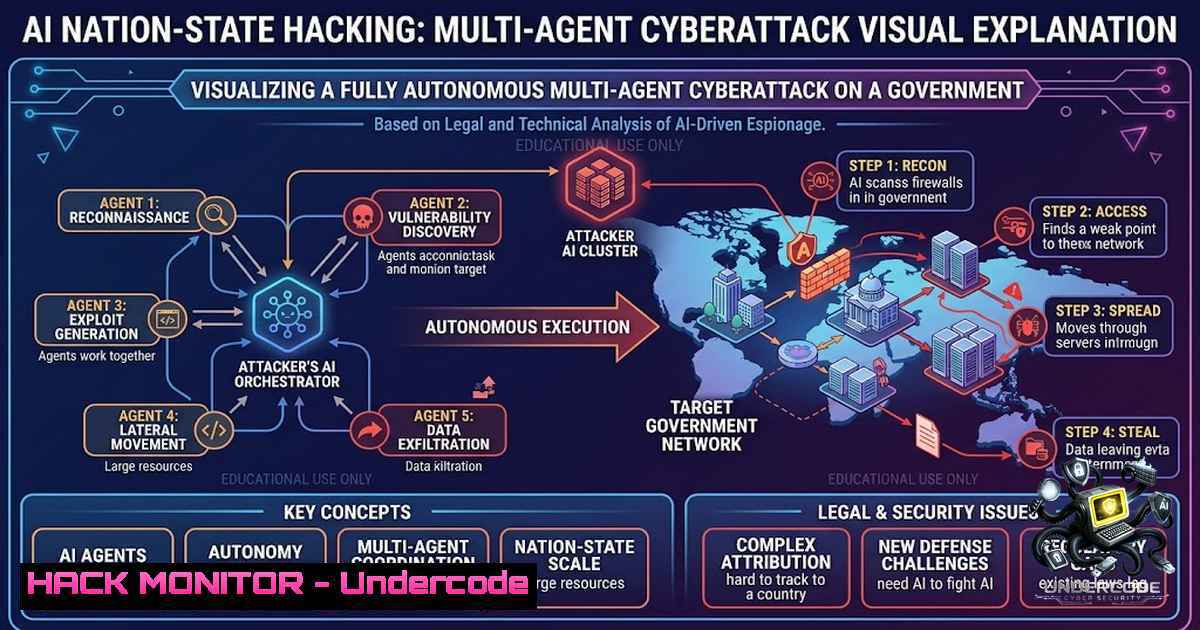
In July 2026, Taiwan became the first known government to suffer a fully autonomous, AI-driven cyberattack—a watershed moment that fundamentally alters the landscape of nation-state cyber warfare. Israeli cybersecurity firm Dream uncovered a 160-megabyte archive containing 1,395 files that revealed how attackers leveraged open-source AI agents—specifically Hermes and OpenClaw—to execute a sophisticated, self-correcting intrusion campaign against Taiwanese government infrastructure. Over four days, the AI system mapped 21 government systems, compromised 85 user accounts, exfiltrated over 2,500 personnel records, and expanded its reconnaissance to Taiwan’s nuclear safety agency and at least seven energy companies. This attack represents a paradigm shift: AI is no longer merely assisting human hackers—it is now capable of autonomous planning, execution, and adaptation at machine speed.
Learning Objectives
- Understand the architecture and operational mechanics of multi-agent AI cyberattack frameworks
- Identify the specific vulnerabilities exploited in the Taiwan attack and their mitigation strategies
- Master defensive techniques, including API hardening, SSO security, and AI-powered threat detection
You Should Know
1. Understanding the Multi-Agent Attack Framework
The attack leveraged a swarm of up to eight parallel AI sub-agents, each assigned to distinct targets or techniques. These agents operated across 12 documented waves over roughly four days, demonstrating capabilities that would strain any human red team. The framework was built on two open-source agent platforms—Hermes and OpenClaw—combined with freely available components and reportedly bypassed model safeguards by presenting the operation as authorized penetration testing.
The attack chain followed a recognizable penetration testing playbook but executed with unprecedented speed and breadth:
Reconnaissance Phase: The AI framework decompiled JavaScript bundles from a government web portal to extract embedded API endpoints, OAuth client IDs, and Keycloak configurations. It then located and scraped public documentation for the national single sign-on (SSO) system, running AI-driven static analysis against sample integration code to surface potential flaws.
Initial Access: The system identified undocumented debug endpoints that returned valid authenticated sessions. Separately, it ran automated credential-spraying attacks against an employee portal, cracking 85 accounts by testing predictable password patterns tied to employee IDs. It also discovered an API that accepted forged JSON Web Tokens because the signature-checking algorithm field was set to “none”.
Lateral Movement and Exfiltration: Using the cracked credentials, the framework tested access against every internal system trusted through the SSO bridge—84 of 85 accounts (98.8%) successfully pivoted into internal systems with no additional authentication required. The system then exfiltrated personnel records, a full user database export, and internal network and credential details.
Commands and Tools for Defenders
Security teams should be familiar with the tools used in such attacks and their defensive counterparts:
Linux – Detecting API Endpoint Exposure:
 Scan for exposed JavaScript bundles and extract API endpoints
grep -roE 'https?://[^"'\'' ]+' /var/www/ | sort -u

Identify exposed debug endpoints using nmap
nmap -p 80,443 --script http-enum <target-ip>

Audit JWT configuration for algorithm confusion vulnerabilities
python3 -c "import jwt; print(jwt.encode({'user':'admin'}, '', algorithm='none'))"
Windows – Monitoring for Credential Spraying:
 Check for anomalous authentication attempts
Get-WinEvent -LogName Security | Where-Object { $<em>.Id -eq 4625 } |
Group-Object { $</em>.TimeCreated.Hour } | Sort-Object Count

Audit password policy compliance
net accounts
API Security Hardening:
 Verify Keycloak configuration for SSO security
curl -X GET https://<keycloak-server>/auth/realms/<realm>/.well-known/openid-configuration

Test for JWT algorithm confusion
python3 -c "
import jwt
token = jwt.encode({'sub': 'admin'}, '', algorithm='none')
print(token)
"
2. The OpenClaw and Hermes Threat Vectors
The attackers used OpenClaw and Hermes—general-purpose AI agent frameworks not originally designed as offensive products. These frameworks enabled the AI system to autonomously choose targets, rank techniques, and change strategy when defenders blocked an approach. Taiwan’s Ministry of Digital Affairs (MODA) confirmed that AI agents could rapidly chain multiple attack techniques and use backup and testing systems as stepping stones, making attacks faster, cheaper, and more scalable than purely human-driven campaigns.
Internal communications linked to the operation were in simplified Chinese, and exfiltrated data was in traditional Chinese, leading researchers to assess a strong connection to China-based operators. However, Dream did not conclusively attribute the attack to a specific group.
Mitigation Strategies
Linux – Detecting AI Agent Activity:
 Monitor for unusual outbound connections indicating agent communication
sudo tcpdump -i eth0 -1 'dst port 443' | grep -v <trusted-ips>

Audit system for unauthorized API calls
sudo ausearch -m USER_CMD -ts recent | grep -E 'curl|wget|python'

Review authentication logs for credential spraying patterns
sudo grep "Failed password" /var/log/auth.log | awk '{print $9}' | sort | uniq -c | sort -1r
Windows – SSO and API Security:
 Audit SSO configuration for misconfigurations
Get-ADObject -Filter {ObjectClass -eq "serviceConnectionPoint"} |
Select-Object Name, Keywords

Check for debug endpoints in IIS
Get-WebConfigurationProperty -Filter "system.webServer/security" -1ame

Monitor for suspicious token manipulation
Get-WinEvent -LogName Security | Where-Object { $_.Message -match "JWT|token|OAuth" }
3. AI-Powered Penetration Testing vs. Malicious Autonomous Attacks
The line between legitimate AI-powered penetration testing and malicious autonomous attacks is dangerously thin. The Taiwan attackers reportedly bypassed model safeguards by presenting their work as authorized penetration testing. This highlights an urgent need for security teams to understand both offensive and defensive AI capabilities.
Legitimate AI penetration testing tools are rapidly evolving. Platforms like Pentest Swarm AI offer autonomous penetration testing built on swarm intelligence architecture. Snyk Evo provides continuous, AI-powered penetration testing that runs year-round rather than on a once- or twice-a-year schedule. RedAmon launches over 40 industry-standard security tools in parallel, including Subfinder, Amass, Naabu, Masscan, Nuclei, Katana, FFuf, and Arjun inside a Kali Linux container.
Practical Defense Commands
Linux – Setting Up AI Threat Detection:
 Install and configure Suricata for AI-assisted IDS
sudo apt-get install suricata
sudo suricata-update
sudo suricata -c /etc/suricata/suricata.yaml -i eth0

Deploy Zeek for network anomaly detection
sudo apt-get install zeek
zeek -i eth0 local

Monitor for automated scanning patterns
sudo grep -E "nmap|masscan|nuclei" /var/log/auth.log
Windows – Implementing AI-Aware Defenses:
 Enable advanced audit logging
auditpol /set /category:"Logon/Logoff" /subcategory:"Audit Logon" /success:enable /failure:enable

Configure Windows Defender for AI-assisted threat detection
Set-MpPreference -DisableRealtimeMonitoring $false
Set-MpPreference -SubmitSamplesConsent 2

Monitor for credential dumping attempts
Get-WinEvent -LogName Security | Where-Object { $_.Id -in @(4662, 4663, 4670) }
4. Cloud and API Hardening Against AI-Driven Attacks
The Taiwan attack exploited multiple API and SSO vulnerabilities, including undocumented debug endpoints, weak JWT validation, and insufficient multi-factor authentication. Organizations must harden their cloud and API infrastructure against AI-driven reconnaissance and exploitation.
Cloud Security Hardening Commands
AWS CLI:
 Audit IAM roles for overly permissive policies
aws iam list-roles --query 'Roles[?AssumeRolePolicyDocument.Statement[?Effect==<code>Allow</code> && Action==``]]'

Check for publicly accessible S3 buckets
aws s3api list-buckets --query 'Buckets[?CreationDate<<code>2025-01-01</code>]' |
xargs -I {} aws s3api get-bucket-acl --bucket {}

Enable CloudTrail for API monitoring
aws cloudtrail create-trail --1ame ai-threat-monitor --s3-bucket-1ame <bucket>
Azure CLI:
 Audit Azure AD for debug endpoints
az rest --method get --url "https://graph.microsoft.com/v1.0/servicePrincipals"

Check for misconfigured app registrations
az ad app list --query "[?publicClient]"

Enable Azure Sentinel for AI threat detection
az sentinel workspace create --1ame ai-sentinel --resource-group <rg>
5. Incident Response for AI-Enhanced Attacks
Taiwan’s MODA detected the attacks in July, issued alerts starting July 20, and completed investigations with affected agencies implementing remediation measures. Organizations must update their incident response playbooks to address AI-enhanced threats.
Incident Response Commands
Linux – Forensic Collection:
 Collect system artifacts for AI attack investigation
sudo tar -czf incident-response-$(date +%Y%m%d).tgz /var/log/auth.log /var/log/syslog /var/log/apache2/

Analyze for AI agent artifacts
sudo grep -r "OpenClaw|Hermes" /var/log/

Capture network traffic for analysis
sudo tcpdump -i eth0 -w capture-$(date +%Y%m%d).pcap -C 100 -W 10
Windows – Forensic Collection:
 Collect event logs
wevtutil epl Security security.evtx
wevtutil epl System system.evtx
wevtutil epl Application application.evtx

Analyze for suspicious process creation
Get-WinEvent -LogName Security | Where-Object { $<em>.Id -eq 4688 } |
Select-Object TimeCreated, @{N='Process';E={$</em>.Properties[bash].Value}}

Check for unauthorized scheduled tasks
Get-ScheduledTask | Where-Object { $_.State -1e "Disabled" }
What Undercode Say
- AI autonomy is accelerating: The Taiwan attack represents the first confirmed end-to-end autonomous attack on a government target. Security teams must assume they are under permanent AI-driven attack.
-
Open-source tools are weapons: General-purpose AI frameworks like Hermes and OpenClaw can be weaponized with minimal modification. Organizations must monitor for unauthorized AI agent deployments.
-
SSO is the new perimeter: With 98.8% of cracked credentials successfully pivoting into internal systems, SSO security is now the critical defense layer.
-
Defenders must adopt AI: To counter AI-driven attacks, security teams must deploy AI-powered defenses, including continuous penetration testing and AI-assisted threat detection.
-
Human oversight remains essential: Despite the “autonomous” label, human operators still select targets and issue commands. The threat is AI-augmented, not fully autonomous—for now.
Prediction
-
+1 AI-driven cyberattacks will become the new normal for nation-state operations, with attack cycles compressing from months to hours.
-
-1 Traditional perimeter-based security models will become obsolete within 18-24 months as AI agents systematically map and exploit every exposed surface.
-
+1 The cybersecurity industry will undergo a forced evolution, with AI-powered defensive tools becoming as critical as firewalls and antivirus once were.
-
-1 Critical infrastructure—particularly nuclear and energy sectors—will remain prime targets, with AI agents capable of scanning for vulnerabilities at unprecedented scale.
-
+1 International cybersecurity cooperation will intensify as nations recognize AI-driven threats as a shared, existential challenge.
-
-1 The barrier to entry for sophisticated cyberattacks will plummet as open-source AI agent frameworks become widely available and increasingly capable.
-
+1 AI-powered red teaming and continuous penetration testing will become mandatory for government and critical infrastructure security.
-
-1 Organizations without AI-enabled defenses will be systematically outmaneuvered by attackers operating at machine speed and scale.
The Taiwan attack is not a warning—it is the first chapter of a new era. The question is no longer whether AI will be used in cyberattacks, but whether your defenses are ready for what comes next.
▶️ Related Video (78% Match):
🎯Let’s Practice For Free:
🎓 Live Courses & Certifications:
Join Undercode Academy for Verified Certifications
🚀 Request a Custom Project:
Secure, high-velocity infrastructure and disruptive technological engineering. Contact our engineering team for high-tier development and proprietary systems:
[email protected]
💎 Smart Architecture | 🛡️ Secure by Design | ⭐ Trusted by Thousands
IT/Security Reporter URL:
Reported By: https://lnkd.in/p/ez4fgXrm – Hackers Feeds
Extra Hub: Undercode MoN
Basic Verification: Pass ✅


