Listen to this Post
Introduction:
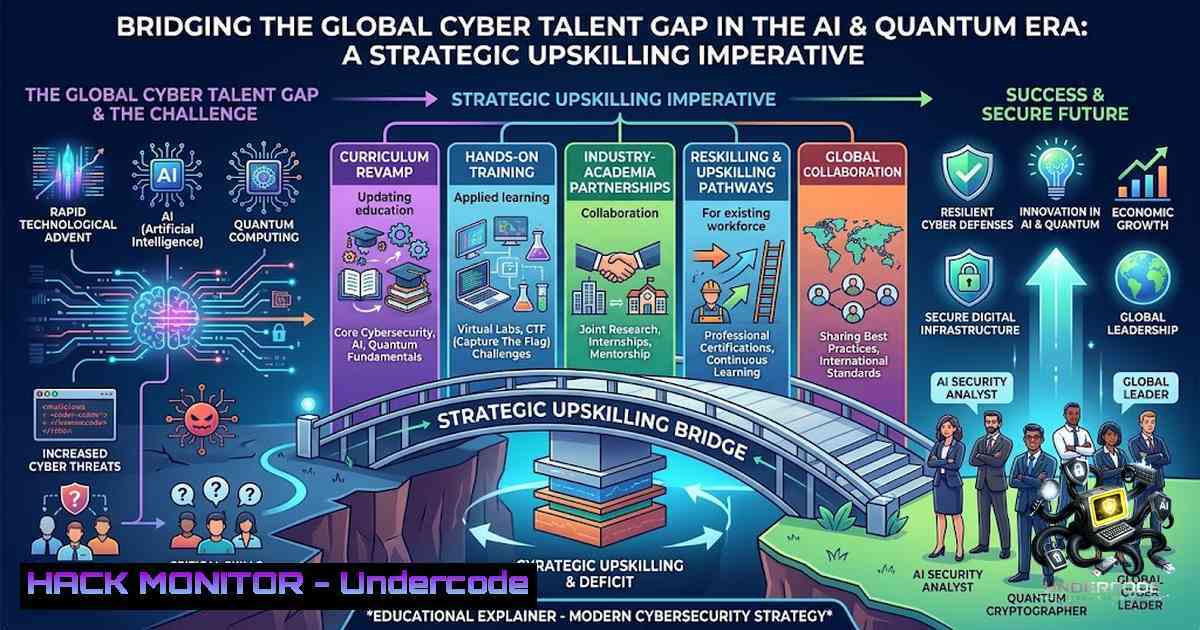
The global cybersecurity workforce shortage has reached a critical inflection point. With over 71% of organizations viewing the skills gap as a direct business risk and 60% of security teams lacking the competencies to defend against modern threats, the demand for specialized expertise has never been more urgent. Simultaneously, the proliferation of AI-driven attack vectors and the impending threat of cryptanalytically relevant quantum computers (CRQC) are fundamentally rewriting the rules of digital defense. This article provides a technical roadmap for professionals seeking to bridge this gap through targeted upskilling, focusing on the practical competencies—from ethical hacking and post-quantum cryptography to AI security—that are essential for leading defense in the next generation of cyber warfare.
Learning Objectives:
- Master AI-Augmented Defense: Understand how attackers leverage AI across the kill chain and learn to deploy AI-driven defensive countermeasures.
- Implement Post-Quantum Readiness: Gain the technical knowledge to inventory cryptographic assets and migrate to NIST-approved quantum-safe algorithms.
- Acquire Industry-Aligned Certifications: Identify and pursue high-impact credentials (Ethical Hacking, Digital Forensics, Network Defense) that are 85% aligned with real-world industry requirements.
You Should Know:
- The AI Threat Vector: From Automation to Autonomous Attack
The integration of Artificial Intelligence into cyberattacks has transitioned from a theoretical concern to an operational reality. In 2026, attackers are no longer merely using AI for reconnaissance; they are employing it to build deployment-ready malware, execute near-autonomous attacks, and automate phishing and social engineering at unprecedented scale. High-risk prompts and enterprise data leakage through GenAI have doubled, while threat actors are actively targeting AI supply chains and developer tools.
Step‑by‑step guide to hardening against AI-driven threats:
- Implement AI-Aware IAM: Review identity and access management (IAM) policies to account for AI agent provenance risks. Traditional trust anchors are no longer reliable.
- Deploy Prompt Injection Defenses: For organizations using LLMs, implement input sanitization and context isolation to mitigate indirect prompt injection attacks.
- Monitor for AI-Generated Phishing: Use email filtering solutions that analyze linguistic patterns and metadata anomalies, as AI-generated phishing is harder to detect.
- Harden AI Supply Chains: Audit all third-party AI models and developer tools used within your organization for vulnerabilities and malicious components.
Linux Command (Log Analysis for Anomalous Access):
Use `ausearch` to check for unusual authentication patterns that might indicate AI-driven credential stuffing:
ausearch -m USER_LOGIN -ts today | grep -E "failed|authentication"
Windows Command (PowerShell – Check for Unusual Service Creation):
Attackers often use AI to automate persistence. List recently created services:
Get-WmiObject -Class Win32_Service | Where-Object {$_.InstallDate -gt (Get-Date).AddDays(-7)}
- Post-Quantum Cryptography (PQC): Preparing for the Quantum Decryption Threat
The emergence of a CRQC poses an existential threat to current public-key cryptography (PKC) standards like RSA and ECC. The “harvest now, decrypt later” strategy means that adversaries are already collecting encrypted data today, waiting for quantum decryption capabilities. Organizations must begin migrating to NIST-approved quantum-safe algorithms now.
Step‑by‑step guide for PQC migration:
- Designate PQC Leadership: Appoint a board member accountable for PQC migration, including allocation of funding.
- Map Cryptographic Dependencies: Identify where PKC is used across systems, applications, and supply chains.
- Prioritize High-Value Assets: Apply the Mosca’s Equation risk model—evaluate how long data needs to remain confidential versus the timeline for quantum decryption.
- Test Migration Paths: Begin with non-production environments. Replace RSA/ECC with NIST-approved alternatives (e.g., CRYSTALS-Kyber for key encapsulation, CRYSTALS-Dilithium for digital signatures).
- Apply to Critical Protocols: Focus on TLS, VPNs, code signing, and IoT device communications.
- Validate and Sustain: Establish crypto-agility—the ability to rapidly swap cryptographic algorithms without overhauling infrastructure.
Linux Command (Check for Weak SSL/TLS Ciphers):
openssl s_client -connect example.com:443 -tls1_2 -cipher 'ECDHE-RSA-AES128-GCM-SHA256' 2>/dev/null | grep -i "cipher"
Windows Command (Check TLS Settings via Registry):
Get-ChildItem "HKLM:\SYSTEM\CurrentControlSet\Control\SecurityProviders\SCHANNEL\Protocols" -Recurse
- Ethical Hacking: Proactive Threat Hunting and Penetration Testing
With attackers leveraging AI to scale their operations, defenders must adopt a proactive mindset. Ethical hacking and penetration testing are no longer optional; they are critical components of a mature security posture. Professionals must develop practical skills in hacking intervention, protection, recovery, and prevention across networks, applications, and devices.
Step‑by‑step guide to an ethical hacking workflow:
- Reconnaissance: Use tools like `nmap` and `theHarvester` to gather intelligence on target systems.
- Scanning and Enumeration: Identify open ports, services, and potential vulnerabilities.
- Exploitation: Attempt to exploit vulnerabilities in a controlled environment using frameworks like Metasploit.
- Post-Exploitation: Assess the potential impact by escalating privileges and moving laterally.
5. Reporting: Document findings with clear remediation steps.
Linux Command (Nmap Scan for Open Ports):
nmap -sV -p- -T4 target_ip
Linux Command (Gobuster for Directory Busting):
gobuster dir -u http://target.com -w /usr/share/wordlists/dirb/common.txt
Windows Command (Netstat for Suspicious Connections):
netstat -ano | findstr ESTABLISHED
4. Digital Forensics and Incident Response
When breaches occur, the ability to investigate and respond effectively is paramount. Digital forensics involves the recovery and investigation of material found in digital devices, often in relation to cybercrime. Professionals must be able to gather evidence, analyze attacks, and strengthen security systems post-incident.
Step‑by‑step guide for forensic investigation:
- Preserve the Scene: Create a forensic image of the affected system (e.g., using `dd` or
FTK Imager) to avoid altering evidence. - Analyze Logs: Correlate system, network, and application logs to trace the attacker’s steps.
- Recover Deleted Files: Use tools like `testdisk` or `PhotoRec` to recover potentially deleted malicious files.
- Memory Analysis: Use tools like `Volatility` to analyze RAM dumps for signs of malware or unauthorized processes.
- Document Chain of Custody: Maintain a detailed log of all actions taken to ensure evidence admissibility.
Linux Command (Creating a Disk Image with dd):
dd if=/dev/sda of=/mnt/evidence/disk_image.dd bs=4096 conv=noerror,sync
Windows Command (Using Windows Event Logs to Find Logon Anomalies):
Get-WinEvent -LogName Security | Where-Object {$_.Id -eq 4625} | Select-Object TimeCreated, Message
5. Cloud Hardening and Network Defense
As organizations migrate to multi-cloud environments (AWS, Azure, GCP), the attack surface expands exponentially. Cloud misconfigurations remain a leading cause of data breaches. Network defenders must secure perimeters, architectures, and monitoring systems.
Step‑by‑step guide to cloud hardening:
- Harden IAM: Enforce least-privilege access, use multi-factor authentication (MFA), and regularly audit IAM roles.
- Secure APIs: Implement API gateways, rate limiting, and validate all inputs to prevent injection attacks.
- Monitor Continuously: Use Cloud Native Application Protection Platforms (CNAPPs) to detect misconfigurations and threats in real-time.
- Encrypt Data: Ensure encryption at rest and in transit, and manage keys using a Hardware Security Module (HSM) or KMS.
- Harden Images: Use minimal base images, scan for vulnerabilities, and apply patches regularly.
Linux Command (Audit AWS CLI Permissions):
aws iam list-users --query 'Users[].UserName'
Windows Command (Check Azure Role Assignments via PowerShell):
Get-AzRoleAssignment | Where-Object {$_.RoleDefinitionName -eq "Contributor"}
6. Securing the AI Supply Chain
The AI supply chain is a new and vulnerable attack vector. Attackers are targeting LLM access, developer tools, and AI models themselves. Organizations must treat AI components with the same security rigor as traditional software.
Step‑by‑step guide:
- Inventory AI Assets: Document all AI models, libraries, and APIs in use.
- Vet Third-Party Models: Assess the security posture of AI vendors and the integrity of their models.
- Monitor for Data Leakage: Implement Data Loss Prevention (DLP) controls to prevent sensitive data from being fed into public GenAI tools.
- Implement AI-Specific IAM: Restrict access to AI model weights and training data.
What Undercode Say:
- The Skills Gap is a Business Risk, Not Just an HR Problem: With 86% of organizations experiencing cyberattacks tied to skills gaps, upskilling is a direct risk mitigation strategy.
- AI is a Double-Edged Sword: The same AI that enables attackers to scale is the tool defenders must master to keep pace. Static defense is no longer viable.
- Quantum Readiness is a Journey, Not a Destination: Organizations must start cryptographic discovery and migration now. Waiting for the quantum computer to arrive is a fatal strategy.
- Micro-Credentials Offer Agile Upskilling: With 100% online, 9-week programs, professionals can rapidly acquire job-ready skills in ethical hacking, digital forensics, and network defense without pausing their careers.
- Industry Alignment is Critical: Programmes that align 85% of their content with industry certifications (EC-Council, Cisco, CompTIA) ensure that learning translates directly to workplace effectiveness.
Prediction:
- +1 The demand for cybersecurity professionals will continue to outpace supply, driving salaries higher and making specialized certifications a primary differentiator in the job market.
- +1 AI-augmented Security Operations Centers (SOCs) will become the norm, requiring analysts to shift from manual log review to AI-assisted threat hunting and incident response.
- -1 Organizations that delay PQC migration will face catastrophic data breaches when quantum decryption becomes viable, potentially exposing decades of sensitive information.
- -1 The proliferation of AI-generated deepfakes and autonomous attacks will erode trust in digital identities, necessitating a fundamental redesign of authentication frameworks.
- +1 Global, online-first educational pathways like micro-credentials will democratize access to cybersecurity education, enabling a more diverse and resilient global cyber workforce.
▶️ Related Video (76% Match):
🎯Let’s Practice For Free:
🎓 Live Courses & Certifications:
Join Undercode Academy for Verified Certifications
🚀 Request a Custom Project:
Secure, high-velocity infrastructure and disruptive technological engineering. Contact our engineering team for high-tier development and proprietary systems:
[email protected]
💎 Smart Architecture | 🛡️ Secure by Design | ⭐ Trusted by Thousands
IT/Security Reporter URL:
Reported By: https://lnkd.in/p/e7d9B-r6 – Hackers Feeds
Extra Hub: Undercode MoN
Basic Verification: Pass ✅


