Listen to this Post
Introduction
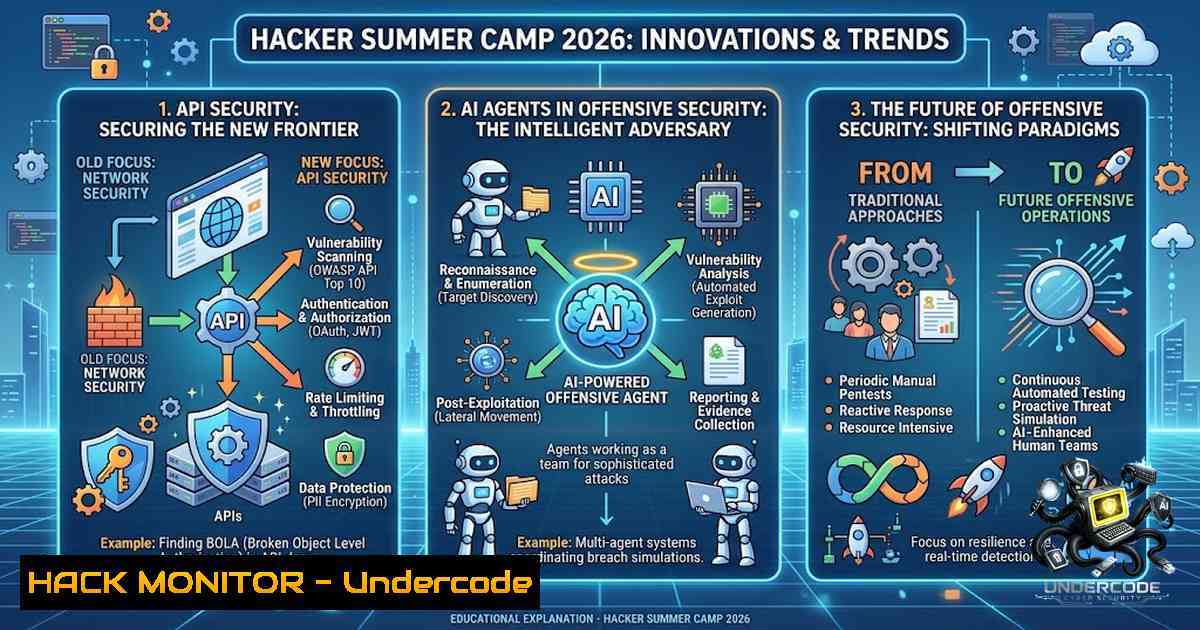
The annual pilgrimage to Las Vegas for Black Hat and DEF CON—collectively known as “Hacker Summer Camp”—remains the definitive gathering for the global cybersecurity community. This year, the convergence of tens of thousands of security professionals highlighted a critical industry shift: the mainstreaming of API security as a core discipline and the rapid integration of agentic AI into both offensive and defensive operations. As organizations accelerate their digital transformations, the attack surface expands exponentially through APIs, while AI promises to reshape how we discover, exploit, and remediate vulnerabilities at machine speed.
Learning Objectives
- Understand the current landscape of API security testing, including hands-on techniques demonstrated at Black Hat and DEF CON
- Explore the integration of AI security agents and their practical applications in penetration testing workflows
- Master Burp Suite’s advanced features, including Burp AT (Automated Testing) for intelligent vulnerability discovery
- Learn practical command-line techniques for API reconnaissance, fuzzing, and exploitation across Linux and Windows environments
You Should Know
1. Hands-On API Hacking: From Theory to Practice
The most impactful sessions at this year’s events were the hands-on API hacking labs. Corey J. Ball, Head of Offensive Security at APIsec and author of Hacking APIs, taught intensive workshops at Black Hat in partnership with PortSwigger and again at DEF CON’s Red Team Village. These sessions moved beyond theoretical discussions, allowing participants to work through real-world API vulnerabilities in controlled lab environments.
API security testing requires a methodical approach. Start by mapping all available endpoints through API discovery. Load OpenAPI/Swagger specifications into Burp Suite or Postman to catalog endpoints, methods, parameters, and authentication requirements. For undocumented APIs, reverse-engineering becomes essential—intercepting traffic and analyzing JavaScript files often reveals hidden endpoints.
Step-by-Step: Initial API Reconnaissance
- Intercept API traffic using Burp Suite’s proxy on `127.0.0.1:8080`
2. Review HTTP history in Proxy > HTTP history to identify API requests - Load API definitions by navigating to Sites > your API site > Details tab > API definition
- Configure authentication under the Authentication tab—select Basic, Fixed tokens, or Dynamic tokens as needed
- Send interesting requests to Repeater for manual manipulation
Linux Command Examples for API Discovery:
 Comprehensive port scan with service detection
nmap -sV -p- --script=http-enum target.com

Directory fuzzing to discover hidden API endpoints
ffuf -u https://api.target.com/v1/user/FUZZ -w /usr/share/wordlists/dirb/common.txt

Automated SQL injection testing
sqlmap -u "https://api.target.com/v1/products?id=1" --batch
Windows PowerShell Commands for API Testing:
 Test API endpoint with Invoke-RestMethod
Invoke-RestMethod -Uri "https://api.target.com/v1/users" -Method Get -Headers @{Authorization="Bearer $token"}

Fuzz parameters with multiple requests
1..100 | ForEach-Object { Invoke-RestMethod -Uri "https://api.target.com/v1/user/$_" -Method Get }
- Agentic AI: The Next Frontier in Security Operations
Jason Haddix of Arcanum Information Security provided one of the most practical insights of the week: guidance on optimizing AI security agents. His latest course, Hackbots, focuses on building and deploying AI agents for security operations. The industry is rapidly moving toward “agentic” security—where AI agents handle repetitive analysis while human analysts retain oversight and make final decisions.
Gartner’s 2025 Cybersecurity Innovations survey revealed that 46% of organizations plan to start using AI agents in security operations in 2026. This shift is already manifesting in Red, Blue, and Green team agents: Red Team agents simulate attacker behavior to identify attack paths, Blue Team agents investigate incidents and analyze contextual information, and Green Team agents take corrective actions to remediate identified issues.
Step-by-Step: Integrating AI Agents into API Security Workflows
- Define the scope—identify which APIs and endpoints the AI agent will test
- Configure authentication—ensure the agent can properly authenticate to target APIs
- Set autonomy levels—determine when the agent needs human approval before taking actions
- Deploy the agent to perform automated reconnaissance, fuzzing, and vulnerability validation
- Review findings—analyze the agent’s discoveries and prioritize remediation
-
Burp Suite and Burp AT: Intelligent Automated Testing
As a Burp Suite Ambassador, Corey Ball spent significant time exploring Burp AT (Automated Testing) with the PortSwigger team. Burp AT represents a paradigm shift in web application penetration testing—it uses agentic AI to plan next steps, leverage Burp’s existing security testing tools, analyze results, and adapt its approach.
Burp AT organizes testing into “tasks,” each focused on a specific area of testing. Tasks can use Burp Collaborator to induce target applications to interact with external servers, detecting out-of-band vulnerabilities. The autonomy mode defines when Burp AT needs permission before using a tool, keeping the human tester in control.
Step-by-Step: Configuring Burp Suite for API Testing
- Launch Burp Suite and navigate to Proxy > Options
- Verify the proxy listener is running on `127.0.0.1:8080`
3. Configure your browser or application to route traffic through Burp’s proxy
4. Install Burp’s CA certificate for HTTPS interception
- Navigate to the target API and observe traffic in Proxy > HTTP history
- Right-click requests and select “Send to Repeater” or “Send to Intruder” for further testing
Automating Burp Suite Scans (Linux/macOS):
 Using burptomator for automated scanning
export BURP_API_KEY="your_api_key_here"
python3 burptomator.py --target https://api.target.com --scan-config full
4. API Security Training and Community Building
A recurring theme throughout the week was the importance of accessible security education. APIsec University now serves over 135,000 students worldwide, offering comprehensive, free courses covering everything from API security fundamentals to advanced penetration testing techniques. The curriculum includes modules on real-world API breaches, the OWASP API Security Top 10, and the three pillars of API security.
Corey Ball met numerous readers of Hacking APIs and APIsec University students face-to-face—a testament to the growing community around API security education. The availability of free, practical training lowers barriers to entry and helps address the cybersecurity skills gap.
5. The Documentary and Industry Reflection
The world premiere of Midnight in the War Room featured CISOs and national security leaders discussing their ongoing battle against cybercriminals and nation-state adversaries. This documentary underscores the human element of cybersecurity—the relentless pressure on defenders and the importance of community and shared knowledge.
What Undercode Say
- API security is no longer optional—as organizations expose more functionality through APIs, the attack surface grows exponentially. Hands-on training and practical labs are essential for building competent security teams.
- AI agents are transforming security operations—the shift from human-speed to machine-speed response is underway. Security professionals must adapt by learning to build, deploy, and oversee AI agents in their workflows.
- Community drives the industry forward—the connections made at events like Black Hat and DEF CON, the sharing of knowledge, and the mentorship between experienced practitioners and newcomers are what sustain the cybersecurity community.
- Accessible education is critical—free resources like APIsec University democratize security knowledge, enabling more people to enter the field and improve overall security posture.
- The convergence of AI and API security—as AI agents become more prevalent, securing the APIs they interact with becomes paramount. The same tools used to attack APIs can be augmented with AI to find vulnerabilities faster and more comprehensively.
Prediction
- +1 Agentic AI will become standard in penetration testing within 24–36 months, with AI agents handling reconnaissance, vulnerability discovery, and initial exploitation while human testers focus on complex business logic flaws and reporting.
- +1 API security will surpass traditional web application security as the primary attack vector, driven by the proliferation of microservices, serverless architectures, and AI-powered applications.
- -1 The skills gap in API security will widen before it narrows, as demand for specialized API penetration testers outpaces the supply of trained professionals.
- +1 Free, community-driven training platforms like APIsec University will play an increasingly vital role in closing the cybersecurity skills gap and democratizing security knowledge.
- -1 The rapid adoption of AI agents without proper security controls will introduce new vulnerabilities—prompt injection, data leakage, and unauthorized actions—that attackers will eagerly exploit.
▶️ Related Video (80% Match):
🎯Let’s Practice For Free:
🎓 Live Courses & Certifications:
Join Undercode Academy for Verified Certifications
🚀 Request a Custom Project:
Secure, high-velocity infrastructure and disruptive technological engineering. Contact our engineering team for high-tier development and proprietary systems:
[email protected]
💎 Smart Architecture | 🛡️ Secure by Design | ⭐ Trusted by Thousands
IT/Security Reporter URL:
Reported By: https://lnkd.in/p/eS9Tvk3j – Hackers Feeds
Extra Hub: Undercode MoN
Basic Verification: Pass ✅


