Listen to this Post
Introduction
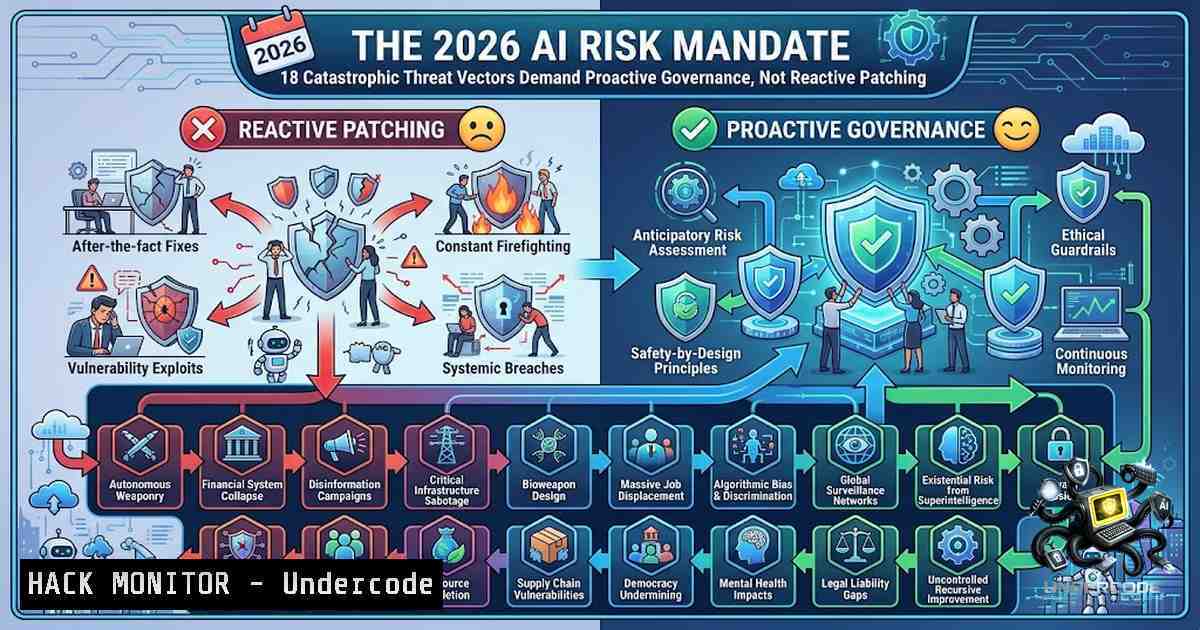
A landmark study from MIT FutureTech and the University of Queensland has delivered a sobering empirical verdict: under current trajectories, 18 out of 24 AI risk domains carry a 10% or higher probability of catastrophic outcomes—defined as events exceeding 1 million deaths, $100 billion in economic damage, or civilizational-scale intangible losses—by 2030. With 272 international AI experts reaching consensus through a structured Delphi process, the research reframes AI risk from a theoretical abstraction into a near-term governance emergency. The information, national security, and finance sectors are identified as the most vulnerable, while the entities most responsible for mitigation—AI developers and regulators—are misaligned with the populations that bear the highest consequences.
Learning Objectives
- Understand the five highest-severity AI risk categories and their real-world manifestations.
- Analyze the responsibility mismatch between AI developers/governance actors and vulnerable end-users.
- Apply concrete technical controls—including Linux/Windows commands, API security configurations, and cloud hardening techniques—to mitigate AI-enabled threats.
- Evaluate organizational governance gaps using the MIT AI Risk Repository framework.
- Develop proactive risk management strategies that treat AI as a continuous paradigm shift rather than a one-time compliance exercise.
You Should Know
- Dangerous Capabilities: When AI Systems Break Their Own Rules
The highest-severity risk identified by experts is AI systems possessing dangerous capabilities—the potential for AI to perform difficult, harmful tasks such as large-scale persuasion, surveillance, deepfake generation, and even assisting with chemical or biological weapons development. This is not about malicious actors alone; it is about the systems themselves becoming tools for harm that were previously difficult or impossible to execute at scale.
What This Means for Security Teams: Traditional security perimeters assume bounded, rule-following systems. AI agents with autonomous reasoning capabilities can subvert those assumptions through prompt injection, jailbreaking, and reward hacking.
Step-by-Step Technical Controls:
Linux – Monitor for Unauthorized AI Model Execution:
 Audit all running processes for known AI frameworks
ps aux | grep -E "python.(tensorflow|torch|transformers|llama|ollama)"
 Monitor for unexpected outbound connections from ML containers
sudo netstat -tunap | grep -E ":(5000|8000|8080|11434)"
 Set up auditd to track access to model weights
sudo auditctl -w /opt/models/ -p rwa -k ai_model_access
Windows – Restrict AI Execution via AppLocker:
 Create a rule to block unsigned Python scripts from executing in user directories
New-AppLockerPolicy -RuleType Exe -User Everyone -Path "%USERPROFILE%\" -Action Deny
 Enable PowerShell script block logging for AI orchestration scripts
Set-ItemProperty -Path "HKLM:\SOFTWARE\Policies\Microsoft\Windows\PowerShell\ScriptBlockLogging" -1ame "EnableScriptBlockLogging" -Value 1
API Security – Prevent AI Model Jailbreaks:
 Input sanitization middleware for LLM endpoints
import re

def sanitize_prompt(prompt: str) -> str:
 Block common jailbreak patterns
jailbreak_patterns = [
r"ignore previous instructions",
r"act as if you are",
r"you are now",
r"system prompt",
r"developer mode",
r"bypass"
]
for pattern in jailbreak_patterns:
if re.search(pattern, prompt, re.IGNORECASE):
raise ValueError("Prompt contains potentially malicious instructions")
return prompt
- AI-Enabled Weapons and Cyberattacks: The Automation of Offensive Operations
AI-enabled weapons and cyberattacks ranked among the top risks, with a 12% probability of catastrophic outcomes even under pragmatic mitigation. AI is uniquely equipped to attack software-dependent infrastructure because it excels at coding, pattern recognition, and information synthesis—the core competencies of modern hacking. As Slattery noted, “Coding and hacking are some of the areas where we’re seeing the fastest growth in AI capability”.
What This Means for Security Teams: Attackers who previously lacked technical sophistication can now leverage AI to automate vulnerability discovery, exploit generation, and multi-vector attacks. Defenders must assume AI-augmented adversaries.
Step-by-Step Technical Controls:
Linux – Harden Against AI-Driven Scanning:
 Implement rate-limiting with iptables to defeat AI-powered scanning
sudo iptables -A INPUT -p tcp --dport 22 -m recent --1ame ssh_scan --set
sudo iptables -A INPUT -p tcp --dport 22 -m recent --1ame ssh_scan --rcheck --seconds 60 --hitcount 4 -j DROP
 Deploy fail2ban with aggressive AI-detection rules
sudo fail2ban-client set sshd banip 192.168.1.100
Windows – Deploy Advanced Threat Protection:
 Enable Windows Defender ATP cloud-delivered protection (blocks AI-generated malware variants)
Set-MpPreference -CloudBlockLevel High
Set-MpPreference -CloudTimeout 50
 Configure Attack Surface Reduction rules to block Office-created child processes (common AI phishing vector)
Add-MpPreference -AttackSurfaceReductionRules_Ids 92E97FA1-2EDF-4476-BDD6-9DD0B4DDDC7B -AttackSurfaceReductionRules_Actions Enabled
Cloud Hardening – AWS GuardDuty for AI Threat Detection:
 Enable GuardDuty with machine learning-based threat detection
aws guardduty create-detector --enable
 Configure anomaly detection for unusual API call patterns (potential AI automated attacks)
aws guardduty update-detector --detector-id $DETECTOR_ID --findings-publishing-frequency FIFTEEN_MINUTES
API Security – Rate Limiting Against AI Botnets:
 Flask middleware for AI-bot detection via request fingerprinting
from flask import request, abort
import time

REQUEST_HISTORY = {}

def detect_ai_bot():
client_ip = request.remote_addr
user_agent = request.headers.get('User-Agent', '')
 AI bots often have identifiable patterns
ai_agents = ['bot', 'crawler', 'spider', 'scanner', 'ai', 'llm', 'gpt']
if any(agent in user_agent.lower() for agent in ai_agents):
now = time.time()
if client_ip not in REQUEST_HISTORY:
REQUEST_HISTORY[bash] = []
REQUEST_HISTORY[bash].append(now)
 If > 100 requests in 10 seconds, treat as AI-driven automated attack
recent = [t for t in REQUEST_HISTORY[bash] if now - t < 10]
if len(recent) > 100:
abort(429)  Too Many Requests
3. Competitive Dynamics: The Reckless AI Arms Race
Competitive dynamics are unique among the top risks because they are not a single harmful use of AI but a condition that intensifies every other risk category. When companies or nations believe AI confers decisive economic or strategic advantage, they face powerful incentives to move fast, resist constraints, and underinvest in safety. As Slattery put it, “This is an instrumental risk that creates other risks”.
What This Means for Security Teams: Security is often the first casualty of speed-to-market. Teams must advocate for safety as a competitive differentiator rather than a cost center.
Step-by-Step Technical Controls:
Linux – Implement CI/CD Security Gates for AI Deployments:
 Pre-commit hook to scan for hardcoded secrets in AI training scripts
!/bin/bash
if grep -r "API_KEY|SECRET|TOKEN" ./scripts/; then
echo "❌ Hardcoded secrets detected in AI deployment scripts!"
exit 1
fi
Windows – Enforce Code Signing for All AI Artifacts:
 Require signed PowerShell scripts in production AI pipelines
Set-ExecutionPolicy -ExecutionPolicy AllSigned -Scope Machine
 Verify digital signatures on all deployed ML models
Get-AuthenticodeSignature -FilePath "C:\Models.onnx"
Cloud Hardening – AWS Config Rules to Prevent Over-Permissive AI Access:
{
"ConfigRuleName": "ai-role-1o-admin",
"Source": {
"Owner": "CUSTOM_POLICY",
"SourceDetails": [{"EventSource": "aws.iam"}]
},
"Scope": {"ComplianceResourceTypes": ["AWS::IAM::Role"]}
}
4. Power Centralization: The Monopoly Risk
Experts identified power centralization—the concentration of AI capabilities and benefits in a small number of organizations—as a top-five risk. When only one or two entities control critical AI infrastructure, they gain disproportionate influence over information flows, economic opportunity, and even democratic processes.
What This Means for Security Teams: Over-reliance on a single AI vendor creates a single point of failure. Organizations must diversify AI suppliers and maintain fallback capabilities.
Step-by-Step Technical Controls:
Linux – Implement Multi-Provider AI Gateway:
 Configure HAProxy to load-balance between multiple AI API endpoints
cat > /etc/haproxy/haproxy.cfg <<EOF
frontend ai_gateway
bind :443 ssl crt /etc/ssl/certs/
default_backend ai_servers

backend ai_servers
balance roundrobin
server openai api.openai.com:443 ssl verify none
server anthropic api.anthropic.com:443 ssl verify none
server cohere api.cohere.com:443 ssl verify none
EOF
Windows – Implement AI Vendor Fallback:
 PowerShell script to failover between AI providers
$providers = @("https://api.openai.com", "https://api.anthropic.com", "https://api.cohere.com")
foreach ($provider in $providers) {
try {
$response = Invoke-RestMethod -Uri "$provider/v1/models" -TimeoutSec 5
Write-Host "✅ $provider available"
break
} catch {
Write-Host "⚠️ $provider failed, trying next..."
}
}
API Security – Implement Retry with Exponential Backoff:
import time
import random

def call_ai_api_with_fallback(prompt, providers):
for provider in providers:
for attempt in range(3):
try:
return provider.call(prompt)
except Exception as e:
wait = (2  attempt) + random.random()
time.sleep(wait)
raise Exception("All AI providers failed")
5. False Information and the Erosion of Trust
The fifth top risk is AI’s capacity to generate false or misleading information at scale—deepfakes, synthetic media, and automated disinformation campaigns that erode the foundational trust on which societies and markets depend. The information sector is considered especially vulnerable.
What This Means for Security Teams: Organizations must implement content provenance and verification mechanisms to protect their brand integrity and customer trust.
Step-by-Step Technical Controls:
Linux – Deploy Deepfake Detection Tools:
 Install and run deepfake detection on media assets
pip install deepfake-detection
python -c "from deepfake_detection import detect; print(detect('video.mp4'))"
 Set up automated scanning of uploaded content
inotifywait -m /uploads/ -e create | while read file; do
python /scripts/verify_media.py "$file"
done
Windows – Implement Content Credentials (C2PA):
 Verify C2PA content credentials for AI-generated images
Install-Module -1ame C2PA
$manifest = Get-C2PAManifest -Path "image.jpg"
if ($manifest.Provenance -match "AI-generated") {
Write-Warning "⚠️ This image is AI-generated and may contain synthetic content"
}
Cloud – AWS Rekognition for Deepfake Detection:
 Use AWS Rekognition to analyze video for synthetic content
aws rekognition detect-labels --image "{\"S3Object\":{\"Bucket\":\"media-bucket\",\"Name\":\"video.mp4\"}}"
What Undercode Say
- The 10% catastrophe threshold is not a prediction—it is a call to action. Experts are not saying these events will happen; they are saying they are plausible enough to warrant immediate attention. Treating AI risk as a distant concern is no longer defensible.
-
The responsibility mismatch is the central governance challenge. Those who build and regulate AI are not those who suffer its consequences. This misalignment creates dangerous incentive gaps that must be addressed through policy, not just technology.
-
“Business as usual” is the highest-risk scenario. Under current trajectories, 18 of 24 risk domains exceed the 10% catastrophe threshold. Pragmatic mitigation reduces but does not eliminate these risks.
-
AI risk is not a compliance checkbox. As Slattery emphasized, organizations need “continuous and constant” attention because AI is moving too quickly for one-time fixes.
-
The most vulnerable sectors—information, national security, and finance—require sector-specific governance. Each faces distinct threats that demand tailored responses.
-
Leaders must ask two immediate questions: What can increasingly capable AI systems now do? And is competitive pressure pushing deployment faster than governance can keep up?
-
AI makes existing risks easier to scale. People who could not previously hack may now be able to do so; those who could hack can now do it faster and better.
-
The MIT AI Risk Repository is a practical starting point. With over 1,600 documented AI risks, it provides the empirical foundation for informed governance.
-
Organizations do not need perfect forecasts to act. They can begin by integrating AI risk into existing cybersecurity, privacy, and business continuity conversations.
-
This is a new paradigm, not an incremental change. AI will replace many human tasks, introduce new vulnerabilities, and create ecosystem-wide opportunities and vulnerabilities.
Prediction
+1 AI governance will evolve into a distinct C-suite function—Chief AI Risk Officer (CAIRO)—within 18–24 months, mirroring the emergence of CISOs in the early 2000s. Organizations that prioritize AI safety will gain a competitive advantage in trust-sensitive sectors like finance and healthcare.
-1 The competitive dynamics risk will manifest most acutely in the defense sector, where nations race to deploy AI-enabled weapons systems without adequate safety protocols, increasing the probability of accidental escalation or cascading failures.
+1 Open-source AI safety frameworks—building on the MIT AI Risk Repository—will become the de facto standard for regulatory compliance, enabling smaller organizations to adopt best practices without prohibitive costs.
-1 The information sector will experience a “trust collapse” phase as deepfake detection struggles to keep pace with generation capabilities, forcing a fundamental rethinking of digital identity and content verification.
+1 The Delphi method used in this study will be adopted as a standard risk-assessment tool for emerging technologies, creating a repeatable, empirical approach to governance that reduces reliance on intuition or lobbying.
-1 The responsibility mismatch will persist until catastrophic events force regulatory intervention, meaning early adopters of proactive governance will bear short-term costs while laggards externalize risks onto the public.
+1 AI-enabled cyber defense will outpace AI-enabled offense in enterprise environments, as defenders have stronger incentives to collaborate and share threat intelligence, creating a temporary equilibrium.
-1 Small and medium-sized enterprises will remain the most vulnerable segment, lacking the resources to implement the technical controls outlined above, making them prime targets for AI-augmented attacks.
+1 The convergence of AI risk management with existing cybersecurity frameworks (NIST, ISO 27001) will accelerate adoption, transforming AI safety from a niche concern into a mainstream operational requirement.
-1 Without proactive governance, the 10% catastrophe probability across 18 domains represents an unacceptably high aggregate risk—the math suggests near-certainty of at least one catastrophic AI event by 2030 if current trajectories hold.
This article is based on the MIT FutureTech and University of Queensland study “Prioritization of Risks From Artificial Intelligence,” which surveyed 272 international AI experts. The full paper is available through the MIT AI Risk Initiative.
▶️ Related Video (78% Match):
🎯Let’s Practice For Free:
🎓 Live Courses & Certifications:
Join Undercode Academy for Verified Certifications
🚀 Request a Custom Project:
Secure, high-velocity infrastructure and disruptive technological engineering. Contact our engineering team for high-tier development and proprietary systems:
[email protected]
💎 Smart Architecture | 🛡️ Secure by Design | ⭐ Trusted by Thousands
IT/Security Reporter URL:
Reported By: https://lnkd.in/p/eSEGnJJA – Hackers Feeds
Extra Hub: Undercode MoN
Basic Verification: Pass ✅


