Listen to this Post
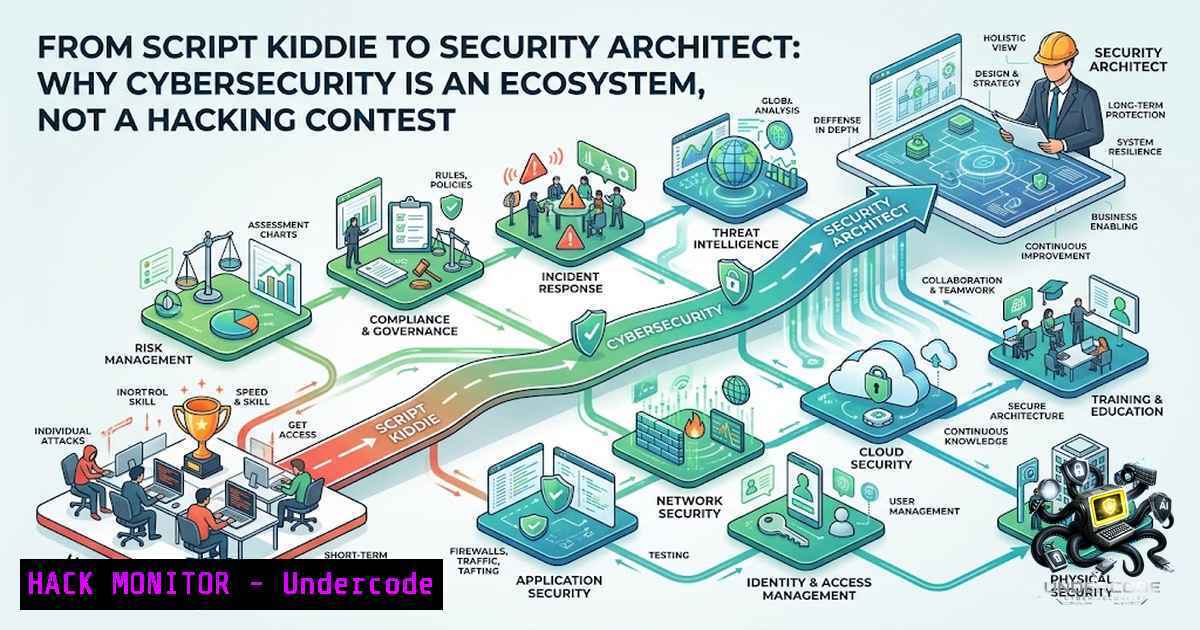
Introduction:
The pervasive cultural image of the cybersecurity professional as a hoodie-clad figure breaking into mainframes under blue light is not only cinematic but dangerously reductive. In reality, the discipline is a complex, multi-layered ecosystem comprising defensive operations, forensic investigation, policy enforcement, and resilient architecture design. Moving past the “hacker” stereotype is essential for students; the modern industry demands pragmatic skill sets—from managing Security Operations Centers (SOCs) to hardening cloud infrastructures and securing AI pipelines—far beyond the scope of simple penetration testing.
Learning Objectives:
- Distinguish between offensive (VAPT) and defensive (SOC, Cloud Security) domains within the security ecosystem.
- Identify the critical practical skills required for roles in Digital Forensics and AI Security.
- Understand how foundational knowledge in networking and system administration integrates with specialized security training.
You Should Know:
1. Demystifying the SOC and VAPT Dichotomy
The Security Operations Center (SOC) is the nervous system of an organization’s defense. It relies on continuous monitoring, threat hunting, and incident response. Conversely, Vulnerability Assessment and Penetration Testing (VAPT) is a proactive, offensive measure to identify weaknesses before adversaries do. To effectively understand network traffic, you must be comfortable analyzing packets. Below is a tcpdump command to capture HTTP traffic on a Linux interface for forensic analysis or vulnerability validation:
sudo tcpdump -i eth0 -s 0 -w http_traffic.pcap port 80
To analyze a PCAP file for suspicious indicators of compromise (IoCs) using tshark (CLI Wireshark), use:
tshark -r http_traffic.pcap -Y "http.request.method == GET" -T fields -e ip.src -e http.host -e http.request.uri
For Windows environments, utilize `netsh` to capture network traces:
netsh trace start capture=yes tracefile=C:\capture.etl
netsh trace stop
2. Cloud Security: Hardening Identity and Access Management
Moving to the cloud introduces a paradigm shift where the perimeter vanishes. Security professionals must implement Zero Trust architectures. A critical skill is managing access keys and API security. When configuring AWS CLI, never hardcode credentials. Instead, use environment variables or IAM roles. For initial troubleshooting, verify your identity via the AWS CLI:
aws sts get-caller-identity
To enforce the principle of least privilege, it is imperative to create and test policies before application. Here is a sample JSON policy restricting S3 bucket access to a specific IP range (a recommended security baseline):
{
"Version": "2012-10-17",
"Statement": [
{
"Effect": "Deny",
"Principal": "",
"Action": "s3:",
"Resource": "arn:aws:s3:::YourSecureBucket/",
"Condition": {
"NotIpAddress": {
"aws:SourceIp": ["203.0.113.0/24"]
}
}
}
]
}
- Digital Forensics: The Art of Retention and Recovery
Digital forensics is not merely about recovering deleted files; it is about maintaining chain of custody and proving integrity. In Linux, the `sleuthkit` toolkit allows for deep file system analysis. To extract a timeline of file activity from a disk image (E01 or raw), use:
fls -r -m /mnt/evidence /dev/sdb1 > body_file.txt
mactime -b body_file.txt -d > timeline.csv
For Windows memory forensics, capturing a process list via the command line for live response can be crucial:
wmic process list full > process_list.txt
4. AI Security: Securing the Data Supply Chain
With the rise of generative AI, the attack surface has expanded to include the model itself and the data it consumes. Security practitioners must secure the training pipeline against data poisoning. A practical exercise is to verify the integrity of training datasets using SHA checksums in Linux to prevent unauthorized modifications:
find ./training_data -type f -exec sha256sum {} \; > checksums.txt
 Verify
sha256sum -c checksums.txt
5. Operational Security: The System Administrator’s Core
A robust security posture is built on the foundation of system hardening. For Linux, implementing `fail2ban` for SSH brute-force mitigation is a foundational step. The configuration file `/etc/fail2ban/jail.local` should contain:
[bash]
enabled = true
port = ssh
filter = sshd
logpath = /var/log/auth.log
maxretry = 3
bantime = 3600
For Windows, Active Directory auditing is pivotal. To enable advanced audit policies via command line to track successful and failed logon attempts:
auditpol /set /subcategory:"Logon" /success:enable /failure:enable
What Undercode Say:
- Key Takeaway 1: Cybersecurity is a diversified career field. The “hacker” persona is just one of many specialized roles; students should explore domains like AI Security or Forensics to find their niche.
- Key Takeaway 2: Practical skills outweigh certification names. Employers seek candidates who can operationalize security concepts—configuring a firewall, responding to alerts, or writing security policies—rather than just executing exploits.
- Analysis: The post effectively dispels the notion that one must be a criminal mastermind to enter the field. It underscores the reality that defensive capabilities, such as threat intelligence analysis and cloud architecture hardening, are in higher demand than ever before. In 2024, the ability to secure an AWS environment or interpret a pcap file is often more commercially viable than running a script from GitHub. Furthermore, the emphasis on “Learning, Practicing, Protecting” aligns with the industry’s shift toward DevSecOps, where security is integrated from the development stage, requiring a broad understanding of code, infrastructure, and human factors.
Prediction:
- +1 The demand for Cloud and AI security specialists will outpace general security roles by 2026, driving an increase in specialized training courses and vendor-specific certifications (AWS Security Specialty, Azure Security Engineer).
- +1 Automation and SOAR (Security Orchestration, Automation, and Response) will minimize the manual workload of SOC analysts, pushing professionals toward scripting skills in Python or PowerShell rather than just “pushing buttons.”
- -1 The proliferation of AI code assistants will likely introduce a surge of vulnerabilities as junior developers deploy insecure code, placing a heavier burden on security architects to review AI-generated patches.
- -1 The misconception linking cybersecurity solely to hacking may hinder the recruitment of diverse talent, creating a skills gap in critical defensive roles like Governance, Risk, and Compliance (GRC) and Digital Forensics.
▶️ Related Video (78% Match):
🎯Let’s Practice For Free:
🎓 Live Courses & Certifications:
Join Undercode Academy for Verified Certifications
🚀 Request a Custom Project:
Secure, high-velocity infrastructure and disruptive technological engineering. Contact our engineering team for high-tier development and proprietary systems:
[email protected]
💎 Smart Architecture | 🛡️ Secure by Design | ⭐ Trusted by Thousands
IT/Security Reporter URL:
Reported By: https://lnkd.in/p/eNWrRsdq – Hackers Feeds
Extra Hub: Undercode MoN
Basic Verification: Pass ✅


