Listen to this Post
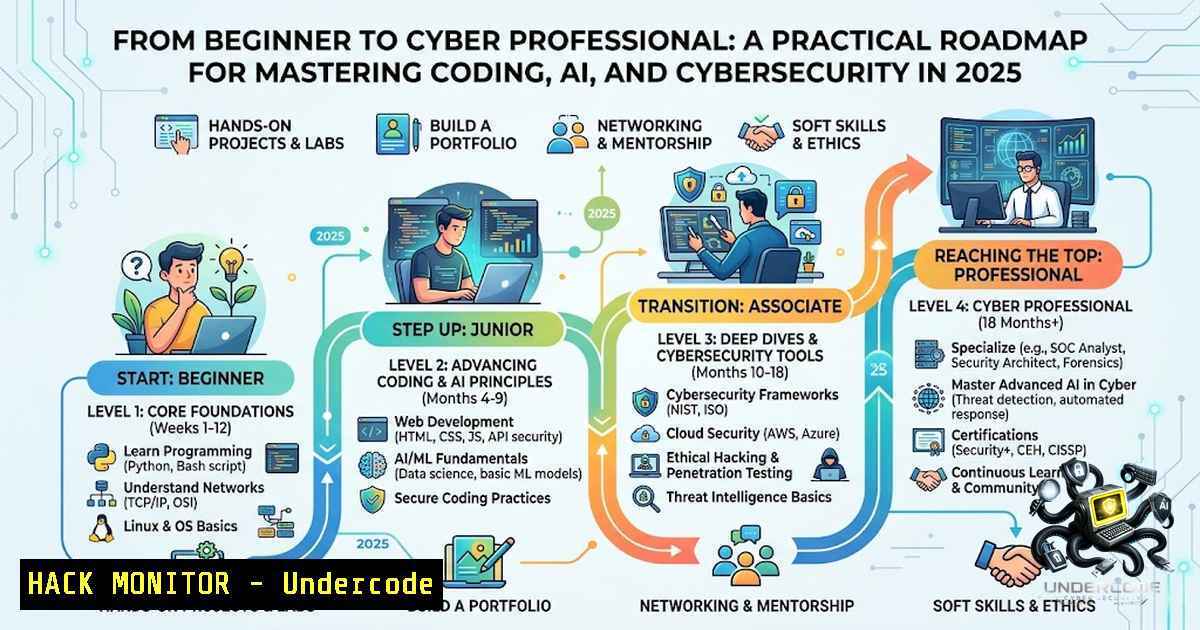
Introduction:
The digital economy waits for no one. As organizations accelerate cloud adoption, the demand for practical ICT skills—from full-stack development to ethical hacking—has never been more urgent. Yet, a staggering 76% of cybersecurity professionals report that skills shortages directly impact their organizations, creating a “perfect storm where limited expertise meets expanding risk”. For aspiring technologists in Nigeria and across the globe, the path forward is clear: hands-on training at institutions like BLISSTECH MULTIMEDIA AND CYBERNETICS TECHNOLOGY provides the practical foundation needed to turn curiosity into a career. This article presents a comprehensive technical roadmap spanning cybersecurity, AI, cloud security, and database management—with verified commands, configurations, and step-by-step guides to accelerate your journey from beginner to practitioner.
Learning Objectives & Secrets:
- Objective 1 – Master Network Reconnaissance and Ethical Hacking Fundamentals: Develop proficiency in Nmap scanning, packet analysis with Wireshark and tcpdump, and packet crafting with Scapy within isolated lab environments. Secret tip: Always conduct scans in a controlled subnet (e.g., 10.6.6.0/24) to avoid legal repercussions and use `-sn` for host discovery before deeper enumeration.
-
Objective 2 – Build AI and Machine Learning Models from Scratch: Transition from Python basics to deploying regression and classification models using Scikit-learn, Pandas, and Matplotlib. Secret tip: Follow a structured 3-month roadmap with daily checklists—start with housing price prediction, then move to customer segmentation, and finally deploy your model using Flask or Streamlit.
-
Objective 3 – Secure Cloud Infrastructure Across AWS, Azure, and GCP: Implement least-privilege IAM, enable multi-factor authentication (MFA) for all privileged accounts, and enforce encryption at rest and in transit. Secret tip: Enable CloudTrail, Azure Monitor, and GCP Cloud Logging for real-time visibility, and configure automated alerts for unauthorized access attempts.
You Should Know:
1. Ethical Hacking Lab Setup and Network Scanning
Before launching any security assessment, establish a controlled lab environment. For Linux (Kali recommended), verify your Nmap version and perform host discovery:
 Verify Nmap version
nmap -v

Host discovery (ping sweep) – skip port scanning
nmap -sn 10.6.6.0/24

OS detection and port enumeration on target
sudo nmap -O 10.6.6.23
What this does: The `-sn` flag performs a ping sweep to identify live hosts without scanning ports—essential for mapping network topography. The `-O` flag enables OS fingerprinting, revealing the target’s operating system. In a typical lab, this might return open ports like 21 (FTP), 22 (SSH), 80 (HTTP), and 445 (SMB).
How to use it: Replace `10.6.6.0/24` with your target subnet. Always run scans with `sudo` for raw packet privileges. For deeper enumeration, combine flags:
 Comprehensive scan with service version, OS detection, and default scripts
sudo nmap -A -p- 10.6.6.23

SMB enumeration via Nmap scripts
sudo nmap --script smb-enum-shares -p 445 10.6.6.23
For Windows users: Install Nmap from https://nmap.org/download.html and run scans from PowerShell with administrative privileges. Use `nmap -sn 192.168.1.0/24` for host discovery on your local network.
- Python for Penetration Testing – Automating Security Tasks
Python is the de facto language for security professionals. Set up a virtual environment to manage dependencies:
 Create virtual environment
python3 -m venv .venv

Activate on Linux/macOS
source .venv/bin/activate

Activate on Windows PowerShell
.venv\Scripts\Activate.ps1

Install essential security libraries
pip install requests scapy impacket paramiko cryptography ldap3
What this does: Virtual environments isolate project dependencies, preventing version conflicts. The installed libraries enable HTTP automation (requests), packet crafting (scapy), Active Directory attacks (impacket), SSH automation (paramiko), and encryption (cryptography).
How to use it: Create a simple port scanner script:
import socket
import sys

def scan_port(host, port):
sock = socket.socket(socket.AF_INET, socket.SOCK_STREAM)
sock.settimeout(1)
result = sock.connect_ex((host, port))
sock.close()
return result == 0

if <strong>name</strong> == "<strong>main</strong>":
host = sys.argv[bash] if len(sys.argv) > 1 else "127.0.0.1"
for port in range(1, 1025):
if scan_port(host, port):
print(f"Port {port} is open")
For web application testing, use the `requests` library with session handling:
import requests

Session persists cookies across requests
session = requests.Session()
login_data = {"username": "testuser", "password": "testpass"}
session.post("https://example.com/login", data=login_data)

Authenticated request
resp = session.get("https://example.com/api/profile")
print(resp.json())
- SQL Database Management – From Queries to Security
Database skills are foundational for both development and security roles. Start with basic MySQL/MariaDB commands:
-- List all databases
SHOW DATABASES;

-- Create and select a database
CREATE DATABASE cyber_lab;
USE cyber_lab;

-- Create a table
CREATE TABLE users (
user_id INT AUTO_INCREMENT PRIMARY KEY,
username VARCHAR(50) NOT NULL UNIQUE,
email VARCHAR(100) NOT NULL,
created_at TIMESTAMP DEFAULT CURRENT_TIMESTAMP
);

-- Insert data
INSERT INTO users (username, email) VALUES ('alice', '[email protected]');

-- Query with filtering
SELECT  FROM users WHERE username LIKE 'a%' ORDER BY created_at DESC;
What this does: These commands demonstrate Data Definition Language (DDL) for creating structures and Data Manipulation Language (DML) for querying data.
How to use it: For security testing, understand SQL injection vectors. A vulnerable query like `SELECT FROM users WHERE username = ‘$input’` can be exploited with ' OR '1'='1. Always use parameterized queries in production:
 Secure Python example with parameterized query
cursor.execute("SELECT  FROM users WHERE username = %s", (username,))
- Cloud Security Hardening – AWS, Azure, and GCP
Cloud misconfigurations are a leading cause of breaches. Implement this hardening checklist across all cloud providers:
Identity and Access Management (IAM):
- Enforce least privilege—grant only the permissions required
- Enable MFA for all privileged accounts
- Regularly audit IAM roles, permissions, and API access
Network Security:
- Restrict inbound/outbound traffic with security groups
- Use private subnets for critical workloads
- Implement VPCs/VNets for logical isolation
Encryption and Monitoring:
- Enable encryption at rest (AWS KMS, Azure Key Vault, GCP Cloud KMS)
- Enable CloudTrail, Azure Monitor, and GCP Cloud Logging
- Configure real-time alerts for unauthorized access
AWS CLI Example:
 List all S3 buckets with encryption status
aws s3api list-buckets --query 'Buckets[].Name' --output text | xargs -I {} aws s3api get-bucket-encryption --bucket {} --output text

Enable CloudTrail in all regions
aws cloudtrail create-trail --1ame security-trail --s3-bucket-1ame your-bucket --is-multi-region-trail
Azure CLI Example:
 Enable Azure Defender for all subscriptions
az security auto-provisioning-setting update --1ame default --auto-provision On

List storage accounts with public access
az storage account list --query "[?allowBlobPublicAccess == true]"
- Artificial Intelligence and Machine Learning – Practical Implementation
Follow this structured roadmap to build AI competency:
Phase 1 – Python Foundations (Weeks 1-2): Variables, data types, loops, functions, and object-oriented programming.
Phase 2 – Data Analysis (Weeks 3-4): NumPy for numerical operations, Pandas for data manipulation.
Phase 3 – Visualization (Week 5): Matplotlib and Seaborn for plotting insights.
Phase 4 – Machine Learning (Weeks 6-10): Supervised learning (regression, classification), unsupervised learning (clustering), model evaluation metrics, and hyperparameter tuning.
Phase 5 – Deployment (Weeks 11-12): Serve models via Flask or Streamlit.
Mini-Project Example – Housing Price Prediction:
import pandas as pd
from sklearn.model_selection import train_test_split
from sklearn.linear_model import LinearRegression
from sklearn.metrics import mean_squared_error

Load data
df = pd.read_csv('housing.csv')
X = df[['square_feet', 'bedrooms', 'bathrooms']]
y = df['price']

Split and train
X_train, X_test, y_train, y_test = train_test_split(X, y, test_size=0.2)
model = LinearRegression()
model.fit(X_train, y_train)

Predict and evaluate
predictions = model.predict(X_test)
print(f"RMSE: {mean_squared_error(y_test, predictions, squared=False)}")
What this does: This script demonstrates a complete ML workflow—loading data, training a linear regression model, and evaluating performance.
- Web Application Security – Directory Brute-Forcing and Vulnerability Scanning
Use Gobuster and ffuf for directory enumeration and fuzzing:
 Directory brute-forcing with Gobuster
gobuster dir -u https://target.com -w /usr/share/wordlists/dirb/common.txt -x php,html

Parameter fuzzing with ffuf
ffuf -w /usr/share/wordlists/fuzz.txt -u http://target.com/FUZZ

POST data fuzzing
ffuf -w wordlist.txt -X POST -d "username=FUZZ&password=test" -u http://target.com/login
SQL Injection Testing with SQLMap:
 Enumerate databases
sqlmap -u "https://target.com/page?id=1" --dbs

Dump a specific table
sqlmap -u "https://target.com/page?id=1" -D database_name -T users --dump
What this does: Gobuster discovers hidden directories and files. SQLMap automates SQL injection detection and exploitation. Always obtain proper authorization before testing any system.
What Undercode Say:
- Key Takeaway 1 – Practical Skills Trump Theory: Employers and clients value demonstrable ability over certificates alone. The labs, scripts, and configurations outlined above represent the exact skills that hiring managers seek—network scanning, Python automation, cloud hardening, and AI modeling. Institutions like BLISSTECH bridge the gap between classroom theory and real-world application by emphasizing hands-on projects.
-
Key Takeaway 2 – The Cybersecurity Skills Gap Is Your Opportunity: With 76% of organizations reporting skills shortages, the demand for trained professionals far exceeds supply. Learning coding, AI, and security today positions you at the forefront of a high-growth industry. The digital economy is not waiting—and neither should you.
Analysis: The convergence of AI, cloud computing, and cybersecurity creates unprecedented opportunities for skilled practitioners. However, the landscape is also becoming more complex—misconfigurations, insecure APIs, and overprivileged accounts remain top attack vectors. Organizations investing in both advanced security tools and user awareness are better positioned to withstand modern threats. For individuals, the message is clear: continuous learning and hands-on practice are non-1egotiable. Whether you’re in Ile-Ife or anywhere else, the skills you build today—starting with that first line of code—will define your digital future.
Prediction:
- +1 The global cybersecurity workforce shortage will continue driving salaries upward, with entry-level practitioners commanding premium rates as organizations compete for talent.
-
+1 AI-powered security tools will augment—not replace—human analysts, creating new roles for professionals who understand both machine learning and threat intelligence.
-
-1 Cloud misconfigurations will remain a top breach vector through 2026 unless organizations prioritize continuous monitoring and automated compliance checks.
-
+1 The rise of remote work and freelance platforms will enable skilled Nigerian technologists to access global job markets directly, bypassing traditional geographic limitations.
-
-1 The rapid adoption of AI without proper security and ethical safeguards will introduce new vulnerabilities, including model poisoning, data leakage, and adversarial attacks—demanding a new generation of AI-security specialists.
-
+1 Institutions like BLISSTECH that emphasize practical, project-based learning will become increasingly vital as traditional education struggles to keep pace with industry demands.
-
+1 The democratization of AI tools means that individuals with basic Python skills can now build sophisticated models, lowering the barrier to entry for innovation and entrepreneurship.
-
-1 Skills obsolescence will accelerate—professionals who fail to continuously update their knowledge risk being left behind as technologies evolve at breakneck speed.
-
+1 The integration of security into DevOps (DevSecOps) will create hybrid roles combining development, operations, and security expertise—rewarding those with diverse skill sets.
-
+1 Nigeria’s growing tech ecosystem, supported by training hubs like BLISSTECH, is poised to become a significant contributor to the global digital economy, exporting talent and innovation.
▶️ Related Video (76% Match):
https://www.youtube.com/watch?v=5xWnmUEi1Qw
🎯Let’s Practice For Free:
🎓 Live Courses & Certifications:
Join Undercode Academy for Verified Certifications
🚀 Request a Custom Project:
Secure, high-velocity infrastructure and disruptive technological engineering. Contact our engineering team for high-tier development and proprietary systems:
[email protected]
💎 Smart Architecture | 🛡️ Secure by Design | ⭐ Trusted by Thousands
IT/Security Reporter URL:
Reported By: https://lnkd.in/p/e-NR7YyF – Hackers Feeds
Extra Hub: Undercode MoN
Basic Verification: Pass ✅


