Listen to this Post
Introduction:
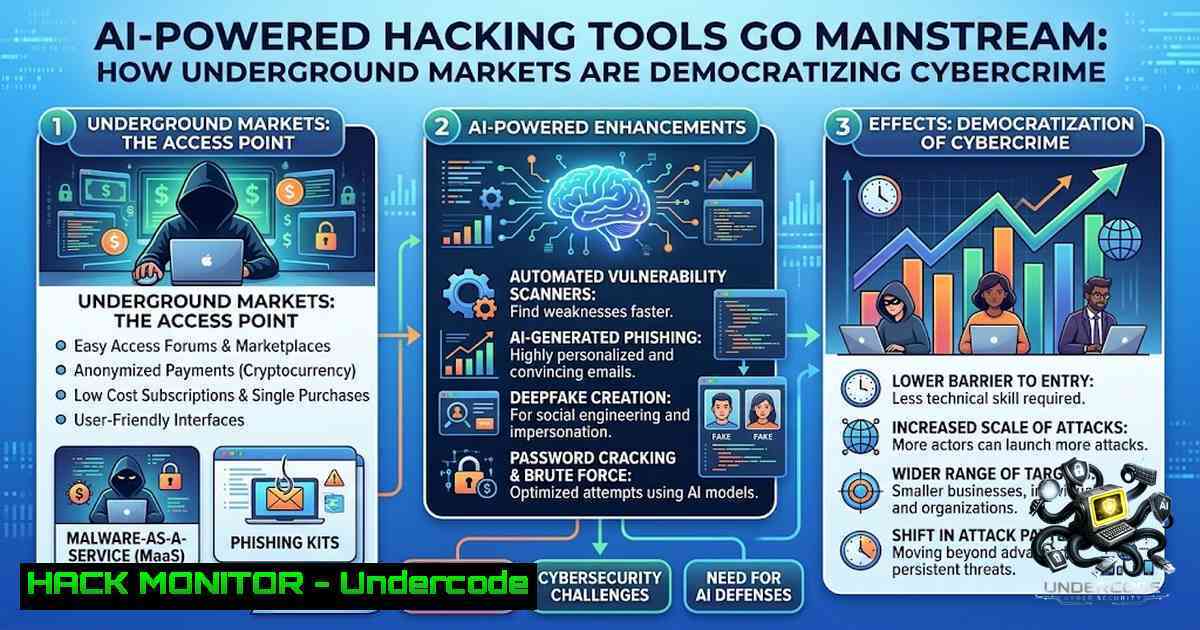
The commoditization of artificial intelligence has reached a dangerous new frontier: underground cybercrime forums. In August 2026, researchers from Trellix and Proofpoint documented a profound shift—AI-powered hacking tools are now systematically advertised and sold on dark web marketplaces, transforming complex attack capabilities into low-cost, subscription-based commodities accessible even to novice threat actors. This commercialization of offensive AI, coupled with emerging AI-specific attack vectors like indirect prompt injection that bypass traditional perimeter defenses, marks a critical tipping point that demands an urgent reassessment of enterprise security architectures.
Learning Objectives & Secrets:
- Objective 1: Understand the Three Emerging AI Attack Vectors. Master the mechanisms of Vibe Hacking (manipulating local Markdown instruction files to deceive AI coding assistants), CursorJacking (malicious browser extensions harvesting API keys and code repositories), and CometJacking (indirect prompt injection on public webpages to hijack agentic browsers).
-
Objective 2 Secret Tip: Identify “Shadow AI” Power Users. Security teams often overlook that just 5% of high-risk employees generate the vast majority of interactive AI prompts within an organization. Focusing telemetry and governance on this cohort can eliminate up to 80% of shadow AI risk.
-
Objective 3 Secret Tip: Treat Browser Extensions as Privileged Software. Nearly 75% of AI browser extensions require high or critical permissions, with 16.3% containing known vulnerabilities. Subjecting these extensions to the same rigorous scrutiny as endpoint security tools is no longer optional—it is foundational.
You Should Know:
- The Underground AI Marketplace: From WormGPT to MessiahGPT
The commoditization of offensive AI has accelerated dramatically since 2023. Early malicious LLMs like WormGPT and FraudGPT—priced at up to $1,700 annually for malware and phishing generation—have evolved into sophisticated, specialized criminal platforms. In August 2026, Trellix researchers identified MessiahGPT, an unrestricted AI service openly advertised on BreachForums capable of generating ransomware, rootkits, crypters, credential stealers, and phishing templates on demand. What distinguishes MessiahGPT is its commercial SaaS model: subscriptions starting at approximately $8 per month via cryptocurrency, 50 free queries without registration, and a dedicated Telegram community. The platform’s operators claim the model was trained from scratch exclusively on dark web archives, leaked documents, and raw internet data—deliberately omitting RLHF or constitutional AI safeguards.
The scale of this market is staggering. Trellix observed a 3,810% surge in underground forum posts mentioning AI tools—from 38 in December 2025 to 1,486 in February 2026. These offerings fall into four distinct categories: weaponized LLMs (dark LLMs without safety guardrails), AI-enabled identity fraud (deepfakes for KYC bypass), AI-augmented malware infrastructure, and jailbroken/stolen AI services—with hacked AI accounts being the largest and cheapest category.
- APEX AI: Nation-State Grade Attack Planning as a Service
A threat actor known as Shadowx007 is offering a service called APEX AI, a tool that provides nation-state-level attack planning capabilities. After inputting a target domain, the service provides a complete attack plan to enable ransomware deployment, including step-by-step commands. What makes APEX AI particularly dangerous is its automation of the entire kill chain into a single-prompt workflow—generating exact commands from initial reconnaissance through to ransomware deployment. Trellix security researcher Jambul Tologonov noted: “Traditionally, hacking required a deep, manual understanding of how network defenses interact with an exploit. You had to chain vulnerabilities yourself, which required a high level of specialized human knowledge. An early-stage hacker can now take a tool like APEX AI and execute the same attack with only a single prompt”.
3. Metamorphic Crypters: AI-Powered Evasion
A threat actor known as ImpactSolutions is offering Metamorphic Crypter, a commercial cryptic service designed to help attackers bypass any signature-based detection technology. The actor claims the service cannot be detected by Windows Defender and most other antivirus products. These AI-enhanced crypters dynamically modify malware code with each compilation, generating signature-less binaries that lack the static markers that antivirus solutions rely on for detection. The tool is marketed as providing what the underground community calls “fully undetectable (FUD)” status.
4. Indirect Prompt Injection: Manipulating AI Agents
Proofpoint researchers identified a growing threat: indirect prompt injection tools designed to manipulate AI agents. Unlike direct prompt injection, indirect prompt injection occurs when an LLM accepts input from external sources such as websites, documents, or emails. Malicious commands are hidden in PDFs, emails, web pages, and calendar invites—and the AI interprets these commands as legitimate, executing them as if they were part of the correct decision-making process. These tools are being offered on underground forums for $150 per month. AI agents at the user level—such as an employee-deployed agent that processes emails or summarizes calendar invites—could be vulnerable to such attacks. Proofpoint researchers warn that this represents a fundamental shift in the threat landscape: “Ultimately, indirect prompt injection is a human-centric attack. It relies on a human trusting their AI, which in turn trusts a malicious email”.
5. Defensive Measures and Mitigation Strategies
To defend against these emerging AI-powered threats, organizations must implement a multi-layered defense strategy:
Linux Commands for Monitoring Suspicious Activity:
 Monitor established outbound connections to suspicious IP ranges
sudo ss -tunp | grep ESTAB | awk '{print $5}' | cut -d: -f1 | sort | uniq -c | sort -1r

Check for unusual outbound traffic patterns
sudo tcpdump -i eth0 -1 'tcp[bash] & 2 != 0' | head -50

Monitor for unauthorized file modifications (Vibe Hacking defense)
sudo auditctl -w /path/to/project -p wa -k project_integrity
sudo ausearch -k project_integrity --format raw

Detect processes with suspicious network connections
sudo netstat -tunap | grep ESTABLISHED | awk '{print $4, $5, $7}' | sort -u
Windows PowerShell Commands for Endpoint Monitoring:
 Monitor outbound connections from suspicious processes
Get-1etTCPConnection | Where-Object {$<em>.State -eq 'Established'} |
Select-Object LocalAddress, LocalPort, RemoteAddress, RemotePort, @{N='Process';E={(Get-Process -Id $</em>.OwningProcess).ProcessName}}

Check for unauthorized file changes (critical for AI instruction files)
$watcher = New-Object System.IO.FileSystemWatcher
$watcher.Path = "C:\Projects"
$watcher.Filter = ".md,.mdc"
$watcher.EnableRaisingEvents = $true

Review installed browser extensions and their permissions
Get-ChildItem "C:\Users\$env:USERNAME\AppData\Local\Google\Chrome\User Data\Default\Extensions" |
ForEach-Object { Get-Content "$_\manifest.json" | ConvertFrom-Json | Select-Object name, permissions }
API Security Hardening (to prevent AI agent manipulation):
 Implement strict input validation for AI API endpoints
 Example: Sanitize all external content before LLM processing
curl -X POST https://api.your-ai-service.com/v1/process \
-H "Content-Type: application/json" \
-d '{"input": "'"$(echo "$USER_INPUT" | sed 's/[;&|`$]//g')"'"}'

Monitor for anomalous API calls to AI services
 Log all prompts and responses for audit
sudo journalctl -u ai-service --since "1 hour ago" | grep -i "prompt|injection"
Cloud Hardening for AI Workloads:
 Implement least-privilege IAM policies for AI agents
 Example: Restrict AI agent permissions to only necessary actions
{
"Version": "2012-10-17",
"Statement": [
{
"Effect": "Deny",
"Action": ["s3:PutObject", "iam:", "ec2:RunInstances"],
"Resource": "",
"Condition": {
"StringEquals": {
"aws:PrincipalArn": "arn:aws:iam::account:role/AIAgentRole"
}
}
}
]
}
Step-by-Step Guide: Monitoring Underground AI Threat Intelligence
To detect and track emerging AI-powered threats targeting your organization:
- Establish Threat Intelligence Feeds: Subscribe to reputable threat intelligence services that monitor dark web forums and Telegram channels for discussions about AI hacking tools.
-
Implement Network Monitoring: Use the Linux and Windows commands above to detect suspicious outbound connections and unusual traffic patterns.
-
Conduct Regular AI Asset Audits: Inventory all AI tools, agents, and browser extensions used within your organization. Verify their permissions and security configurations.
-
Deploy Prompt Injection Defenses: Implement content filtering and sanitization for all external content processed by AI agents. Treat all external inputs as potentially malicious.
-
Educate and Govern Shadow AI Users: Identify the 5% of high-risk employees who generate most interactive AI prompts and provide targeted governance and training.
What Undercode Say:
-
Key Takeaway 1: The democratization of AI-powered hacking tools represents a fundamental shift in the threat landscape—what was once the domain of nation-state actors and elite hackers has become a pay-per-use service available to anyone with cryptocurrency and a Telegram account. The 3,810% surge in underground forum posts about AI tools is not hype; it is a market forming in real time.
-
Key Takeaway 2: Indirect prompt injection is particularly insidious because it exploits trust relationships—humans trust their AI assistants, and those AI assistants trust external content sources. Organizations must treat all external content processed by AI agents as potentially malicious and implement strict input validation and sanitization. The financial barrier to entry for cybercriminals is “virtually zero” thanks to widely available freemium tools and automated distribution channels like Telegram bots that function as “unmanned storefronts”.
The emergence of tools like APEX AI, Metamorphic Crypter, and MessiahGPT signals that we have entered a new era of cybercrime—one where sophisticated attack capabilities are commoditized and accessible to anyone willing to pay a monthly subscription fee. The traditional barriers to entry—technical expertise, specialized knowledge, and access to advanced tools—have been systematically dismantled by the underground AI economy. Security professionals must adapt by treating AI agents as potential attack vectors, implementing rigorous input validation, and monitoring for the telltale signs of AI-assisted attacks. The race is on between defenders and attackers, and AI has just leveled the playing field in favor of the adversaries.
Prediction:
- +1 The increased accessibility of AI-powered hacking tools will drive a surge in demand for AI-security specialists, creating new opportunities for cybersecurity professionals who can defend against these emerging threats.
-
-1 Small and medium-sized businesses without dedicated security teams will be disproportionately affected by the democratization of cybercrime, as they lack the resources to defend against sophisticated AI-assisted attacks.
-
-1 The proliferation of indirect prompt injection tools will lead to a wave of AI agent compromises, as organizations deploy AI assistants without adequate security controls.
-
-1 Traditional signature-based antivirus solutions will become increasingly ineffective against AI-generated metamorphic malware, forcing a costly transition to behavioral and AI-based detection systems.
-
+1 Regulatory bodies will likely introduce new frameworks and compliance requirements specifically addressing AI security, creating a market for AI security auditing and compliance services.
▶️ Related Video (86% Match):
https://www.youtube.com/watch?v=0tHb6U2604g
🎯Let’s Practice For Free:
🎓 Live Courses & Certifications:
Join Undercode Academy for Verified Certifications
🚀 Request a Custom Project:
Secure, high-velocity infrastructure and disruptive technological engineering. Contact our engineering team for high-tier development and proprietary systems:
[email protected]
💎 Smart Architecture | 🛡️ Secure by Design | ⭐ Trusted by Thousands
IT/Security Reporter URL:
Reported By: https://lnkd.in/p/eFX-qZ3J – Hackers Feeds
Extra Hub: Undercode MoN
Basic Verification: Pass ✅


