Listen to this Post
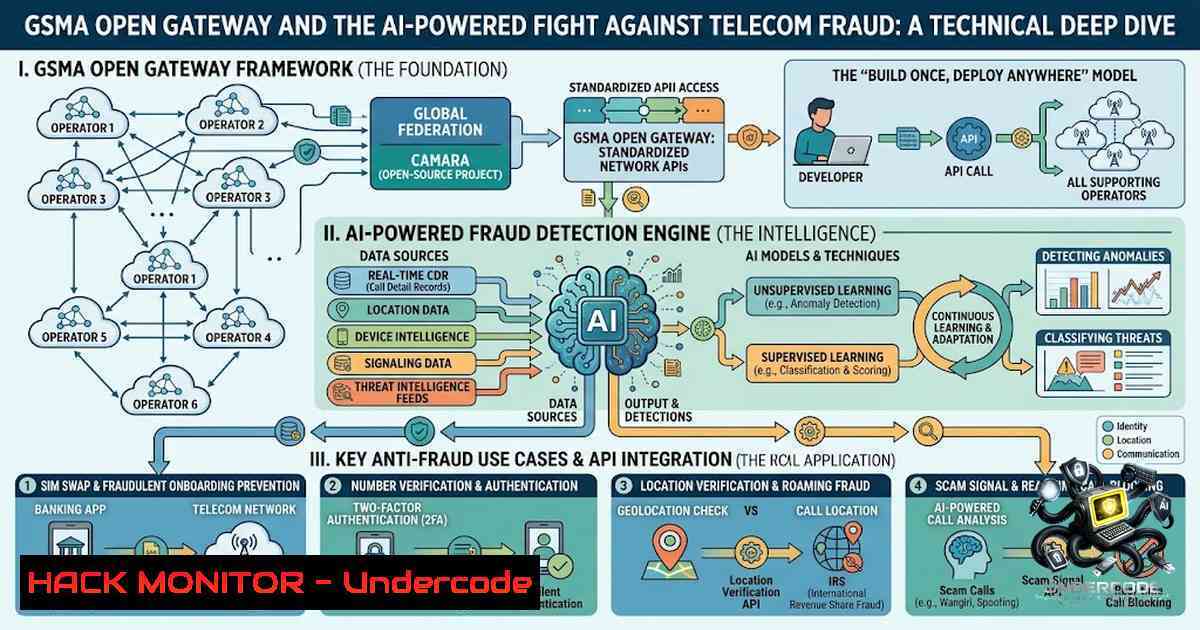
Introduction:
The mobile telecommunications industry is at a critical inflection point. According to the GSMA’s Mobile Economy Asia Pacific 2026 report, mobile technologies and services are projected to contribute USD 1.4 trillion to the Asia Pacific economy by 2030—a 40% increase from today’s USD 1 trillion. Yet this growth is shadowed by a staggering rise in digital fraud: the proportion of ASEAN consumers reporting they have been scammed climbed from 31% in 2024 to 45% in 2025. As fraud becomes increasingly AI-enabled, traditional siloed defences are no longer sufficient. This article explores the technical pillars of modern telecom fraud prevention—GSMA Open Gateway APIs, AI-driven detection systems, and cross-sector intelligence sharing—and provides hands-on implementation guidance for security professionals.
Learning Objectives:
- Understand the GSMA Open Gateway API framework and its role in standardising fraud prevention across telecom operators and financial institutions
- Implement SIM Swap detection and Number Verification APIs for real-time identity verification
- Deploy AI and machine learning models for anomaly detection in telecommunications traffic
- Secure PBX and VoIP infrastructure against hacking and toll fraud
- Establish cross-sector intelligence sharing frameworks to combat AI-enabled fraud
1. GSMA Open Gateway APIs: Standardising Fraud Prevention
The GSMA Open Gateway initiative has transformed how telecom operators expose network capabilities to developers. Today, 86 operator groups—representing more than 300 networks and 80% of global mobile connections—are aligned around a common API framework. Fraud prevention remains the most compelling use case, with more than 300 instances of 20 different CAMARA APIs commercially launched across 65 markets.
Key Anti-Fraud APIs:
- SIM Swap API: Detects recent changes to the SIM card associated with a mobile number, returning either a timestamp of the last change or a simple yes/no response for a defined period.
- Number Verification API: Confirms that a phone number is linked to the SIM card in the device accessing a service, eliminating reliance on vulnerable SMS-based OTPs.
- Scam Signal API: An AI-driven API that analyses live telephony patterns to detect impersonation calls and block fraudulent payments before completion.
- KYC Match API: Verifies customer identity against mobile subscription data.
Implementation: SIM Swap API with Python
The following example demonstrates how to query the SIM Swap API using the Telefónica Open Gateway Sandbox:
 Install the Open Gateway SDK
 pip install opengateway-sandbox-sdk

from opengateway_sandbox_sdk import OpenGatewayClient
from opengateway_sandbox_sdk.services import SimSwap

Initialize the client with your credentials
client = OpenGatewayClient(
client_id="YOUR_CLIENT_ID",
client_secret="YOUR_CLIENT_SECRET"
)

Instantiate the SIM Swap service
sim_swap = SimSwap(client)

Check if a SIM swap occurred in the last 24 hours
phone_number = "+60123456789"
response = sim_swap.check(
phone_number=phone_number,
max_age=86400  24 hours in seconds
)

if response.get("swapped"):
print(f"⚠️ SIM swap detected for {phone_number} at {response.get('last_swap_time')}")
else:
print(f"✅ No SIM swap detected for {phone_number} in the last 24 hours")
Linux Command-Line Verification
For environments where SDK integration is not feasible, you can use `curl` to interact with Open Gateway APIs directly:
 Obtain an OAuth 2.0 access token
curl -X POST https://api.gateway.example.com/oauth/token \
-H "Content-Type: application/x-www-form-urlencoded" \
-d "grant_type=client_credentials&client_id=YOUR_ID&client_secret=YOUR_SECRET"

Query SIM Swap status
curl -X GET "https://api.gateway.example.com/sim-swap/v1/check?phone=+60123456789&maxAge=86400" \
-H "Authorization: Bearer YOUR_ACCESS_TOKEN"
2. AI-Powered Fraud Detection in Telecommunications
The integration of AI and machine learning has become essential for detecting sophisticated fraud patterns that evade rule-based systems. Research demonstrates that integrating ML-based anomaly detection with multi-factor authentication can reduce fraudulent attempts by up to 80%. Advanced frameworks now combine machine learning for pattern recognition, large language models for behavioural reasoning, and blockchain for transparent enforcement.
Deploying a Telecom Fraud Detection Pipeline
A typical AI-powered fraud detection pipeline for telecom includes:
- Data Collection: Aggregate CDRs (Call Detail Records), SMS logs, and network signalling data
- Feature Engineering: Extract behavioural features—call frequency, destination patterns, duration anomalies, location deviations
- Model Training: Deploy isolation forests, LSTM networks, or graph neural networks for anomaly detection
- Real-Time Scoring: Evaluate transactions against model predictions with sub-second latency
Example: Anomaly Detection with Isolation Forest (Python)
import pandas as pd
from sklearn.ensemble import IsolationForest
import joblib

Load call detail records
cdr_data = pd.read_csv('call_records.csv')
features = ['call_duration', 'call_frequency_24h', 'unique_destinations', 'avg_duration']

Train isolation forest on normal behaviour
model = IsolationForest(contamination=0.01, random_state=42)
model.fit(cdr_data[bash])

Predict anomalies in real-time
new_call = [[120, 45, 12, 180]]  duration, frequency, destinations, avg duration
prediction = model.predict(new_call)

if prediction[bash] == -1:
print("🚨 Anomalous call pattern detected - potential fraud")
else:
print("✅ Call pattern appears normal")
3. Securing PBX and VoIP Infrastructure Against Hacking
PBX hacking and VoIP fraud remain significant threats, with attackers using stolen credentials to route unauthorised premium-rate traffic. Common attack vectors include SIP account hijacking, toll fraud, and vishing (VoIP phishing).
Hardening Checklist for PBX/VoIP Security:
- Restrict SIP Access: Limit SIP traffic to trusted IP ranges using firewall rules
- Disable Unused Features: Turn off guest/anonymous calling and unnecessary extensions
- Enforce Strong Authentication: Use MD5 digest authentication and implement MFA for admin access
- Deploy Fail2ban for SIP: Protect against brute-force attacks
Fail2ban Configuration for SIP
 Install fail2ban
sudo apt-get install fail2ban -y

Create SIP jail configuration
sudo nano /etc/fail2ban/jail.local

Add the following:
[bash]
enabled = true
port = sip,sips
filter = asterisk
logpath = /var/log/asterisk/security
maxretry = 5
bantime = 3600

Restart fail2ban
sudo systemctl restart fail2ban
SIP Traffic Analysis with Wireshark
 Capture SIP traffic on eth0
sudo tshark -i eth0 -Y "sip" -V

Filter for failed authentication attempts
sudo tshark -i eth0 -Y "sip.Response-Line contains '401 Unauthorized'"
4. GSMA Fusion: Bridging Telecom and Financial Services
GSMA Fusion acts as a demand-side bridge between industries and the global mobile ecosystem, making it easier for financial institutions to access advanced network capabilities through standardised APIs. The Scam Signal API, delivered through the FICO Platform, analyses live telephony patterns to detect impersonation calls—reducing scam losses by more than 40% for UK banks.
API Security Best Practices
As operators expose network functions through standardised APIs, robust security controls are essential:
- OAuth 2.0 Authentication: Validate all API requests with OAuth 2.0 tokens
- Rate Limiting: Prevent API abuse and denial-of-service attacks
- IP Whitelisting: Restrict API access to trusted partners
- Input Validation: Sanitise all API parameters to prevent injection attacks
- Mutual TLS: Implement mTLS for service-to-service authentication
5. Cross-Sector Intelligence Sharing and Threat Hunting
Fraud does not operate within organisational boundaries. The GSMA’s ASEAN Consumer Scam Report 2025 highlights that 68% of scam victims lost money, underscoring the need for coordinated intelligence sharing.
Threat Hunting Commands for Fraud Detection
Linux Log Analysis for SIM Swap Indicators:
 Search for SIM swap events in telecom logs
grep -E "SIM_SWAP|port_request|sim_change" /var/log/telecom/events.log

Identify unusual porting requests
awk '$4 ~ /port_request/ && $7 > 5 {print $0}' /var/log/telecom/porting.log

Monitor for abnormal IMEI changes
grep "IMEI_CHANGE" /var/log/telecom/device.log | awk '{print $3}' | sort | uniq -c | sort -1r
Network Traffic Analysis for IMSI Catcher Detection:
 Capture and analyse GSM signalling
tshark -i eth0 -Y "gsm_a" -V

Detect downgrade attacks (2G fallback)
tshark -i eth0 -Y "gsm_a.ciphering_algorithm == 0"
Windows PowerShell for Fraud Log Analysis:
 Search Windows Event Logs for suspicious authentication patterns
Get-WinEvent -LogName Security | Where-Object { $<em>.Id -eq 4625 } |
Group-Object -Property @{Expression={$</em>.Properties[bash].Value}} |
Sort-Object -Property Count -Descending

Monitor for unusual outbound call patterns in PBX logs
Select-String -Path "C:\PBX\Logs.log" -Pattern "TOLL_FRAUD|PREMIUM_RATE"
What Undercode Say:
- Digital trust is the new currency of the digital economy. The 45% scam victimisation rate across ASEAN is not merely a security metric—it is an economic warning. As the mobile economy expands to USD 1.4 trillion, consumer confidence will determine whether that growth is realised or undermined.
-
Cross-sector collaboration is no longer optional—it is existential. Fraudsters operate across banking, telecom, and digital platforms. Organisations must adopt the GSMA Open Gateway framework to share intelligence and verify identities in real time. The technology exists; the will to implement it across organisational boundaries is what separates effective defences from fragmented failures.
The mission remains the same: build trust, strengthen resilience, and work together to stay ahead of those who seek to exploit our digital world. With AI-enabled fraud accelerating, the window for proactive defence is closing. Now is the time to operationalise these technical capabilities and foster the cross-sector partnerships that will define the next era of digital security.
Prediction:
-1 The rapid adoption of AI by fraudsters will outpace traditional rule-based detection systems within 18–24 months, potentially increasing scam success rates by 30–40% before ML-based defences achieve parity.
+1 GSMA Open Gateway APIs will become the de facto global standard for telecom-fintech fraud prevention by 2028, with 90% of major financial institutions integrating SIM Swap and Number Verification APIs into their authentication workflows.
+1 AI-powered fraud detection platforms leveraging graph neural networks and behavioural analytics will reduce false positive rates by 60% while improving detection accuracy, enabling frictionless customer experiences without compromising security.
-1 The proliferation of deepfake voice technology will fuel a new wave of vishing attacks targeting corporate finance departments, potentially costing enterprises billions before voice biometrics and liveness detection achieve widespread deployment.
+1 Cross-sector intelligence sharing frameworks, facilitated by GSMA Fusion and similar initiatives, will reduce scam-related financial losses by over 50% in mature markets by 2030, restoring consumer trust and accelerating digital adoption.
▶️ Related Video (80% Match):
🎯Let’s Practice For Free:
🎓 Live Courses & Certifications:
Join Undercode Academy for Verified Certifications
🚀 Request a Custom Project:
Secure, high-velocity infrastructure and disruptive technological engineering. Contact our engineering team for high-tier development and proprietary systems:
[email protected]
💎 Smart Architecture | 🛡️ Secure by Design | ⭐ Trusted by Thousands
IT/Security Reporter URL:
Reported By: https://lnkd.in/p/eqXZYmdM – Hackers Feeds
Extra Hub: Undercode MoN
Basic Verification: Pass ✅


