Listen to this Post
Introduction:
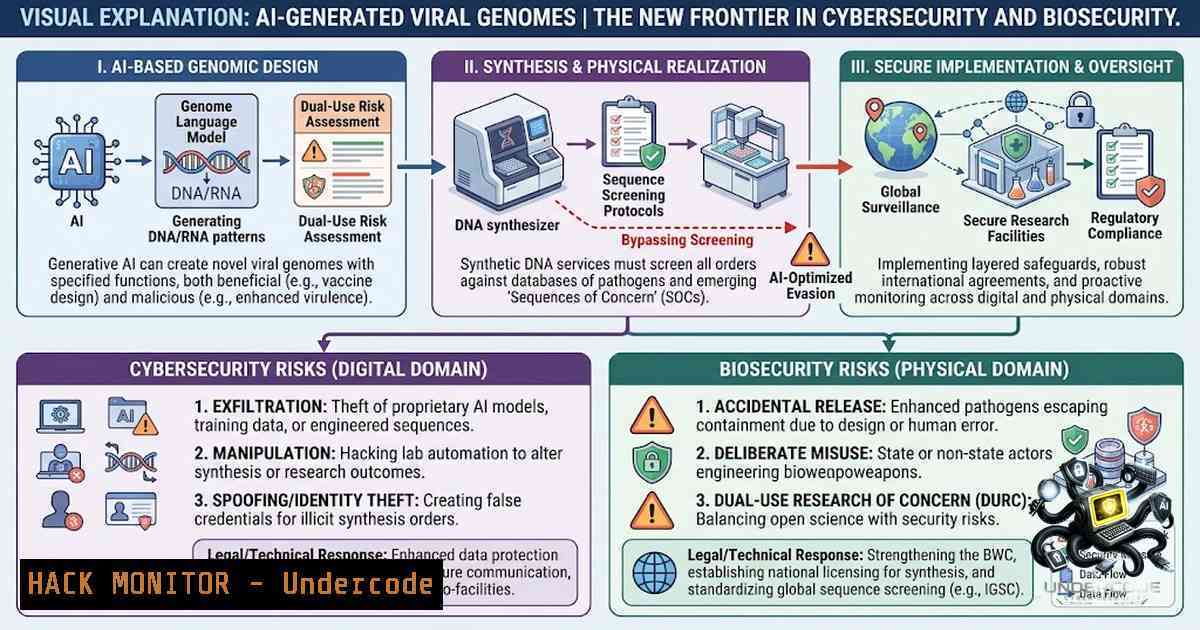
For the first time in history, artificial intelligence has successfully designed complete, functional viral genomes from scratch. Researchers at Stanford University used genomic language models—Evo1 and Evo2—trained on vast DNA sequence databases to generate 302 candidate bacteriophage genomes, of which 16 produced fully functional viruses capable of infecting E. coli. While these AI-designed phages currently target only bacteria and pose no direct human threat, the breakthrough marks a pivotal moment where generative AI transitions from analyzing biological information to actively designing it. For cybersecurity professionals, this convergence of AI, synthetic biology, and digital genetic code represents an unprecedented attack surface—one where the lines between biological weapons, AI governance, and information security blur into a single, urgent challenge.
Learning Objectives:
- Understand the technical mechanisms behind AI-driven viral genome design and its implications for biosecurity
- Identify the cybersecurity risks posed by generative AI in synthetic biology, including data poisoning and model misuse
- Learn practical security measures for protecting AI training pipelines and genomic datasets from adversarial manipulation
You Should Know:
1. How Genomic Language Models Design Functional Viruses
The AI systems behind this breakthrough—Evo1 and Evo2—operate on principles analogous to large language models like ChatGPT, but instead of predicting words, they predict sequences of DNA nucleotides (A, C, G, and T). Trained on genetic data from viruses, bacteria, plants, and humans, these models learn the “grammar” of life—the complex patterns that determine whether a genetic sequence will produce a functional organism. For the Stanford experiment, the models were further refined on thousands of bacteriophage genomes related to ΦX174, a well-studied virus with a genome of approximately 5,400 DNA letters and only 11 genes.
The AI did not invent a completely unrelated virus from nothing; it generated previously unseen ΦX174-like whole genomes within a known biological framework. Scientists selected promising designs, physically synthesized the DNA, and introduced it into E. coli. If the genetic instructions were biologically coherent, the bacterial machinery produced new phage particles. Of the 285 AI-generated designs physically synthesized and tested, 16 produced functioning phages—a success rate of approximately 5.6%. Notably, when delivered as a cocktail, the designer phages infected E. coli strains that had evolved resistance to the natural virus, something a comparable mix of natural phages could not achieve.
Step-by-Step Guide: Understanding the AI Viral Design Pipeline
For security professionals seeking to understand this threat surface, here is the technical workflow:
- Data Collection: Aggregate genomic sequences from public databases (NCBI, GenBank) containing viral, bacterial, plant, and human genetic data.
- Model Training: Train genomic language models (Evo1/Evo2) on these sequences to learn DNA “grammar” and evolutionary patterns.
- Fine-Tuning: Refine models on specific viral families (e.g., bacteriophages) to generate targeted genome designs.
- Genome Generation: Use the AI to propose thousands of novel genome sequences within the learned biological framework.
- Filtering: Select promising candidates based on predicted viability and functionality.
- Synthesis: Physically manufacture the DNA using commercial synthesis services.
- Assembly: Introduce synthesized DNA into host cells to produce functional viral particles.
8. Validation: Test viral functionality against target organisms.
Linux Commands for Genomic Data Analysis:
 Download genomic sequences from NCBI
wget https://ftp.ncbi.nlm.nih.gov/genomes/all/GCF/000/XXX/XXX/GCF_000XXX.1_ASMXXXv1_genomic.fna.gz
gunzip GCF_000XXX.1_ASMXXXv1_genomic.fna.gz

Basic sequence analysis with seqkit
seqkit stats genomic.fna
seqkit grep -p "ATGC" genomic.fna | head -20

Generate sequence length distribution
seqkit fx2tab -l genomic.fna | sort -k2 -rn | head -10

Convert between sequence formats (FASTA to GenBank)
seqkit convert genomic.fna -o genomic.gb

Search for specific motifs (e.g., promoter sequences)
seqkit locate -p "TATAAT" genomic.fna
Windows PowerShell Commands for Sequence Handling:
 Download sequences using Invoke-WebRequest
Invoke-WebRequest -Uri "https://ftp.ncbi.nlm.nih.gov/genomes/all/.../genomic.fna.gz" -OutFile "genomic.fna.gz"
Expand-Archive -Path "genomic.fna.gz" -DestinationPath "."

Count sequences in FASTA file
(Select-String -Pattern "^>" genomic.fna).Count

Extract sequence headers
Select-String -Pattern "^>" genomic.fna | ForEach-Object { $_.Line }

Basic sequence statistics using Python
python -c "import Bio; from Bio import SeqIO; seqs=list(SeqIO.parse('genomic.fna','fasta')); print(f'Count: {len(seqs)}, Avg Length: {sum(len(s.seq) for s in seqs)/len(seqs)}')"
2. Biosecurity Implications and the Cyber-Biological Threat Surface
The ability to compose viral genomes using generative AI now exists; the governance to safely steer it does not. This is not merely a biological concern—it is fundamentally a cybersecurity issue. The same AI models that can design therapeutic phages could, in theory, be repurposed to design harmful biological agents. Dr. Thomas Inglesby and Dr. Moritz Hanke from Johns Hopkins University’s Center for Health Security wrote that the findings raise “urgent biosafety and biosecurity questions” and that it is no longer a question of “whether generative viral genome design will exist” but whether it can be used without “enabling serious harm”.
For cybersecurity professionals, several attack vectors emerge:
- Model Poisoning: Adversaries could corrupt training datasets to produce AI models that generate dangerous sequences.
- Prompt Injection: Malicious actors could craft inputs to bypass safety filters and generate prohibited genome designs.
- Data Exfiltration: Sensitive genomic data used for AI training represents valuable intellectual property and potential bioweapon blueprints.
- Synthesis Order Fraud: AI-generated dangerous sequences could be ordered from DNA synthesis companies if screening mechanisms are inadequate.
Step-by-Step Guide: Securing AI Training Pipelines for Genomic Data
- Data Provenance Verification: Implement cryptographic signatures and blockchain-based verification for all training data sources.
- Access Control: Restrict access to training datasets using role-based access control (RBAC) and multi-factor authentication.
- Dataset Sanitization: Exclude sensitive viral sequences (those capable of infecting humans, animals, and plants) from training data.
- Model Output Filtering: Implement real-time screening of AI-generated sequences against databases of known pathogens.
- Audit Logging: Maintain comprehensive logs of all model queries, generated sequences, and synthesis orders.
- Adversarial Testing: Regularly test models with red-team exercises to identify potential bypasses.
- Synthesis Screening: Integrate with DNA synthesis screening frameworks (e.g., International Gene Synthesis Consortium guidelines).
- Incident Response: Develop protocols for detecting and responding to unauthorized AI-generated sequence synthesis.
Windows Security Configuration for Genomic AI Environments:
 Enable Advanced Audit Policy for genomic data access
auditpol /set /category:"Object Access" /subcategory:"File System" /success:enable /failure:enable

Configure Windows Defender Application Guard for isolated AI training
Add-WindowsCapability -Online -1ame "Microsoft.Windows.AppGuard.Capability"

Set up BitLocker encryption for genomic datasets
Enable-BitLocker -MountPoint "D:" -EncryptionMethod XtsAes256 -SkipHardwareTest

Implement AppLocker policies for AI model execution
Set-AppLockerPolicy -PolicyType Enforced -RuleType Publisher -User Everyone -Action Allow -Path "C:\AI_Models\"

Configure Windows Firewall for genomic data transfer restrictions
New-1etFirewallRule -DisplayName "Block Genomic Data Exfiltration" -Direction Outbound -Action Block -RemoteAddress "192.168.0.0/16"
Linux Security Hardening for AI Training Environments:
 Set up SELinux for genomic data containers
setenforce 1
semanage fcontext -a -t container_file_t "/data/genomic/(/.)?"
restorecon -Rv /data/genomic/

Implement file integrity monitoring with AIDE
aide --init
mv /var/lib/aide/aide.db.new.gz /var/lib/aide/aide.db.gz
aide --check

Configure auditd for genomic data access
auditctl -w /data/genomic/ -p rwxa -k genomic_access

Set up fail2ban for AI model API endpoints
systemctl enable fail2ban
systemctl start fail2ban

Implement network isolation for training environments
iptables -A INPUT -s 192.168.0.0/16 -j ACCEPT
iptables -A INPUT -j DROP
- The AI-Phage Therapy Promise and the Dual-Use Dilemma
The breakthrough offers genuine medical promise. Phage therapies have been used to treat infectious diseases for over a century, but the field has struggled with biological and commercial hurdles. AI-designed phages could be made to order to combat bacterial infections that antibiotics can no longer touch. The AI-designed phages successfully overcame bacterial resistance that defeated the original virus, demonstrating that AI can explore biological possibilities that humans might not think to explore.
However, the dual-use nature of this technology is inescapable. An independent analysis found that the successful AI-designed phages were, on average, about 97% identical to their natural template. They were not completely unprecedented organisms, but some contained novel combinations of genetic elements that produced differences in protein structure, growth behavior, and infection dynamics. This suggests that AI’s near-term biological value may lie less in inventing completely alien organisms and more in efficiently exploring enormous spaces of possible genetic configurations.
Step-by-Step Guide: Implementing AI Governance for Synthetic Biology
- Establish Ethics Review Boards: Create multidisciplinary committees including bioethicists, cybersecurity experts, and biologists to review AI-generated genome projects.
- Implement Tiered Access Controls: Classify AI models based on capability (e.g., bacteria-only vs. eukaryote-capable) and restrict access accordingly.
- Deploy Output Validation: Use secondary AI models to validate generated sequences for safety before physical synthesis.
- Create Incident Reporting Systems: Establish channels for reporting suspicious AI-generated sequence orders.
- Regular Security Audits: Conduct periodic reviews of AI training data, model outputs, and synthesis orders.
- International Collaboration: Align with global biosecurity frameworks and information-sharing networks.
- Continuous Monitoring: Implement real-time monitoring of AI model usage patterns for anomalous behavior.
- Training and Awareness: Educate researchers and security teams on biosecurity risks and mitigation strategies.
API Security Configuration for Genomic AI Services:
 Python Flask API with rate limiting and authentication for genomic AI
from flask import Flask, request, jsonify
from flask_limiter import Limiter
from flask_limiter.util import get_remote_address
from functools import wraps
import jwt

app = Flask(<strong>name</strong>)
limiter = Limiter(app, key_func=get_remote_address)

def token_required(f):
@wraps(f)
def decorated(args, kwargs):
token = request.headers.get('Authorization')
if not token:
return jsonify({'message': 'Token missing'}), 401
try:
data = jwt.decode(token, app.config['SECRET_KEY'], algorithms=['HS256'])
except:
return jsonify({'message': 'Invalid token'}), 401
return f(args, kwargs)
return decorated

@app.route('/generate_genome', methods=['POST'])
@token_required
@limiter.limit("5 per hour")
def generate_genome():
data = request.get_json()
 Validate input parameters
if not data or 'target' not in data:
return jsonify({'error': 'Missing target parameter'}), 400
 Screen for prohibited targets
prohibited = ['human', 'animal', 'plant']
if any(p in data['target'].lower() for p in prohibited):
return jsonify({'error': 'Prohibited target organism'}), 403
 Generate genome (simplified)
genome = ai_model.generate(data['target'])
 Log the request
log_request(data, genome)
return jsonify({'genome': genome})
4. Cloud Hardening for Genomic AI Workloads
Genomic AI models require significant computational resources, making cloud deployment common. This introduces additional attack surfaces that must be secured.
Step-by-Step Guide: Securing Cloud-Based Genomic AI Deployments
- Encryption at Rest and in Transit: Use AES-256 for stored genomic data and TLS 1.3 for all data in transit.
- Network Segmentation: Isolate training environments from production networks using VPCs and security groups.
- Identity and Access Management: Implement least-privilege access with temporary credentials and MFA.
- Container Security: Scan container images for vulnerabilities and use minimal base images.
- Secrets Management: Store API keys and credentials in secure vaults (e.g., AWS Secrets Manager, HashiCorp Vault).
- Monitoring and Logging: Enable comprehensive logging for all API calls and data access.
- DDoS Protection: Deploy web application firewalls and rate limiting.
- Disaster Recovery: Maintain encrypted backups in geographically distributed locations.
AWS CLI Commands for Genomic AI Security:
 Create encrypted S3 bucket for genomic data
aws s3api create-bucket --bucket genomic-data-secure --region us-east-1
aws s3api put-bucket-encryption --bucket genomic-data-secure --server-side-encryption-configuration '{"Rules":[{"ApplyServerSideEncryptionByDefault":{"SSEAlgorithm":"AES256"}}]}'

Set bucket policy to restrict access
aws s3api put-bucket-policy --bucket genomic-data-secure --policy file://bucket-policy.json

Enable CloudTrail for audit logging
aws cloudtrail create-trail --1ame genomic-trail --s3-bucket-1ame genomic-logs
aws cloudtrail start-logging --1ame genomic-trail

Configure VPC with private subnets for training
aws ec2 create-vpc --cidr-block 10.0.0.0/16
aws ec2 create-subnet --vpc-id vpc-xxx --cidr-block 10.0.1.0/24

Set up security group with restricted inbound rules
aws ec2 authorize-security-group-ingress --group-id sg-xxx --protocol tcp --port 22 --cidr 10.0.0.0/16
5. Vulnerability Exploitation and Mitigation in AI-Generated Biology
The convergence of AI and synthetic biology creates novel vulnerability classes that security professionals must understand.
Step-by-Step Guide: Identifying and Mitigating AI-Biology Vulnerabilities
- Threat Modeling: Map potential attack vectors including model theft, data poisoning, and synthesis bypass.
- Vulnerability Scanning: Regularly scan AI models for adversarial vulnerabilities using tools like CleverHans or Foolbox.
- Red Team Exercises: Simulate attacks on genomic AI systems to identify weaknesses.
- Patch Management: Keep AI frameworks, dependencies, and operating systems updated.
- Input Validation: Sanitize all inputs to AI models to prevent injection attacks.
- Output Verification: Implement independent verification of AI-generated sequences before synthesis.
- Incident Response Planning: Develop specific procedures for AI-biology security incidents.
- Collaboration: Share threat intelligence with biosecurity and cybersecurity communities.
What Undercode Say:
- Key Takeaway 1: The Stanford breakthrough demonstrates that AI can now design functional viral genomes, representing a fundamental shift from analyzing biology to actively creating it. This capability, while promising for medicine, introduces unprecedented biosecurity risks that demand immediate attention from cybersecurity professionals.
-
Key Takeaway 2: The same techniques that enable customized phage therapies could lower barriers to designing harmful biological agents. The risk is not necessarily an immediate ability to create a human pathogen—it is that AI is steadily making biological design more powerful and accessible, meaning biosecurity systems need to evolve alongside AI capabilities rather than after them.
Analysis:
The convergence of AI and synthetic biology represents one of the most significant cybersecurity challenges of the coming decade. The ability to generate functional viral genomes using AI means that biological weapons can now be designed digitally, raising the stakes for information security to an existential level. The Stanford team deliberately excluded viruses capable of infecting humans, animals, and plants from training data, but these safeguards depend entirely on today’s intentions. Technology, once built, does not stay contained to the hands that built it responsibly. For cybersecurity professionals, this means securing AI training pipelines, genomic databases, and DNA synthesis supply chains must become a priority. The governance frameworks meant to regulate this technology are lagging behind, creating a window of vulnerability that malicious actors could exploit. The progression is clear: we learned to read viral genomes, then to write them, then to modify them—now AI is beginning to help decide what should be written. The question is not whether generative viral genome design will exist, but whether it can be used without enabling serious harm.
Prediction:
- -1 The democratization of AI-powered genome design will inevitably lower barriers to entry for malicious actors, potentially enabling the creation of novel biological weapons without traditional laboratory expertise.
-
+1 The same AI capabilities could accelerate the development of personalized phage therapies, offering solutions to antibiotic-resistant infections that currently kill millions annually.
-
-1 Current biosecurity governance frameworks are insufficient to address the speed and accessibility of AI-driven biological design, creating a regulatory gap that could be exploited.
-
+1 The cybersecurity community’s expertise in threat modeling, access control, and incident response can be directly applied to securing AI-biology systems, creating new career opportunities and interdisciplinary collaboration.
-
-1 The 97% similarity of AI-designed phages to natural templates suggests that AI is primarily optimizing within known biological space—but as models improve, the potential for truly novel and dangerous designs increases exponentially.
-
+1 International collaboration on biosecurity and AI governance, including frameworks for screening DNA synthesis orders, could establish effective safeguards if implemented proactively.
-
-1 The physical synthesis of AI-generated DNA remains a bottleneck, but advances in commercial synthesis and automation will progressively remove this barrier.
-
+1 The Stanford experiment demonstrates that AI can propose genetic combinations that conventional engineering struggles to achieve, potentially unlocking breakthroughs in medicine and biotechnology.
-
-1 The lack of understanding regarding how AI-proposed genetic changes translate into pathogenicity in complex organisms means we may not recognize dangerous designs until it is too late.
-
+1 Proactive investment in AI safety research, biosecurity infrastructure, and cybersecurity for synthetic biology could position the global community to harness the benefits of this technology while mitigating its risks.
▶️ Related Video (88% Match):
https://www.youtube.com/watch?v=-FRw7tZdElg
🎯Let’s Practice For Free:
🎓 Live Courses & Certifications:
Join Undercode Academy for Verified Certifications
🚀 Request a Custom Project:
Secure, high-velocity infrastructure and disruptive technological engineering. Contact our engineering team for high-tier development and proprietary systems:
[email protected]
💎 Smart Architecture | 🛡️ Secure by Design | ⭐ Trusted by Thousands
IT/Security Reporter URL:
Reported By: https://lnkd.in/p/efAZvq4C – Hackers Feeds
Extra Hub: Undercode MoN
Basic Verification: Pass ✅


