Listen to this Post
Introduction:
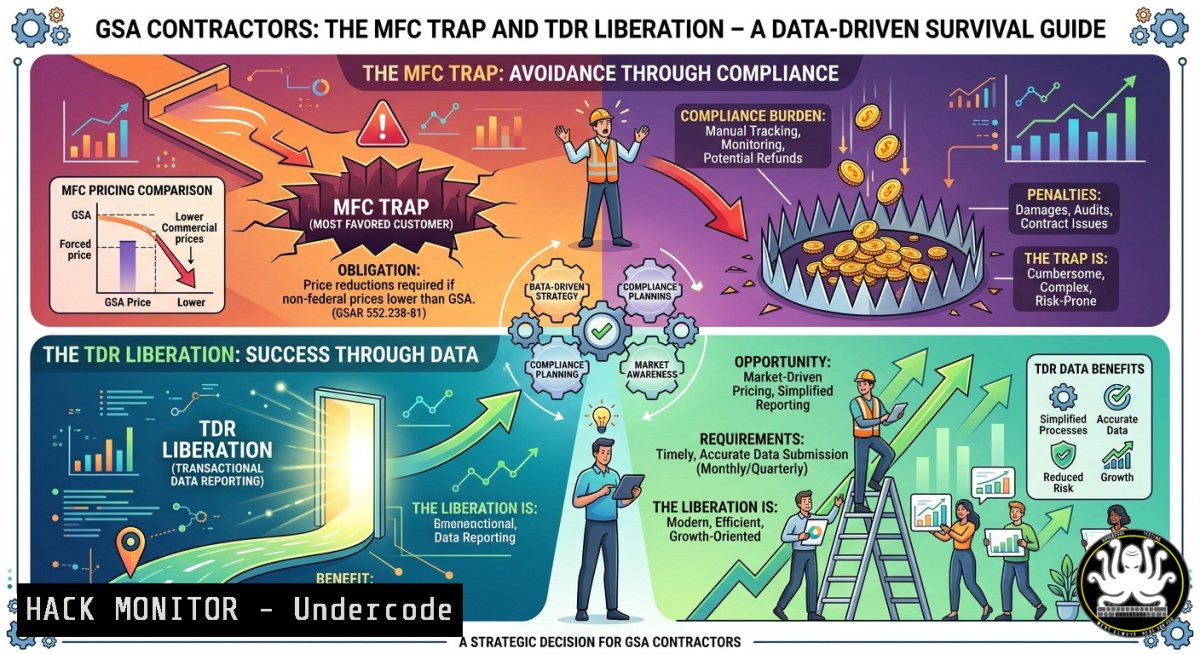
The Most Favored Customer (MFC) clause has long been a false safety net for GSA contractors, locking them into rigid pricing that erodes margins. Transactional Data Reporting (TDR) replaces this trap with real-time market intelligence, but only if you have the discipline and technical infrastructure to track competitor data continuously. This article breaks down how to automate TDR workflows using open-source tools, command-line scripts, and cloud security best practices – because in federal procurement, data-driven transparency is your only true leverage.
Learning Objectives:
- Understand the legal and financial risks of the MFC clause versus the flexibility of TDR.
- Implement automated Linux/Windows scripts to scrape, normalize, and analyze competitor pricing data.
- Apply API security and cloud hardening techniques to protect sensitive procurement intelligence.
You Should Know:
- Automating Competitor Price Tracking with Bash & PowerShell
The post warns: “TDR only works if you track competitor moves consistently. Most contractors pull data once, then default back to lowest price.” To avoid this, build a daily automated pipeline.
Step‑by‑step guide (Linux):
- Use `curl` or `wget` to fetch public GSA eLibrary data or SAM.gov API endpoints (where legally allowed).
2. Parse HTML/JSON with `jq` and `grep`. Example:
 Fetch contract award data (hypothetical public endpoint)
curl -s "https://api.sam.gov/prod/contracts/v1/?" \
-H "API-Key: YOUR_KEY" | jq '.contracts[] | {vendor, price}'
3. Store results in a timestamped CSV:
echo "$(date +%Y-%m-%d),$price" >> competitor_prices.csv
4. Schedule with `cron` (daily at 6 AM):
0 6 /home/user/tdr_scraper.sh
Step‑by‑step guide (Windows):
1. Use PowerShell `Invoke-WebRequest` to fetch data.
2. Export to CSV with `Export-Csv`.
- Schedule with Task Scheduler: create a basic task to run `powershell -File C:\tdr\scraper.ps1` daily.
Security note: Always respect `robots.txt` and rate limits. For authenticated APIs, store credentials in environment variables or Windows Credential Manager – never hardcode.
- Building a TDR Pricing Database with SQLite or PostgreSQL
Raw price data is useless without structure. Create a local database to track trends and flag deviations.
Step‑by‑step guide:
- Install SQLite (Linux:
sudo apt install sqlite3, Windows: download from sqlite.org).
2. Create schema:
CREATE TABLE competitor_prices (
id INTEGER PRIMARY KEY,
vendor TEXT,
product TEXT,
price REAL,
date TEXT
);
3. Ingest your CSV:
sqlite3 tdr.db ".mode csv" ".import competitor_prices.csv competitor_prices"
4. Generate alerts for price drops >15% (possible MFC violation risk):
SELECT vendor, product, price, date FROM competitor_prices
WHERE price < (SELECT AVG(price)0.85 FROM competitor_prices WHERE vendor = 'XYZ');
Windows alternative: Use PowerShell with `Invoke-SqlCmd` if SQL Server is available. For lightweight needs, import CSV directly into Excel Power Query.
3. Securing Your TDR Intelligence Pipeline
Because procurement data is sensitive, apply zero-trust principles to your automation scripts and storage.
Hardening checklist:
- Encrypt database at rest (Linux: LUKS or eCryptfs; Windows: BitLocker).
- Use TLS for all API calls: verify certificates with
curl --cacert. - Implement least-privilege service accounts for scheduled tasks.
- Log all access and set up file integrity monitoring (e.g., `auditd` on Linux, Sysmon on Windows).
- Example audit rule on Linux:
auditctl -w /home/user/tdr_scraper.sh -p wa -k tdr_script_change
4. Using AI/ML to Predict Competitive Pricing Shifts
Extract value from historical TDR data with simple machine learning. This transforms “raw intelligence” into actionable strategy.
Step‑by‑step (Python, cross‑platform):
1. Export SQLite data to pandas:
import sqlite3, pandas as pd
conn = sqlite3.connect('tdr.db')
df = pd.read_sql_query("SELECT  FROM competitor_prices", conn)
2. Train a linear regression to forecast next month’s price:
from sklearn.linear_model import LinearRegression
df['date_ordinal'] = pd.to_datetime(df['date']).map(pd.Timestamp.toordinal)
model = LinearRegression().fit(df[['date_ordinal']], df['price'])
3. Schedule weekly retraining. The post calls this “data-driven transparency” – AI adds predictive edge.
Note: No prior ML experience? Use Azure Automated ML or Google Vertex AI with your CSV uploads.
- Vulnerability Assessment: The MFC Clause as an Attack Surface
Treat your GSA contract like a software supply chain. The MFC clause is a “logic bomb” – if a competitor lowers their price even once, you may owe retroactive discounts.
Mitigation steps:
- Continuous monitoring (as above) is your IDS/IPS for pricing anomalies.
- Define automated alerts in your database (e.g., SQL triggers).
- Legal playbook: TDR allows negotiation based on “real market intelligence” – document every price change with timestamps to defend against false MFC claims.
- Example trigger in PostgreSQL:
CREATE OR REPLACE FUNCTION alert_price_drop() RETURNS TRIGGER AS $$
BEGIN
IF NEW.price < OLD.price  0.9 THEN
PERFORM pg_notify('price_alert', row_to_json(NEW)::text);
END IF;
RETURN NEW;
END;
$$ LANGUAGE plpgsql;
6. Cloud Hardening for TDR Data Stores
If you move your TDR pipeline to AWS, Azure, or GCP, follow these security controls:
- S3 buckets / Azure Blob: Block public access, enable default encryption (AES-256), and require MFA delete.
- IAM policies: Grant read-only to analysts, write-only to the scraper role.
- VPC / Private Link: Keep your scraping EC2 instance in a private subnet, use NAT gateway for outbound API calls.
- Logging: Enable CloudTrail / Azure Monitor to audit every access to price data.
- Command to check S3 bucket policy (AWS CLI):
aws s3api get-bucket-policy --bucket my-tdr-data --query Policy --output text | jq .
What Undercode Say:
- Key Takeaway 1: The MFC clause is a trap, but TDR is not automatic liberation – it demands disciplined, automated competitor tracking or you will default to the lowest price.
- Key Takeaway 2: Building a repeatable data pipeline (scraping → database → alerts) is the only way to protect margins; treat this as a security operations center for procurement intelligence.
Analysis (10 lines):
Undercode’s warning echoes the original post’s core conflict: flexibility versus rigidity. However, the comment “TDR only works if you track competitor moves consistently” highlights the operational reality. Most contractors lack the DevOps mindset to maintain daily scrapers, falling back to manual price checks that fail. This article bridges that gap by providing concrete scripts and database schemas – turning a legal strategy into an engineering problem. The inclusion of AI forecasting and cloud hardening elevates TDR beyond simple price monitoring into a predictive, secure capability. For federal contractors, the cost of implementing these steps is minimal compared to the millions lost to undisciplined MFC compliance. The “Forte way” – engineering rules to work for your growth – is realized through automation. Without it, TDR becomes just another compliance burden.
Expected Output:
A fully automated, daily TDR pipeline that:
- Scrapes competitor pricing from public GSA/SAM.gov endpoints using cron/Task Scheduler.
- Stores historical data in a SQLite database with automated alerts for price drops >10%.
- Secures all data with encryption, least-privilege accounts, and cloud hardening controls.
- Provides a weekly AI forecast of pricing trends to guide negotiation strategy.
Prediction:
Within 18 months, the GSA will mandate TDR for all MAS contractors, and the MFC clause will be deprecated as unworkable in dynamic markets. Contractors who fail to adopt automated competitor tracking will lose 20-30% margin to undisciplined pricing. Meanwhile, those who implement the pipeline described above will gain a permanent arbitrage advantage, driving smaller competitors out of federal procurement. The future belongs to firms that treat contract pricing as a real-time data engineering problem – not a legal form to sign once a year.
▶️ Related Video (80% Match):
🎯Let’s Practice For Free:
IT/Security Reporter URL:
Reported By: Motivation Branding – Hackers Feeds
Extra Hub: Undercode MoN
Basic Verification: Pass ✅


