Listen to this Post
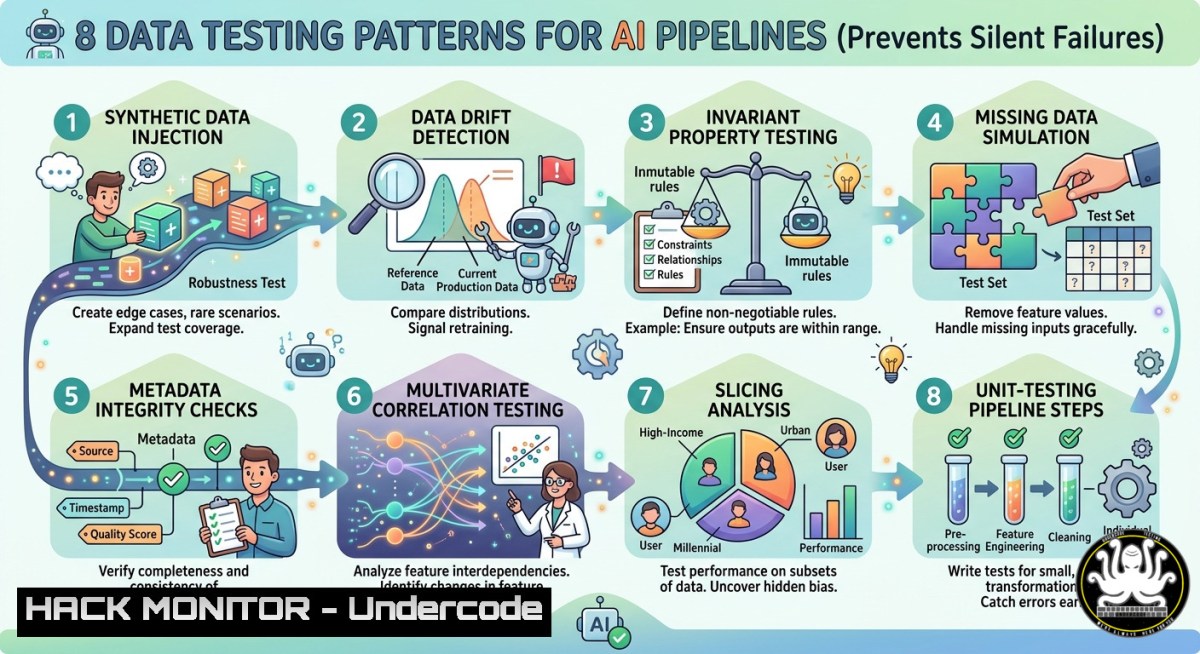
Introduction:
Modern data pipelines are the backbone of AI systems, dashboards, and business intelligence. Yet most engineers focus on SQL logic and orchestration while neglecting the testing layers that catch silent data corruption, schema drift, and security regressions. The eight core testing patterns—unit, integration, contract, regression, smoke, snapshot, data diff, and synthetic data tests—transform a fragile pipeline into a trustworthy foundation for high-stakes AI and analytics.
Learning Objectives:
- Understand and implement eight essential data testing patterns to prevent pipeline failures before they impact models or reports
- Apply automated testing using open-source tools like dbt, Great Expectations, and data-diff across Linux and Windows environments
- Leverage contract and synthetic data tests to enforce API security, GDPR compliance, and schema integrity in production pipelines
You Should Know:
1. Unit Testing Transformations with Pytest and dbt
Unit tests validate one transformation function at a time, confirming that logic works as expected before integration. This catches off-by-one errors, null handling bugs, and incorrect aggregations early.
Step‑by‑step guide:
- Isolate a transformation function (e.g., a Python function that calculates customer lifetime value or a dbt SQL macro).
- Write test cases covering normal inputs, edge cases (nulls, empty strings), and boundary values.
- Run tests in isolation using a framework like pytest (Python) or dbt’s built-in unit testing.
Commands and code (Linux):
 Install pytest and set up virtual environment
python3 -m venv data_test_env
source data_test_env/bin/activate
pip install pytest pandas

Create a test file test_transforms.py
pytest tests/ -v
Windows equivalent:
python -m venv data_test_env
data_test_env\Scripts\activate
pip install pytest pandas
pytest tests/ -v
Example test (Python):
def test_null_handling():
from transforms import calculate_daily_active_users
input_df = pd.DataFrame({'user_id': [1, None, 3], 'last_active': ['2025-01-01', None, '2025-01-01']})
result = calculate_daily_active_users(input_df)
assert result['active_count'] == 2  nulls excluded
- Integration Testing with Environment Parity and Test Containers
Integration tests reveal how sources, jobs, storage, and outputs behave together. Many failures only appear when real dependencies interact. Running tests in a production‑like environment (e.g., Docker containers) eliminates assumptions from local testing.
Step‑by‑step guide:
- Define a test environment using Docker Compose to spin up PostgreSQL, Redis, or an S3 emulator (MinIO).
- Seed the test database with representative (but safe) data.
- Run the full pipeline end‑to‑end and validate outputs against expected results.
Commands (Linux):
 Docker Compose for a test stack
cat > docker-compose.test.yml <<EOF
version: '3.8'
services:
postgres:
image: postgres:15
environment:
POSTGRES_DB: testdb
POSTGRES_USER: test
POSTGRES_PASSWORD: test123
ports:
- "5433:5432"
minio:
image: minio/minio
command: server /data --console-address ":9001"
ports:
- "9000:9000"
EOF

Start test environment
docker-compose -f docker-compose.test.yml up -d

Run integration tests
python -m pytest tests/integration/ --db-host=localhost --db-port=5433
Windows (PowerShell):
docker-compose -f docker-compose.test.yml up -d
$env:DB_HOST="localhost"; $env:DB_PORT="5433"
pytest tests/integration/
- Contract Testing for Schema Integrity and API Security
Contract tests validate the agreement between data producers and consumers by checking schema, payload structure, and data types before deeper validation begins. This prevents API security issues like injection attacks that exploit unexpected fields and ensures that schema changes do not break downstream AI models.
Step‑by‑step guide:
- Define a contract using JSON Schema or Avro for each data product (e.g.,
user_events.json). - Implement contract tests using Great Expectations or `jsonschema` in Python.
- Run contract tests as a gate in your CI/CD pipeline before any data is written to production.
Commands (Linux):
 Install Great Expectations
pip install great_expectations

Initialize a new expectation suite
great_expectations init
great_expectations datasource new

Validate a JSON payload against a schema
cat > validate_contract.py <<EOF
import jsonschema
from jsonschema import validate
import json

schema = {
"type": "object",
"properties": {
"user_id": {"type": "integer"},
"email": {"type": "string", "pattern": "^[^@]+@[^@]+\.[^@]+$"},
"pii_data": {"type": "array"}  Additional security: require encryption flag
},
"required": ["user_id", "email"]
}

payload = json.load(open('sample_payload.json'))
validate(instance=payload, schema=schema)
print("Contract passed")
EOF
python validate_contract.py
Windows: Same commands using PowerShell or Command Prompt with Python installed.
4. Regression Testing with Data Diff Tools
Regression tests compare new pipeline outputs against a trusted baseline to catch unintended changes. This is critical when refactoring or updating transformation logic. Using a dedicated data diff tool (e.g., `data-diff` from Datafold) provides row‑by‑row and column‑by‑column comparison.
Step‑by‑step guide:
- Capture a baseline output from a known good pipeline run (snapshot or exported table).
- Run the updated pipeline on identical input data.
- Run `data-diff` to compare the two result sets and file issues for any mismatches.
Commands (Linux):
 Install data-diff
pip install data-diff

Compare two tables in the same database (or across different databases)
data-diff postgresql://user:pass@localhost:5432/prod_db baseline_table \
postgresql://user:pass@localhost:5433/test_db new_table \
--key-column id --verbose

Export baseline to CSV and compare with new output
python -c "import pandas as pd; pd.read_sql('SELECT  FROM baseline', conn).to_csv('baseline.csv', index=False)"
data-diff csv://baseline.csv csv://new_output.csv --key-column id
Windows: Same `data-diff` commands after installing Python. Use `python -m data_diff` if path issues occur.
5. Snapshot Testing for Analytics Workloads
Snapshot tests freeze expected outputs (e.g., a monthly sales report) and compare future runs against those frozen results. This provides a stable reference point for reporting cycles, making it easy to spot unintended regressions during refactoring.
Step‑by‑step guide:
- Run the pipeline once to generate a reference snapshot (e.g., a parquet file or database table).
- Store the snapshot in a version‑controlled location or a dedicated storage bucket.
- On each pipeline run, compare the new output against the snapshot using a diff tool.
- If differences exist, review them manually – they may indicate intended improvements or bugs.
Commands (Linux):
 Using dbt snapshots (in dbt_project.yml)
dbt snapshot --select my_snapshot

Custom Python snapshot comparison
cat > snapshot_test.py <<EOF
import pandas as pd
import sys
baseline = pd.read_parquet('sales_report_snapshot.parquet')
new = pd.read_parquet('sales_report_new.parquet')
if not baseline.equals(new):
diff = baseline.compare(new)
diff.to_csv('snapshot_diff.csv')
print(f"Differences found: {len(diff)} rows changed")
sys.exit(1)
else:
print("Snapshot test passed")
EOF
python snapshot_test.py
Windows: Use same Python script; ensure `pyarrow` is installed for Parquet support (pip install pyarrow).
- Synthetic Data Generation for PII Masking and Compliance
Synthetic data creates safe fake datasets when real data is sensitive, limited, or unavailable. This balances realism and privacy, allowing teams to test edge cases, performance, and security controls without exposing personally identifiable information (PII) or violating GDPR/HIPAA.
Step‑by‑step guide:
1. Identify the schema and statistical properties of the real dataset (column types, distributions, relationships).
2. Use a synthetic data tool (Faker, SDV, or Gretel) to generate realistic but artificial records.
3. Apply additional masking or encryption if needed (e.g., hash user IDs, shuffle dates).
4. Validate that no real PII leaks and that edge cases (nulls, outliers) are represented.
Commands (Linux):
 Install Faker and pandas
pip install faker pandas

Generate synthetic user data
cat > generate_synthetic.py <<EOF
from faker import Faker
import pandas as pd
import random

fake = Faker()
data = []
for _ in range(1000):
data.append({
'user_id': fake.uuid4(),
'name': fake.name(),
'email': fake.email(),
'purchase_amount': round(random.uniform(5, 500), 2),
'country': fake.country()
})
df = pd.DataFrame(data)
df.to_csv('synthetic_users.csv', index=False)
print("Generated 1000 synthetic rows (no real PII)")
EOF
python generate_synthetic.py

Verify no real emails (quick grep)
grep -E '@(gmail|yahoo|hotmail)' synthetic_users.csv  Should return nothing
Windows: Same Python script. For large scale, consider using `pandas` with parallel processing.
7. Smoke Testing Pipeline Health Before Deep Validation
Smoke tests quickly confirm that the main pipeline path is running properly – read paths, write paths, and component uptime. They are designed for speed, catching obvious infrastructure issues before teams invest time in deeper testing.
Step‑by‑step guide:
- Define a minimal set of critical operations (e.g., connect to source DB, read a single row, write to a staging table).
- Write a script that performs these operations and reports success/failure.
- Run smoke tests as the first step in your CI/CD or deployment pipeline.
- If smoke tests fail, halt deployment and investigate infrastructure.
Commands (Linux):
 Smoke test for PostgreSQL and API endpoint
cat > smoke_test.sh <<EOF
!/bin/bash
 Test database connectivity
psql "postgresql://user:pass@localhost:5432/prod_db" -c "SELECT 1" || exit 1

Test API endpoint for data ingestion
curl -f -X GET "https://api.example.com/health" || exit 1

Test write permission to staging bucket
echo "test" | aws s3 cp - s3://my-bucket/smoke_test.txt || exit 1

echo "All smoke tests passed"
EOF
chmod +x smoke_test.sh
./smoke_test.sh
Windows (PowerShell):
 Test database
& "C:\Program Files\PostgreSQL\15\bin\psql.exe" "postgresql://user:pass@localhost:5432/prod_db" -c "SELECT 1"
if ($LASTEXITCODE -ne 0) { exit 1 }

Test API
Invoke-WebRequest -Uri "https://api.example.com/health" -Method Get
if ($LASTEXITCODE -ne 0) { exit 1 }
What Undercode Say:
- Key Takeaway 1: Testing is not an extra step but the mechanism that turns clean data movement into trustworthy, usable intelligence. Without it, AI models train on garbage and dashboards mislead executives.
- Key Takeaway 2: Contract tests and synthetic data are essential for security and compliance – they prevent PII leaks and enforce API contracts, reducing the attack surface from schema drift.
Analysis: Undercode’s emphasis on contract testing aligns with zero‑trust principles: never assume upstream sources will honor your schema. In practice, many data breaches originate from unexpected fields injected into pipelines (e.g., a malicious `javascript` payload in a `user_bio` column). By validating payload structure before any processing, teams can block injection attacks that bypass traditional firewalls. Similarly, synthetic data generation reduces the risk of testing with production PII, a common source of GDPR fines. The eight patterns collectively form a defense‑in‑depth strategy for data pipelines – unit tests catch logic errors, integration tests expose dependency failures, regression tests prevent silent regressions, and smoke tests provide rapid feedback. For AI pipelines, where data drift is the leading cause of model decay, snapshot and data diff tests become critical monitoring tools. The missing piece in many organisations is automation: these tests must run continuously in CI/CD, not as manual one‑offs. When implemented with tools like dbt, Great Expectations, and data-diff, teams can achieve 80% failure detection within minutes of code commit, drastically reducing production incidents.
Prediction:
By 2027, data pipeline testing will converge with AI model validation, leading to “test‑driven MLOps” where every feature engineering step and model training run is gated by automated data diff and contract tests. As regulations like the EU AI Act require auditable data provenance, synthetic data will shift from a nice‑to‑have to a mandatory compliance layer. However, the proliferation of testing tools may create fragmentation – expect a standardisation effort around Open Contract Testing (OCT) and unified snapshot formats. Teams that fail to adopt these eight patterns will see their AI pipelines become unreliable liability vectors, while mature organisations will treat data testing with the same rigor as application security testing today.
▶️ Related Video (72% Match):
🎯Let’s Practice For Free:
IT/Security Reporter URL:
Reported By: Goyalshalini A – Hackers Feeds
Extra Hub: Undercode MoN
Basic Verification: Pass ✅


