Listen to this Post
Introduction:
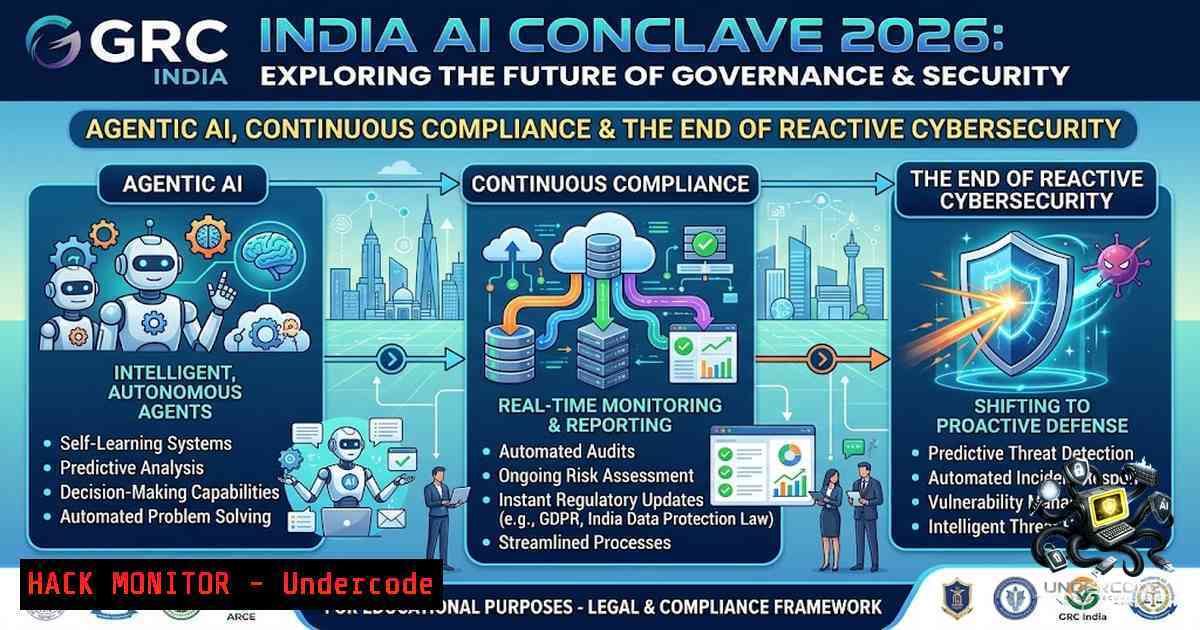
The GRC India AI Conclave 2026, hosted by Ampcus Cyber on 7th August at JW Marriott, Aerocity, New Delhi, marked a pivotal moment for India’s cybersecurity landscape. As artificial intelligence permeates every facet of the digital economy, the convergence of AI governance, cyber resilience, and regulatory compliance has become the defining challenge for organizations. The conclave brought together policymakers, regulators, and industry leaders to address this challenge head-on, culminating in the “Make in India” launch of Ampcus Cyber’s indigenous AI-powered ComplyX portfolio—comprising GRACE, MIRROR, and WIZARD—three next-generation platforms designed to modernize governance and strengthen cyber resilience.
Learning Objectives:
- Understand the architectural and operational principles behind AI-driven Governance, Risk, and Compliance (GRC) platforms.
- Learn how to implement continuous, autonomous penetration testing within CI/CD pipelines.
- Master the configuration and deployment of AI-powered Third-Party Risk Management (TPRM) for vendor ecosystem oversight.
- Acquire hands-on skills in automating compliance audits and real-time risk visibility using modern toolchains.
You Should Know:
1. GRACE: Orchestrating Continuous Compliance with AI
GRACE (Governance, Risk, and Compliance Engine) is a cloud-1ative GRC platform designed to replace qualitative risk guesswork with quantitative precision. It unifies multiple regulatory frameworks (PCI, NIST, ISO, HIPAA, GDPR) into a single intelligent view, automating audits and delivering real-time visibility into enterprise risk. Unlike traditional GRC tools that rely on periodic manual assessments, GRACE operates on a continuous compliance model, maintaining audit readiness 365 days a year.
Step-by-Step Guide: Automating Compliance Evidence Collection with GRACE
This guide demonstrates how to set up automated evidence collection for a PCI-DSS audit using GRACE’s API-driven architecture.
- API Authentication: Obtain your GRACE API key from the platform’s admin console. Store it securely as an environment variable:
export GRACE_API_KEY="your_api_key_here"
export GRACE_ENDPOINT="https://api.grace.ampcuscyber.com/v1"
-
Define Control Mappings: Create a JSON payload mapping your internal security controls to PCI-DSS requirements. GRACE uses a unified data model to correlate evidence across frameworks.
{ "framework": "PCI-DSS", "requirement": "10.6.1", "control": "audit_log_review", "evidence_source": "siem_aggregator" } -
Automate Evidence Ingestion: Use `curl` to push evidence logs from your SIEM (e.g., Splunk, ELK) directly into GRACE. The platform uses AI to validate the completeness of the evidence.
curl -X POST $GRACE_ENDPOINT/evidence \ -H "Authorization: Bearer $GRACE_API_KEY" \ -H "Content-Type: application/json" \ -d '{"control_id": "audit_log_review", "evidence": "base64_encoded_log_snippet"}' -
Real-Time Dashboard: Access the GRACE dashboard to view real-time compliance posture. The platform automatically highlights gaps and recommends remediation steps, reducing audit fatigue significantly.
2. MIRROR: Autonomous Penetration Testing for Continuous Delivery
MIRROR is an AI-powered penetration testing platform that autonomously discovers, chains, and validates vulnerabilities across web applications, APIs, infrastructure, and mobile apps. It simulates real-world attacker behavior, reducing the time to identify exploitable weaknesses from weeks to hours. Designed for modern DevOps environments, MIRROR integrates directly into CI/CD pipelines, ensuring security evolves alongside code.
Step-by-Step Guide: Integrating MIRROR into a Jenkins CI/CD Pipeline
This section explains how to embed MIRROR’s autonomous scanning into your build pipeline to catch vulnerabilities before deployment.
- Install MIRROR CLI: Download and install the MIRROR command-line interface on your build server.
wget https://mirror.ampcuscyber.com/cli/mirror-cli-linux-amd64 -O /usr/local/bin/mirror
chmod +x /usr/local/bin/mirror
-
Configure Scan Target: Define the target environment (e.g., staging URL) in a `mirror.yaml` configuration file.
target: "https://staging.myapp.com"
scope:</p></li>
</ol>

<p>- web
- api
depth: "full"
- Integrate into Jenkins Pipeline: Add a stage in your `Jenkinsfile` to trigger MIRROR’s autonomous scan. The tool autonomously discovers attack surfaces and chains vulnerabilities.
stage('AI Penetration Test') { steps { sh 'mirror scan --config mirror.yaml --output report.json' } } -
Validate Exploitability: MIRROR does not just list vulnerabilities; it validates exploitability, dramatically reducing false positives. Post-scan, use the `mirror validate` command to confirm if a vulnerability is genuinely exploitable.
mirror validate --vulnerability-id CVE-2024-1234 --target https://staging.myapp.com
-
Generate Audit-Ready Reports: Generate a report compliant with SOC2, ISO 27001, and PCI DSS standards directly from the CLI.
mirror report --format pdf --output audit_report.pdf
3. WIZARD: AI-Driven Third-Party Risk Management (TPRM)
WIZARD is an AI-driven TPRM platform that provides continuous, real-time visibility into cyber, operational, and ESG risks across third-party ecosystems. It moves beyond one-time assessments, establishing a scalable monitoring program that delivers automated governance and actionable intelligence throughout the vendor lifecycle.
Step-by-Step Guide: Onboarding and Monitoring a Vendor with WIZARD
This guide walks through the process of onboarding a new vendor and setting up continuous risk monitoring.
- Vendor Onboarding: Use the WIZARD portal to initiate vendor onboarding. The platform uses AI to automatically request and ingest necessary security documentation (e.g., SOC 2 reports, ISO certifications).
wizard vendor add --1ame "Acme Corp" --email "[email protected]" --tier "critical"
-
Automated Questionnaires: WIZARD leverages AI to send dynamic, risk-based questionnaires to vendors. The platform uses natural language processing to analyze responses and flag inconsistencies.
Python SDK example for triggering a questionnaire
from wizard_sdk import TPRMClient
client = TPRMClient(api_key="your_api_key")
client.vendors["vendor_id"].send_questionnaire(template="standard_v3")
-
Continuous Monitoring: Configure WIZARD to continuously monitor the vendor’s external attack surface. The platform autonomously scans for new vulnerabilities, leaked credentials, and changes in security posture.
wizard monitor enable --vendor-id vendor_123 --frequency daily
-
Cyber Risk Quantification: WIZARD quantifies risk in financial terms, enabling leadership to make faster, data-driven decisions. Access the quantified risk score via the CLI:
wizard risk score --vendor-id vendor_123
-
Automated Alerts: Set up alerting rules to notify your security team when a vendor’s risk score exceeds a defined threshold.
wizard alert create --vendor-id vendor_123 --threshold 75 --action email
-
Cloud Hardening and API Security in the AI Era
The integration of AI into GRC introduces new attack surfaces. The conclave emphasized the need for robust cloud security and API security as foundational elements of AI governance. Organizations must harden their cloud environments and secure APIs that facilitate AI model interactions and data exchanges.
Step-by-Step Guide: Hardening Kubernetes for AI Workloads
- Restrict API Access: Use Kubernetes Network Policies to restrict API access. This is critical for AI workloads where APIs are often exposed.
apiVersion: networking.k8s.io/v1
kind: NetworkPolicy
metadata:
name: ai-api-deny-all
spec:
podSelector:
matchLabels:
app: ai-inference
policyTypes:</li>
</ol>

- Ingress
ingress: []
- Secrets Management: Use HashiCorp Vault or Azure Key Vault to manage API keys and credentials for AI services. Avoid storing secrets in plain text or environment variables.
kubectl create secret generic ai-credentials --from-literal=api-key=$WIZARD_API_KEY
-
Continuous Vulnerability Scanning: Integrate MIRROR or similar tools to scan container images for vulnerabilities before deployment.
mirror scan-image --image myregistry/ai-model:latest
5. Vulnerability Exploitation and Mitigation Strategies
With the rise of agentic AI, vulnerabilities are no longer static. Attackers are using AI to automate exploitation. The GRACE, MIRROR, and WIZARD trinity addresses this by shifting from reactive to predictive security.
Step-by-Step Guide: Using MIRROR to Simulate an AI-Powered Attack Path
- Discover Attack Surface: Use MIRROR to autonomously map your entire attack surface.
mirror discover --target https://api.myapp.com --depth full
-
Chain Vulnerabilities: MIRROR autonomously attempts to chain a series of low-severity vulnerabilities into a critical attack path, simulating how an AI-powered attacker would operate.
mirror chain --start-vuln CVE-2024-001 --target https://api.myapp.com
-
Remediate and Validate: Apply the recommended patch or configuration change. Re-run the scan to validate that the attack path is no longer exploitable.
mirror scan --target https://api.myapp.com --output report_fixed.json
What Undercode Say:
-
Key Takeaway 1: The launch of GRACE, MIRROR, and WIZARD signals a definitive industry shift from periodic, manual GRC to continuous, AI-driven security operations. The integration of these platforms addresses the critical time-to-remediation gap that plagues modern security teams.
-
Key Takeaway 2: The “Make in India” initiative behind the ComplyX portfolio is a strategic move to build indigenous cybersecurity capabilities, reducing reliance on foreign technologies and aligning with national digital sovereignty goals.
Analysis: The GRC India AI Conclave 2026 was not merely a conference; it was a declaration that the future of cybersecurity lies in autonomous, AI-1ative platforms. The ComplyX trinity—GRACE for compliance, MIRROR for testing, and WIZARD for third-party risk—provides a holistic defense framework. By embedding AI into every layer of GRC, Ampcus Cyber is enabling organizations to move from a reactive “break-fix” model to a proactive “predict-prevent” paradigm. The emphasis on continuous compliance and real-time risk visibility is particularly critical as regulatory frameworks like India’s Digital Personal Data Protection Act (DPDP) come into full effect. The conclave’s focus on public-private collaboration underscores that cybersecurity is a shared responsibility, requiring dialogue between policymakers, industry, and academia.
Prediction:
- +1 The adoption of AI-powered GRC platforms like ComplyX will become a competitive differentiator, with early adopters achieving faster audit cycles, reduced compliance costs, and stronger security postures.
- +1 The integration of autonomous penetration testing into CI/CD pipelines will normalize “security as code,” significantly reducing the prevalence of critical vulnerabilities in production environments.
- -1 Organizations that fail to adopt continuous compliance and AI-driven risk management will face increased regulatory scrutiny, higher breach costs, and potential market exclusion as supply chain security requirements tighten.
- +1 India’s focus on indigenous AI cybersecurity solutions will catalyze a new wave of innovation, positioning the country as a global hub for AI security research and development.
▶️ Related Video (78% Match):
🎯Let’s Practice For Free:
🎓 Live Courses & Certifications:
Join Undercode Academy for Verified Certifications
🚀 Request a Custom Project:
Secure, high-velocity infrastructure and disruptive technological engineering. Contact our engineering team for high-tier development and proprietary systems:
[email protected]
💎 Smart Architecture | 🛡️ Secure by Design | ⭐ Trusted by ThousandsIT/Security Reporter URL:
Reported By: Ampcus Cyber – Hackers Feeds
Extra Hub: Undercode MoN
Basic Verification: Pass ✅🔐JOIN OUR CYBER WORLD [ CVE News • HackMonitor • UndercodeNews ]
📢 Follow UndercodeTesting & Stay Tuned:
- Secrets Management: Use HashiCorp Vault or Azure Key Vault to manage API keys and credentials for AI services. Avoid storing secrets in plain text or environment variables.
- Integrate into Jenkins Pipeline: Add a stage in your `Jenkinsfile` to trigger MIRROR’s autonomous scan. The tool autonomously discovers attack surfaces and chains vulnerabilities.


